


By the third night in Lapland, I had quietly accepted that the Northern Lights might remain a no-show. Rovaniemi’s snow-muted streets, the orange haze above the city and the stubborn cloud cover all conspired to make the aurora feel more like a marketing slogan than a promise. I had husky sledded through frosted forests, visited Santa’s Village, and soaked in the silence of the Arctic, but the sky itself stayed resolutely blank. Then, in the frozen dark beside a remote forest road north of the Arctic Circle, the horizon flickered lime green and my entire trip shifted in a heartbeat.
Get the latest updates straight to your inbox!
When the Sky Finally Came Alive
The evening started unremarkably at a log-walled reception building on the edge of Rovaniemi. Outside, the thermometer hovered around minus 15 degrees Celsius, and a row of minivans idled in the snow, each bound for a different direction in search of clearer skies. I had booked a small-group aurora tour the day before for just under 150 euros, the kind of outing every visitor debates: is it really worth paying someone to drive you into the dark and stare hopefully at the sky?
Inside, the guide refreshed satellite cloud maps on a tablet, switching between weather apps and aurora forecasts. It felt oddly clinical: indices, percentages, probabilities. But once we left the glow of Rovaniemi behind, the science gave way to sensation. The snowbanks along the roadside rose into soft white walls, the spruce trees thinned, and above us a silver river of stars appeared, layered and deep in the kind of darkness you rarely experience further south.
Our van finally pulled onto a narrow forest track, the headlights catching the edges of snow-laden branches. The guide killed the engine, and the sudden quiet was absolute. We stepped out into the squeak of dry snow and started tilting our chins to the heavens, trying not to feel foolish. For twenty long minutes nothing happened. Conversations shrank to murmurs, people shuffled their boots for warmth, and someone laughed nervously about the souvenir brochures promising “guaranteed magic.”
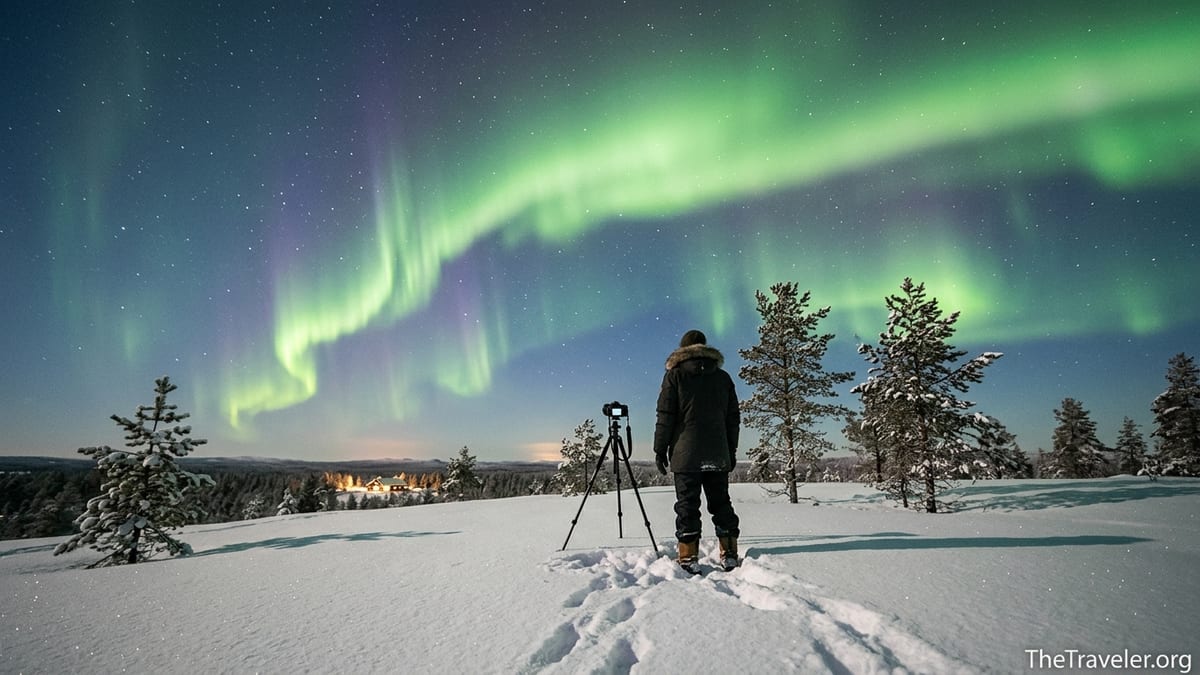
Then the guide pointed wordlessly toward the northern horizon. At first it looked like a faint, out-of-place cloud. But the line brightened, taking on a washed green tint, then grew wider, like ink slowly blooming on paper. Within minutes, that smudge became an arch stretching across the sky and started to move, pulsing, twisting, sending ghostly curtains overhead. Phones dropped to gloved sides. A couple from Spain began to cry. Under that churning, luminescent sky, every kilometer of icy road and every euro spent felt suddenly, obviously justified.
How That One Night Reframed My Entire Lapland Journey
Before that aurora, Lapland had been beautiful in a brochure-friendly, slightly unreal way: Santa Claus Village with its tidy log cabins and souvenir shops; the glass-roofed cabins showing glossy videos of bright green skies; tour price lists taped up in hotel lobbies, promising snowmobiles, reindeer safaris and ice fishing packages. It was easy to treat the trip as a carefully curated checklist, something to schedule between connecting flights.
Once I had seen the Northern Lights, that neat structure fell apart. The experience was far messier, more human and far more powerful than the marketing suggested. Instead of a backdrop to snowmobiling selfies, the sky became the main character, its moods dictating our days. People in my hotel lobby checked space weather updates with the same urgency usually reserved for breaking news. Conversations at breakfast shifted from which Santa show to book to which direction the clouds might drift after dark.
I noticed, too, how the local rhythm tied into the aurora. In the days that followed, guides at places like Apukka Resort and Santa’s Igloos Arctic Circle spoke about the lights as if they were an unpredictable relative: beloved, unreliable, and impossible to schedule. One server at a Rovaniemi café described stepping outside during cigarette breaks, scanning the sky for a faint arc even after a shift that ended near midnight. In Levi, further north, hotel staff at a small guesthouse said they kept a WhatsApp group just to warn each other when the sky suddenly exploded above the ski slopes.
My own priorities changed. I skipped an extra afternoon in Santa’s Village and took the bus instead to a viewpoint above town where locals said the glow of Rovaniemi fell away. I stopped caring whether my photos were sharp or whether my tripod shook in the wind. The trip ceased to be about collecting activities and became about placing myself, as often as possible, beneath an open patch of sky.
Choosing the Right Base: Rovaniemi, Levi, Saariselkä and Beyond
Seeing the Northern Lights in Lapland is partly about luck, but your base matters. Rovaniemi, the regional capital of Lapland, is the most accessible choice. With an airport handling direct winter flights from several European cities and frequent connections via Helsinki, it is the easiest starting point for most travelers. You can land in the afternoon and be standing under spruce trees with an aurora forecast in hand by evening.
Rovaniemi’s popularity has a trade-off: more light pollution and a strong Christmas focus. Glass igloo resorts on the outskirts, such as those near the Arctic Circle and around 30 minutes from the city center, are carefully positioned away from the worst glow, but you are still close enough to the roads and airport that the experience feels more like wilderness-lite than pure remoteness. On the upside, the convenience is real. A night in a glass-roofed cabin near Rovaniemi can start around 300 to 350 euros for two people in winter, and you can combine it with visits to Santa’s Village, museums and good restaurants without long transfers.
Further north, around Levi and Saariselkä, the atmosphere shifts. Levi is Finland’s most well-known ski resort, and its glass cabins perched on the nearby fell offer wide views over the surrounding valley. Nightly rates at igloo-style properties there tend to be similar to or slightly higher than those around Rovaniemi in peak season, but you trade airport convenience for darker skies and a stronger feeling of being in the high fells. In Saariselkä and the Ivalo region, roughly 250 kilometers north of Rovaniemi, resorts spread out among forests and low hills, giving you more distance from big towns and a bit more of that edge-of-the-world sensation.
If you want the quintessential “aurora from bed” experience, Finnish Lapland offers an unusually dense cluster of glass igloo concepts. Properties around Inari, Levi, Saariselkä and near Rovaniemi range from intimate cabins with in-floor heating and private saunas to larger complexes with restaurants, snowmobile safaris and photography tours built in. The key is to decide whether you want easy logistics and a busy activity program, or a quieter, more remote stay where the night sky is your main entertainment.
Inside a Glass Igloo: Comfort, Cost and Expectations
Sleeping under a glass roof sounds like a fantasy until you are actually lying in bed, watching ice crystals creep across the curved windows while you wait for a break in the clouds. My own igloo stay came after that first big aurora, at a resort about 15 minutes’ drive from Rovaniemi. The cabin itself was surprisingly compact: a double bed facing north, a small seating area, a kitchenette corner and a private bathroom tucked behind a wooden partition. Underfloor heating kept the inside comfortably warm even when temperatures outdoors dropped below minus 20 degrees Celsius.
The resort had its own aurora alert system: you could request a call or a discreet light signal when activity picked up. In practice, this meant that at 1:30 in the morning, a soft chime woke us, and we stumbled out from under the duvet to see a faint, hazy ribbon of green hovering above the tree line, weaker than the display of the previous night but still quietly mesmerizing. It was a reminder that the most dramatic photographs you see in brochures are only one version of reality. On many nights, the aurora glows gently, wavers a little, and then fades, a softer sort of magic that does not always shout for attention.
Financially, a glass igloo night is a splurge rather than a staple. In high winter season, especially around Christmas and New Year, midrange igloo resorts in the Rovaniemi area can reach above 400 euros per night for two with breakfast, while stays in more remote areas can vary widely depending on the level of luxury and inclusions. Some packages wrap in husky rides, snowshoeing, dinners and transfers, which can make the nightly rate look steep but simplify planning. For many travelers, the sweet spot is to book one or two igloo nights and spend the rest of the trip in a conventional hotel or cabin, combining comfort with that one unforgettable aurora-focused splurge.
Expectation management is crucial. The glass roof does not guarantee a show. Clouds, moonlight, and solar activity all play a role, and even in a year of strong solar storms you can experience several nights of nothing but stars. Think of the igloo as increasing your chances by letting you watch the sky in comfort, rather than as a vending machine for green curtains. When you reframe it that way, even a quiet night under a clear, star-flooded sky becomes part of the reward.
Guided Aurora Hunts vs Going It Alone
Before my trip, I was skeptical about guided aurora tours. The prices add up quickly: in Rovaniemi and Levi, expect to see evening excursions starting around 100 to 130 euros per person for simple minibus chases, and rising for smaller groups, photography-focused tours or outings that include campfire dinners, snowshoeing or snowmobiling. It is tempting to save the money, rent a car and drive out on your own to the nearest dark lay-by.
Standing under that first exploding sky, though, I began to understand what the guides bring. The team that evening juggled live satellite data, local road knowledge and a feel for how fast cloud banks were moving. Instead of staying under the stubborn gray lid that hung over Rovaniemi, they pushed north and then east, eventually parking near a frozen lake that opened a clean window to the northern horizon. Had I gone alone, with my novice understanding of Lapland’s backroads, I might have given up much earlier or parked in a spot where southern light pollution washed out the sky.
On another night, I tried the independent approach, walking away from the resort lights along a marked snowshoe trail that climbed gently onto a small hill. Here the cold felt sharper, the silence deeper and the darkness more complete. The aurora that night was timid, a low, green line that shimmered occasionally before vanishing. Yet the solitude changed the character of the experience. Instead of sharing gasps with strangers and passing cameras back and forth for tripod shots, I simply stood alone in the crunch of snow, listening to my own breath and feeling, in the best possible way, very small.
There is no single right choice. If you have limited nights, a guided chase can maximize your odds, especially in changeable weather. If you have more time and are comfortable with winter driving or longer walks in the dark, mixing in some self-guided outings lets you experience the aurora on your own terms. Many travelers do both: one or two organized hunts, balanced with evenings spent in glass cabins or by a frozen river within walking distance of their accommodation.
Planning, Packing and Staying Sane in the Waiting
What I had not anticipated was how much of aurora travel consists of waiting. Waiting for dark, for clouds to shift, for an index to climb, for a vague brightening on the edge of the sky to decide whether it will become something more. This waiting has its own texture in Lapland. Hotel bars fill just before 21:00 with people in thermal layers, glancing out of windows between sips of hot chocolate or beer. Guides in reception lobbies refresh the same aurora apps that guests have on their phones. Cabin terraces stay empty until someone shouts, then suddenly fill with half-dressed travelers shrugging on parkas over pajamas.
Packing well makes those in-between hours far more bearable. Rental outfitters in Rovaniemi, Levi and Saariselkä can provide insulated overalls and boots, but bringing your own high-quality thermal base layers, thick socks, a windproof outer shell and chemical hand warmers can be the difference between staying out for hours and giving up after ten minutes. Many aurora tours include the loan of heavy outerwear in the price, which is useful if you do not want to invest in specialist gear for a single trip.
Timing also matters. In Finnish Lapland, aurora season runs roughly from late August until April, with the darkest, coldest period from November to February offering the longest nights. March and early April bring more daylight and often clearer skies, at the cost of shorter viewing windows. Strong solar activity in the current cycle has made even shoulder months surprisingly productive for aurora chasers, but no month is a guarantee. Planning a trip of at least four or five nights, and treating the Northern Lights as a hoped-for bonus rather than the sole purpose of your journey, is the surest way to protect your mood.
Above all, keeping the rest of your itinerary rich helps. My own days were filled with short ski outings, visits to local museums, long lunches over reindeer stew and lingonberry sauce, and slow walks along frozen rivers near town. That way, if the sky had stayed stubbornly blank, the trip would still have felt complete. The aurora did not define Lapland for me, but once it appeared, it colored everything else I experienced.
The Takeaway
When I think back to Lapland now, it is not only that first wild night of shifting green that I remember, but the way it echoed through the rest of the trip. The husky trails felt more alive when I looked up and imagined the same sky that had danced above me. The quiet streets of Rovaniemi after midnight, lit by soft halos of snow-reflected light, seemed charged with possibility. Even the small disappointments, like a fully clouded evening in a glass igloo, felt like part of a larger story rather than failed attempts.
Seeing the Northern Lights in Lapland will not look exactly like the photos you see online, and it will not follow a script. You may stand shivering on a frozen lake for hours and see only a pale glow, or you may glance up while walking back from dinner and find the whole sky rippling above you. But if you give yourself enough nights, pick your base thoughtfully, and build a trip that would be worthwhile even without the aurora, those moments when the sky does ignite can transform everything around them. For me, that first bloom of green on the horizon turned a good winter holiday into one of the most quietly profound journeys I have taken.
FAQ
Q1. When is the best time of year to see the Northern Lights in Lapland?
The main aurora season in Finnish Lapland runs from late August to April, with the longest, darkest nights from November to February. March and early April often bring clearer skies and slightly milder temperatures, but shorter hours of darkness.
Q2. How many nights should I stay in Lapland to have a decent chance of seeing the aurora?
A stay of at least four to five nights is a sensible minimum. The more nights you have, the more you spread your risk across different weather patterns and give yourself chances to adjust plans based on forecasts.
Q3. Is Rovaniemi a good base for a first Northern Lights trip?
Yes. Rovaniemi is easy to reach by air or rail and has many tours that drive you away from the city lights at night. Light pollution is higher than in remote areas, but nearby wilderness resorts and guided outings help balance convenience and viewing conditions.
Q4. Are glass igloos worth the high price?
They can be, as a special experience. A glass igloo will not guarantee you see the aurora, but it lets you watch the sky in comfort and can turn even a quiet, starry night into a memorable part of your trip. Many travelers book just one or two nights to control costs.
Q5. Do I need to book an organized aurora tour, or can I go on my own?
Both approaches work. Organized tours cost extra but offer experienced guides, live weather adjustments and safe transport to darker areas. Independent travelers with winter driving skills or good walking routes can explore alone, often combining both options on one trip.
Q6. How cold does it actually get on an aurora hunt?
In midwinter, temperatures in Lapland during night-time aurora viewing can drop below minus 20 degrees Celsius, and wind can make it feel colder. Good layering, insulated boots, gloves, a warm hat and hand warmers are important if you plan to be outside for long periods.
Q7. What should I pack to photograph the Northern Lights?
A camera that allows manual settings, a sturdy tripod and a wide-angle lens with a large aperture are ideal. Spare batteries are essential because cold drains them quickly. Many modern smartphones can capture decent aurora images if you keep them warm and use a stable surface.
Q8. Can I see the Northern Lights directly from Rovaniemi town?
It is possible during strong displays, but city lights reduce contrast. Your chances improve significantly if you go a short distance outside the center, to riverbanks, nearby fells or organized viewpoints with darker skies.
Q9. What daytime activities pair well with Northern Lights trips?
Popular options include husky and reindeer safaris, downhill and cross-country skiing, snowshoeing, ice fishing and visits to Sámi cultural sites or local museums. Mixing active days with relaxed evenings helps your trip feel rewarding regardless of aurora success.
Q10. Is it safe to travel alone to Lapland for the Northern Lights?
Finnish Lapland is generally considered safe, with well-organized tours and reliable public services. Solo travelers should still take normal precautions, dress for the cold, share their plans when going out at night and consider joining guided outings for remote areas.