


Most first-time visitors to New York City assume the best skyline views are found in Manhattan, lining up for crowded observatories or jostling for space along the Battery. Locals know better. Just across the Hudson River, Liberty State Park in Jersey City delivers the same sweep of skyscrapers, closer views of the Statue of Liberty and Ellis Island, and something Manhattan struggles to offer: room to breathe.
Get the latest updates straight to your inbox!
Why Locals Slip Across the River for the View
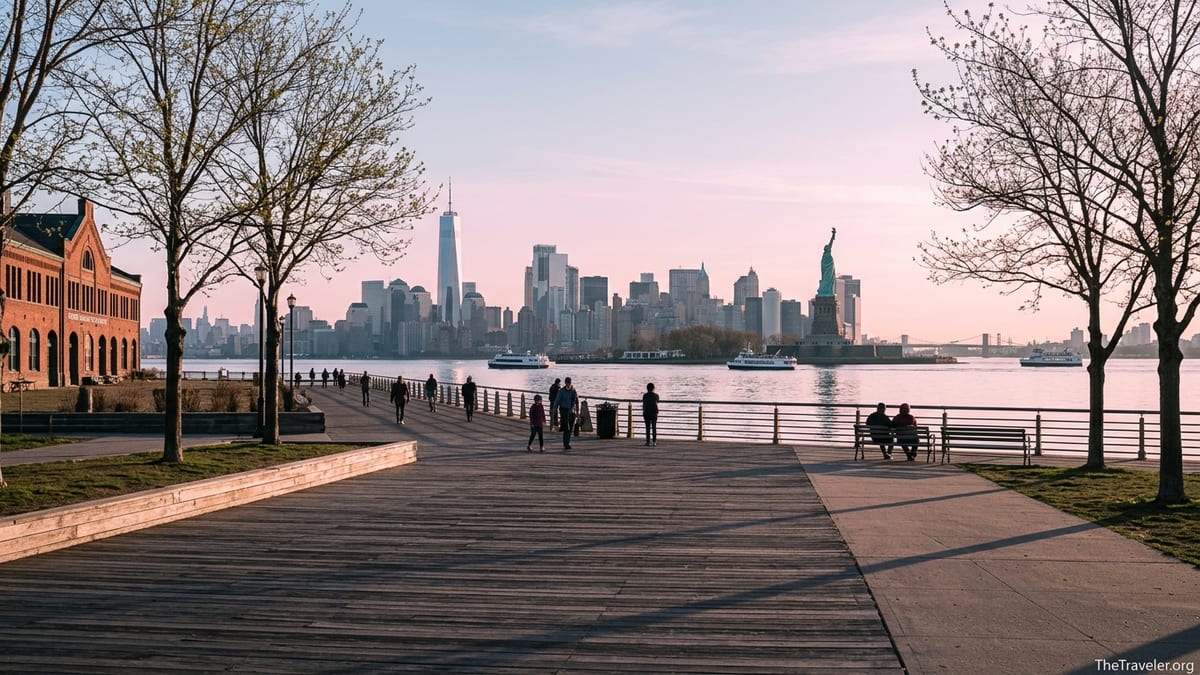
Stand on the two-mile waterfront promenade at Liberty State Park and the entire lower Manhattan skyline stretches in front of you, from One World Trade Center down to the Staten Island Ferry slips. On clear evenings, the towers glow gold, ferries cut slow paths across the harbor, and the Statue of Liberty stands just off to the south, close enough that you can pick out details on her pedestal with the naked eye. It is the iconic New York panorama, only seen from the calmer New Jersey side.
Compare that to Battery Park on a sunny Saturday. Benches fill early, joggers weave through photo-taking visitors, and security queues for the Statue of Liberty ferries can snake across the plaza. Travelers who cross to Jersey City by PATH train or light rail often find the contrast startling. At Liberty State Park, the same harbor breeze blows, the same skyline glitters, but there are broad lawns to stretch out on and space to frame a photo without a stranger’s head in the corner.
The scale of the park plays a big role. Liberty State Park encompasses hundreds of acres of former rail yards and waterfront, much of it now planted with grass, wildflower meadows, and tree-lined paths. Even on busy spring weekends when families arrive with picnic coolers and cyclists zip along the promenade, it rarely feels hemmed in. For anyone who wants New York harbor views without Manhattan’s shoulder-to-shoulder crush, this is where the equation quietly shifts.
Practical details reinforce the appeal. Visitors staying in downtown Jersey City hotels can reach the park in about 10 to 15 minutes by car or ride-hail, and in roughly 20 minutes via the Hudson Bergen Light Rail and the park’s weekend shuttle that connects to the historic terminal area. Taxi and rideshare drop-offs usually happen directly along Freedom Way or near the Central Railroad of New Jersey Terminal, so you step out almost on the water’s edge.
Space to Move: Lawns, Promenades and Quiet Corners
Once inside Liberty State Park, the first impression is how much open space there is relative to Manhattan’s compact waterfront. The main promenade runs for about two miles along the Hudson River, offering wide, uncluttered walkways and frequent benches. Runners and cyclists favor the long, flat stretches, but it is just as easy to wander slowly, stopping to photograph tugboats sliding past or the changing angles of the skyline as you round each curve.
Behind the walkway, broad lawns roll back toward the interior of the park. On a typical summer weekend you might see local soccer games unfolding near the south end, families grilling at picnic tables, and kites darting above the open fields. There is enough space that groups can spread blankets without competing for every square meter of grass, something that can be challenging in Manhattan parks like the Battery or the narrow Hudson River Park segments downtown.
For quieter moments, there are smaller pockets of calm. Near the western side, away from the ferry docks, tree-shaded areas along the interior paths attract locals walking dogs or pushing strollers. Even during peak travel months, these sections remain relatively tranquil compared with Manhattan’s high-profile viewing platforms such as Top of the Rock or One World Observatory, where timed tickets and security lines are part of the experience.
Travelers with children often appreciate that the park feels manageable at ground level. Instead of elevators, crowd control ropes and glass walls, kids have room to run on real grass while still being in constant sight of the skyline. The combination of playgrounds, paved paths for scooters and clear sightlines to One World Trade Center can turn what might be a rushed photo stop in Manhattan into an unhurried half day outside.
The CRRNJ Terminal: History at the Edge of the Harbor
Liberty State Park is not just a scenic overlook. At its heart stands the restored Central Railroad of New Jersey Terminal, a red-brick, gabled station house that once handled waves of immigrants continuing their journeys inland after processing at Ellis Island. Passenger service ended in the late 1960s, but the terminal building has been carefully renovated, with the clock tower and waiting room now forming one of the park’s most recognizable landmarks.
Walking through the old concourse, you can still see the lines of track platforms stretching toward the water, now silent under open sky. Interpretive signs explain how, in the early 20th century, trains and ferries interlocked here, carrying millions of newcomers toward factory towns and farming communities across New Jersey and Pennsylvania. For visitors who have just explored the immigration museum on Ellis Island, the terminal provides a tangible next chapter to the story.
The station also serves as a practical hub. From here, Statue City Cruises ferries depart for Ellis Island and Liberty Island, giving travelers a less crowded boarding point than Manhattan’s Battery Park. On typical mornings, queues at the Jersey side tend to be shorter and security screening feels less hectic, something regulars often mention when advising friends on where to start their visit to the Statue of Liberty.
Just outside the terminal, a historic cobblestone plaza opens directly to the waterfront. It is one of the best vantage points in the park for wide-angle photos that capture both the building’s brick façade and the wall of glass towers across the river. In early evening, the station’s warm brick contrasts against the cool blues and silvers of the lower Manhattan skyline, a juxtaposition that appeals to photographers seeking more than the standard skyline silhouette.
Getting to the Statue of Liberty and Ellis Island the Calmer Way
For many travelers, the Statue of Liberty is non-negotiable. Choosing Liberty State Park as your departure point can make the day smoother. Authorized ferries operated by Statue City Cruises run from both Battery Park in Manhattan and Liberty State Park in Jersey City, and tickets purchased in advance are valid from either side. From the New Jersey dock, ferries typically sail first to Ellis Island, then continue to Liberty Island before looping back, which can be helpful if you want extra time at the immigration museum.
Ticket prices are the same regardless of departure point, and a standard round-trip ticket that includes access to both islands generally costs under thirty dollars for adults, with reduced rates for children and seniors. The difference is not the fare but the feel of the experience. At Liberty State Park, security screening is housed in and around the historic terminal area, and the surrounding space means waiting in line usually involves views of the harbor instead of concrete canyons.
Travelers who have boarded from both sides often remark on the relative calm in Jersey City. On peak summer mornings in Manhattan, long lines can form even for timed departures, and aggressive unofficial ticket sellers sometimes confuse first-time visitors near the park entrances. Arriving at Liberty State Park by rideshare or light rail sidesteps much of that friction. You walk through the park, check in at the official ticket windows or kiosks, pass through security, and step directly out to the pier with unobstructed views of the Statue ahead.
The ferry ride itself doubles as a moving viewpoint. Leaving Liberty State Park, the boat angles across the harbor, offering classic postcard shots of Lady Liberty framed by the skyscrapers of downtown New York behind her. It is common to see visitors head for the top deck on departure, take their photographs, then settle in along the railings with coffee as the boat traces its short arc toward Ellis Island.
When to Visit: Light, Weather and Crowd Patterns
Liberty State Park is open year-round, and each season brings a slightly different character to the skyline. Spring and fall are the sweet spots for many visitors, with clear air and comfortable temperatures that make walking the length of the promenade a pleasure. On bright April weekends, cherry and ornamental trees near the interior paths begin to bloom while the skyscrapers still feel sharp and crisp across the river.
Summer delivers longer evenings and more frequent events, from local fun runs to casual weekend gatherings on the lawns. It can be warm and humid, but breezes off the harbor usually keep the promenade comfortable, especially around golden hour. This is when serious photographers often arrive, tripods in hand, to capture the sun dropping behind the New Jersey skyline and soft side light catching the glass of lower Manhattan.
Winter visits have a different appeal. On cold, clear days the air over the Hudson can feel almost crystal, making the outlines of One World Trade Center and the World Financial Center towers appear unusually sharp. There are fewer picnickers and families then, which means you may have long stretches of walkway largely to yourself, aside from local dog walkers and bundled-up joggers. Ferries to Liberty and Ellis Islands typically continue year-round, though schedules can be adjusted during severe weather, so it is wise to check operating notices before heading out.
Time of day matters as much as season. Early mornings offer soft light and relatively empty paths, ideal if you want uninterrupted photos or a quiet run with skyline views. Midday is the busiest period, driven by Statue of Liberty visitors. Late afternoon and early evening see a second wave, as Jersey City residents come for after-work walks and couples settle onto benches to watch the lights come on across Manhattan.
How Liberty State Park Compares to Manhattan’s Classic Viewpoints
For first-timers, it helps to frame Liberty State Park in context with Manhattan’s better-known skyline spots. Observatories at the Empire State Building, One World Trade Center, and newer platforms like Edge in Hudson Yards offer towering, straight-down perspectives over the city grid. They are thrilling, but they emphasize vertical drama and altitude rather than the long, cinematic sweep of the skyline from water level.
Waterfront parks in Manhattan, such as Battery Park and parts of Hudson River Park near Tribeca, do provide harbor views, but their narrow footprints and heavy use mean open space is at a premium. Finding a quiet bench with an unobstructed angle to the skyline can be difficult on weekends, and green space is interlaced with busy bike paths, playgrounds, and construction zones.
Liberty State Park offers a different balance. It sits far enough from Manhattan that you can see the skyline as a complete composition, yet close enough that details remain clear. Unlike rooftop bars or observation decks, there is no ticket required just to stand by the water and watch the sun rise behind the towers. Travelers on a budget can pack sandwiches from a Jersey City deli, claim a spot on the grass, and soak up a million-dollar view for the cost of a transit fare.
The park is also part of a broader Hudson waterfront constellation. A traveler could spend one evening watching the skyline from Liberty State Park, another from the piers in Hoboken, and a third from Hamilton Park high above the Jersey City cliffs, comparing how the city transforms from different angles. Among those vantage points, Liberty State Park stands out for combining space, direct access to the Statue of Liberty ferries, and a strong sense of history via the old rail terminal and memorials.
Planning a Visit: Transport, Costs and Nearby Neighborhoods
Reaching Liberty State Park is straightforward from both New York and New Jersey. From Manhattan, many visitors take the PATH train from the World Trade Center or midtown to Exchange Place or Grove Street, then transfer to the Hudson Bergen Light Rail toward the park. Others opt for a direct rideshare from lower Manhattan or Brooklyn, especially if traveling with family or heavy camera gear, crossing the Holland Tunnel and arriving at the park entrance in roughly 20 to 30 minutes in typical traffic.
Parking within the park is generally paid but reasonably priced by New York metro standards, with daily rates that are often lower than a single Manhattan garage hour. Drivers can usually find spaces near the ferry terminal area on regular weekdays and many weekends, though holiday periods around Independence Day and major summer events can be busier. For visitors without a car, the combination of light rail and the seasonal internal shuttle bus provides a low-cost alternative that still delivers you close to the waterfront.
There is no admission fee to enter Liberty State Park itself, so casual visitors can walk the promenade and enjoy the skyline at no cost beyond transit and any food or bike rentals. Costs rise if you add a Statue of Liberty and Ellis Island visit, but even a full excursion that includes museum access remains comparatively affordable for a full day out in the New York area. Food options within the park are limited to seasonal vendors and small concessions, so many locals recommend stopping at a café or grocery in downtown Jersey City beforehand.
After you finish exploring, nearby neighborhoods reward lingering. The restaurant-lined streets around Grove Street and Newark Avenue offer everything from casual taquerias to contemporary bistros, often at lower prices than similar venues across the river. In the evenings, rooftop bars near the waterfront provide yet another angle on Manhattan, this time framed between Jersey City’s own growing cluster of glass towers.
The Takeaway
Travelers chasing the quintessential New York skyline often head straight for Manhattan’s observatories and waterfront parks, assuming that proximity equals experience. Liberty State Park in Jersey City quietly challenges that assumption. It delivers the same drama of glass and steel rising above the Hudson, pairs it with close-up views of the Statue of Liberty and Ellis Island, and layers on history through the restored rail terminal and memorials.
Most importantly, it offers something in short supply on the Manhattan side: space. Space to walk without weaving constantly through crowds, space to let children run on open lawns, space to frame the skyline in your camera without waiting for a brief break in the flow of people. Add easier ferry boarding, lower-key security lines, and convenient links to Jersey City’s restaurants and hotels, and the park becomes more than a side trip. For many visitors, it is the place where the New York harbor finally comes into full view.
FAQ
Q1. How do I get to Liberty State Park from Manhattan?
Most visitors take the PATH train to Jersey City and transfer to the Hudson Bergen Light Rail toward the park, or use a rideshare or taxi directly through the Holland Tunnel.
Q2. Is there an entrance fee for Liberty State Park?
No, entry to the park is free. You only pay for parking if you drive, and for any ferry or activity tickets you choose to purchase.
Q3. Are the Statue of Liberty ferries less crowded from Liberty State Park?
Lines can still be busy in peak season, but security queues at Liberty State Park are typically shorter and calmer than at Battery Park in Manhattan.
Q4. Can I visit both Ellis Island and Liberty Island from Liberty State Park?
Yes. Official ferries from Liberty State Park usually stop at Ellis Island first and then Liberty Island on the same round-trip ticket.
Q5. Is Liberty State Park a good place for photos of the Manhattan skyline?
Yes. The two-mile waterfront promenade offers unobstructed views of lower Manhattan, especially around sunset and early evening.
Q6. Are there food and drink options inside the park?
Food options inside the park are limited to seasonal vendors and small concessions, so many visitors bring snacks or buy food in downtown Jersey City beforehand.
Q7. Is Liberty State Park suitable for families with children?
Very much so. There are open lawns, playground areas, wide paths for strollers and scooters, and plenty of space to move without heavy crowds.
Q8. What is the best time of day to visit for views?
Early morning and late afternoon into sunset usually provide the best light and more relaxed atmosphere along the promenade.
Q9. Can I ride a bike in Liberty State Park?
Yes. Bicycles are allowed and the park’s flat, paved paths make it a popular spot for casual cycling with harbor and skyline views.
Q10. How long should I plan to spend at Liberty State Park?
For skyline views alone, one to two hours is enough, but combining the park with Statue of Liberty and Ellis Island visits can easily fill a full day.