


Ask most visitors what Eixample means and they will point to Sagrada Família or Casa Batlló. Ask a Barcelona local, and you will hear something very different: wide pavements where you can push a stroller without dodging crowds, corner cafes that know your usual order, food markets that still quote prices by the kilo, and a nightlife scene that belongs to neighbors more than influencers. Eixample is Gaudí country, yes, but it is also the everyday Barcelona that residents fight to preserve and quietly celebrate.
Get the latest updates straight to your inbox!
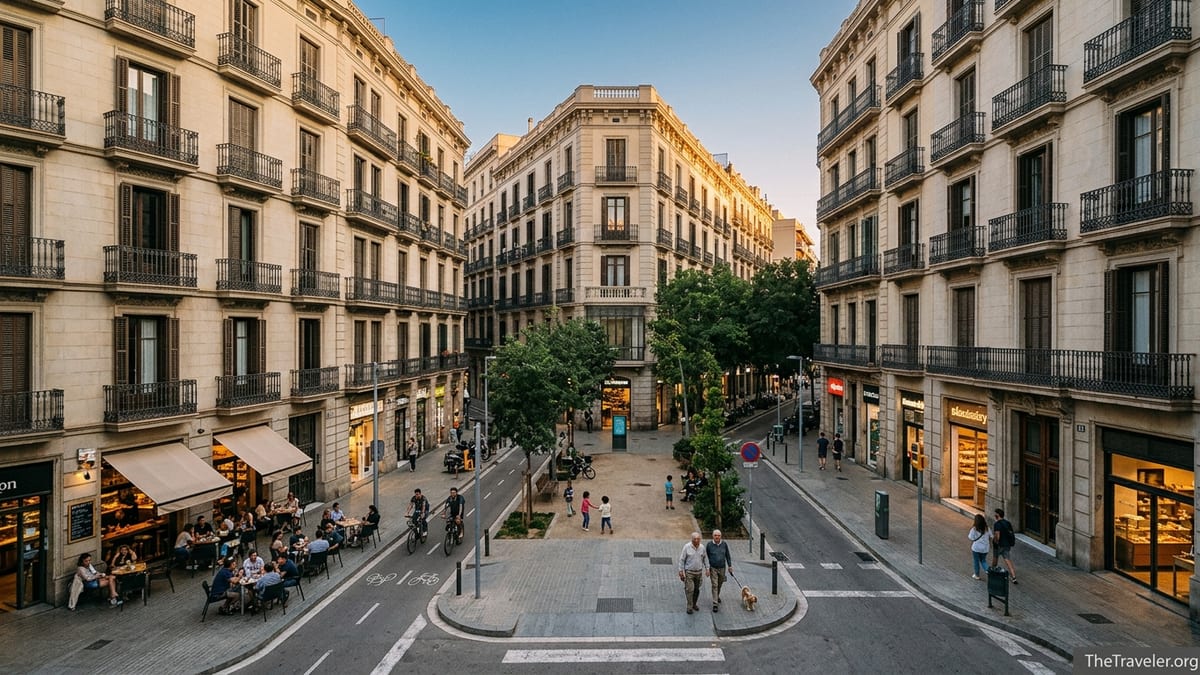
A Neighborhood Built for Everyday Life, Not Just Postcards
Eixample began as a 19th century solution to an overcrowded medieval city. Civil engineer Ildefons Cerdà drafted a bold grid of wide streets, chamfered corners and inner courtyards intended to bring light, air and greenery into daily life. Locals today may not cite Cerdà by name, but they feel his influence when they walk three abreast on Passeig de Sant Joan, cross an intersection with clear visibility, or find a pocket garden behind an austere stone facade. This is the opposite of the Gothic Quarter’s cramped lanes: an urban plan that quietly serves residents before it dazzles visitors.
The grid also makes Eixample remarkably practical. Parents cycle children to school along the new “superblock” green axes where traffic is restricted and playgrounds spill into former car lanes. Elderly residents roll shopping trolleys from their apartment blocks straight to corner butchers, without steep slopes or cobbles. Commuters know that if one bus line is delayed, another is rarely more than two blocks away. It is the kind of everyday functionality that rarely appears on Instagram, yet explains why so many Barcelonins choose to live here even if they work or socialize elsewhere.
Tourists experience this without always realizing it. A visitor staying in a mid-range hotel near Girona or Tetuan often remarks that they slept better than in the old town, because traffic noise is absorbed by the broad avenues and solid buildings. Cafes with big windows at the ground floors of Eixample’s modernist blocks become all-day living rooms for freelancers and retirees. Step away from the major monuments and you are in a neighborhood where the urban fabric is designed not around a single spectacular view, but around the rhythm of a full working week.
For locals, that sense of order and predictability has real value. Rent may be higher than in some peripheral districts, but being able to run every errand on foot within ten minutes of home, while still living in architecturally striking buildings, is part of Eixample’s enduring appeal. The Gaudí landmarks are a bonus. The grid itself is the reason people put down roots.
Sant Antoni: The Market-Driven Heartbeat
If there is one place that captures why residents love Eixample beyond Gaudí, it is Mercat de Sant Antoni and the streets around it. Housed in a vast cast-iron hall from the 1880s, the market reopened in 2018 after a long renovation and immediately reclaimed its role as the neighborhood pantry. Locals buy fruit and vegetables by the crate, choose fish laid out on crushed ice, and chat with butchers who remember family orders. Prices are similar to other city markets rather than tourist-oriented spots; shoppers talk about paying only a few euros for a bag of seasonal tomatoes or a whole chicken that will feed the household for days.
Beyond the raw produce, Sant Antoni has become a social anchor. A weekday morning might find office workers standing at stainless-steel counters outside a market bar, eating a fork-tender beef stew or a plate of grilled sardines cooked minutes before. On Sunday, the atmosphere changes again as the streets around the building fill with stalls selling books, stamps and vintage magazines. Longtime residents leaf through secondhand Catalan novels, while families pick up children’s comics and football cards. For neighbors, this weekly ritual is as important as any museum visit.
The surrounding streets amplify the market’s energy. Carrer del Parlament, once a modest thoroughfare, now hosts independent cafes, bakeries and natural wine bars that feel thoroughly local in their clientele. On a typical Saturday, groups of friends cluster at sidewalk tables for vermut hour: a glass of dark vermouth on ice, perhaps for 3 or 4 euros, with olives and crisps. You will hear Catalan, Spanish and a sample of languages from new arrivals, but almost no shouted tour groups. The draw is not spectacle, but the chance to linger.
Restaurants around Sant Antoni reflect this balance of tradition and trend. Simple bars near the market still serve hearty daily menus at lunchtime, often including a starter, main course, dessert and drink for a price that feels like a bargain compared with ajoining central districts. A few steps away, younger chefs experiment with small plates, from chargrilled vegetables dressed in local olive oil to fusion dishes that mix Catalan produce with Asian techniques. Locals appreciate that they can choose between a no-frills home-style lunch after shopping or a more adventurous dinner out, all within a few blocks of home.
Everyday Food Culture: From Menú del Día to Midnight Churros
Eixample’s food culture is not only about star chefs or tasting menus. It is about the daily rituals that keep residents loyal to their streets. One of the most cherished is the affordable set lunch, or menú del día, which many neighborhood restaurants offer on weekdays. In streets such as Compte d’Urgell, Rocafort or Mallorca, blackboards advertise two or three-course lunches for a fixed price that typically remains accessible by big-city standards. Office workers from nearby co-working spaces and public offices fill the tables, creating a midday buzz that feels entirely different from the evening tourist circuit.
Cafes and bakeries function as informal meeting points throughout the day. In the morning, parents stop at family-run bakeries near schools for a coffee and a flaky croissant or a slice of coca de llardons before heading to work. Later, freelancers and students occupy window tables at minimalist espresso bars, where a carefully poured flat white costs only slightly more than a traditional cortado at the corner bar. Many of these cafes have become anchors for micro-communities: the barista knows which regular is working on a novel, who is looking for an apartment, and who is back in town after a long work trip.
After dark, food culture shifts again. Eixample’s side streets hold dozens of modest tapas bars and bodega-style venues that rarely make international lists but are beloved locally. On a Tuesday night, one bar on Carrer d’Aribau might be full of neighbors sharing patatas bravas and grilled squid after a football match on television. A few blocks away, a tiny Basque-style bar serves pintxos skewered with toothpicks, with customers charged by counting the sticks at the end of the meal. Prices may have risen in recent years, but regulars still mark out spots that offer generous portions and a friendly welcome rather than polished interiors.
Even late-night snacks feed into this everyday loyalty. Near busy intersections, traditional granja cafes serve thick hot chocolate and churros long after dinner hours, attracting both teenagers coming back from concerts and grandparents finishing an evening stroll. For residents, queueing here on a winter night is as much a part of Eixample’s identity as any iconic facade. It is a neighborhood that feeds people at all hours, in ways that feel comforting and familiar.
Nightlife for Neighbors: Cocktails, Gaixample and Quiet Corners
Eixample’s nightlife scene is another reason locals value the district beyond its monuments. In recent years, contemporary cocktail bars have opened around streets like Consell de Cent and Girona, offering carefully mixed drinks in relaxed settings. In one bar near Consell de Cent, regulars might order a seasonal gin-based cocktail infused with citrus and local herbs, while chatting quietly at the bar without shouted orders or standing-room-only crowds. Prices reflect the quality, but locals appreciate that they can enjoy a serious drink without crossing the city or queuing behind influencers looking for a photo opportunity.
The district is also home to Gaixample, an area centered roughly around Diputació and Aragó streets where many LGBTQ+ bars, clubs and restaurants have flourished since the late 20th century. Here, rainbow flags hang from balconies above everyday supermarkets and pharmacies, and nightlife venues range from intimate wine bars to lively dance clubs. Residents describe it as a place where they can meet friends for a casual drink on a weeknight or attend events during Pride season without feeling that the area is only a seasonal attraction. For many, Gaixample is as much about feeling safe holding hands on the street as it is about nightlife itself.
Not all of Eixample’s evening energy is loud. Some corners specialize in low-key, community-focused venues. Small live-music bars might host jazz trios on a Thursday night, drawing a regular crowd who know the musicians by name. On streets behind big thoroughfares like Gran Via or Diagonal, wine bars serve Catalan and Spanish bottles by the glass, often at prices slightly lower than in the city’s most fashionable quarters. Patrons sit at high stools, pick at simple plates of cured meats or local cheeses, and talk long after the first glass is finished.
For locals, the key point is choice. Within a radius of ten or fifteen minutes on foot, a resident can move from an elegant hotel rooftop bar with skyline views to a humble neighborhood tavern that still pours house red wine straight from the barrel. This layered nightlife allows people at different life stages and income levels to carve out their own routines. Unlike some entertainment districts that serve primarily visitors, Eixample’s night scene is interwoven with daily life, so that the bartender at a late-night spot might also be the parent you nod to at school drop-off the next morning.
Shops, Services and Small Businesses That Anchor Community
Another reason locals love Eixample lies at street level: a dense network of independent shops and essential services. Walk along Carrer de València or Provença away from the main avenues and the ground floors of stately apartment buildings reveal a sequence of greengrocers, family pharmacies, key-cutters and tailor shops. Many have been in the same location for decades. The owner of a corner stationery store may remember selling school notebooks to three generations of the same family. These businesses provide not only convenience but continuity.
Eixample also offers an unusually high concentration of specialist stores. There are instrument repair shops near Conservatori music schools, design bookstores around Passeig de Gràcia, and cycling boutiques catering to commuters who ride daily. In side streets near Sant Antoni, creative studios share space with concept stores selling locally designed clothing and ceramics. Residents often prefer to buy a handmade mug or small-run T-shirt here rather than from international chains, knowing that their money stays in the neighborhood.
Crucially, these small businesses coexist with the practical services that make life smoother: medical clinics, language academies, driving schools and co-working spaces. A young professional might work remotely from a shared office in Eixample during the day, go to an evening Catalan class two blocks away, then meet friends for dinner within walking distance. Parents appreciate being able to combine after-school activities, orthodontist visits and grocery runs without leaving the grid. For them, Eixample feels less like a museum district and more like a fully equipped town center stitched into Barcelona’s core.
Even the larger commercial avenues retain a local flavor behind the international brands. Rambla de Catalunya, for instance, mixes global fashion labels with long-established perfumeries, shoe stores and cafes. Locals might browse a big-name shop for a specific item, then cross the street to buy coffee at a bar where the staff know their name. The combination of variety and familiarity is part of what keeps residents loyal to the area, even as commercial rents climb.
Green Streets, Superblocks and a Softer Urban Future
In the past decade, Eixample has become a testing ground for Barcelona’s efforts to reclaim streets from traffic and heat. The “superblock” model reduces car access in selected areas and converts intersections into small plazas with benches, trees and playground equipment. Around streets like Consell de Cent, a drive-heavy corridor has been transformed into a calmer axis where children play on painted pavements and neighbors chat on newly installed seating. For residents, these changes are not abstract urban-planning concepts, but new places to walk dogs, practice scooter tricks or sit with a takeaway coffee from a nearby cafe.
Local families in particular praise the way these interventions make everyday routines easier. Instead of shepherding children across multiple lanes of traffic, parents can stroll along greened routes to reach schools or after-school activities. Elderly residents, who might once have limited their outings to the nearest corner shop, now use the new benches as intermediate resting spots, allowing them to cover longer distances on foot. The introduction of more trees and shade structures also helps mitigate the summer heat, which locals increasingly notice during July and August.
The transformation has not been without debate. Some residents worry about traffic congestion being pushed into adjacent streets or about the impact of construction on local businesses. Yet many Eixample neighbors see the longer-term benefits. Apartment dwellers without balconies or private gardens suddenly have access to small, semi-pedestrian squares where children can ride bicycles and adults can read in the sun. Travellers who stay in the district experience these changes firsthand when they find themselves walking along quiet, tree-lined sections of what, on a map, still appears to be a major road.
For locals, these new green corridors reinforce the idea that Eixample is more than a backdrop for famous buildings. It is a living district that can adapt to contemporary challenges such as climate stress and air quality, while maintaining the practical grid that defines its character. The urban experiment plays out at eye level, in the way neighbors greet each other on redesigned corners and how they incorporate these softer spaces into their daily routines.
Living Like a Local: How Visitors Can Experience the Real Eixample
Travelers who want to understand why Eixample matters to locals can do so by adjusting how they spend their time. Instead of racing between Gaudí landmarks, they can dedicate a day to moving through the district at neighborhood speed. That might start with breakfast at a simple bar on a residential street, standing at the counter for a coffee and a toasted baguette with tomato, as office workers do. From there, a slow walk through a nearby food market, whether Sant Antoni or another Eixample market hall, reveals how residents actually shop: by season, by relationship with vendors, and often with a mental list rather than a pre-written one.
Mid-morning, visitors can detour along one of the newer greened axes, watching how school groups use them as safe walking routes and how older residents claim benches as informal meeting points. Stopping at an independent bookstore or design shop, they might notice that many items on sale highlight Barcelona’s everyday iconography: tram lines, tiled pavements, modest corner kiosks. These are the details locals carry with them, rather than only the most photographed facades.
Lunch offers another window into local life. Choosing a menú del día in a place filled predominantly with residents, travelers can observe how colleagues share a bottle of house wine, discuss local news, and linger until coffee is served. In the late afternoon, a visit to a neighborhood playground or small square shows how children from different backgrounds play together while adults catch up on benches. By early evening, a vermut at a standing-room-only bar in Sant Antoni, or a glass of wine in Gaixample, completes the picture of a district that truly works from early morning until past midnight.
Approaching Eixample this way also changes the traveler’s relationship with Gaudí’s works. Instead of existing as isolated marvels, Sagrada Família and the modernist mansions along Passeig de Gràcia become part of a wider urban story: extraordinary buildings embedded in a grid where laundry still hangs in interior courtyards and delivery cyclists weave between errands. Visitors who recognize this context come away with a deeper appreciation not only of the architecture, but of the city-making that allows residents to live comfortably around it.
The Takeaway
For many outsiders, Eixample is shorthand for blockbuster architecture and tree-lined boulevards. For Barcelonins, it is something more subtle and more essential: the district that best balances beauty and practicality, history and present-day needs. Its markets, small businesses, bars and new green streets support the everyday lives of hundreds of thousands of residents. Children learn to ride bicycles on its quiet corners, grandparents do their weekly shop under iron-and-glass market roofs, and friends toast small milestones at bars that will never be “must see” attractions.
That is why locals talk about Eixample not just as a place to visit, but as a place to live well. Gaudí’s masterpieces remain a point of pride, and rightly so. Yet ask a neighbor what they would miss most if they moved away, and the answer is just as likely to be their favorite market stall, the particular quality of afternoon light on a chamfered corner, or the knowledge that nearly everything they need is within a ten-minute walk. For travelers willing to slow down and look past the postcards, those are exactly the qualities that make Eixample unforgettable.
FAQ
Q1. Is Eixample a good area to stay in Barcelona for first-time visitors?
Eixample is a strong choice for first-time visitors because it is central, well connected by metro and bus, and generally quieter at night than the old town, while still offering easy access to major sights like Sagrada Família and Casa Batlló.
Q2. How do locals usually move around Eixample?
Most residents move around Eixample on foot, by bicycle or scooter, and via public transport such as the metro and buses, taking advantage of the flat grid, wide pavements and growing network of traffic-calmed streets.
Q3. What time of day is best to visit Mercat de Sant Antoni?
The liveliest time is usually mid-morning on weekdays, when local shoppers fill the aisles, while Sunday mornings are best for the outdoor book and vintage market around the building.
Q4. Is Eixample safe at night?
Eixample is generally considered one of Barcelona’s safer central districts, with well-lit streets and regular foot traffic, although visitors should still take normal big-city precautions against pickpocketing.
Q5. Where do locals in Eixample go for an authentic drink before lunch?
Many locals enjoy a traditional vermut before lunch at simple bars near markets or along streets like Parlament and around Sant Antoni, often accompanied by olives or crisps.
Q6. Are there green spaces or parks within Eixample?
Yes, Eixample has interior block courtyards, small neighborhood squares, and increasingly, redesigned “superblock” intersections with trees, benches and play areas that function as mini-parks.
Q7. Is Eixample suitable for families with children?
Families often favor Eixample because of its wide pavements, numerous schools and playgrounds, proximity to services, and the relative ease of walking or cycling with strollers and small children.
Q8. How expensive is it to eat out in Eixample compared with more touristy areas?
Prices vary, but many neighborhood spots in Eixample still offer reasonably priced menú del día lunches and tapas, often cheaper and better value than heavily touristed streets closer to the Rambla.
Q9. What is Gaixample and why is it significant?
Gaixample is the informal name for an area of Eixample with a high concentration of LGBTQ+ bars, clubs and businesses, valued by locals as an inclusive, welcoming part of the city’s social life.
Q10. How can visitors experience Eixample more like a local and less like a tourist?
Visitors can slow down, shop at markets, eat a weekday set lunch among office workers, stroll along greened streets, and spend evenings in small neighborhood bars rather than focusing only on famous monuments.