


On a coastline where gloss and glamour often take center stage, Menton feels almost disarmingly human. Wedged between the last folds of the Maritime Alps and the Italian border, this small seaside town has pastel houses that really do tumble toward the sea, church bells that still seem to set the pace of the day, and café terraces where the loudest noise is usually the hiss of an espresso machine. For travelers weary of crowds and looking for beauty that has not been polished into something anonymous, Menton continues to stand out as one of the French Riviera’s most quietly compelling destinations.
Get the latest updates straight to your inbox!
A Riviera Town That Still Feels Like a Town
Part of Menton’s enduring appeal is that it still functions first as a place where people live, and only second as a resort. While it has its share of hotels and holiday rentals, the rhythm on a Tuesday morning in March or an ordinary Thursday in October is unmistakably local. You see schoolchildren racing down the Rue Saint-Michel, residents wheeling shopping trolleys home from the covered market, and pensioners claiming the same bench along the Promenade du Soleil every afternoon. That everyday life softens the edges of tourism and gives visitors the sense of briefly sharing in a community rather than passing through a stage set.
The town’s manageable scale adds to that feeling. From the train station, it is a 10 to 15 minute walk to the waterfront, and most of the old town and seafront sights lie within a compact radius. Travelers coming from Nice or Monaco often note how quickly Menton feels walkable and legible. You can arrive on a regional TER train, roll your suitcase down to a small family-run hotel near the seafront, and be sipping a coffee on a shaded square half an hour after stepping off the platform. For many, that ease is a welcome contrast to larger Riviera cities where crossing town can feel like a logistics operation.
Even in high season, Menton tends to attract a slightly different crowd. Instead of large cruise groups or party weekends, you are more likely to encounter couples in hiking shoes heading toward the Col de la Madone, gardening enthusiasts comparing notes about Serre de la Madone, or food travelers making a pilgrimage to taste local lemon specialties. Reddit threads where visitors compare Menton with Antibes or Monaco often describe it as quieter and more “Italian in feeling,” with fewer nightlife options but more space to stroll, read on the beach, or linger at dinner without being rushed from your table.
This quieter profile has practical consequences. Accommodation prices in Menton, while not cheap in summer, are often noticeably lower than in neighboring Nice or Cannes. Mid-range hotels a short walk from the sea can be more accessible for longer stays, allowing travelers to use Menton as a base for day trips up and down the coast while returning each night to a town that winds down early and sleeps deeply.
Pastel Old Town and Baroque Heights
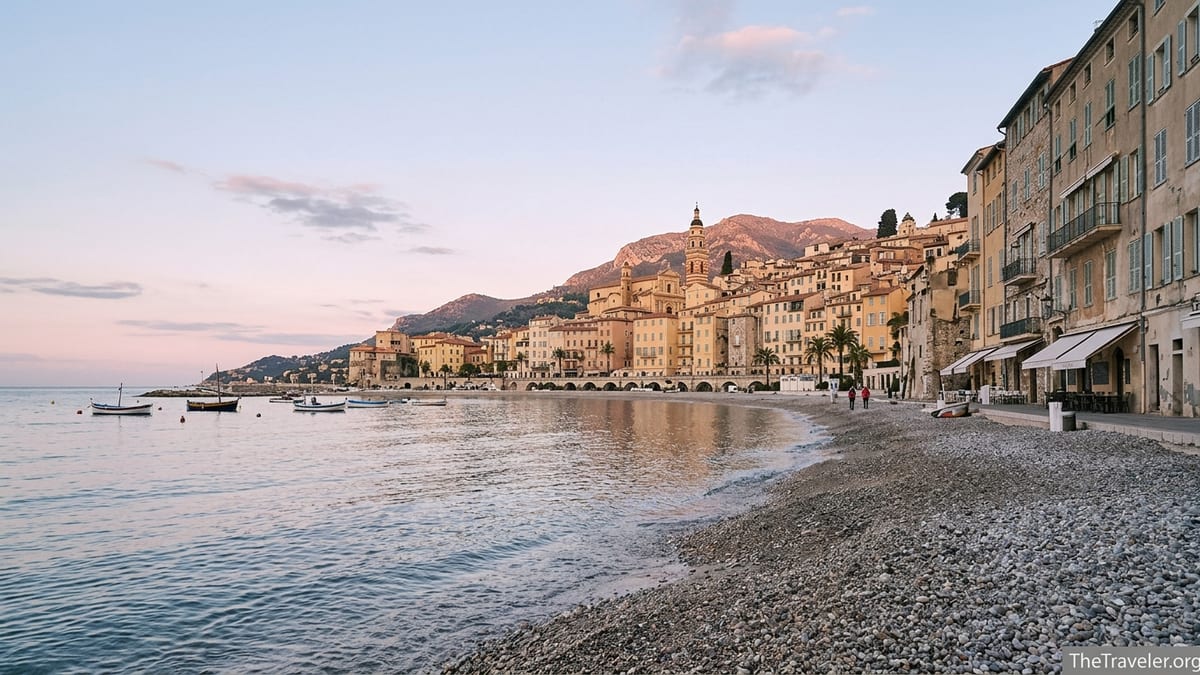
If Menton has a single postcard image, it is the view of its old town rising steeply from the Baie de Garavan: a cascade of terracotta roofs and sorbet-colored facades leading the eye up to the striped bell tower of the Basilique Saint-Michel. Seeing that view in person, particularly in the soft gold of late afternoon, is often the moment when travelers understand why so many writers and painters have been drawn here. The architecture feels unmistakably Mediterranean yet distinctly Mentonnais, with narrow, vaulted passageways and ochre buildings that seem to glow against the cobalt sea.
Exploring the old town on foot brings that image down to human scale. From the seafront, a climb up the stone steps of the Rampe Saint-Michel leads to the church square, where the tiled pavement fans out like a mosaic and musicians often play in the evenings during summer festivals. A little higher, the cemetery crowns the hill with views that sweep from the Italian coast to the cliffs above Monaco. Travelers who make the climb frequently remark that the panorama from the cemetery is one of the most memorable on the Riviera, yet you may share it with only a handful of other visitors, even in July.
The streets between the waterfront and the basilica hold their own subtle charms. Laundry still flutters between windows along rue Longue, cats doze in sun patches beside worn doorsteps, and small details like carved lintels or faded fresco fragments hint at the town’s layered history under Monaco, Savoy and France. Unlike in some heavily restored historic centers, many buildings show their age: peeling shutters, small patches of exposed stone, gently uneven staircases. Far from feeling neglected, these textures give Menton an authenticity that appeals to travelers who prefer patina to perfection.
At ground level, the boundary between old town and everyday town is porous. On market days, locals stream through Porte Saint-Antoine, one of the medieval gates, to reach the covered market on Quai de Monléon. Stepping through the arch from the tangle of alleys into the brighter, seaside light is a simple experience, but it illustrates how closely linked Menton’s history is with its present daily life.
Gardens and Citrus: Living Traditions, Not Just Slogans
Menton’s self-proclaimed status as “capital of the lemon” could easily have become a marketing slogan. Instead, the town’s citrus and garden culture remains a living, tangible part of the landscape and daily economy. The Jardin d’agrumes du Palais Carnolès, just inland from the seafront, is a two-hectare public garden that maintains more than a hundred varieties of citrus trees, from bitter oranges to rare lemons. Visitors wander between geometric beds, often catching the scent of blossom in spring or brushing against fruit-heavy branches in winter. Interpretive panels explain that this was once the summer residence of the prince of Monaco, a reminder of the town’s historic ties.
On a more intimate scale, small producers in the hills above Menton continue to cultivate the protected Menton lemon, prized for its thick, fragrant rind. Several agencies offer half-day visits that combine short walks through terraced groves with tastings of lemon marmalade, liqueur or olive oil infused with citrus zest. These tours are popular with travelers who want something more concrete than simply buying a jar as a souvenir. Spending a morning talking with a grower about irrigation challenges or harvest rhythms grounds the idea of “local product” in real people and work.
The town’s gardens extend far beyond citrus. Serre de la Madone, created in the 1920s and 1930s by British plantsman Lawrence Johnston, unfurls across a hillside to the west of town. Visitors move through a series of shaded terraces planted with rare species collected from around the world, interspersed with old olive trees and small reflecting pools. Another notable garden, Val Rahmeh, managed as a botanical garden, showcases sub-tropical plants that thrive in Menton’s unusually mild microclimate. For many travelers, an afternoon in these gardens, away from the seafront, is where Menton’s gentle pace and connection to the natural world become most apparent.
These green spaces also shape the visitor calendar. While seaside resorts elsewhere on the Riviera are sharply seasonal, Menton’s gardens and citrus groves make it appealing well beyond July and August. Garden festivals, heritage days highlighting the town’s landscaped estates, and special guided visits in spring and autumn draw a slower, more reflective type of traveler, one who might structure a trip around blooming seasons or a specific theme rather than school holidays alone.
The Lemon Festival: A Carnival of Color With Local Roots
Every February and early March, Menton’s quiet streets erupt into one of Europe’s more unusual winter festivals. The Fête du Citron, or Lemon Festival, transforms the town with giant sculptures built from citrus fruits, parades along the Promenade du Soleil and nighttime light shows. Unlike some carnivals created purely for tourism, this event grew out of Menton’s long citrus heritage and was formalized in the 1930s, long before social media made it a visual phenomenon.
Visitors arriving during the festival period find the Biovès Gardens filled with towering structures built around an annual theme, from mythical creatures to world monuments, all clad in thousands of lemons and oranges fixed to wire frames. Alongside them, you might see gardeners on ladders carefully pinning fresh fruit into gaps, a reminder that these installations are temporary, fragile works that must be maintained daily. Families weave between the displays taking photos, while older residents recall previous themes and point out small artistic details that a casual visitor could miss.
Ticketed parades, known as corsos, animate the seafront. Grandstand seats and promenade access are sold by the local tourist office, with recent prices for adult standing places typically in the mid-teens of euros and seats in the higher twenties, depending on the day and time. Night parades combine floats, music, dancers and fireworks, drawing both international visitors and residents from elsewhere on the Riviera who come specifically for the spectacle. Travel bloggers who have attended in recent years often recommend pre-booking at least one parade and setting aside time for a behind-the-scenes tour to understand how the festival is organized.
What strikes many travelers, however, is how the event remains entangled with everyday life. Local pastry shops create special lemon tarts and brioches for the occasion, restaurants add seasonal citrus menus, and schoolchildren take part in creative projects tied to the theme. While the festival certainly brings crowds, especially on main parade days, it also reinforces Menton’s identity as a place where agricultural tradition and cultural celebration still inform one another.
Markets, Kitchens and a Distinctive Food Culture
Beyond the lemons, Menton attracts travelers who are serious about food but not necessarily seeking only high-end tasting menus. The covered market near the old port, open most mornings, is a focal point. Inside, visitors find stalls piled with local vegetables from the Roya and Bévéra valleys, glistening fish caught just off the coast, and cured meats and cheeses from the nearby Ligurian hills. One stall might specialize in socca, the chickpea pancake more typically associated with Nice, while another offers Pissaladière and small stuffed vegetables that are staples of the region.
Several Menton bakeries and patisseries have made their names on lemon creations: tarts with almost white, intensely aromatic custard, glossy lemon éclairs, or soft cakes soaked in citrus syrup. Food-focused travelers often map out a self-guided “lemon tasting” walk, moving from one address to another between the seafront and the old town, comparing versions and chatting with staff about which fruit they use. Coffee bars, meanwhile, offer the simple pleasure of sitting with an espresso and a slice of fougasse flavored with orange blossom, watching the morning’s routines unfold.
The town’s restaurant scene spans from casual trattoria-style eateries along side streets to ambitious contemporary kitchens. On the formal end, the three-Michelin-starred Mirazur, perched on the hillside above the sea, has drawn international attention with menus that emphasize biodynamic gardens and local citrus. Although reservations can be difficult to secure and tasting menus are priced for special occasions, even travelers who do not dine there feel the ripple effect of its philosophy in the wider local food culture. More affordable bistros and Italian kitchens around town showcase the same excellent vegetables, herbs and seafood in simpler preparations.
Practical details help keep dining accessible. Set lunch menus at mid-range restaurants can offer very good value outside the peak of summer, and many places serve reasonably priced plat du jour options focused on seasonal produce. Visitors who stay in apartments often shop at the market in the morning, then assemble their own feasts of olives, cheeses, bread, and ripe tomatoes on a balcony overlooking the sea, finding in that simple ritual as much pleasure as in any formal meal.
Art, Cocteau and a Layered Cultural Identity
Menton’s cultural identity owes much to the poet and artist Jean Cocteau, who first encountered the town in the 1950s and left an enduring mark. The small Bastion Museum, housed in a 17th-century fort on the harbor wall, exhibits his drawings, ceramics and tapestries in a setting that feels closer to a personal chapel than a grand institution. Inside, visitors pass through intimate whitewashed rooms where Cocteau’s line drawings come alive against the stone, then step outside to terraces that frame the old town and sea in almost cinematic vignettes.
Across the road from the covered market stands the striking contemporary building that once housed the larger Jean Cocteau Museum, designed by architect Rudy Ricciotti. Although the main collection has been closed for several years due to storm damage, the structure itself has become part of the townscape, its black-and-white arches echoing the play of light and shadow on the waterfront. Many visitors pause simply to walk around the exterior, noting how this bold modern intervention sits beside Belle Époque facades and the 19th-century market hall without overwhelming them.
Cocteau’s influence is also visible in the Salle des Mariages, the wedding hall in the town hall, which he decorated in the late 1950s with murals depicting Orpheus, Eurydice and stylized couples. Access is usually through guided visits organized by the tourist office, often in small groups that allow time to absorb the details and hear anecdotes about the artist’s time in Menton. For culturally inclined travelers, this room is often a highlight: a civic space still used for its original function, animated by an avant-garde artist who helped shape the image of twentieth-century France.
Beyond Cocteau, Menton hosts a classical music festival each summer, with concerts staged on the square outside the Basilique Saint-Michel or in nearby venues. The setting, with performers framed by baroque stonework and the sea below, feels remarkably intimate compared with urban concert halls. Smaller galleries, seasonal exhibitions in the Palais de l’Europe, and occasional open-studio events in the old town round out a cultural offering that, while not vast, is consistently enriched by the town’s history and geography.
Borderland Atmosphere and Slow-Travel Appeal
One of Menton’s subtler qualities is its borderland character. A few minutes east on the coastal road or a short hop on the train and you are in Italy, which has practical implications for travelers. Day trips to Ventimiglia’s Friday market or to the beaches just across the frontier are common, and some visitors base themselves in Menton specifically to enjoy this dual access. You might spend the morning exploring Ligurian hill villages, then be back in Menton for an afternoon swim and dinner of stuffed vegetables and lemon tart.
This proximity influences everyday details in town as well. Menus slide easily between French and Italian, with risotti and fresh pasta sharing space with Provençal fish stews. Delis stock both Ligurian pesto and local tapenade, and many shop staff shift effortlessly between languages when serving customers. Travelers often comment that, while they remain firmly in France, the cadence of speech and flavors on the plate carry a distinctly Italian undertone, which adds a layer of cultural richness to even the simplest café stop.
Crucially, Menton lends itself to slow travel. Because the town is compact, visitors who stay several days or longer can establish gentle routines: morning coffee at the same bar on Place du Cap, a mid-day swim from the pebble beach at Les Sablettes, an evening stroll on the Promenade du Soleil timed to catch the last light on the old town facade. Hikers head inland on waymarked trails to villages like Sainte-Agnès, officially listed among the most beautiful in France, then return by bus in time for dinner. Cyclists test themselves on the legendary climb of the Col de la Madone, used by professional riders training out of nearby Monaco.
Compared with glossier Riviera destinations, Menton seldom demands that visitors rush. Trains along the coast make day trips simple, but many travelers report that some of their most satisfying days are those spent entirely inside the town limits. Wandering the market, visiting a garden and reading under a palm tree on the seafront might not sound dramatic, yet for those seeking beauty and authenticity, this accumulation of small, unhurried pleasures is exactly the point.
The Takeaway
Menton continues to attract travelers not because it offers the loudest nightlife or the biggest luxury resorts, but because it has quietly preserved a balance between beauty and everyday life. Its pastel old town, lemon groves and hillside gardens are certainly photogenic, yet they remain embedded in a functioning community that grows, cooks and celebrates according to its own rhythms. For visitors, that means the chance to encounter the French Riviera not as an abstract idea, but as a lived-in place where baroque church squares fill with music on warm evenings and gardeners still check the citrus scaffolds before each Lemon Festival parade.
For anyone planning a trip to the Côte d’Azur and wondering whether to venture beyond the marquee names of Nice, Cannes and Monaco, Menton offers a persuasive answer. It is a town where you can swim before breakfast, visit a world-class garden before lunch, taste an almost impossibly fragrant lemon tart in the afternoon and listen to chamber music under the stars at night, all without feeling hurried or out of step with local life. In an era when many destinations struggle to preserve their character under the weight of attention, Menton’s enduring charm lies in how quietly, and confidently, it remains itself.
FAQ
Q1: When is the best time of year to visit Menton for good weather and fewer crowds?
For mild weather and relatively light crowds, late April to early June and late September to October are ideal. The sea is often warm enough for swimming, many gardens are at their best, and accommodation prices are generally lower than in the peak summer holidays.
Q2: Is Menton a good base for exploring the rest of the French Riviera?
Yes. Menton sits on the main coastal rail line, with regular TER trains to Nice, Monaco, Antibes and Cannes. Many travelers choose it as a quieter base, using day trips to visit busier resorts while returning each evening to a calmer, more lived-in town.
Q3: How expensive is Menton compared with Nice or Monaco?
While Menton is not a budget destination, hotel rates, restaurant prices and beach rentals are often lower than in Nice, and significantly below Monaco. Mid-range hotels near the sea can be more attainable, and set lunch menus in local restaurants can offer good value, especially outside July and August.
Q4: Do I need to rent a car to enjoy Menton and its surroundings?
A car is not essential for most visitors. The town itself is very walkable, and regional trains and buses connect Menton to nearby villages, gardens and coastal cities. A car can be useful for exploring more remote hilltop villages or hiking areas, but many travelers are comfortable relying entirely on public transport.
Q5: What are the beaches in Menton like?
Menton’s main beaches are a mix of pebbles and coarse sand, with calm, sheltered water suitable for families. Plage des Sablettes, at the foot of the old town, offers scenic views of the pastel facades and easy access to cafés and restaurants, while longer stretches east and west of the center feel more relaxed.
Q6: Is the Lemon Festival suitable for children and families?
Yes. The Lemon Festival is very family-friendly, with colorful citrus sculptures in the Biovès Gardens and lively parades along the seafront. Parents should be prepared for crowds on main event days and may want to book grandstand seats for younger children to have a clear view without standing for long periods.
Q7: Are there options for hiking and outdoor activities around Menton?
There are several marked trails leading from Menton into the surrounding hills, including routes up to Sainte-Agnès and toward the Col de la Madone. The town is also a good base for road cycling, coastal walks, swimming and boat excursions, giving active travelers plenty of options beyond the beach.
Q8: How many days should I plan to stay in Menton?
With one full day, you can visit the old town, the covered market and at least one garden. A stay of three to four nights allows time for a slower exploration of Menton itself plus a couple of day trips along the coast or into the hills, which many travelers find to be an ideal balance.
Q9: Is Menton suitable for travelers who do not speak French?
Yes. While Menton feels less international than some Riviera resorts, many people working in hotels, restaurants and shops speak at least basic English, and Italian is also widely understood. Simple efforts in French are appreciated, but non-French speakers generally manage without difficulty.
Q10: What should I pack for a visit to Menton?
Comfortable walking shoes for cobbled streets and hillside paths are essential, along with swimwear, sun protection and a light jacket for evenings, even in summer. If you plan to visit gardens or hike, breathable clothing and a small daypack for water and snacks will make outings more enjoyable.