


I arrived in Menton expecting a gentler, sleepier version of Nice. What I did not expect was to step off the train and feel, almost instantly, as if I had wandered into Liguria by mistake. From the way people sipped espresso at the counter to the lemon-yellow facades climbing the hill, my biggest surprise in Menton was how profoundly Italian it felt, despite technically being very much in France.
Get the latest updates straight to your inbox!
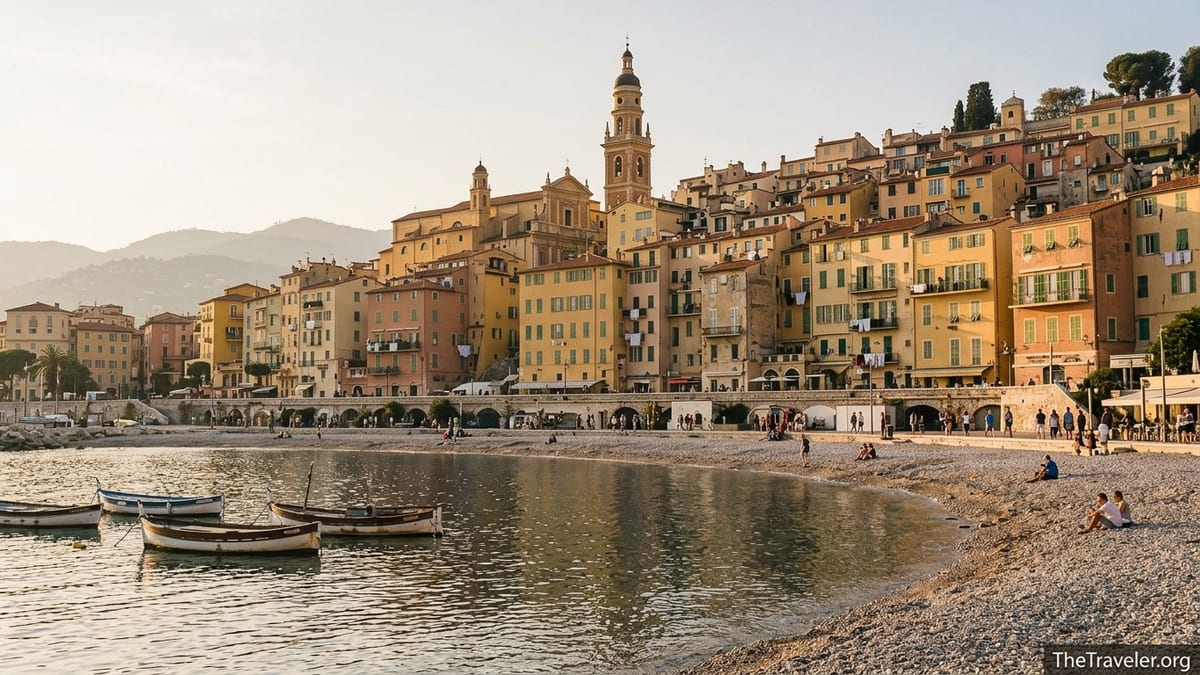
First Impressions on the Border of Two Worlds
The moment the regional TER train rolled into Menton Garavan, the last French stop before Italy, the geography explained everything. On one side, the tracks curved back toward Nice and the Côte d’Azur. On the other, they pushed on just a few minutes further to Ventimiglia, the first town across the Italian border. You can literally sit on the beach in Menton and see the Ligurian coastline unfold to the east, which makes it less surprising that Italian influences seep into almost every corner of town.
On the seafront promenade, I heard as much Italian as French. Elderly couples debated in rapid-fire Italian over which gelato flavor to choose, while a shopkeeper greeted a regular with a cheerful “Ciao, come stai?” before sliding back into French with the next customer. For a traveler arriving from Paris or Lyon, where English frequently steps in as a second language, this everyday switching between French and Italian feels like a small cultural jolt.
Menton’s scale also nudges you toward an Italian state of mind. The compact station, the tight lanes squeezing between shuttered houses, and the way laundry flutters between balconies above your head recall small Ligurian towns like Bordighera more than big French Riviera resorts. Walking from the station down to the sea takes only a few minutes, and by the time your feet hit the pebbles, you are already in a place that feels both French and undeniably something else.
An Old Town That Looks Straight to Liguria
Climb into Menton’s vieille ville and that “something else” clarifies itself as distinctly Italian. The old town is a tumble of steep, winding alleys that feel more like a Ligurian hill village than a typical French seaside resort. The houses are tall and narrow, painted in shades of terracotta, mustard, and soft apricot. Wooden shutters in faded greens and blues throw deep shadows onto the cobblestones, a scene that would not look out of place in Sanremo or Ventimiglia just across the border.
As you wind upward on the Rampes Saint-Michel, the wide, zigzag staircase that climbs toward the basilica, you are surrounded by architecture that owes more to Genoa than to Paris. The façades are ornate yet sun-worn, doorways are crowned with simple stone arches, and you catch glimpses of pocket-sized piazzette rather than grand French squares. Many of the tiny side streets are barely wide enough for two people to pass, reminiscent of the carrugi, the narrow lanes typical of Ligurian coastal towns.
Practical details underline the Italian atmosphere. Small alimentari-style grocery shops sell jars of pesto, packets of trofie pasta, and Ligurian olive oil alongside French cheeses. Street signs flip between French and the local Mentonasc dialect, which linguists class as a variety of Occitan heavily influenced by nearby Ligurian speech. It is a reminder that before borders hardened, these coastal communities were tied together more by shared language and trade than by national lines on a map.
The Italianate Heart: Basilica and Baroque Skyline
The most striking symbol of Menton’s Italian character is its skyline. From the beach, the town rises in layers of pastel buildings to a single, unmistakably Italianate crown: the Basilica Saint-Michel-Archange with its tall bell tower. Built in the 17th century under the Princes of Monaco and designed in Baroque style by a Genoese architect, the church would look perfectly at home above a Ligurian harbor. Its decorative façade, columns, and bell tower feel closer to what you might find in Porto Maurizio or Albenga than in a typical French parish church.
Stand on the parvis in front of the basilica in the late afternoon and the illusion deepens. The piazza is paved with a pebble mosaic in black and white, forming patterns reminiscent of the church squares you see all along the Italian Riviera. Children kick footballs across the stones, locals drift by with gelato in hand, and visitors linger on the low walls facing the sea. The scene is pure Mediterranean, but that pebble square, the ochre façade, and the elegant bell tower read strongly Italian to anyone who has spent time across the border.
Even the way sound carries feels Italian. Church bells ring out over the roofs with a resonance that instantly evokes small-town Liguria. On summer evenings during the music festivals that take over the basilica’s parvis, you might sit listening to classical concerts with the sea below and the serrated line of the Italian coast glowing to the east, unsure which side of the frontier your ears are telling you you are on.
Cafés, Aperitivi, and a Very Italian Rhythm of the Day
The daily rhythm in Menton felt more like that of a small Italian town than a fast-paced French resort. Morning began not with croissant-only breakfasts, but with a kind of Franco-Italian compromise. In bars near the covered market, locals leaned on the counter over a tight, dark espresso rather than a large café crème. At some spots a quick espresso at the bar hovered around the same price you would expect in Liguria, often a little over 1 euro, which feels notably less “Riviera” than the prices in neighboring Monaco or central Nice.
Later in the day, the Italian influence becomes even more tangible in the concept of aperitivo. By late afternoon, seafront cafés put out bowls of olives and crisps beside glasses of Aperol spritz and Campari soda. The drinks list in many bars reads like that of a Ligurian town: Vermentino and Pigato wines from just over the border, prosecco by the glass, and limoncello made from the local citrus groves. While French rosé is ever-present, it often shares equal billing with Italian labels rather than dominating the menu.
Even dining hours have a border-town flexibility. Restaurants along Rue Saint-Michel and in the old town lanes will usually seat you on a French schedule, but a few places clearly cater to Italian visitors, staying open later and leaning heavily into pasta and pizza rather than Provençal classics. On a warm night, it is common to see groups of Italian families sharing large platters of fritto misto or seafood linguine while their children switch effortlessly between French and Italian with the waitstaff.
On the Plate: Pasta, Pesto, and Lemons Everywhere
Nowhere does Menton’s Italian side declare itself more clearly than on the plate. The town’s culinary identity sits squarely where Liguria meets Provence, and if you arrive expecting purely French bistro fare, you quickly discover how much pasta and pesto shape local menus. At casual trattoria-style spots around the market, tagliatelle al pesto and gnocchi with tomato and basil appear alongside niçoise-style socca and salade niçoise, a blend that mirrors the town’s geography.
Fresh seafood preparations are just as likely to follow Italian models as French ones. You see plenty of spaghetti alle vongole, mixed fried fish platters, and whole grilled branzino served with lemon and olive oil, not drenched in rich sauces. Olive oil from Liguria often shares space on shelves with French oils from Provence, and servers readily recommend Italian wines to match Mediterranean fish dishes. For a traveler, this means you can move from a Provençal-style fish soup at lunch to a full Italian pasta feast at dinner without ever leaving town.
Then there are the lemons, Menton’s signature fruit, which act as a bridge between its French and Italian personalities. The terraced citrus groves that rise behind the town recall the lemon gardens of the Amalfi Coast and Liguria’s Riviera, and local restaurants lean into lemon in very Italian ways. You find risotto al limone, lemon-scented olive oil over grilled vegetables, and homemade limoncello served icy-cold at the end of a meal. During the February Fête du Citron, the whole town becomes a citrus fantasy, but even at other times of year, it is common to see crates of lemons spilling onto sidewalks the way they do in small Italian markets.
Border Hopping: Ventimiglia as Menton’s Italian Back Garden
Part of why Menton feels so Italian is how easy it is to slip across the border and back within a single morning. Frequent regional trains run between Menton and Ventimiglia, covering the distance in roughly 15 to 20 minutes depending on the stop, and tickets on these TER services are typically in the low double digits in euros for a simple cross-border journey. The two towns are so close that some visitors simply stroll along the seafront from Menton toward the frontier, realizing only when they see Italian police checks near the road that they have left France.
Ventimiglia itself is firmly Italian: a slightly rough-around-the-edges Ligurian town with a medieval old quarter, lively Friday markets, and a daily covered food market stacked with Italian specialties. Many Menton residents and visitors make regular forays there to stock up on Parma ham, Parmigiano Reggiano, fresh pasta, and inexpensive Italian wines, then trundle it all back to Menton on the train. When you walk through Menton’s supermarkets and delis and spot entire aisles of Italian brands, it is a direct result of this effortless back-and-forth movement.
For travelers, this proximity opens up easy day trips that blend both cultures. You might spend the morning wandering Menton’s baroque lanes, then hop over to Ventimiglia for lunch at a simple trattoria, where a plate of trofie al pesto and a carafe of house wine might come to under 20 euros. By evening, you can be back in Menton on the promenade, watching the last light fade over a coastline that ignores political boundaries entirely.
A History That Explains the Italian Echoes
That persistent Italian feeling in Menton is not accidental. Historically, this corner of the coast was long tied to Liguria and the Italian states. Menton once fell under the influence of Genoa and later came under the control of the Princes of Monaco before it was definitively integrated into France in the 19th century. The local Mentonasc dialect developed at this crossroads, drawing heavily from nearby Ligurian speech while remaining distinct from standard French.
Over the centuries, waves of workers and traders crossed the border to settle in Menton, especially from Liguria. They brought with them building styles, culinary traditions, and ways of life that have proven remarkably durable. Even during the 20th century, when borders and national identities hardened, cross-border commuting remained part of everyday reality. Construction workers, farmers, and service staff moved back and forth between Menton and the Italian towns of Ventimiglia and Sanremo, further entangling the cultures.
Walk through Menton with this history in mind, and the details make more sense. Family names painted above old shopfronts often have Italian roots. Local festivals borrow from both French and Italian religious and cultural traditions. Even the habit of taking a proper pause in the middle of the day, with shops closing and the town quieting down, feels closer to Italian tempo than to the busier rhythm you might find in larger French cities.
Practical Tips for Travelers Seeking Menton’s Italian Side
If you are drawn specifically to Menton’s Italian atmosphere, a few practical choices will help you feel it more intensely. Base yourself near the old town or Menton Garavan station rather than in the more conventionally French modern center. From these points you can walk within minutes to the basilica’s Baroque square, the steep alleys that resemble Ligurian carrugi, and the seafront that visually connects straight to Italy. Early mornings and late evenings are particularly revealing, when the town belongs mostly to locals.
Visit the covered market, usually buzzing in the mornings, and look for stalls that lean heavily Italian: fresh burrata, salumi, pesto alla Genovese, and crates of artichokes and tomatoes that seem trucked in straight from across the border. When you choose a restaurant, check the menu for homemade pasta, Ligurian-style focaccia, and simple grilled fish seasoned with olive oil and lemon. Ask where the wine comes from, and you will often be guided toward labels from Liguria or nearby Piedmont.
Finally, plan at least one quick hop to Ventimiglia to complete the picture. Buy a same-day ticket on the regional train, travel light, and treat the town as an extension of Menton rather than a separate excursion. Browse the food market, have an espresso standing at the bar for around 1 euro, and note how many other French visitors you see doing the same. Returning to Menton that evening, when you step off the train and hear Italian still echoing through the station, you may momentarily forget which country you are in.
The Takeaway
In guidebooks, Menton is often described as the “Pearl of France.” Spend a little time here, though, and another truth emerges: it is also one of the most Italian-feeling towns in the country. The surprise lies not in dramatic contrasts, but in a thousand small details. The basilica that could crown a Ligurian harbor. The old town lanes that twist like carrugi. The menus where pesto and pasta appear as naturally as bouillabaisse and salade niçoise. The soundtrack of voices that glide easily from bonjour to buongiorno.
For travelers, this blend is precisely Menton’s magic. You can wake up in France, order your morning espresso the Italian way, lunch on a plate of pasta that tastes like it came from a kitchen in Ventimiglia, and end the day watching the sun set over a coastline that does not bother to check passports. My biggest surprise in Menton was how Italian it felt. My biggest pleasure was realizing that here, at least, you do not have to choose between France and Italy at all.
FAQ
Q1. Is Menton in France or Italy?
Menton is firmly in France, in the Provence Alpes Côte d’Azur region, but it sits right on the border with Italy, just west of Ventimiglia.
Q2. Why does Menton feel so Italian?
The town has deep historical ties to Liguria, a local dialect influenced by Italian, strong cross border trade, and architecture and food that closely resemble nearby Italian coastal towns.
Q3. How do I get from Menton to Italy for a day trip?
Frequent regional trains run between Menton and Ventimiglia, usually taking around 15 to 20 minutes. Tickets are inexpensive and can be bought on the day of travel.
Q4. What Italian style dishes should I try in Menton?
Look for fresh pasta with pesto, seafood spaghetti, mixed fried fish, focaccia, and lemon based desserts or homemade limoncello made from Menton’s famous citrus.
Q5. Does anyone speak Italian in Menton?
Yes. Thanks to its location, many locals understand at least some Italian, and you will often hear Italian spoken in shops, cafés, and on the seafront.
Q6. Is the architecture in Menton more French or Italian?
It is a mix, but the old town and the Baroque Basilica Saint Michel Archange have a strongly Italianate character that resembles churches and streets in Liguria.
Q7. Can I walk from Menton to the Italian border?
Yes. From the eastern side of town near Menton Garavan, you can follow the coastal road and promenade to reach the frontier on foot in under an hour.
Q8. Are prices in Menton more like France or Italy?
Accommodation and restaurants tend to follow French Riviera pricing, but simple items like espresso, pizza, and market produce can feel closer to Italian levels than in nearby Monaco or central Nice.
Q9. Is Menton a good alternative to staying in Italy?
For many travelers it is ideal, offering French Riviera comforts with a strong Italian flavor, plus easy day trips across the border without changing your base.
Q10. When is the best time to experience Menton’s Italian atmosphere?
Spring and autumn are ideal, when the weather is mild, cross border trains run frequently, and both Menton and nearby Italian towns feel lively but not overcrowded.