


If you fly to New York City often, you probably have strong feelings about JFK or LaGuardia. Newark Liberty International Airport, on the other hand, is easy to overlook. It sits across the Hudson River in New Jersey, feels psychologically “far,” and sometimes suffers from dated reputations about delays and aging terminals. Yet for many trips, Newark is not just a workable alternative. It can actually be the most efficient, pleasant and strategically smart gateway to New York City.
Get the latest updates straight to your inbox!
Newark Is Not “Far Away” – And Often Competes With JFK
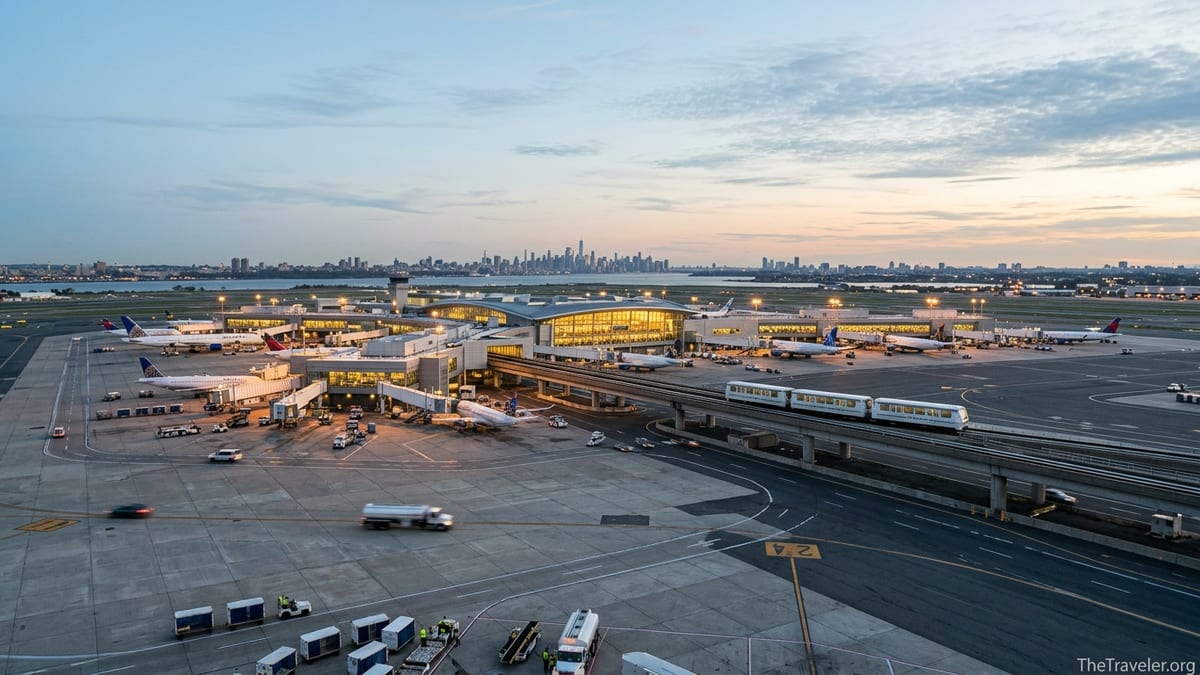
On a map, Newark Liberty International Airport looks like the outlier among New York’s three main airports. It sits in New Jersey, just south of downtown Newark and across the Hudson River from Manhattan. In practice, though, its distance from Midtown is comparable to JFK. Travel guides routinely note that JFK is roughly 15 miles from Midtown Manhattan while Newark is about 16 miles away, a negligible gap once you factor in traffic, bridges and tunnels.
For a traveler staying near Penn Station or on the West Side of Manhattan, Newark can actually feel closer than JFK. A typical trip from EWR to Midtown via New Jersey Transit rail takes about 30 minutes from Newark Airport Rail Station to New York Penn Station, not counting the short AirTrain ride inside the airport. In light to moderate traffic, a car service or rideshare can reach Midtown West in roughly 35 to 60 minutes, similar to or better than surface trips from JFK at busy times.
This matters in real life when flights are delayed or weather deteriorates. Imagine landing at Newark at 10:30 p.m. after a late-running flight from Chicago. At that hour, you can still be on a train into Manhattan within 20 to 30 minutes of reaching the AirTrain, and at your hotel in Midtown by around 11:30 p.m. Trying to make the same connection from JFK via the subway and AirTrain often takes longer and involves more transfers, especially if you are unfamiliar with the system or carrying heavy luggage.
For business travelers who value time over everything else, the difference between adding 30 minutes or an hour to the end of a long day is meaningful. Even leisure travelers feel it when they are arriving with children, skis, or a red-eye hangover. Newark’s notional “distance” often looms larger in people’s minds than in their actual itineraries.
Fast, Direct Rail Links Give Newark a Quiet Advantage
The feature that most consistently surprises visitors is how easily Newark plugs into the regional rail network. EWR is connected to the Newark Liberty International Airport Rail Station by the AirTrain, a people-mover that loops between terminals, parking and the rail link. From there, New Jersey Transit and Amtrak trains run directly to New York Penn Station, Newark Penn Station and points south toward Philadelphia and Washington, D.C.
For most Manhattan-bound travelers, New Jersey Transit is the smart play. Combined tickets that include both the AirTrain segment and the NJ Transit ride to New York Penn Station typically cost in the mid-teens one way, depending on the latest pricing, and travel time from the rail station to Manhattan is around half an hour. Many trains run at least twice an hour during the day. The result is a simple, predictable routine: follow the AirTrain signs from your terminal, ride to the rail station, buy or validate your NJ Transit ticket and board the next train to New York Penn.
This simplicity stands in contrast to LaGuardia, which still relies on buses and road traffic for transit access, and even to JFK, where the AirTrain requires a separate connection to either the Long Island Rail Road or the subway and an additional fare. Regular visitors quickly note that at Newark they are dealing with one rail system and one logical destination. If you are staying anywhere near Penn Station, Hudson Yards, the High Line or Times Square, the NJ Transit link from EWR is one of the cleanest airport-to-city journeys in the region.
Newark’s rail hub status also unlocks itineraries that are clumsy from other New York airports. A traveler flying in from Toronto for a same-day train to Philadelphia can land at EWR, take the AirTrain to the rail station and board an Amtrak train south without ever setting foot in Manhattan. Similarly, business travelers headed to New Brunswick, Trenton or Jersey Shore towns along the NJ Transit network can ride directly from the airport station, avoiding an extra cab or transfer.
Terminal A’s Overhaul Is Changing the Passenger Experience
For years, Newark had a reputation for cramped, dated terminals and long lines. That story is changing, largely because of the new Terminal A. Opened in January 2023 as part of an airport-wide modernization program, the one-million-square-foot facility replaced the old Terminal A and has become the visual centerpiece of EWR’s renaissance. The building’s soaring windows, streamlined security checkpoints and high ceilings give it a light, contemporary feel that would be at home in any top-tier international hub.
Inside, Terminal A offers wide concourses, clearly marked wayfinding and a mix of seating that actually reflects how people travel now: counter-height work tables with power outlets, soft lounge chairs, family-friendly clusters and quiet corners where you can take a video call without shouting. Restrooms were designed with aesthetics in mind, using materials and lighting inspired by New Jersey landscapes, and include better ventilation and more private stalls than many older U.S. terminals.
The food and retail mix is notably more curated than in decades past. Instead of a generic mall lineup, travelers find a blend of national names and regional favorites, from grab-and-go coffee bars to full-service restaurants showcasing New Jersey-based chefs and brands. Parents will appreciate interactive children’s play areas and pet relief zones that are easy to locate on the terminal map. Travelers on American, Delta, JetBlue, Air Canada and some United flights now routinely start or end their trips in this upgraded environment rather than in the much-maligned older spaces.
Crucially, the new Terminal A is designed with connectivity in mind. Post-security shuttle links allow for smooth transfers to United’s Terminal C for connecting flights, and the building incorporates modern sensor technology to monitor restroom occupancy and queue lengths at security. Over time, those invisible systems should translate into more accurate wait-time estimates and less time spent in unpredictable lines, one of the biggest stress points in Newark’s past.
EWR’s Network: More Nonstops, More Competitive Fares
While JFK still leads the region in total international service, Newark quietly punches above its weight in nonstop destinations, especially for transatlantic flights and routes important to business travelers. EWR functions as a major hub for United Airlines, which funnels a large portion of its East Coast and international traffic through the airport. The result is a dense web of nonstop options to European capitals, key West Coast cities and mid-size markets that might otherwise require a connection through another hub.
For travelers, this network depth can translate into better schedules and pricing. A family in Denver heading to Manhattan for a long weekend might find that United offers multiple daily nonstops into Newark at competitive fares, while options to LaGuardia or JFK involve tight connections or higher prices. Similarly, a financial-services traveler commuting between London and New York can often choose among several daily nonstops on major carriers into EWR, which makes it easier to protect meetings when weather or air-traffic issues force schedule changes.
Newark also tends to be strong for domestic point-to-point traffic, including routes to Florida, Texas and the Midwest. When low-cost carriers or competing legacies add capacity on those routes, it can drive down fares not only at EWR but across the region, because New Yorkers suddenly have a viable alternative to the traditional JFK or LaGuardia options. Savvy travelers routinely check all three airports on search engines and are sometimes surprised to find that Newark offers the best combination of price, nonstop availability and arrival time.
For some international flyers, EWR can provide smoother U.S. connections. A traveler from São Paulo or Frankfurt connecting onward to Nashville, Raleigh or Cleveland may have shorter minimum connection times and less backtracking via Newark than via JFK, particularly on United-to-United itineraries. That convenience, combined with the updated facilities in Terminal A and the well-developed lounge network in Terminal C, makes EWR an appealing through-hub rather than just a backup gateway.
Ground Transport Choices That Suit Different Travelers
Another reason Newark matters more than many realize is the variety of realistic ground transport choices from the airport to New York City and New Jersey. While the AirTrain plus NJ Transit combination is often the sweet spot between cost and speed, it is far from the only option. Travelers who value simplicity above all might choose the Newark Airport Express bus, which runs between EWR and Manhattan with stops at the Port Authority Bus Terminal, Bryant Park and Grand Central Terminal. For visitors staying around Times Square or in Midtown East, this one-seat ride avoids the need to navigate Penn Station right after a long flight.
Rideshares and yellow cabs remain popular, particularly for small groups or travelers with heavy luggage. While fares fluctuate, a typical app-based ride from EWR to Midtown can rival or slightly undercut similar rides from JFK, especially if you are heading to the West Side or Lower Manhattan where you avoid some crosstown traffic. Pre-booked car services will often offer flat rates to popular neighborhoods, which can be cost-effective for families or colleagues traveling together.
Budget-conscious travelers have options too. Local NJ Transit buses connect Newark Penn Station with the airport terminals, providing a low-cost alternative for those comfortable with a short transfer. Some visitors heading to Brooklyn or Queens choose to take NJ Transit from the airport to New York Penn Station and then transfer to the subway or Long Island Rail Road, splitting the journey between rail and local transit to keep costs manageable while still avoiding the most congested roads.
Because Newark sits at the junction of major interstates and freight corridors, it also serves travelers who never enter New York City at all. Drivers headed south on the New Jersey Turnpike, students traveling to New Brunswick or Princeton, and business visitors meeting clients in Jersey City or Hoboken all benefit from EWR’s location. For them, Newark is not a secondary New York airport; it is the primary gateway.
Ongoing Upgrades: AirTrain Replacement and a Long-Term Vision
Newark Liberty is not standing still. The Port Authority of New York and New Jersey has launched a multi-year program to replace the aging AirTrain system with a new, more reliable people-mover. Planning documents describe the project as a multi-billion-dollar effort aimed at improving on-time performance and capacity while integrating with other redevelopment work around the terminals, parking and roadways. For travelers, that should ultimately mean fewer service disruptions, smoother transfers between terminals and rail, and clearer wayfinding.
The AirTrain replacement is part of a broader vision plan that positions EWR as New Jersey’s primary international gateway and a key partner in meeting regional demand for air travel. Alongside the new Terminal A, that vision includes upgraded road access, modernized parking facilities and improved connections to regional transit. In the near term, construction can introduce temporary inconveniences such as detours, shuttle buses and changing pickup zones, so it is wise for travelers to build a little extra time into their itineraries and pay close attention to airport signage.
In the longer term, however, these investments should make Newark feel less like an older, patched-together facility and more like a coherent, modern campus. Imagine arriving from a long-haul flight in the late 2020s, stepping onto a new people-mover with large windows and real-time transit information, then changing to a frequent NJ Transit or Amtrak service that delivers you directly to Midtown Manhattan or Philadelphia. That is the experience planners are aiming for, and it will likely reshape perceptions of Newark among both locals and international visitors.
The ongoing improvements also signal a recognition that EWR plays a structural role in the New York metro area. As LaGuardia’s rebuilt terminals and JFK’s expansion drive more demand, Newark’s ability to handle additional passengers smoothly becomes crucial. Travelers who start exploring Newark now will be well positioned to benefit from a more polished, efficient airport over the next decade.
How to Decide When Newark Is the Smart Choice
For travelers planning a trip to New York City, the right airport is rarely a simple popularity contest. It depends on where you are staying, when you are arriving and departing, and which airlines serve your home city. Newark deserves a careful look whenever your hotel or rental is on the West Side of Manhattan, near Penn Station, or in New Jersey cities such as Jersey City, Hoboken or Newark itself. In those cases, EWR’s rail connection and road access can easily outclass JFK or LaGuardia.
The timing of your flights matters too. If you are arriving late in the evening or departing early in the morning, the relative simplicity of the AirTrain plus NJ Transit route can be a real asset, especially compared with multi-transfer subway journeys from JFK or the unpredictable traffic around LaGuardia. Business travelers who prize on-time performance may also appreciate Newark’s role as a major United hub, with multiple daily departures and arrivals on key business routes providing a degree of schedule resilience.
Cost and airline loyalty should enter the equation. Before you default to JFK or LaGuardia, search fares into and out of EWR as well, especially if your preferred carrier is United or another airline with a strong Newark presence. Consider the full door-to-door journey: a ticket that is 40 dollars cheaper into JFK can lose its advantage once you add in a longer, more expensive taxi ride or a complicated late-night transit connection.
The key is to treat Newark Liberty not as a last-resort backup, but as a legitimate first-choice option. By factoring in its realistic travel times, upgraded facilities, rail links and expanding route map, you may find that EWR quietly solves problems you did not know you had.
The Takeaway
Newark Liberty International Airport sits in a peculiar place in the New York traveler’s imagination: close enough to count as one of the city’s airports, yet distant enough in perception that many people never seriously consider it. Recent investments, changing airline networks and evolving ground transport connections have shifted that equation. Today, Newark often offers a faster, easier and more comfortable path into New York and New Jersey than its reputation suggests.
The airport’s modernized Terminal A, direct rail link to Manhattan and role as a major United hub combine to make it especially compelling for West Side stays, New Jersey destinations and transatlantic business trips. Ongoing projects to replace the AirTrain and refine the airport campus will only strengthen that position. For travelers willing to look beyond old assumptions and evaluate all three New York–area airports on their current merits, Newark Liberty is increasingly hard to ignore.
On your next trip to New York City, pause before defaulting to JFK or LaGuardia. Check schedules and fares into EWR, map out the AirTrain and NJ Transit options, and weigh the convenience of a quick ride into Penn Station. You may discover that the airport across the river quietly delivers the smoothest arrival of all.
FAQ
Q1. Is Newark Liberty International Airport actually in New York City?
Newark Liberty International Airport is physically located in Newark and Elizabeth, New Jersey, but it is one of the three primary airports serving the New York City metropolitan area.
Q2. How long does it usually take to get from Newark Airport to Midtown Manhattan?
Using AirTrain plus New Jersey Transit to New York Penn Station, many travelers make the trip in about 40 to 60 minutes from terminal to Midtown, depending on connection times and crowds.
Q3. Is Newark or JFK closer to Manhattan?
In pure mileage, they are very similar, with JFK slightly closer. In real-world travel time, Newark often matches or beats JFK, especially if you are staying near Penn Station or on Manhattan’s West Side.
Q4. How much does it cost to take the train from Newark Airport to Manhattan?
Combined AirTrain and New Jersey Transit tickets to New York Penn Station typically cost in the mid-teens for a one-way adult fare, though exact prices can change over time.
Q5. Is Newark a good option if I am staying in Brooklyn or Queens?
Newark can still work, but you will usually need to connect through Manhattan by rail or car, so LaGuardia or JFK may be more direct if you are staying deep in Brooklyn or Queens.
Q6. Which airlines use Newark as a hub?
United Airlines operates a major hub at Newark, offering extensive domestic and international connections, while several other U.S. and international carriers also run important services at the airport.
Q7. Is the new Terminal A at Newark worth seeking out?
Yes. Travelers who depart from or arrive into Terminal A generally experience brighter, more spacious gate areas, upgraded dining and retail, and more modern amenities than in older parts of the airport.
Q8. Is Newark Airport safe and easy to navigate for first-time visitors?
For most visitors, Newark feels similar to other large U.S. airports. Clear signage to AirTrain, rail links and rideshare zones helps first-timers, and staff are used to assisting travelers unfamiliar with the layout.
Q9. Can I connect directly from Newark Airport to Amtrak trains?
Yes. Amtrak trains serve the Newark Liberty International Airport Rail Station, allowing some travelers to connect directly between flights and long-distance trains without going through Manhattan.
Q10. When should I choose Newark over LaGuardia or JFK?
Newark is especially smart if your airline options or fares are better there, you are staying near Penn Station or on Manhattan’s West Side, or you are heading to destinations in New Jersey or along the Northeast Corridor.