


Step off the train in Ocean Grove, New Jersey, and it can feel like you have drifted a century back in time. Within a single square mile you find narrow streets lined with gingerbread-trimmed cottages, a soaring wooden auditorium that looks more 1890s than 2020s, and an improbable summer tent village where families still live under canvas a block from the Atlantic. While neighboring Asbury Park hums with nightlife and beachfront bars, Ocean Grove keeps a decidedly old-fashioned pace, shaped by its 19th century roots as a Methodist camp meeting ground and carefully preserved Victorian streetscape. For travelers who want a quieter, quirkier slice of the Jersey Shore, this little enclave genuinely feels like a town from another era.
Get the latest updates straight to your inbox!
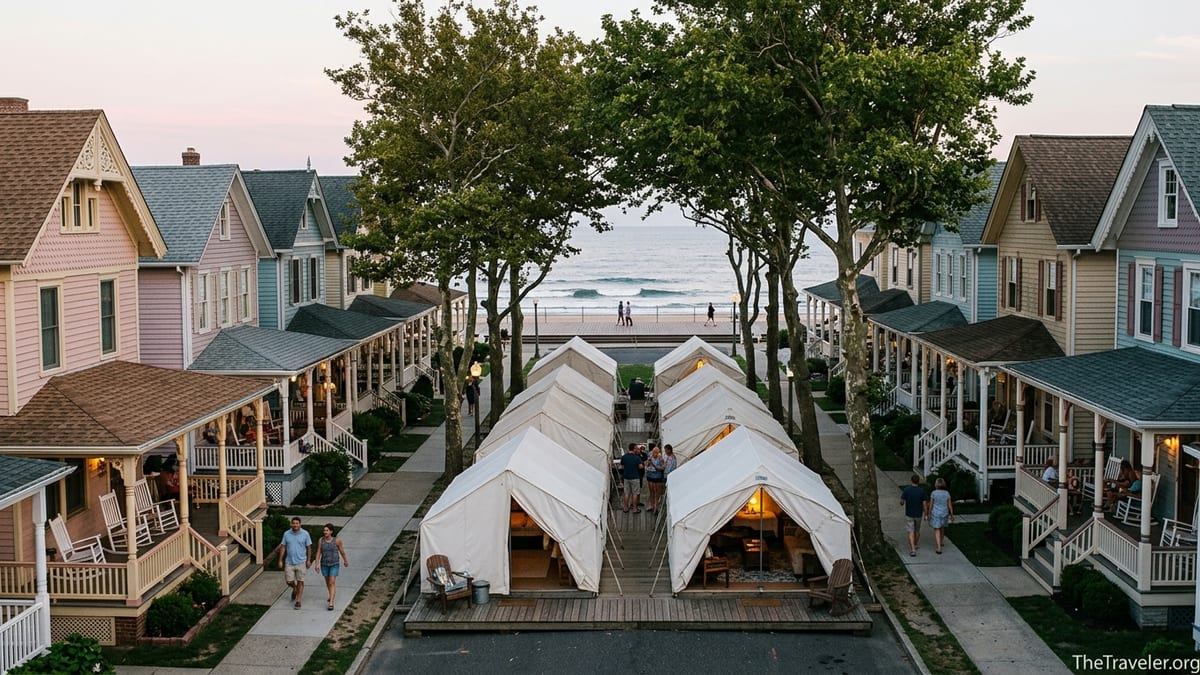
A Seaside Resort Frozen in Its Victorian Origins
Ocean Grove was founded in 1869 by Methodist ministers who wanted a permanent seaside camp meeting ground, and the town still carries that origin story in its bones. The streets radiate out from Founders Park and the Great Auditorium in a planned pattern that was carefully laid out in the 19th century, rather than adapted to cars and parking lots later. Walking along Ocean Pathway toward the ocean, you see original boarding houses and inns dating from the 1870s and 1880s that still operate as seasonal hotels, often with rocking chairs lined across their porches instead of sleek glass-front lobbies.
Much of the town is listed on the National Register of Historic Places, and local preservation groups often describe Ocean Grove as having one of the largest collections of authentic Victorian architecture in the United States. That sounds abstract until you stroll down Heck Avenue or Webb Avenue and realize that almost every house is a variation on the same charming theme. Narrow lots hold three-story wood-frame homes stacked with balconies, decorated with spindlework, turned posts, and scalloped shingles in pastel paint schemes. Unlike many shore towns where newer condominiums dominate the blocks behind the beach, Ocean Grove’s core remains an almost uninterrupted Victorian neighborhood.
This preservation is not accidental. The Historical Society of Ocean Grove and Neptune Township’s planning rules encourage restoration over demolition, so visitors still see original details like stained-glass transoms, ornamental cornices, and wraparound porches rather than aluminum siding and enlarged garages. For travelers, that means an ordinary evening walk to dinner can feel like a self-guided architecture tour, with each block revealing new flourishes from a time when summer cottages were meant to be both pious and picturesque.
Even the town’s small commercial district on Main Avenue feels rooted in that earlier era. Instead of big-name brands, you find independently owned ice cream parlors, bakeries, and gift shops occupying ground floors of 19th century buildings with apartments above. It resembles the main street of a small Mid-Atlantic town from decades ago more than a typical beach-strip lined with mini-golf, neon bars, and t-shirt shops.
Tent City: Living Under Canvas a Block From the Ocean
Nothing captures Ocean Grove’s time-warp quality quite like its famous Tent City. Each summer, about 100 canvas tents are erected on wooden platforms surrounding the Great Auditorium, occupied by families who return year after year. The tradition dates back to the camp meeting days of the 1870s, when visitors stayed in simple tents for religious revivals instead of building permanent homes. While many of those early tents eventually gave way to cottages, this cluster of seasonal tent dwellings endures as one of the last of its kind in the United States.
From late spring through early fall, walking through these lanes feels like wandering into a 19th century campground that somehow acquired modern conveniences. The tents are attached to small wooden “cottages” at the rear that house kitchens and bathrooms, while the front portion remains canvas, with flaps that can be tied open on warm evenings. You might see a box fan humming at the entrance, a string of white lights looped along the ridge pole, and rocking chairs on the platform, but at heart these are still tents, susceptible to ocean breezes and summer thunderstorms.
Most of the tents are not available as short-term rentals; they are leased seasonally through the Ocean Grove Camp Meeting Association, and many have been passed down within families for generations. That sense of continuity is part of what makes Tent City feel like a living time capsule. Longtime tenters decorate with old photographs and seashell collections, hold potluck dinners on the platforms, and attend evening services or concerts at the Great Auditorium just steps away, much as their predecessors did a hundred years ago.
For travelers staying in town, the tents are still a must-see. On a summer evening, when porch lights glow on the platforms and the sound of the Great Auditorium’s organ drifts through the canvas, the scene feels almost impossibly distant from the beachfront condos and loud bar decks that define so much of the modern shore. It is an intimate, communal style of seaside living that has largely disappeared elsewhere.
An Old-Fashioned Beachfront Without the Bar Scene
Ocean Grove’s oceanfront looks and feels different from many neighboring Jersey Shore towns. The boardwalk is narrow and understated, essentially a wooden promenade running along the dunes with a few beach offices and benches instead of a dense lineup of amusement rides and bars. You will not find nightclubs, arcades with blasting music, or large beachfront restaurants here. For visitors used to the spectacle of Seaside Heights or the buzzy boardwalk of Asbury Park just across the lake, Ocean Grove’s simple plank walk can feel almost minimalist.
The town is also officially dry, meaning there are no liquor stores, bars, or restaurants serving alcohol within its boundaries. Travelers who want a glass of wine with dinner simply walk across the footbridges over Wesley Lake or Fletcher Lake to Asbury Park or Bradley Beach, where they can find rooftop cocktail bars, brewpubs, and live music venues. Then they return to the quieter, darker streets of Ocean Grove to sleep. This split personality gives visitors practical access to contemporary nightlife while preserving an atmosphere in town that is noticeably calmer and more family-oriented.
The beach itself retains some of the idiosyncratic character of the town’s religious roots. For more than a century the Ocean Grove Camp Meeting Association enforced strict Sunday rules that included closing the beach on Sunday mornings. Recent legal challenges have pushed the community to relax those policies, and by 2024 the beach was open more in line with other Jersey shore towns, but the lingering controversy highlights how strongly tradition still shapes daily life. Even today, summer Sundays feel unusually quiet: church bells ring from the Great Auditorium, and families stroll in their Sunday clothes along Ocean Pathway on their way to services before changing back into swimsuits.
On a practical level, Ocean Grove’s beach works similarly to other Monmouth County resorts. From Memorial Day to Labor Day, visitors need daily or seasonal badges, checked at stairs and ramps staffed by attendants. There are lifeguards, simple bathhouse facilities, and beach offices near Embury Avenue where you can buy badges and ask about conditions. Yet even here the town feels slightly out of step with the more commercial shore: you are more likely to see multi-generational families with beach wagons and umbrellas than loud bachelor parties or amplified music.
Boarding Houses, Porches, and Inns from Another Century
Where you sleep in Ocean Grove shapes how strongly you feel this sense of stepping back in time, and the options lean heavily toward historic properties. On Ocean Pathway, the Hotel Albatross, originally built in 1881, still welcomes guests behind a deep, shaded porch lined with white pillars and wooden rocking chairs. Rooms are simple and vary in size, and the experience is more like staying in a vintage seaside boarding house than a modern chain hotel. In high summer, nightly rates are often comparable to mid-range hotels in nearby Asbury Park, but what you are really paying for is immersion in a particular period of shore life.
Along Ocean Avenue, the Shawmont Hotel faces directly onto the oceanfront with a lawn and porch that feel reminiscent of a 19th century seaside veranda. Many rooms are compact and some share hall bathrooms, a layout that would be unusual in a newly built property but perfectly typical of older seaside hotels that were designed for guests who spent most of their day outdoors. Travelers who expect hotel bars, room service, or glossy lobbies may find the accommodations rustic, but visitors who value atmosphere and history often describe these stays as a highlight of their time in town.
Beyond the larger hotels, Ocean Grove is full of bed-and-breakfasts and small inns in lovingly restored cottages. Properties on streets like Heck Avenue and Webb Avenue often include details such as carved newel posts, original hardwood floors, and front parlors converted into breakfast rooms. Many owners offer complimentary beach badges, loaner bicycles, and beach chairs rather than the resort fees and branded loyalty programs common in bigger destinations. It is easy to imagine the same houses hosting church groups and extended families in the early 1900s, when guests might arrive by train in heavy wool bathing costumes.
Vacation rentals exist too, but here again the housing stock nudges visitors into the past. A typical summer rental might be a narrow three-story cottage with a front porch and tiny backyard, sleeping eight people in small bedrooms with sloped ceilings rather than in open-plan living spaces. Porches often function as outdoor living rooms, where neighbors chat over the railings in the evening and visiting kids play board games by lamplight. It feels markedly different from staying in a modern condominium tower with balconies stacked above a parking garage.
Sabbath Traditions and a Slower Weekly Rhythm
Ocean Grove’s founding as a religious retreat continues to shape its weekly rhythm in subtle but noticeable ways. Historically, the town enforced very strict Sunday observance: for many decades, cars were not allowed to drive on the streets on Sundays, and the beach was closed entirely. Although those blue laws have been largely dismantled through court decisions and state pressure, echoes of that culture remain in both formal practices and informal habits.
On summer Sundays, the Great Auditorium becomes the focal point of town life. The enormous wooden structure, built in 1894 with a distinctive barrel-vaulted roof, hosts morning worship services that draw congregants from across the region. Inside, an immense pipe organ fills the hall with sound, and massive wooden doors stand open to catch the ocean breeze. For visitors, simply standing outside on the surrounding lawn and listening to the music spill into the streets can feel like glimpsing a style of communal religious life that is rare in contemporary beach resorts.
Because of this focus on worship and rest, Sunday mornings in Ocean Grove tend to be quieter than Saturday nights in most shore towns. Shops open later, many residents dress more formally for part of the day, and even beachgoers often talk about keeping the early hours more low-key. Recent legal disputes over Sunday beach access have pushed the town closer to mainstream beach practices, but they have also reinforced how unusual it is for a seaside community in the 2020s to actively debate questions of Sabbath observance and public space.
For travelers, this slower rhythm can be part of the appeal. If you stay in Ocean Grove over a weekend, you might spend Friday evening at a concert in Asbury Park, Saturday afternoon on the sand, and Sunday morning wandering past the tent platforms as families head toward the Great Auditorium with hymnals in hand. The juxtaposition of surfboards, Victorian cottages, and Sunday-best clothing on the same blocks is precisely what makes the town feel suspended between eras.
The Great Auditorium and Old-School Summer Programming
Few structures at the Jersey Shore feel as untouched by time as Ocean Grove’s Great Auditorium. Completed in the 1890s, it is a vast wooden hall with soaring trusses, simple wooden pews, and a wraparound balcony that evokes the scale of old Chautauqua assemblies and revival meetings. Its acoustics are renowned, thanks in part to the curved wooden ceiling, and over the decades it has hosted a mix of religious services, organ recitals, classical concerts, and summer shows ranging from sacred music to patriotic programs.
Today, the Ocean Grove Camp Meeting Association still organizes a robust seasonal calendar. In a typical summer, you might find free or low-cost organ recitals on the massive pipe organ, a classical “Summer Stars” series featuring guest soloists, and choral performances that bring community singers together on stage. The programming feels different from the pop and rock concerts that dominate most contemporary beach entertainment, skewing toward hymn festivals, oratorio, and patriotic spectaculars that would not have seemed out of place in the mid-20th century.
For visitors, attending an evening event in the Great Auditorium can be a way of time-traveling without leaving the present day. You buy simple paper tickets from volunteers, take a seat on worn wooden pews, and watch as the late light filters through stained-glass windows while the organist pulls out all the stops. The crowd might include older regulars who have been coming for decades, families with children in camp meeting programs, and curious travelers who heard the music while walking on the boardwalk. The result is a form of communal entertainment and civic life that feels rooted in an earlier idea of what a seaside summer should look like.
Around the Auditorium, the surrounding lawns and pathways often host smaller gatherings and religious retreats, with portable chairs grouped under trees and tents used for workshops and Bible studies. While the Camp Meeting Association’s religious identity is central, many events are open to the general public, and visitors are welcome to wander the grounds, read the historical plaques, and take in the atmosphere even if they are simply passing through on their way to the beach.
A Walkable Enclave Beside a Modern Shore Hotspot
Geographically, Ocean Grove sits in a fascinating position between the past and the present. On one side, Wesley Lake separates it from Asbury Park, one of the Jersey Shore’s most rapidly revived cities, with music venues, cocktail bars, and high-rise hotels. On the other side, Fletcher Lake divides it from Bradley Beach, a classic family resort with a more conventional boardwalk scene. Two small footbridges connect Ocean Grove to its neighbors, and crossing them can feel like stepping through invisible time gates.
Walk north over the bridge to Asbury Park, and within minutes you are among murals, vintage shops, and restaurants serving craft cocktails and globally inspired small plates. Return across the lake at night, and the contrast is immediate: Ocean Grove’s streets are dimmer and quieter, many front porches occupied by couples reading or friends chatting in low voices. Walk south across the other bridge toward Bradley Beach, and you encounter a more typical line of beachfront eateries and frozen-custard stands, with families renting umbrellas in front of mid-century apartment buildings and newer condos.
Within Ocean Grove itself, the compact size and pedestrian-oriented street pattern reinforce that old-fashioned character. The town is only about a square mile, and most visitors park their car once on arrival and then walk everywhere. The NJ Transit station in nearby Bradley Beach or Asbury Park puts Ocean Grove within train reach of New York City, just as it was in the late 19th century when urban residents escaped the summer heat. Streets laid out long before modern traffic volumes can feel narrow for two-way driving but perfectly scaled for strolling and cycling.
Because there are no waterfront nightclubs or large commercial developments, much of the town goes to sleep not long after dark, especially on weeknights. Nightlife is more likely to involve an ice cream cone on Main Avenue, an evening organ recital, or a quiet conversation on a second-story balcony than a DJ set or sports bar. For some travelers, that lack of stimulus is exactly the point: the town functions as an antidote to the hyper-stimulated version of the Jersey Shore, a place where you can still hear waves and church bells rather than amplified bass.
The Takeaway
Ocean Grove feels like a Jersey Shore town from another era because so many of its founding ideas remain visible in everyday life. The grid of narrow streets still converges on the Great Auditorium instead of a parking deck or shopping center. Victorian cottages and boarding houses still dominate the skyline where coastal towers might otherwise rise. A tent village still blossoms each summer around the Auditorium, populated by families who trade central air conditioning for canvas roofs and porch conversations.
At the same time, Ocean Grove is not a museum piece. Beach badges, lifeguard chairs, and sunscreen-slicked boogie boards remind you that this is a working, contemporary seaside resort. Legal disputes over Sunday beach access show that the town continues to negotiate between its religious heritage and modern expectations of public space. Footbridges connect it seamlessly to the present-day energy of Asbury Park, letting travelers toggle between eras as easily as crossing a lake.
For travelers deciding whether to visit, the key is alignment of expectations. If you are looking for clubs, beachfront bars, and late-night noise, Ocean Grove will likely feel too quiet. But if you are drawn to porch culture, walkable streets, and the surprise of turning a corner to find a canvas tent glowing in the twilight, this little square mile offers a rare experience: a living seaside community that still, in many ways, moves to a 19th century rhythm. In a region where much of the shore has been rebuilt, Ocean Grove’s stubborn, sometimes controversial commitment to its past is exactly what makes it feel so special in the present.
FAQ
Q1. Is Ocean Grove really different from other Jersey Shore towns?
Yes. Ocean Grove’s large collection of Victorian homes, the summer tent colony, dry-town status, and relatively quiet boardwalk give it a noticeably older, calmer feel than many neighboring resorts.
Q2. Can I buy alcohol or visit bars in Ocean Grove?
No. Ocean Grove is a dry community, so there are no liquor stores, bars, or restaurants serving alcohol in town, but full bar and dining options are a short walk away in Asbury Park and Bradley Beach.
Q3. Do I need a beach badge to use the beach in Ocean Grove?
Yes. Like many New Jersey shore towns, Ocean Grove requires daily or seasonal beach badges during the main summer season for anyone above a certain age, typically checked at beach entrances.
Q4. Can visitors stay in the Ocean Grove tents?
Generally no. The seasonal tents around the Great Auditorium are leased through the Camp Meeting Association and are usually occupied by long-term returning families rather than rented night by night to tourists.
Q5. How close is Ocean Grove to Asbury Park’s restaurants and nightlife?
Very close. A short walk over the Wesley Lake footbridge brings you into Asbury Park’s boardwalk and downtown, making it easy to enjoy its restaurants and music venues while staying in quieter Ocean Grove.
Q6. Is Ocean Grove good for families with children?
Yes. The calmer atmosphere, lack of bars, walkable streets, and relatively low-key boardwalk make Ocean Grove popular with multigenerational families seeking a quieter beach base.
Q7. What kind of accommodations are available in Ocean Grove?
Most lodging consists of historic hotels, bed-and-breakfasts, and Victorian cottages, often with porches and older-style room layouts rather than large modern resort amenities.
Q8. Do I need a car to visit Ocean Grove?
Not necessarily. Many visitors arrive by NJ Transit train to nearby stations in Asbury Park or Bradley Beach and then walk into town. Once there, Ocean Grove is compact and easy to explore on foot.
Q9. Are there still Sunday restrictions in Ocean Grove?
Some historical restrictions have eased after legal challenges, especially around beach access, but Sundays still have a quieter, more church-centered feel than in many beach towns.
Q10. What time of year best showcases Ocean Grove’s old-fashioned charm?
Late June through early September is ideal, when the tents are up, the Great Auditorium hosts regular events, porches are lively, and the beach and boardwalk are in full swing.