


For many travelers, Russia is a contradiction. It is a country associated with tense geopolitics, sanctions, and stark travel advisories, yet it remains one of the world’s most alluring destinations for those drawn to complex history, monumental culture, and vast wild landscapes. Even as organized tourism from Western Europe and North America has declined sharply since 2022, millions of visitors from Asia, the Middle East, and elsewhere continue to arrive each year, while a smaller number of independent Western travelers still go through the effort, cost, and paperwork to experience the country for themselves. Understanding why Russia continues to fascinate travelers, despite its complex reputation, requires looking beyond headlines to the realities on the ground.
Get the latest updates straight to your inbox!
The Magnetic Pull of Russia’s Iconic Cities
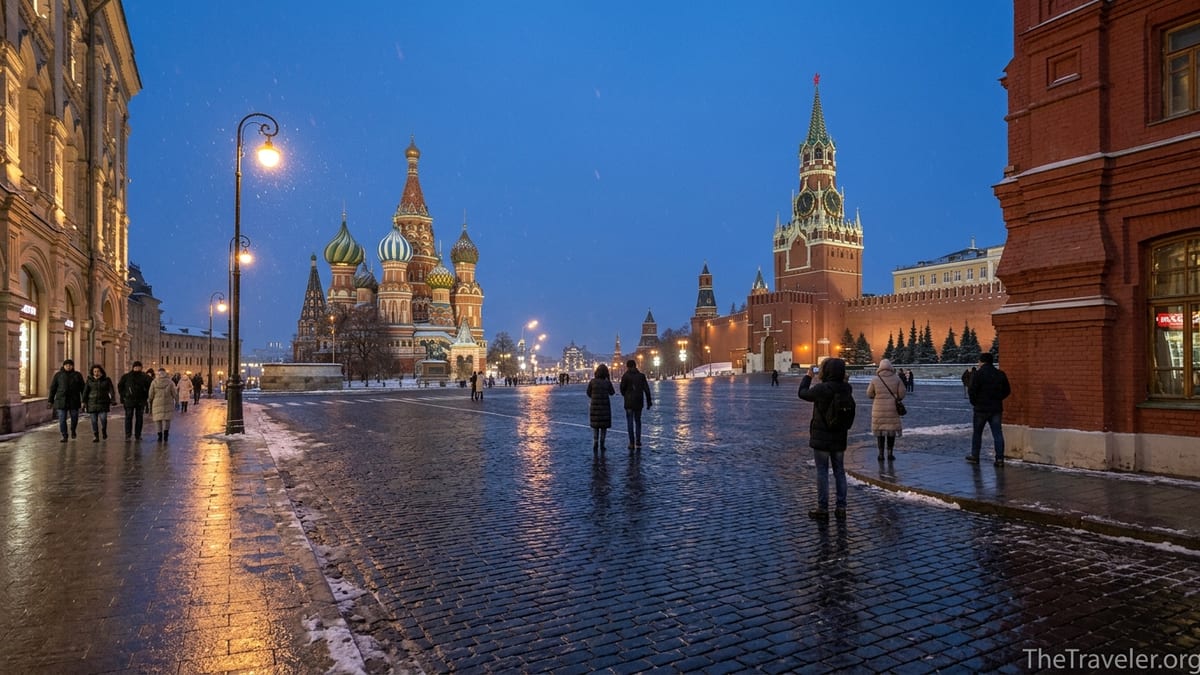
Ask anyone who has visited Moscow or St Petersburg recently, and the same words tend to appear: monumental, intense, and unexpectedly beautiful. Moscow’s Red Square, still dominated by St Basil’s colorful onion domes and the Kremlin walls, remains one of the most recognizable public spaces on earth. A traveler arriving on a winter evening steps out of the Okhotny Ryad metro station into a scene of floodlit brick, golden church cupolas and the glowing GUM department store, which inside feels more like an elegant 19th century arcade than a typical shopping mall. For many, that first view alone justifies the bureaucracy of getting a visa and the anxiety of crossing a politically charged border.
St Petersburg offers a different kind of magnetism. Purpose-built by Peter the Great as an imperial window on Europe, the city’s baroque and neoclassical facades line a network of canals that, in summer, can feel almost Mediterranean on a rare hot day. The State Hermitage Museum, spread across the Winter Palace and several adjoining buildings, holds one of the world’s largest collections of art, from Italian Renaissance paintings to French impressionists. A visitor can easily spend a full day wandering past works by Rembrandt and Matisse, then cross Palace Square to the General Staff Building, where more of the modern collection is displayed in airy galleries.
What makes these cities uniquely compelling is how quickly monumental spaces give way to intimate detail. Just a few streets from Red Square, travelers find tiny coffee bars serving single-origin brews, Georgian bakeries selling khachapuri for the equivalent of a few US dollars, and courtyard bookstores with shelves of Soviet-era posters and new Russian fiction. In St Petersburg, visitors often talk about stumbling into basement jazz clubs off Nevsky Prospekt, or sharing a late-night bowl of borscht in a canteen-style stolovaya, surrounded by students and local workers rather than tourists.
Even in the current climate, the urban experience is not frozen in time. Domestic tourism has boomed since 2022, and Russian travelers themselves fill hotels and trains, especially in high season. That gives foreign visitors a rare window into how contemporary Russians vacation, socialize, and spend their leisure time, from weekends at dacha-style country houses outside Moscow to evenings in new food halls that bring together Siberian dumplings, Tatar cuisine, and vegan street food under one roof.
Epic Scale: From the Baltic to the Pacific
Part of Russia’s enduring fascination lies in its sheer size. On a map, the country stretches from the Gulf of Finland to the shores of the Pacific, and on the ground that scale translates into profoundly different travel experiences. A traveler who begins in St Petersburg among pastel palaces and European-style boulevards can, within a week of train rides, find themselves stepping out into the birch forests of the Urals or the windswept platforms of Siberian cities like Novosibirsk and Irkutsk. For many, that journey is an adventure in itself, rather than a means to an end.
The Trans Siberian Railway remains the symbol of this sense of scale. Regular long-distance trains still run the nearly 9,300 kilometer route from Moscow to Vladivostok, taking about seven days if done without overnight stops. In practice, most foreign travelers who undertake the journey break it up, spending two or three days in Yekaterinburg to visit the Europe–Asia border monument, detouring to Lake Baikal to stay in a guesthouse in Listvyanka or Olkhon Island, or continuing onward into the Russian Far East, where seaside Vladivostok feels closer to Seoul and Tokyo than to Moscow.
Travelers who have made the trip in recent years often describe small, concrete details that become some of their most vivid memories: buying hot pirozhki from babushkas on station platforms, watching forests of larch give way to open steppe as the train moves east, or sharing a compartment with a Russian family returning home from a holiday in Sochi. The practicality of the journey has changed somewhat as many Western tour operators have suspended trips, but Russian Railways still sells tickets online, and independent travelers report that sleeper berths on standard trains can cost less than a budget hotel room in Western Europe.
Beyond the classic rail line, Russia’s regions offer landscapes that feel almost like separate countries. In winter, domestic tourists flock to ski resorts in the Caucasus and Altai, while summer brings crowds to Black Sea beaches near Anapa and Gelendzhik. More adventurous travelers head for Kamchatka’s volcanic trekking routes or the tundra of the Yamal Peninsula, where specialized expedition companies arrange visits to Nenets herder camps. These are not casual trips: they require substantial budgets, domestic flights on regional carriers, and a realistic tolerance for cold, mud, and unpredictability. For the small number of foreign visitors who make it there, though, the remoteness is precisely the point.
Culture, Art, and Everyday Life Behind the Headlines
Despite the country’s political isolation from many Western governments, Russia’s cultural institutions remain a major draw. In Moscow, the Pushkin State Museum of Fine Arts and the Tretyakov Gallery offer deep dives into European masters and Russian painting respectively. Ballet lovers still travel to watch performances at the Bolshoi Theatre or the Mariinsky in St Petersburg, booking tickets through official box offices or reputable ticketing agencies and often paying less than they would for a major production in Paris or New York. Classical music festivals in cities like Perm and Yaroslavl continue to attract both domestic and some international audiences, even if the global star power on stage has shifted.
At the same time, much of what captivates travelers is not high culture but the texture of everyday life. Guests staying in mid-range Moscow hotels in neighborhoods such as Tverskaya or Kitay-Gorod talk about starting their day with kasha and syrniki at the breakfast buffet, then joining commuters on the metro, where stations function as a living museum of socialist realism, complete with marble columns and mosaics. In St Petersburg’s residential districts, short-term rental apartments often sit above corner grocery stores where shoppers pick up kefir, dark rye bread, and local chocolate brands late into the evening.
Food culture, in particular, surprises many first-time visitors. Beyond traditional cabbage soups and dumplings, major cities now host thriving restaurant scenes that reflect both regional diversity and late-Soviet nostalgia. It is possible in a single day to have Dagestani lamb, Uzbek plov, and Sakhalin seafood, then finish the night in a bar themed around 1980s Moscow, decorated with vintage radios and Soviet soda machines. Prices vary widely, but travelers often note that a substantial sit-down meal outside of the most fashionable venues can cost significantly less than in Western European capitals, while high-end tasting menus in Moscow’s elite restaurants still undercut their equivalents in London or New York.
Importantly, contact with local people tends to puncture many preconceptions. Foreign visitors routinely describe encounters with strangers who go out of their way to help navigate a bus system, order at a cafeteria with no English menu, or decode the cryptic entry system of a Soviet-era apartment block. While experiences vary, and language barriers can be real outside tourist hubs, many travelers leave with the impression of a society more nuanced and varied than any caricature allows.
Traveling in a Time of Sanctions and Warnings
Russia’s reputation today cannot be separated from the political realities of war in Ukraine, sanctions, and sharply worded government advisories issued by the United States, Canada, the European Union, and several other countries. Many Western foreign ministries currently warn against all travel to Russia or recommend that citizens leave if their presence is not essential. These advisories are based on concerns that include the risk of arbitrary law enforcement, limited consular support, flight disruptions, and the potential for rapidly changing regulations affecting visas and payment systems.
Despite this, travel has not stopped entirely. The profile of foreign visitors has shifted, with more arrivals from China, the Gulf states, and parts of Asia and the Middle East, along with a much smaller flow of independent travelers from Europe and North America who choose to go after weighing the risks. The rise in domestic tourism also means that popular destinations rarely feel empty. Trains to resort areas such as Sochi or the Golden Ring towns around Moscow can still sell out in peak season, and hotels in cities like Kazan and Kaliningrad report strong business from Russian families and business travelers.
On a practical level, travelers face a more complicated environment than before 2022. Many Western airlines no longer fly to Russian cities, so most international visitors route through hubs such as Istanbul, Dubai, Yerevan, or Belgrade, piecing together multi-leg itineraries that can take considerably longer than pre-war direct flights from Western Europe. Payment is another challenge: several major Western card networks have suspended operations in Russia, so visitors often need to bring more cash, rely on local payment solutions, or work with banks in third countries that still provide limited card functionality.
This complexity itself has become part of the story for those who still choose to visit. Travelers describe the logistical puzzle of arranging flights on foreign carriers, booking Russian domestic tickets through local agencies, and confirming that their travel insurance explicitly covers a trip to Russia under current conditions. For some, successfully navigating these hurdles and arriving in Moscow or Vladivostok with documents in order becomes part of the appeal, turning the journey into an exercise in self-reliance and careful planning.
Visas, E‑Visas, and the New Bureaucratic Landscape
Russia’s visa system has long been a barrier and a filter. For many nationalities, a traditional visa still requires an invitation letter from a hotel or tour company, an application at a consulate or visa center, and a processing fee that can add substantially to the cost of a short trip. In recent years, however, the government has revived and expanded a unified electronic visa program for citizens of dozens of countries, allowing them to apply online and, if approved, enter Russia for up to 16 days on a single-entry basis. The rollout began again in August 2023, and by now the list of eligible nationalities has been gradually extended.
In practice, this e‑visa has made short city breaks more feasible for certain travelers. A tourist from a qualifying country can, for example, plan a five-day trip to St Petersburg, submitting an application with a photograph and basic details through an official portal, then receiving a digital document that can be presented along with their passport at border control. The system has processing fees that, while not trivial, are often lower than the combined costs of a traditional visa, agency service charge, and courier shipping of documents.
Yet the visa landscape remains uneven. Citizens of countries outside the e‑visa list must still use the classic route, and processing times and requirements can change with little notice. Travelers also need to pay attention to the rules inside Russia, such as registration requirements if staying more than a few days, and the necessity of carrying a passport and migration card when traveling domestically. Agencies in cities like Istanbul, Dubai, and Belgrade have, in effect, become informal hubs for handling Russian visa logistics for travelers whose home countries have downsized consular services.
For those determined to go, the bureaucratic challenge is often framed as a test of commitment. Some travel forum posts read almost like initiation stories: applicants recount gathering bank statements, purchase confirmations, and proof of accommodation, then navigating consular queues before finally collecting a stamped passport. Others describe the relative relief of using the new e‑visa system, noting the importance of double-checking dates and entry points to avoid surprises at the border.
Safety, Ethics, and Traveler Responsibility
Deciding whether to visit Russia today is not just a question of logistics but also of personal ethics and risk tolerance. Some travelers feel strongly that tourism money should not flow to a state engaged in an active war and prefer to explore Russian culture through diaspora communities, literature, or digital experiences. Others argue that contact between ordinary people retains value even in moments of deep political conflict, and that the small-scale economic impact of individual visitors primarily benefits private citizens working in hospitality, guiding, or transport.
On the ground, personal safety concerns tend to be more nuanced than many imagine. Petty crime rates in major Russian cities are generally comparable to or lower than in many large global capitals, and violent crime targeting foreign tourists remains relatively rare in areas where visitors typically stay. At the same time, travelers must consider specific risks highlighted in official advisories, including the possibility of selective law enforcement, bans on participating in demonstrations, and legal restrictions around photographing certain sites, especially near critical infrastructure or security installations.
There is also the question of how to talk about current events while in the country. Several recent visitors have described consciously avoiding political discussions in public spaces, focusing conversations with local hosts and acquaintances on daily life, culture, and personal histories unless their counterparts bring up more sensitive topics themselves. This approach reflects both respect for local laws around public speech and an awareness that many Russians navigate complex information environments and may have differing views or personal constraints.
For travelers who decide that a trip aligns with their values and risk assessments, preparation becomes an ethical tool as well as a practical one. That can mean buying comprehensive insurance that clearly covers travel to Russia, preparing contingency funds in case a card fails, learning basic Russian phrases to reduce pressure on local service workers who may not speak English, and seeking out smaller, locally owned accommodations where spending has a more direct impact on residents rather than large state-linked entities.
The Takeaway
Russia continues to fascinate travelers because it refuses to be simple. It is a place where imperial palaces overlook rivers that freeze deep in winter, where long-distance trains cross time zones like stepping stones, and where centuries of literature, music, and political upheaval have left visible traces in city streets and museum halls. For some, the current political climate, sanctions, and security concerns make a visit unthinkable, at least for now. For others, those same factors sharpen the sense that any journey there will be layered, morally complicated, and impossible to forget.
What is clear is that the nature of travel to Russia has changed. Mass-market sightseeing groups from Western capitals have largely disappeared, replaced by domestic tourists, visitors from new source markets, and a thin but determined stream of independent travelers prepared to handle complex routes and paperwork. The barriers to entry are higher, and potential consequences for missteps more serious, than in many other destinations.
Yet the core reasons people once wove the Trans Siberian into round-the-world itineraries or saved for a winter weekend at the Bolshoi have not vanished. The country’s cities remain architecturally and culturally rich, its landscapes vast and varied, and its people, in all their diversity, often far more hospitable and pragmatic than distant rhetoric suggests. Whether or not an individual traveler chooses to go in the current context is ultimately a personal decision, but the ongoing fascination with Russia speaks to a deeper truth about travel: that some places continue to draw the curious precisely because they are difficult, demanding, and resistant to simple narratives.
FAQ
Q1. Is it currently legal for US and EU citizens to travel to Russia as tourists?
Yes, in most cases it is legally possible, but many governments issue strong advisories against travel. Travelers must check their own country’s latest guidance and understand that consular assistance inside Russia may be limited.
Q2. How do travelers typically reach Russia now that many direct flights have stopped?
Most visitors route through third-country hubs such as Istanbul, Dubai, Yerevan, or Belgrade, then connect to Russian cities on carriers that still operate those routes. This often increases travel time and cost compared with pre-2022 direct flights.
Q3. Are electronic visas available, and who can use them?
Russia has reintroduced a unified e‑visa for citizens of a specific list of countries, allowing a single short stay after an online application. Eligibility depends entirely on nationality, and the list can change, so travelers must confirm current rules before planning.
Q4. Is using foreign bank cards and paying for everyday expenses difficult in Russia now?
Several major international card networks no longer function inside Russia, so visitors often need to bring more cash, explore local payment options, or work with banks in third countries that still provide partial card acceptance. Day-to-day costs remain manageable once a reliable payment method is in place.
Q5. How safe is it to travel in Russian cities like Moscow and St Petersburg?
In normal circumstances, levels of street crime in central areas are broadly similar to many large European cities, and violent crime against tourists is uncommon. The greater concerns today involve political and legal risks highlighted in official advisories, which travelers should study carefully.
Q6. Is the Trans Siberian Railway still running and accessible to foreign travelers?
Long-distance trains along the classic Trans Siberian route still operate, and foreign travelers can, in principle, book berths. However, organized tours are fewer, and travelers need to navigate complex visa, routing, and insurance questions before attempting such a trip.
Q7. What kinds of cultural experiences remain available to visitors?
Major museums, theaters, and concert halls continue to function, and travelers can still attend ballet performances, classical concerts, and exhibitions. Programming may change, and some international collaborations have paused, but day-to-day cultural life in big cities remains active.
Q8. Are there parts of Russia that travelers should avoid for security reasons?
Yes, several regions near conflict zones or with specific security issues are considered higher risk. Official advisories usually list these areas in detail, and visitors should avoid them, focusing instead on established urban centers and well-traveled routes.
Q9. How expensive is a trip to Russia compared with Western Europe?
Once inside the country, mid-range accommodation, public transport, and restaurant meals are often less expensive than in major Western European capitals. However, higher airfare, visa fees, and insurance can offset those savings, especially for short stays.
Q10. How can travelers approach the ethical questions around visiting Russia now?
There is no single right answer. Some people choose not to go for political reasons, while others believe person-to-person contact still matters. A thoughtful approach includes researching where money is spent, supporting smaller local businesses, and respecting local laws and sensitivities.