


Travelers racing from Naples to the Amalfi Coast or Capri often glide straight past one of Campania’s most scenic coastal corners. Tucked into the Campi Flegrei west of Naples, Miseno and its neighboring town of Bacoli combine cinematic views, sandy beaches, and extraordinary Roman ruins without the tour-bus crush. Skipping Miseno might mean missing the very stretch of shoreline that locals escape to when the Amalfi Coast feels too crowded and too polished.
Get the latest updates straight to your inbox!
Where Miseno Sits on the Map, and Why It Stays Under the Radar
Miseno is a seaside frazione of Bacoli, about 15 kilometers west of central Naples, on the northwestern edge of the Gulf of Naples. It lies within the volcanic landscape of the Campi Flegrei, with low tuff cliffs, crater lakes, and warm, mineral-rich waters that have drawn visitors since Roman times. Today, most international travelers know nearby hotspots such as Pozzuoli, Baiae, or the islands of Ischia and Procida, yet they rarely realize that Miseno is the headland they see from ferry decks and panoramic viewpoints.
Part of Miseno’s relative anonymity comes from how people plan their southern Italy itineraries. Many visitors build a route around brand names such as Positano, Amalfi, and Capri, relying on familiar ferry lines and package tours. Miseno does not appear in most standard Amalfi Coast brochures, and there is no cruise-ship pier or high-speed hydrofoil shuttling tourists in and out by the hour. Instead, Miseno is connected to Naples by a regional rail line to Torregaveta and local buses onward to Bacoli and the beaches, plus a growing network of summer shuttle services operated by the municipality of Bacoli.
That relative logistical obscurity has preserved a quieter, more local rhythm. On summer weekends, Neapolitans arrive with umbrellas and coolers for a day on the sand at Miseno or neighboring Miliscola, while in the shoulder seasons the seafront can feel almost meditative. For travelers willing to slightly step off the classic Amalfi route, Miseno offers a chance to experience a coastal town that still feels primarily Italian rather than international.
Capo Miseno: The Viewpoint That Frames the Gulf
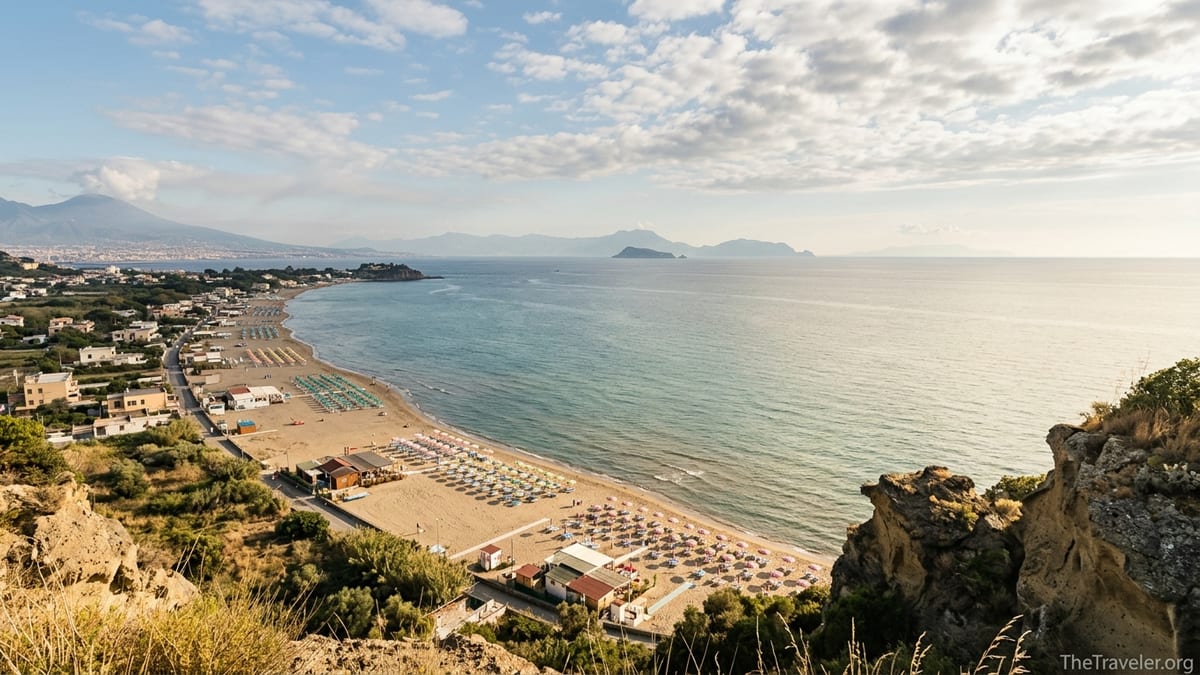
The headland of Capo Miseno is the defining feature of the area. It marks the northwestern limit of the Gulf of Naples and separates it from the Gulf of Pozzuoli, creating a natural panorama platform that feels purpose-built for photographers. Climb toward the summit or the lighthouse road on a clear afternoon and you are rewarded with an almost 360-degree sweep: the outline of Vesuvius across the bay, the city of Naples curving along the waterfront, and the silhouettes of Procida and Ischia sitting low on the horizon.
Locals often recommend an early-evening walk up Capo Miseno, especially in late spring and early autumn when the air is clear and the heat has faded. The path is not a wilderness trail but a mix of small roads and tracks, typically taking around one to two hours round-trip at a relaxed pace from the lower town. Travelers posting recent trip reports describe it as a manageable outing even with light daypacks, suitable for moderately fit visitors in regular walking shoes, though the final stretches can be steep and exposed.
Along the way, the geology of the Campi Flegrei is on full display. The headland itself is part of an ancient volcanic structure, layered with soft yellow tuff that catches the low sun. From various bends in the road, you can look down on Lago Miseno, once the inner basin of a Roman naval harbor, and trace the line of sandy beaches that now draw modern swimmers. For photographers, a compact mirrorless camera with a 24–70 mm lens will capture both wide vistas and details like fishing boats or the white outline of the lighthouse perched at the cape.
Sandy Beaches and Local Lidos: Miseno’s Everyday Waterfront
In contrast to the pebbled coves and stepped cliffside beaches of much of the Amalfi Coast, Miseno and neighboring Miliscola offer long, shallow, sandy shorelines. These are the city beaches of choice for many Neapolitans, particularly families with small children who appreciate the gentle entry into the water and the space to spread out. Miliscola beach stretches in a broad arc of sand facing Capri and the Sorrentine Peninsula, while Miseno’s main beach curves beneath the headland with views toward Procida and Ischia.
The waterfront here follows the classic Campania lido model. Beach clubs rent sunbeds and umbrellas for a daily fee that in recent summers has typically ranged from roughly 15 to 30 euros for two beds and an umbrella, depending on the month, the day of the week, and the front-row premium. Most lidos provide freshwater showers, changing cabins, and a bar or small restaurant serving espresso, cold beer, pasta, and seaside staples such as fried seafood or “cuoppo” cones filled with mixed fish. Between the organized lidos, small stretches of free public beach remain, where locals set up their own umbrellas at no cost beyond whatever they bring in their bags.
Reaching the sand from Naples usually involves a combination of rail and bus. A common route is to take the Cumana commuter train from Naples to its terminus at Torregaveta, then connect to a local bus toward Miliscola or Miseno. In recent seasons, visitors and residents have also used municipal shuttle services that run between Bacoli, Baiae, Cuma, and the Miseno and Miliscola shoreline during peak weekends and holidays. These services are often free or low cost and are designed to ease traffic and parking pressure near the beaches. Visitors who prefer more flexibility can rent a car at Naples Airport and reach Bacoli in about 35 to 45 minutes in normal traffic, though parking near the beach can be tight on August weekends.
Roman Miseno: From Naval Superpower to Submerged Ruins
For historically minded travelers, one of the great surprises of Miseno is that this quiet seaside town was once the nerve center of Roman naval power in the Tyrrhenian Sea. In the early imperial period, Misenum hosted the main base of the Classis Misenensis, the key fleet of the western Mediterranean. The sheltered lagoon of Lago Miseno and the surrounding inlets formed a vast harbor where warships and supply vessels could anchor, repair, and resupply before fanning out toward Spain, North Africa, or the eastern provinces.
Little remains at first glance of this military infrastructure, because the shoreline and lagoons have shifted over the centuries and parts of the ancient harbor are now underwater. However, traces of Roman engineering still surface around Bacoli and Miseno. Stone fragments, brick walls, and arches built from volcanic tuff peek out behind modern homes and restaurants. The broader area of Baiae, just a few kilometers away, is famous for its submerged archaeological park, where divers and glass-bottom boats pass over mosaic floors and collapsed porticoes. Together with Miseno, it forms one of the most evocative Roman coastal landscapes in Italy.
Within easy walking or driving distance of Miseno’s beaches lie several important Roman sites. Among them, the most dramatic is the Piscina Mirabilis, a vast underground cistern that once stored freshwater brought by aqueduct from the Apennine springs near Serino. This cistern supplied the naval base and nearby settlements with enough water to support thousands of sailors, artisans, and residents. Today it is often called the “cathedral of Bacoli,” a phrase that captures both its scale and its atmosphere.
Piscina Mirabilis: The Cathedral Beneath the Streets
The Piscina Mirabilis sits on a residential street above the former harbor of Miseno, an unassuming doorway in Bacoli that conceals one of the largest Roman cisterns ever built. Inside, a grid of 48 pillars supports a vaulted ceiling, creating five long naves that stretch into a dim, echoing space. Sunlight filters through small openings high above, illuminating moss and mineral stains on the walls and casting reflections in any puddles that linger on the floor after rain.
Built in the Augustan period, the cistern is estimated to have held over 12,000 cubic meters of water, channeled from the Serino aqueduct over a distance of roughly 90 to 100 kilometers. For modern visitors, the numbers matter less than the feeling of descending a metal staircase into a man-made cavern that looks like it could be a film set, yet is entirely the work of Roman engineers. The quiet cool air and the regular rhythm of pillars make it easy to imagine the structure filled to the brim with water as ships waited in the harbor below.
Access to the Piscina Mirabilis is intentionally controlled, both to protect the structure and to preserve its atmosphere. Current practice requires visitors to arrange entry in advance, typically by phone with the site’s custodian or via local tourism networks, and to pay a modest admission fee in cash on arrival. Opening days and hours can change seasonally, and numbers are often limited, so travelers should plan at least a day or two ahead during busy periods. Guided visits are available in Italian, and some local guides or tour operators can arrange English explanations. Even without extensive commentary, simply walking the length of the cistern and pausing beneath the central vaults is one of the most memorable experiences in the Campi Flegrei.
Staying, Eating, and Planning Your Time in Miseno
Unlike the steep hillside towns of the Amalfi Coast, Miseno and Bacoli spread out on gentler terrain around the lake and headland, with accommodations ranging from modest guesthouses to upscale resort-style hotels. One of the most scenic places to stay is on the Capo Miseno promontory itself, where properties overlook the bay and face the islands of Procida and Ischia. These hotels tend to emphasize sea views, quiet gardens, and direct access to small coves or private terraces rather than high-gloss nightlife. Closer to the beaches, family-run bed and breakfasts and small hotels sit within a short walk of the sand, popular with Neapolitan families staying for a long weekend.
Dining in Miseno reflects its working seaside roots. Along Via Miseno and Via Miliscola, simple trattorias and pizzerias share space with more polished seafood restaurants that plate up local catch such as clams, mussels, anchovies, and squid. A typical evening might start with a plate of mixed fried fish and a glass of Falanghina from Campania, followed by spaghetti alle vongole or linguine with local shellfish. Prices are generally more modest than in Amalfi or Positano; it is still possible to sit down for a seafood pasta, a shared appetizer, and wine for a per-person cost that feels in line with everyday Italian dining rather than luxury restaurant pricing.
For most visitors, Miseno works best as a two or three day stop woven into a broader Campania itinerary. One full day can be dedicated to the beaches and the Capo Miseno viewpoints, another to the Roman sites of Bacoli and Baiae, and a third to excursions into the wider Campi Flegrei or a day trip to Procida or Ischia via nearby ferry routes. Travelers based in Naples can also treat Miseno as a day trip, catching an early train and bus to the coast, spending the morning at the Piscina Mirabilis, and then walking or shuttling down to the beach for a late lunch and swim.
Practical Tips for Experiencing Miseno At Its Best
Seasonality plays a significant role in how Miseno feels. In July and, especially, August, Miseno and Miliscola fill with beachgoers from the surrounding region. Lidos book out front rows of sunbeds, the narrow streets back up with traffic, and dinner reservations become essential at seafront restaurants. For travelers who enjoy a lively Italian seaside atmosphere, this can be part of the charm, with evening passeggiate, gelato stands open late, and music drifting from beach bars. Those seeking quieter exploration may prefer late May to mid-June or September, when the water is warm but the crowds have thinned.
Transport requires a bit of planning. Public transit works well for patient travelers who are comfortable with regional trains and buses. Tickets for the Cumana train from Naples to Torregaveta can be bought at city stations and are typically inexpensive compared with long-distance rail. Once in the Campi Flegrei, municipal shuttle services often operate on fixed timetables connecting Baiae, Bacoli, Miseno, Miliscola, and Cuma, particularly during summer weekends and holidays. Visitors should check the latest schedules posted by the municipality of Bacoli or at local tourist information points, since times and routes can shift year to year.
For those renting a car, driving from Naples Airport to Bacoli is straightforward in terms of route, but the driving culture around Naples is energetic, with close following distances and assertive lane changes. Parking in Miseno can be challenging on peak days; arriving early in the morning or later in the afternoon increases the chances of finding a legal space near the waterfront. Many visitors in recent seasons have chosen to park in central Bacoli or near Baiae and then rely on shuttles or walking for the final stretch to the beaches.
The Takeaway
Miseno rarely appears on the first draft of a Campania itinerary. Yet for travelers who slow down long enough to trace the curves of the northern Gulf of Naples, this understated corner of the Campi Flegrei delivers some of the region’s most atmospheric views and experiences. From the headland of Capo Miseno you can watch the light move across Vesuvius and the islands, a panorama that feels both intimate and grand. On the sand below, families and friends claim their regular umbrellas, and the scent of coffee and fried seafood drifts over the sound of waves and conversation.
Just inland, the Roman world still lingers in the shadows of the Piscina Mirabilis and in the scattered ruins around Bacoli and Baiae, reminders that this quiet stretch of coast once anchored imperial fleets. Combine those layers of history with accessible beaches, local dining, and the ability to reach Naples in under an hour, and Miseno emerges as one of Campania’s most rewarding yet underappreciated seaside bases. Skipping it might save a line or two on a checklist, but it would mean missing the chance to see the Gulf of Naples from the vantage point locals choose for themselves.
FAQ
Q1. Where exactly is Miseno, and how far is it from Naples?
Miseno is a seaside district of Bacoli, within the Campi Flegrei area of Campania. It lies about 15 kilometers west of central Naples and can typically be reached in around 45 to 60 minutes by a combination of commuter train and local bus, or in about 35 to 45 minutes by car in normal traffic.
Q2. How do I get from Naples to Miseno on public transport?
The most common route is to take the Cumana commuter train from a central Naples station such as Montesanto to its terminus at Torregaveta, then connect to a local bus heading toward Bacoli, Miliscola, or Miseno. In summer, the municipality of Bacoli often runs shuttle services linking Baiae, Bacoli, Miseno, and the beaches, which can simplify the last leg. Schedules change seasonally, so it is wise to confirm times locally.
Q3. Is Miseno a good alternative to the Amalfi Coast for beaches?
Miseno and nearby Miliscola are excellent choices if you want sandy, gently sloping beaches and a more local atmosphere than the Amalfi Coast. You will not find the dramatic cliffs of Positano, but you will get long stretches of sand, good swimming, and views of Procida, Ischia, and the Sorrentine Peninsula, usually at lower prices and with fewer international tour groups.
Q4. What makes Capo Miseno special for viewpoints and photography?
Capo Miseno forms the northwestern edge of the Gulf of Naples and offers sweeping views over the bay, including Vesuvius, the city skyline, and the islands offshore. A walk toward the headland or lighthouse near sunset on a clear day yields some of the most comprehensive panoramas of the region, with layered horizons and changing light that reward both casual smartphone shots and more serious camera work.
Q5. Can I visit the Piscina Mirabilis without a tour, and how do I arrange it?
The Piscina Mirabilis is typically visited on a guided or supervised basis, but you do not need to join a large group tour. Access is controlled by a local custodian, and visitors usually arrange entry in advance by phone or through local tourism contacts. Opening days, hours, and small entry fees can vary, so it is important to confirm details shortly before you plan to visit.
Q6. Are Miseno and Bacoli suitable bases for visiting Procida or Ischia?
Yes, Miseno and Bacoli can work well as quieter bases for exploring the nearby islands. From nearby ports in the Campi Flegrei area, seasonal ferries and boats connect to Procida and Ischia, allowing you to take day trips without staying on the islands themselves. The exact routes and frequencies change by season, so travelers should check current timetables once in the region.
Q7. When is the best time of year to visit Miseno?
Late May to mid-June and September are especially attractive, with warm sea temperatures, generally pleasant weather, and fewer crowds than in the peak holiday month of August. July and August offer the liveliest atmosphere, with beach clubs in full swing, but also bring heavier traffic, higher demand for sunbeds, and the need to book accommodations and restaurants well in advance.
Q8. Is Miseno expensive compared with other coastal areas in Campania?
Overall, Miseno is typically more affordable than the most famous parts of the Amalfi Coast. Sunbed and umbrella rentals at the lidos, seafood dinners, and accommodation rates often come in below what you might pay in towns such as Positano or Amalfi, especially if you book simple guesthouses or travel outside high season.
Q9. Is Miseno suitable for families with children?
Yes, Miseno works very well for families. The key advantages are the sandy beaches with gradual entry into the water, the presence of organized lidos with facilities and lifeguards, and the generally relaxed, local feel. Families should still pay attention to sun protection and crowd levels in peak summer, but many Neapolitan families choose Miseno and Miliscola precisely because they are manageable with children.
Q10. How many days should I spend in Miseno as part of a Campania trip?
If you are combining Miseno with Naples, Pompeii, and perhaps the Amalfi Coast or Capri, two to three nights is a comfortable amount of time. This allows one day focused on beaches and Capo Miseno, another on Roman sites such as the Piscina Mirabilis and Baiae, and flexibility for a day trip into the wider Campi Flegrei or to one of the nearby islands.