


Few museums in the world are built entirely around a single object, and fewer still manage to turn a 17th century failure into a 21st century must see. The Vasa Museum in Stockholm does exactly that. Housing an almost fully intact warship that sank on its maiden voyage in 1628 and was raised from the seabed in 1961, it has become one of Scandinavia’s most visited attractions and a defining stop on any trip to the Swedish capital.
Get the latest updates straight to your inbox!
A Shipwreck That Became a Superstar
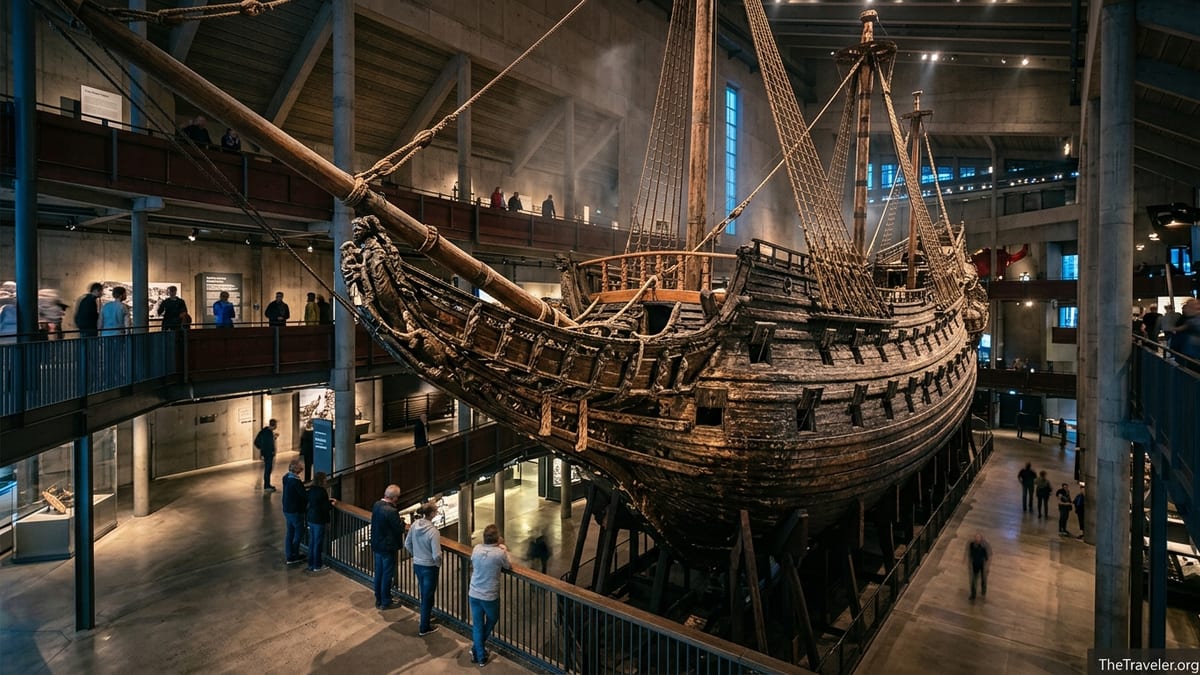
The core reason the Vasa Museum fascinates travelers is disarmingly simple. It is home to a real 17th century warship, Vasa, that spent more than three centuries on the bottom of Stockholm’s harbor before being brought up largely intact. When visitors step into the dim main hall today, the 69 meter long, multi decked ship dominates the space, towering above them like a dark wooden cathedral. Most people have seen historic ships in films or replicas at heritage harbors, but almost no one has stood beside a genuine flagship from the age of sail that still carries its original timbers and ornate carvings.
Vasa’s story is as dramatic as its appearance. Commissioned by King Gustavus Adolphus during the Thirty Years’ War, the ship was meant to showcase Swedish power with two gun decks and richly carved sculptures of lions, warriors and biblical figures. Yet on 10 August 1628, it sailed only about 1,300 meters from its quay before a gust of wind pushed it over, water rushed in through the open gunports, and the vessel sank in front of hundreds of onlookers. That mix of grandeur and immediate disaster is compelling in its own right, and the museum leans into it. Short introductory films, models and clear wall texts help visitors picture the maiden voyage and understand how a symbol of national ambition could fail so quickly.
For many travelers, this contrast between intention and outcome is what makes the visit linger in memory. A couple arriving from the nearby cruise terminal or from central Stockholm by tram can walk into the museum expecting to “see an old ship” and find instead a vivid cautionary tale. The result is that the Vasa Museum feels much less like a dusty maritime collection and much more like a human drama that just happens to be 400 years old.
World Class Preservation in the Heart of Stockholm
What also sets the Vasa Museum apart is how astonishingly complete the ship is. Experts often describe Vasa as the world’s best preserved 17th century warship. Cold brackish water, a lack of shipworm in the Baltic Sea and the mud of Stockholm harbor helped protect the hull for centuries. When Swedish engineer and amateur historian Anders Franzén located the wreck in the 1950s and a massive salvage operation finally raised Vasa in 1961, it emerged with around 98 percent of its wooden structure still in place. Visitors today can clearly see the original planking, gunports, stern galleries and decorative sculptures, instead of a skeletal frame or partial reconstruction.
The museum building on Djurgården, Stockholm’s museum and park island, is designed entirely around this preservation story. Climate control keeps temperature and humidity stable for the fragile oak. Lighting is intentionally low and slightly theatrical, not only to preserve the wood but also to highlight the three full decks of cannons and the carved stern. From the entrance level, travelers can circle the ship on several floors, moving from almost eye level with the barnacled keel to viewpoints that align with the upper gun deck and the former fighting tops high above.
This careful presentation has turned Vasa into a global reference point for maritime conservation. Staff and researchers continually monitor the ship’s condition and continue to refine how it is supported and displayed. For visitors, that ongoing work appears in accessible ways. Exhibition panels explain why the ship looks dark brown rather than freshly painted, and they describe how, after decades of spraying the timbers with polyethylene glycol, conservators now focus on controlling acidity inside the wood. Travelers who might never read a technical paper on conservation can still walk away with a sense of the scientific effort needed just to keep Vasa standing.
The museum’s location also helps its popularity. It sits just a few minutes’ walk from other major sights like the ABBA Museum and Skansen open air museum, and many travelers fit Vasa into a half day circuit on Djurgården. For a first time visitor staying near Stockholm Central Station, it often makes sense to buy a transit card, take the tram or ferry to the island in the late morning, visit Vasa for two to three hours, and then continue on to other attractions nearby without backtracking across the city.
From Salvage Operation to International Icon
Part of the fascination with the Vasa Museum lies not only in the ship itself, but also in the extraordinary salvage and reconstruction story that surrounds it. When Vasa was rediscovered in 1956, the idea of raising a 17th century warship from 32 meters of water, intact enough to display, was unprecedented. Over several years, divers tunneled under the hull, threaded steel cables through purpose built tunnels, and attached them to pontoons that inch by inch lifted Vasa out of the mud. On 24 April 1961 the ship broke the surface, in front of television cameras and crowds on the quayside, turning a local archaeological project into a national event.
The museum devotes entire sections to this mid 20th century chapter, displaying divers’ equipment, archival photographs, original notes and scale models that show how the lifting pontoons worked. For travelers used to seeing artifacts behind glass with minimal context, it is striking to realize how recently Vasa returned to view. A visitor waiting out a rainy afternoon in Stockholm can easily spend half an hour in these galleries alone, following the sequence from murky sonar scans to the moment when waterlogged cannons and carved figures saw daylight again.
In the decades since, the Vasa Museum has grown into one of Sweden’s most visited attractions. Before the pandemic it regularly welcomed more than 1.3 million visitors per year, and in 2019 it reached a record of over 1.5 million guests. More recently, the museum reported about 1.36 million visitors in 2025, around 85 percent of them from outside Sweden. The Guinness World Records organization has even recognized it as the most visited museum in the world dedicated to a single shipwreck. Those numbers mean that for many travelers flying in from North America or Asia, Vasa is the one Swedish museum they know by name before they land at Arlanda Airport.
This popularity feeds back into the experience. Audio guides are offered in multiple languages. Staff are highly practiced at managing school groups and cruise ship excursions alongside independent travelers. Exhibitions are refreshed and expanded, and the museum has invested in accessible design so that visitors with mobility or visual impairments can still appreciate the ship from different angles. In a city with approximately 100 museums, the Vasa Museum’s sustained international draw has helped fund that constant improvement.
A Time Capsule of 17th Century Life
Another reason visitors describe the Vasa Museum as uniquely compelling is that it offers far more than a single impressive object. Because the ship sank so quickly and lay undisturbed for centuries, it preserved an enormous range of everyday material from the 1620s. Archaeologists recovered clothing, tools, weapons, coins, dishes, games and even the remains of meals. These finds have allowed curators to reconstruct how sailors and soldiers lived on board and what life in early 17th century Stockholm looked like.
Inside the museum, travelers wandering the ring of galleries around the ship encounter exhibits on everything from naval technology to diet. One case might display leather shoes and wooden spoons, while another shows muskets, powder horns and cannon shot. A reconstruction of a gun deck gives visitors used to modern cruise ships a sense of how cramped conditions were. Information panels explain that as many as 450 people might have crowded onto Vasa in wartime, a figure that makes the narrow passageways and low ceilings even more striking.
Human remains recovered from the wreck have also been studied in detail, and the museum uses respectful reconstructions to tell some of these individual stories. Facial reconstructions, based on skulls and scientific analysis, appear alongside short biographies that hint at where these people came from and what ailments they lived with. For example, visitors might learn about a young woman who appears to have been on board without authorization or a soldier whose bones show signs of old injuries. These elements help shift the focus from a single grand ship to the people who built, sailed and died with it.
For families traveling with children, these human details can be the difference between a quick look and an engaged visit. A child who might lose focus when faced only with dates and tonnage figures often perks up at the sight of a reconstructed sailor’s chest, complete with combs, dice and small personal items. The museum’s family oriented storytelling, such as the children’s narrative about a boy in 1620s Stockholm encountering Vasa, gives younger visitors a way into the history that feels immediate rather than distant.
An Immersive Visitor Experience, Not Just a Display
Modern travelers increasingly judge museums by the quality of their experience rather than the size of their collections. The Vasa Museum has become one of Stockholm’s most fascinating attractions partly because it anticipates how people want to move, look and learn. Instead of a single viewing platform, the building offers multiple levels that wrap around Vasa, allowing visitors to approach the ship as if circling a sculpture in a vast gallery. Benches and low railings encourage people to linger and study the hull’s details, from the gunport lids to the carved lion figureheads.
Daily guided tours in English and Swedish are included in the admission price, which in 2026 is set at around 240 Swedish kronor for adults if bought directly from the museum. There are also combo tickets that pair the Vasa Museum with the nearby Vrak Museum of Wrecks over a 72 hour period, useful for travelers who are particularly interested in maritime history. Audio guides, available for an additional fee, let independent visitors move at their own pace while still hearing the ship’s story in their preferred language.
Practical design choices also enhance the visit. The museum café, for example, overlooks the harbor and offers simple Swedish dishes and pastries, which makes it easy to break up a visit without leaving the building. Lockers near the entrance allow travelers who have just arrived from the airport or who are between hotel check out and an evening ferry to stow luggage and move freely. Signage is clear and multilingual, and staff at the information desk routinely advise visitors on how to fit Vasa into a wider day on Djurgården or align their visit with departure times for ferries back to the Old Town.
Crucially, the museum manages crowds while still feeling contemplative. Even on busy summer days, when coach groups and families line up outside before opening time, the large central hall absorbs visitors well. Those who want quieter moments can often find them by exploring upper levels or visiting in the late afternoon after early morning tour groups have departed. In winter, when daylight is short and Stockholm’s temperatures drop, the museum becomes an especially appealing indoor stop, with its dim golden lighting contrasting with the muted blue light outside.
A Mirror for Sweden’s Ambitions and Mistakes
Beyond the visuals and logistics, Vasa’s story resonates because it speaks to universal themes of ambition, miscalculation and learning from failure. The ship was built in a period when Sweden was asserting itself as a major power in Northern Europe, and the pressure to deliver an impressive flagship contributed to decisions that compromised stability. Vasa was made taller and more heavily armed than earlier ships, but the underlying knowledge of how to balance such a design lagged behind royal expectations. The result was a beautiful yet dangerously unstable vessel.
The museum does not shy away from this. Exhibitions explain that stability tests conducted before launch raised concerns, but those worries were not given sufficient weight. For many travelers used to corporate or political stories in which failures are glossed over, it is striking to see a national museum frankly present an expensive, well documented mistake. The term “Vasa syndrome” has even entered management vocabulary to describe projects that become so politically or emotionally invested that they continue despite clear warning signs.
For Swedish visitors in particular, this honesty has made the museum a place to reflect on national identity. For international travelers, it offers a way to connect past and present. A business traveler attending a conference in Stockholm, for instance, might visit Vasa one evening and come away drawing parallels between the ship’s fate and modern infrastructure projects or software launches that went wrong. The museum’s interpretive texts invite this kind of reflection without oversimplifying the history.
By turning a 17th century embarrassment into a source of learning and even pride, the Vasa Museum models how societies can handle uncomfortable heritage. The ship is celebrated not as a military success, but as a vehicle for understanding craftsmanship, politics, science and human fallibility over time. That layered meaning gives depth to what might otherwise be a straightforward maritime attraction.
Easy to Reach, Easy to Recommend
On a practical level, the Vasa Museum has become one of Stockholm’s signature attractions because it fits naturally into most itineraries and offers strong value for time and money. Djurgården is well connected by trams, buses and ferries from central Stockholm, and many travelers enjoy the short boat ride from near the Royal Palace, which doubles as a mini harbor tour. From the ferry dock it is only a few minutes’ walk past waterfront cafés and parkland to the museum’s unmistakeable roofline, topped by stylized masts that echo those Vasa once carried.
Admission prices are competitive compared with other major institutions in the city. While exact amounts vary over time, adults in 2026 can expect to pay under 300 Swedish kronor for a standard ticket, with children and young people often admitted at reduced rates or for free. Considering that a typical visit lasts between two and three hours and includes a 25 minute guided tour as well as access to multiple exhibitions and a short introductory film, many travelers judge the experience as good value, particularly compared with the cost of other Scandinavian attractions and meals.
Visitors can easily combine Vasa with other highlights. A family staying in the popular Östermalm district might start their day at Vasa, walk across the island to the open air folk museum at Skansen for the afternoon, and finish with dinner back in the city center, all without using a car. Cruise passengers with only one day in port frequently choose shore excursions that include Vasa because it delivers a dense, memorable experience in a limited timeframe. Even locals use the museum as a go to suggestion when friends from abroad ask what they should see with only one or two days in the city.
Accessibility also plays a role in the museum’s appeal. Ramps, lifts and carefully designed walkways make most of the building navigable for wheelchair users and those with strollers. Clear information on opening hours and seasonal adjustments helps travelers avoid disappointment, and because many Stockholm hotels and visitor centers recognize Vasa as a top draw, front desk staff are usually well informed about practical details such as the best time of day to visit or how long to allow for the tram ride from different neighborhoods.
The Takeaway
The Vasa Museum has become one of Stockholm’s most fascinating attractions because it combines an extraordinary object, world class preservation, compelling storytelling and visitor friendly design. At its center is a real 17th century warship, raised almost intact from the harbor after 333 years and presented in a way that lets modern travelers appreciate both its beauty and its flaws. Around that ship, curators have built exhibitions that illuminate daily life in the 1620s, the science of conservation and the broader currents of Swedish history.
For visitors, this translates into a museum experience that feels immersive and memorable rather than abstract. Whether you are a family trying to keep teenagers engaged on a winter city break, a solo traveler filling a free afternoon between ferries, or a conference attendee with just a few hours to see Stockholm, Vasa offers a clear narrative, striking visuals and the chance to reflect on how societies handle their triumphs and failures. Its combination of accessibility, emotional resonance and sheer visual impact explains why so many people leave the building convinced that this sunken ship is worth crossing a continent to see.
FAQ
Q1. Where is the Vasa Museum located in Stockholm?
The Vasa Museum stands on the island of Djurgården, a short tram or ferry ride from central Stockholm and within walking distance of other major attractions.
Q2. How long does a typical visit to the Vasa Museum take?
Most travelers spend between two and three hours at the museum, which usually allows time for the introductory film, a guided tour, and a full circuit of the exhibitions.
Q3. How much does it cost to visit the Vasa Museum?
Adult tickets in 2026 are generally under 300 Swedish kronor, with reduced or free admission for many children and young people; prices can vary slightly by season and ticket type.
Q4. Is the Vasa Museum suitable for children?
Yes. The museum offers child friendly storytelling, engaging exhibits, and plenty of visual detail, making it one of Stockholm’s most popular visits for families.
Q5. Do I need to join a guided tour, or can I explore on my own?
Guided tours in English and Swedish are included in the ticket price and are recommended, but visitors are also free to explore independently or use an audio guide.
Q6. What is the best time of day to visit to avoid crowds?
Early morning right after opening and later in the afternoon tend to be quieter, especially outside the peak summer season and major holiday periods.
Q7. Can I take photos inside the Vasa Museum?
Photography for personal use is generally allowed, though flash and tripods may be restricted; visitors should always follow on site signage and staff instructions.
Q8. Is the museum accessible for wheelchair users and strollers?
Yes. The building includes ramps, lifts and wide walkways, allowing visitors with wheelchairs or strollers to reach most viewing platforms and exhibition areas.
Q9. Are there food and drink options at the Vasa Museum?
The museum has a café serving light meals, snacks and drinks, and its location on Djurgården means more cafés and restaurants are available within a short walk.
Q10. Is the Vasa Museum worth visiting if I am not especially interested in ships?
Many visitors who are not maritime enthusiasts still rate it as a highlight of Stockholm, thanks to its human stories, dramatic history and impressive presentation.