


For decades, Wyndham Vacation Resorts Shawnee Village in Pennsylvania’s Pocono Mountains was a classic drive-to timeshare escape: ski weekends at Shawnee Mountain, rafting on the Delaware River, and family reunions in the woods. So when owners and guests began receiving notices that the resort would leave the Club Wyndham portfolio and ultimately cease timeshare operations, many asked the same question: why would a long-running, largely sold-out resort suddenly close? The answer lies in a mix of aging buildings, rising maintenance costs, shifting travel demand, and a broader “portfolio refresh” strategy at Wyndham’s parent company.
Get the latest updates straight to your inbox!
What Actually Happened at Wyndham Vacation Resorts Shawnee Village
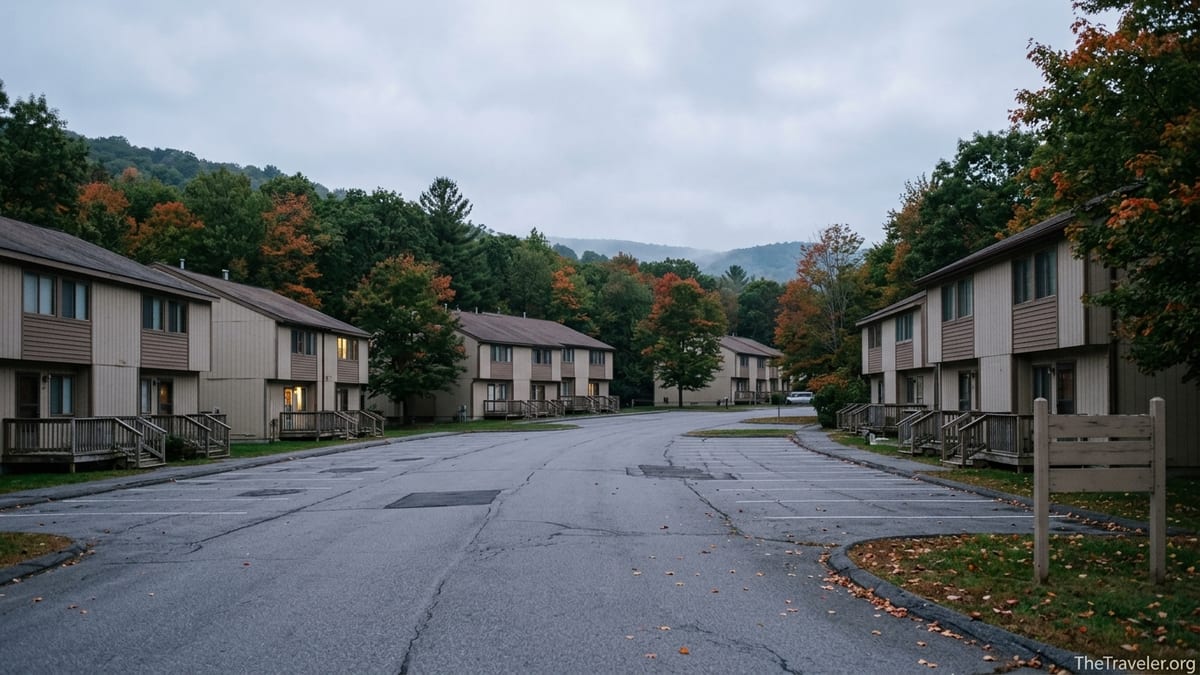
Shawnee Village was a collection of townhome-style timeshare units in Shawnee-on-Delaware, near East Stroudsburg in the Pocono Mountains of northeastern Pennsylvania. For years it was marketed through Club Wyndham and, for a time, WorldMark by Wyndham, appealing to families from New York, New Jersey, and Pennsylvania looking for an affordable, nature-focused getaway near Shawnee Mountain Ski Area and the Delaware Water Gap National Recreation Area.
Beginning in 2024 and into 2025, owners began to report official communications that the Shawnee timeshare property was being removed from Wyndham’s vacation ownership portfolio and that the underlying association would pursue a sale of the resort rather than invest in extensive upgrades. Local discussion forums in the Poconos also referenced “Wyndham closing down the Shawnee resort,” with former guests sharing memories of the cobblestone roads and older cabins while noting visible wear and tear in recent years.
At the same time, Travel + Leisure Co., the parent company of Club Wyndham and WorldMark, announced that a small group of older or underperforming resorts would be removed from the portfolio as part of a multi-year “resort portfolio refresh.” Corporate notices explained that where a resort’s homeowners’ association voted to cease operations, maintenance fees for that location would stop being charged for future years and the property would be marketed for sale in partnership with the association.
In simple terms, Shawnee Village was caught at the intersection of aging infrastructure, rising costs, and a parent company that now prefers to focus capital and owner demand on fewer, more modern resorts. The closure was not a sudden shutdown of a healthy property, but the end point of years of deferred decisions about how much to reinvest in a 1970s-era complex.
Wyndham’s “Portfolio Refresh” Strategy and Why Older Resorts Are Leaving
The closure of Shawnee Village is part of a wider strategy rather than a one-off decision. In late 2024 and 2025, Club Wyndham began notifying owners that their “resort portfolio is getting a refresh,” explaining that a handful of properties that no longer met owner expectations or required disproportionately high investments would be removed from the network. The company framed this as a way to keep overall maintenance fees in check and avoid large special assessments on aging buildings.
In practice, this has meant closing or exiting certain long-running resorts with older construction or limited appeal compared to newer destinations. While specific resorts vary, the pattern is consistent: properties with 1970s and 1980s-era townhomes, sprawling road networks, and wood-frame exteriors in harsh climates often sit at the top of the review list. Shawnee Village fits that profile closely, with multiple phases of townhomes, steep hillside roads, and exposure to snow, ice, and freeze-thaw cycles in the Poconos.
Travel + Leisure Co. has also been channeling capital into renovations and new developments that better match how members travel today. Company renovation spotlights highlight upgrades at more urban or amenity-rich resorts, such as modernizing units in downtown locations, updating beachfront properties in Florida, and enhancing high-demand mountain resorts in Colorado. Owners often see the results in things like keyless entry, refreshed kitchens and bathrooms, and contemporary furnishings, but the less visible part is structural: roofs, siding, plumbing, and mechanical systems that can cost millions of dollars per resort to replace.
From a portfolio management perspective, keeping every legacy property indefinitely is not realistic. When a resort requires major structural work, has scattered occupancy, or sits in a destination that no longer draws the same number of drive-to visitors it once did, executives have to decide whether to reinvest or exit. Shawnee Village’s combination of age, layout, and local demand level made it more likely to be on the exit side of that equation.
Aging Buildings and Harsh Pocono Weather: The Hidden Structural Problem
Shawnee Village’s charm for many guests was exactly what created long-term headaches for its association: low-rise townhomes nestled among trees, accessed by winding internal roads that predated many modern construction standards. The core residential designs dated back decades, and even though interior furnishings could be updated periodically, the underlying shells of the buildings aged in a harsher-than-average environment.
The Pocono Mountains see heavy snow, significant freeze-thaw cycles, and long periods of moisture. Over time, that combination is tough on wood siding, balconies, staircases, foundations, and underground plumbing. Similar mountain timeshare resorts in the eastern United States have faced expensive structural surprises, from rusting steel balconies to failing retaining walls. When problems are widespread rather than isolated to a single building, the cost to remediate can quickly move into eight-figure territory.
Owners at other older timeshare resorts in the United States have shared experiences of discovering that decades of patchwork repairs were no longer enough. One Virginia Beach timeshare under a competing brand, for example, had to close indefinitely around 2024 after inspectors found corroded steel framing and significant waterproofing failures, making balcony and facade repairs unavoidable. When that happens, owners are often told to expect special assessments of many thousands of dollars per week owned, on top of regular maintenance fees, if they want the resort to reopen.
At Shawnee Village, the combination of older construction methods and mountain weather meant that large-scale replacements were on the horizon: roofs, windows, siding, roads, and underground lines all eventually age out. By the mid-2020s, owners were already seeing the signs in more frequent maintenance issues, cosmetic wear, and a resort experience that felt dated compared to newer properties in the Club Wyndham network.
Maintenance Fees, Special Assessments, and the Economics Behind Closure
Behind every resort closure is a series of spreadsheets that compare the cost of keeping the property operating versus the likely revenue and owner satisfaction. For timeshare resorts, most of the funding comes from annual maintenance fees paid by owners. At a mature resort like Shawnee Village, the initial purchase price paid decades ago is long spent; what matters now is whether annual fees can realistically support the next wave of major investments.
Owners at established mountain timeshares routinely report annual maintenance bills in the range of 900 to 1,600 dollars per week for a typical two-bedroom unit, depending on resort size and amenities. At some older properties that have required building-wide replacements of siding or balconies, special assessments have approached or exceeded 5,000 to 10,000 dollars per week owned, billed over a few years. Those numbers are representative rather than specific to Shawnee Village, but they illustrate the financial stakes when contractors estimate major structural work.
For many Shawnee owners who bought into the resort years ago for a few thousand dollars on the resale market, an unexpected assessment in that range would feel disproportionate to the perceived value of their week. The alternative would be dramatically increasing regular maintenance fees going forward and hoping that enough owners continued to pay. If a significant share of owners simply walk away, the burden shifts to the remaining paying owners and the developer, making the resort even harder to sustain.
Wyndham’s communications around its broader resort portfolio refresh hinted at this concern. The company noted that some properties would require “significant upgrades” that could lead to unaffordable maintenance fees or special assessments and that, to prevent that outcome, those resorts could be removed from the network and marketed for sale instead. In this context, closure becomes a way of drawing a line before the financial demands become unmanageable for a large number of owners, especially retirees on fixed incomes.
Homeowners’ Association Votes and How the Decision Was Made
Most timeshare resorts, including Shawnee Village, are legally structured around a homeowners’ association or property owners’ association that represents the collective interests of deeded owners. That association typically has an elected board that works with the management company to set budgets, approve capital projects, and make recommendations on the resort’s long-term future. For a resort to cease operations as a timeshare, the governing documents usually require a formal vote of the association members.
Travel + Leisure Co. has explained in its portfolio refresh notices that resort closures are not made unilaterally: associations first review the condition of the property, consider options such as partial refurbishment, phased rebuilding, or selling the resort, and then present recommendations to owners. In many cases, owners receive a detailed proxy or ballot that spells out the consequences of each option, including estimated maintenance fees or assessments under different scenarios.
In situations similar to Shawnee Village, associations have concluded that the cost and disruption of a full-scale refurbishment would be too much for owners to bear. When enough owners agree, they can vote to terminate the timeshare plan, which legally winds down the vacation ownership structure. Once that happens, the association typically works with the management company and outside brokers to market the resort as a whole, often to hotel operators, residential developers, or institutional investors.
For individual owners, the HOA vote is both the mechanism of closure and a way to retain some control over the outcome. While many owners are emotionally attached to their home resort, especially one with generational use like Shawnee Village, the reality of voting often forces a trade-off between nostalgia and financial practicality.
What Closure Means for Owners: Usage Rights, Fees, and Potential Payouts
For Shawnee Village owners, the closure process involves several phases that are fairly typical for timeshare terminations. First, once the association approves the plan to cease operations, future reservations at the resort are curtailed or stopped entirely after a defined date. Owners may be offered the chance to use remaining weeks in a final season, or bookings may be gradually phased out to accommodate the sale timeline.
Second, maintenance fees tied specifically to the closing resort usually end for future years after the termination date. Club Wyndham has indicated in its communications that when an association votes to cease operations, maintenance fees for that location will not be charged for the following year and will not be factored into pooled maintenance obligations such as Club Wyndham Access fees. For Shawnee owners who were current on their obligations, this can mean an immediate reduction in annual bills, although it also means losing a long-familiar vacation destination.
Third, once the resort is sold, any net proceeds after paying off debts, outstanding obligations, and transaction costs are typically distributed to owners, either directly or via credits, according to the rules in the resort’s governing documents. In practice, owners should temper expectations: at most older timeshare resorts that have been sold, the individual payout per week is modest, often a small fraction of the original developer price and sometimes only a few hundred dollars per week or less. The primary benefit for many is release from future maintenance obligations.
Owners who hold points rather than deeded weeks, such as Club Wyndham Access points, may experience the closure differently. Instead of a deed tied to Shawnee Village, their points represent a share of a much larger, diversified portfolio. When one resort exits, the club can reallocate inventory and, over time, may add new properties or increase capacity at other resorts. The main impact for these owners is the loss of a familiar booking option in the Poconos rather than a direct sale-related payout.
How the Closure Affects Travelers and the Local Poconos Community
For regular guests, the closure of Wyndham Vacation Resorts Shawnee Village removes a long-standing midscale option in the Poconos for multi-night stays in condominium-style units. Families who were used to booking a two- or three-bedroom townhome with a full kitchen, fireplace, and access to on-site pools now have to look to alternative accommodations nearby. These might include independent vacation rentals, regional condo resorts, or hotels attached to larger attractions like water parks.
The local community also feels the impact. Shawnee Village brought a predictable flow of drive-to visitors who would ski at Shawnee Mountain, play golf at nearby courses, dine in local restaurants in East Stroudsburg and Delaware Water Gap, and book rafting or tubing trips on the Delaware River. While the Poconos remain a strong regional tourism market, the shift away from one of the area’s older resort complexes changes traffic patterns and may reduce shoulder-season business for some small operators.
At the same time, closure does not necessarily mean that the land will sit idle. Neighboring properties have been quick to clarify that they remain open and independent of Wyndham’s timeshare decisions, and the sale of the Shawnee Village timeshare property could eventually bring in new investment. In other markets, former timeshare resorts have been converted into traditional condominium communities, boutique hotels, or mixed-use developments with a combination of short-term rentals and full-time residents.
Travelers who loved the style of accommodations at Shawnee Village can still find similar experiences within the broader Club Wyndham and WorldMark systems, though often in different locations. For example, Club Wyndham offers townhouse-style units near ski areas in New England and the Rockies, while WorldMark has cabin-like units in mountain regions of the Pacific Northwest. However, the specific combination of proximity to New York City, a drive of roughly 80 to 100 miles depending on route, and the rural Pocono setting is harder to replicate exactly.
Lessons for Other Timeshare Owners Watching Resort Closures
The Shawnee Village closure highlights several lessons for timeshare owners anywhere, especially those at older, seasonal resorts. First, it emphasizes how important it is to pay attention to HOA communications, financial statements, and reserve studies. If your resort’s roofs, siding, balconies, and roads are approaching the end of their expected life, and reserve funds appear thin, there is a higher risk that you could face steep assessments or, eventually, a closure vote.
Second, it underlines the difference between buying a timeshare at a newer, centrally built high-rise versus a spread-out complex of older townhomes. A high-rise, for example a 25-year-old urban resort with concrete construction, may have fewer separate buildings and a simpler structural profile, even if interior decor looks dated. A wooded, multi-phase development like Shawnee Village often has more individual foundations, stairways, and utilities, giving time and weather more opportunities to create high-cost problems.
Third, it is a reminder that developer alignment matters. In Shawnee’s case, Travel + Leisure Co. is actively reshaping its vacation ownership footprint, putting more capital behind resorts it believes can deliver modern experiences at acceptable fee levels. Owners at resorts that feel neglected should candidly ask board members and management what the long-term plan is. If a resort appears to be receiving minimal investment while fees slowly climb, closure and sale might already be part of internal scenarios.
Finally, Shawnee Village shows that closure is not always a worst-case outcome. For some long-time owners, especially those no longer traveling every year, the combination of ending maintenance fees and receiving a modest sale distribution can be preferable to funding a large assessment for renovations they may never fully enjoy. However, that trade-off is deeply personal and depends on how often a family uses their ownership and how emotionally attached they are to their home resort.
The Takeaway
Wyndham Vacation Resorts Shawnee Village did not close because of a single dramatic event, but because a series of long-term trends converged. Decades-old construction in a demanding climate, rising maintenance and capital costs, evolving travel preferences, and a parent company focused on refreshing its portfolio all played a role. When the numbers were run, and owners were asked to vote through their homeowners’ association, continuing as a timeshare resort was no longer the favored option.
For current and prospective timeshare owners, Shawnee Village is a case study in why it is crucial to look beyond glossy brochures. Understanding the age of the buildings, the local climate, the strength of reserve funds, and the developer’s long-term strategy can help you gauge whether a resort is likely to be renovated, sold, or closed in the coming decades. For the Poconos community and for families who built memories along those winding Shawnee roads, the closure marks the end of an era, but it also opens the door to whatever new chapter comes next for that hillside above the Delaware River.
FAQ
Q1. Is Wyndham Vacation Resorts Shawnee Village permanently closed as a timeshare resort? Yes. The Shawnee Village timeshare property has been removed from the Club Wyndham portfolio and is in the process of being wound down and marketed for sale, which effectively ends its role as an operating timeshare resort.
Q2. Why did Wyndham and the association decide to close Shawnee Village instead of renovating it? The buildings at Shawnee Village are decades old and located in a harsh mountain climate, which drives up the cost of major repairs. Renovating to modern standards would likely have required very large assessments or sharply higher maintenance fees, so the association and management concluded that closure and sale were more realistic.
Q3. Did owners get to vote on the closure of Shawnee Village? Timeshare closures typically require an owners’ association vote under the resort’s governing documents. In line with Wyndham’s stated process, Shawnee Village’s association would have reviewed options, presented them to owners, and sought approval to terminate the timeshare plan before moving forward.
Q4. What happens to my maintenance fees now that Shawnee Village is closing? Once the association votes to cease timeshare operations, maintenance fees tied specifically to that resort generally stop for future years. Owners should still pay any outstanding amounts due before the termination date and should rely on official written notices for exact billing cutoffs and refund policies.
Q5. Will I receive any money from the sale of the Shawnee Village property? After the resort is sold, any net proceeds remaining after debts and transaction costs are usually distributed according to the rules in the resort’s documents. Individual payouts are often modest at older timeshare properties, so owners should expect a relatively small amount per week owned rather than a large lump sum.
Q6. I own Club Wyndham points, not a deeded week at Shawnee. How am I affected? If your ownership is in a points-based product such as Club Wyndham Access, the main impact is the loss of Shawnee Village as a booking option. Your points remain valid for use at other Club Wyndham resorts, and the club may eventually add or expand inventory elsewhere to offset removed properties.
Q7. Can I still vacation in the Poconos through Wyndham after the Shawnee closure? Availability in the immediate Shawnee-on-Delaware area will decrease with the closure, but Club Wyndham and associated exchange networks still offer other resorts in the broader Mid-Atlantic and Northeast regions. Owners who want a similar drive-to, mountain-style trip may need to consider other Pocono properties outside Wyndham or look at nearby states with comparable settings.
Q8. What are my options if I no longer want my Shawnee-related timeshare? Owners can inquire about any formal surrender or deed-back programs offered by Wyndham or, after closure, follow the association’s guidance on how the termination and sale will affect their ownership. Resale options for older timeshares are typically limited and may involve low or zero resale value, so proceeding carefully and avoiding third-party “exit” scams is important.
Q9. Could Shawnee Village reopen in the future under a different operator? It is possible that a buyer could redevelop the property as a traditional hotel, residential community, or another form of lodging, but it would not automatically restore existing timeshare rights. Any future operation would be based on new ownership and a different legal structure from the original Shawnee Village timeshare.
Q10. What should I watch for at my own resort to avoid surprises like this? Review annual budgets, reserve studies, and board communications to see whether major components such as roofs, siding, balconies, and mechanical systems are adequately funded. If you own at an older resort in a demanding climate and reserve balances seem low relative to upcoming needs, start asking detailed questions about long-term plans, potential assessments, and whether a closure or sale is being considered.