


More news on this day
Flight operations across New York City and Atlanta faced severe disruption this weekend, as a combination of wildfire smoke and slow-moving thunderstorms triggered more than one thousand cancellations, with Republic Airways and Delta Air Lines among the hardest hit operators.
Get the latest news straight to your inbox!
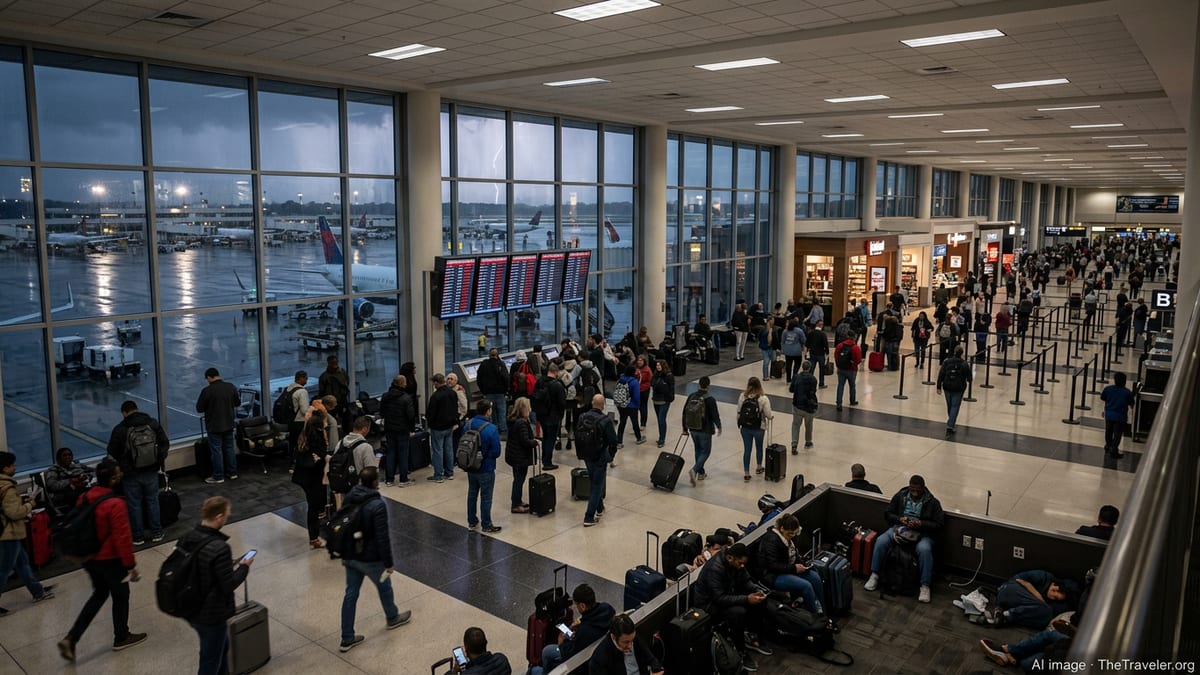
Severe Weather and Smoke Converge on Major Hubs
Publicly available FAA traffic management advisories show that repeated rounds of thunderstorms across the Northeast on July 18 and July 19 led to ground delay programs and intermittent ground stops affecting New York’s major airports, including LaGuardia, John F. Kennedy, and Newark. At the same time, meteorological reports describe dense smoke from ongoing wildfires drifting into the region, reducing visibility and further constraining air traffic flows.
In Atlanta, similar slow-moving storm cells built through the afternoons during the same period, prompting temporary ground stops at Hartsfield-Jackson Atlanta International Airport and extended departure queues. Local broadcast coverage from Atlanta indicated that even after a ground stop was lifted, long delays persisted as airlines attempted to clear backlogs of stranded passengers and reposition aircraft throughout the Southeast.
Aviation analysts note that when convective storms and smoke coincide around major hubs, capacity can fall sharply as controllers increase spacing between aircraft, temporarily suspend arrivals, or halt departures altogether. The knock-on effect can ripple across the national network, particularly when the disruption hits two of the busiest connecting complexes on the same day.
New York’s tightly managed airspace is especially sensitive to weather and visibility constraints. Historical FAA records show that similar smoke-related events, such as Canadian wildfire plumes in recent years, have previously resulted in rapid ground stops at LaGuardia or other New York airports when visibility deteriorated quickly.
Republic Airways and Delta See Heavy Operational Impact
Republic Airways, a large regional carrier that operates as a partner for several major airlines, maintains extensive schedules between New York, Atlanta, and smaller markets throughout the eastern United States. Public timetables and fleet data indicate that many of its Embraer regional jet flights feed Delta’s hubs at LaGuardia and Atlanta, making the company particularly exposed when those airports slow or shut down.
According to aggregated flight-tracking data reviewed on Saturday, regional routes flown by Republic between the Northeast and Southeast experienced a wave of cancellations and diversions as holding patterns grew and inbound slots tightened. Once rotations were broken early in the day, aircraft and crews often ended up out of position, reducing Republic’s ability to restore normal schedules even when weather windows briefly improved.
Delta, which operates a major domestic hub at LaGuardia and its largest global hub in Atlanta, also canceled a substantial share of its planned departures as the storms intensified. Other publicly available operational summaries and historic disruption analyses indicate that Delta typically processes targeted cancellations at its hubs during severe weather in order to preserve safety margins and create space for recovery flights later in the schedule.
Industry observers note that when both a primary hub such as Atlanta and a key coastal gateway like New York are simultaneously constrained, any airline with large operations in those cities will see a sharp spike in cancellations. Delta’s broad network and reliance on connecting flows through Atlanta and New York mean the airline can quickly account for a large portion of the total daily cancellations recorded nationwide.
Over One Thousand Flights Scrubbed Across the Network
Real-time aviation data providers reported that systemwide cancellations climbed into four figures by late Saturday, with a significant concentration around the New York metropolitan airports and Atlanta. These tallies include mainline and regional operations for Delta, flights operated by Republic Airways on behalf of major carriers, and other airlines serving the same constrained airspace.
The combined influence of ground delay programs, temporary ground stops, and airspace flow restrictions drove a surge in same-day cancellations, particularly on short-haul routes that rely on tight aircraft turns. Once multiple rotations on a given aircraft were interrupted, later flights were frequently removed from the schedule preemptively rather than risk extended gate and tarmac delays.
Publicly available analyses of prior summers show a similar pattern when strong thunderstorms stall over the Eastern Seaboard. Airlines often cancel flights in blocks around the busiest afternoon and evening periods, both to prevent excessive congestion on the ground and to ensure that crews remain within legal duty limits.
On this occasion, the added complication of wildfire smoke over the Northeast magnified the operational challenge. Reduced visibility and shifting wind patterns forced additional spacing between aircraft and limited the number of arrival and departure slots controllers could safely handle, raising the likelihood that flights already running late would not depart at all.
Passengers Face Long Lines, Rebookings, and Limited Options
Travelers passing through New York and Atlanta reported crowded terminals, lengthy waits at customer service counters, and limited same-day rebooking options as cancellation counts rose. With school holidays and summer events driving strong demand, many later flights were already nearing capacity before the disruptions began.
Public information channels from the airlines encouraged passengers to use mobile apps and self-service tools to check flight status, rebook without fees where eligible, and opt into automatic notifications. In prior weather events, Delta has often issued flexible travel waivers for affected hubs, allowing customers to change their itineraries within a limited date range without incurring additional charges, and similar measures were highlighted again in recent advisories.
In some cases, passengers on shorter routes into the New York area were re-accommodated via alternative airports such as Boston, Philadelphia, or Washington, then connected by rail or ground transport. Others chose to delay their journeys entirely until more stable weather windows appeared over the Northeast and the Southeast.
Travel forums and social media posts described missed connections, overnight stays in airport hotels, and improvised itineraries involving multiple carriers as travelers sought any remaining seats. With many aircraft and crews out of position, even early-morning departures the following day were expected to operate with residual delays as airlines attempted to rebuild their networks.
What This Disruption Reveals About Summer Air Travel Risks
Aviation research on delay propagation within the United States airspace system consistently identifies major hubs and weather-sensitive regions as key nodes where local disruptions can quickly escalate into nationwide problems. When both New York and Atlanta encounter capacity reductions on the same day, the interconnected nature of airline schedules means that impacts can extend far beyond the immediate storm zone.
Experts point to several structural factors that contribute to such large-scale disruptions: tightly timed banked schedules at hub airports, limited spare aircraft during peak travel periods, and the dependence on regional partners such as Republic Airways to feed mainline networks. Any disturbance that breaks these finely tuned rotations, whether thunderstorms or smoke, can result in cascading cancellations.
For travelers, the events of this weekend underscore the heightened volatility of summer flying. Industry guidance often recommends booking earlier departures, allowing extra time for connections, and monitoring weather forecasts along entire routings, not just at origin and destination, since convective systems and wildfire smoke can shift quickly.
As climate-related extremes and extended wildfire seasons become more common, airlines and regulators continue to evaluate how tools such as enhanced forecasting, real-time traffic management systems, and more flexible scheduling could help reduce the scale of future disruptions. For now, New York and Atlanta’s latest wave of weather-related cancellations offers a clear example of how quickly conditions can overwhelm even the largest and most experienced carriers.