


More news on this day
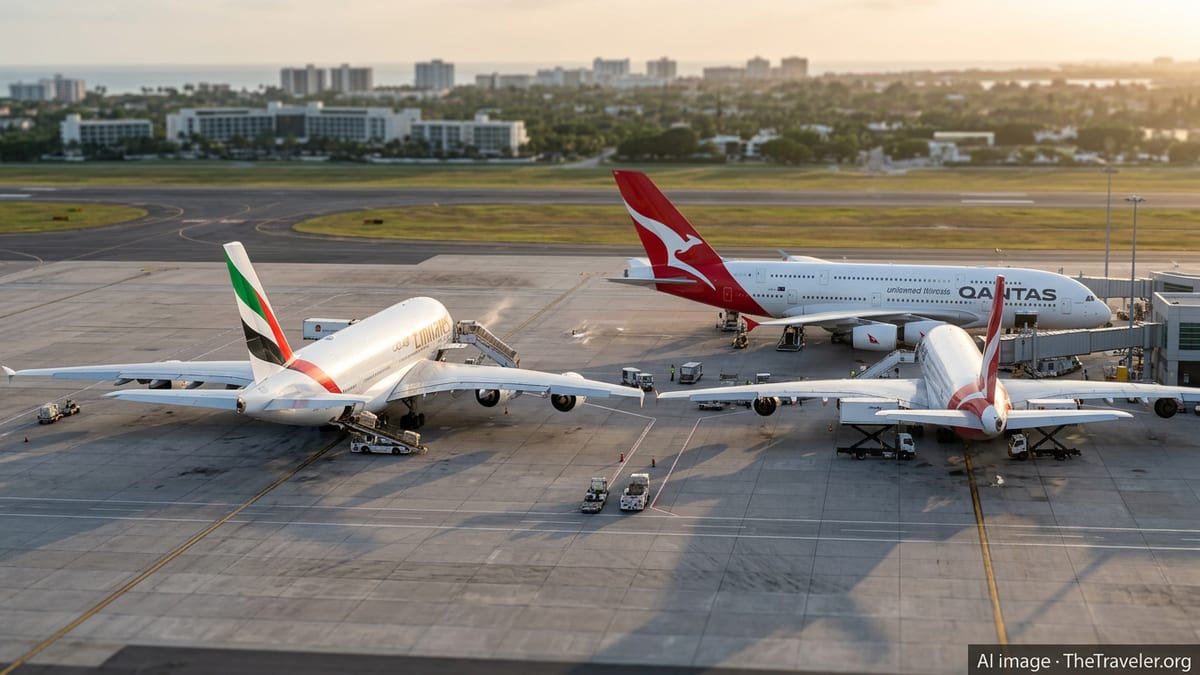
The world’s largest passenger airliner, an Emirates Airbus A380 operating from Dubai to Moscow, spent hours circling in Russian airspace on October 23 after drone-related airspace restrictions temporarily shut all four airports serving the capital, disrupting travel for thousands of passengers across the region.
Get the latest news straight to your inbox!
Drone Alerts Trigger Sudden Halt to Moscow Arrivals
According to publicly available air traffic data and Russian media coverage, flight EK133 from Dubai to Moscow Domodedovo on October 23 was among dozens of services affected when airspace around the Russian capital was sharply restricted following reports of incoming drones. Russia’s federal air transport regulator announced that Sheremetyevo, Domodedovo, Vnukovo and Zhukovsky stopped accepting and dispatching aircraft shortly after 14:00 local time, effectively closing the main aerial gateways to the city.
Flight-tracking platforms showed a rapid thinning of traffic over Moscow, with inbound aircraft diverted to alternate airports or instructed to enter holding patterns well away from the capital. Reports indicate that at least ten flights approaching from international and domestic origins were placed in extended airborne queues while controllers assessed the security situation and coordinated any possible reopenings.
The closure followed a series of drone incidents targeting the wider Moscow region in recent months, part of a wider pattern of aerial harassment linked to the war in Ukraine. Coverage by Russian and international outlets described temporary evacuations at Sheremetyevo and other transport hubs as airport operators implemented contingency procedures for a potential strike.
While ground operations were paused, long-haul aircraft already en route to Moscow, including the double deck Airbus A380, had limited options beyond circling and waiting for clearance, creating a rare spectacle in regional airspace and adding a new layer of complexity to travel planning into Russia.
Emirates A380 Traces Prolonged Holding Pattern Over Penza
Data from live tracking services and Russian-language reports indicate that the Emirates A380, identified as aircraft A6-EEM, was instructed into an extended holding pattern south of Moscow, near the border of Penza Region and the Republic of Mordovia, several hundred kilometers from its intended destination at Domodedovo Airport. Aviation-focused outlets describe the aircraft flying repeated racetrack loops as controllers managed traffic flows and awaited confirmation that at least one Moscow airport could safely resume limited operations.
One analysis of the flight’s recorded track shows EK133 arriving in the Moscow flight information region on schedule, then remaining airborne for roughly two additional hours while restrictions remained in place. Arrival logs cited by specialist travel publications show the aircraft finally landing at Domodedovo at approximately 17:11 local time, more than two hours after its scheduled 14:50 arrival.
The Airbus A380 is certified to carry more passengers than any other commercial airliner in service, and Emirates typically configures the type with several hundred seats across economy, business, and first class. While precise on-board numbers for EK133 have not been published, the incident meant that one of the world’s most recognizable long-haul aircraft spent a substantial portion of its journey effectively “stranded” in the sky, waiting for a safe window to reach the Russian capital.
Throughout the disruption, there were no public indications of technical problems with the aircraft itself. The delay instead highlighted the operational vulnerability of large, long-haul flights when destination airports suddenly close, particularly in an environment where diversion options for a very large airliner are constrained.
Why the A380 Has Limited Options in Russian Airspace
The Airbus A380, which first entered commercial service in 2007, remains the largest passenger airliner ever built by overall capacity. Technical specifications published by Airbus describe a wingspan close to 80 meters and a maximum takeoff weight approaching 560 tons, factors that require long runways, reinforced taxiways and tailored ground handling equipment.
In Russia, only a small number of airports are able to receive the A380. Domodedovo and Sheremetyevo in Moscow, along with major hubs such as Saint Petersburg’s Pulkovo, have previously been identified by Russian aviation publications as capable of handling the type’s size, pavement loading, and passenger volumes. When airspace restrictions are imposed simultaneously on the main Moscow airports, potential diversions become significantly more complicated for an ultra-large aircraft.
Smaller regional fields in central Russia often lack the combination of runway length, taxiway geometry, passenger handling facilities and specialized ground vehicles needed to safely accommodate an A380. That reality increases the likelihood that crews will be instructed to hold at altitude and burn fuel while awaiting clearance, rather than diverting immediately to a nearby regional airport that may not be fully compatible with the aircraft.
The October 23 incident illustrates how those infrastructure constraints play out in practice. With Moscow’s principal airports temporarily unavailable and alternatives several hundred kilometers away, the Emirates crew remained in a managed holding pattern until Domodedovo could begin accepting inbound traffic again, allowing the superjumbo to complete its scheduled route instead of diverting.
Ripple Effects for Passengers and Travel Plans
Travel-industry outlets report that the October 23 airspace restrictions produced widespread knock-on effects for passengers flying into and out of Moscow over that 24-hour period. In addition to extended airborne holding patterns, multiple flights bound for the capital were rerouted to cities such as Kazan and Nizhny Novgorod, forcing unscheduled ground transfers and overnight stays for some travelers.
For those aboard EK133 and other affected flights, the most immediate impact was a significantly longer time in the air, compounded by uncertainty over when an approach would be permitted. Delays of more than two hours can lead to missed connections on onward itineraries, including long-haul departures from Moscow to Asia, the Middle East and other parts of Europe. Airlines generally rebook passengers in such cases, but the process can be slow during large-scale, security-related disruptions when many flights are affected simultaneously.
Publicly available information did not immediately indicate the number of Emirates passengers who missed onward connections as a result of the A380’s delayed arrival. However, travel experts note that the limited frequency of some international routes out of Moscow can mean a wait of 24 hours or more for the next available seat, particularly after a major disruption affecting several peak-time arrivals.
Travel advisories issued by specialist aviation and security analysts after the incident urged passengers planning to fly into Moscow in the near term to monitor flight status closely, build extra connection time into itineraries, and stay alert to any updates related to drone activity or airspace restrictions that could once again affect the capital’s airports.
What the Incident Signals for Future Flights into Moscow
The sight of the world’s largest passenger plane describing circles over central Russia underscores how quickly evolving security risks can intersect with commercial aviation. The October 23 closures followed earlier drone-related interruptions to Moscow’s airports this year, suggesting that similar events cannot be ruled out as the conflict in Ukraine continues and airspace security remains a sensitive issue.
Aviation analysts observing Moscow’s recent pattern of disruptions note that authorities appear to favor rapid, sweeping restrictions on air traffic when potential threats are detected, followed by a staged resumption of flights once the immediate risk is assessed. For large widebody aircraft arriving from the Middle East, Asia and Europe, that approach raises the likelihood of unplanned holding or diversions, even when weather and technical conditions are otherwise normal.
For international travelers, the episode involving the Emirates A380 serves as a reminder that journeys into the Russian capital may be subject to last-minute changes that have little to do with traditional airline reliability metrics. Before upcoming trips, passengers are increasingly advised to check not only standard operational data such as on-time performance but also broader geopolitical and security developments that may influence whether flights land on schedule.
While flight EK133 ultimately reached Moscow Domodedovo on October 23 after its extended circuit over Penza Region, the images of the superjumbo apparently “stranded” midair highlight an evolving era for long-haul travel, in which airspace security alerts far from departure and destination cities can still dictate when, where and whether the world’s largest passenger jets are allowed to touch down.