


Rome Fiumicino is one of Europe’s better run mega airports, regularly winning awards and handling tens of millions of passengers a year. That did not stop my last trip through from being far more stressful than it needed to be. Between misjudged timing, confusing terminal changes and a scramble for the Leonardo Express, I learned a few hard lessons. If I were flying through Leonardo da Vinci–Fiumicino Airport again tomorrow, here is exactly what I would do differently.
Get the latest updates straight to your inbox!
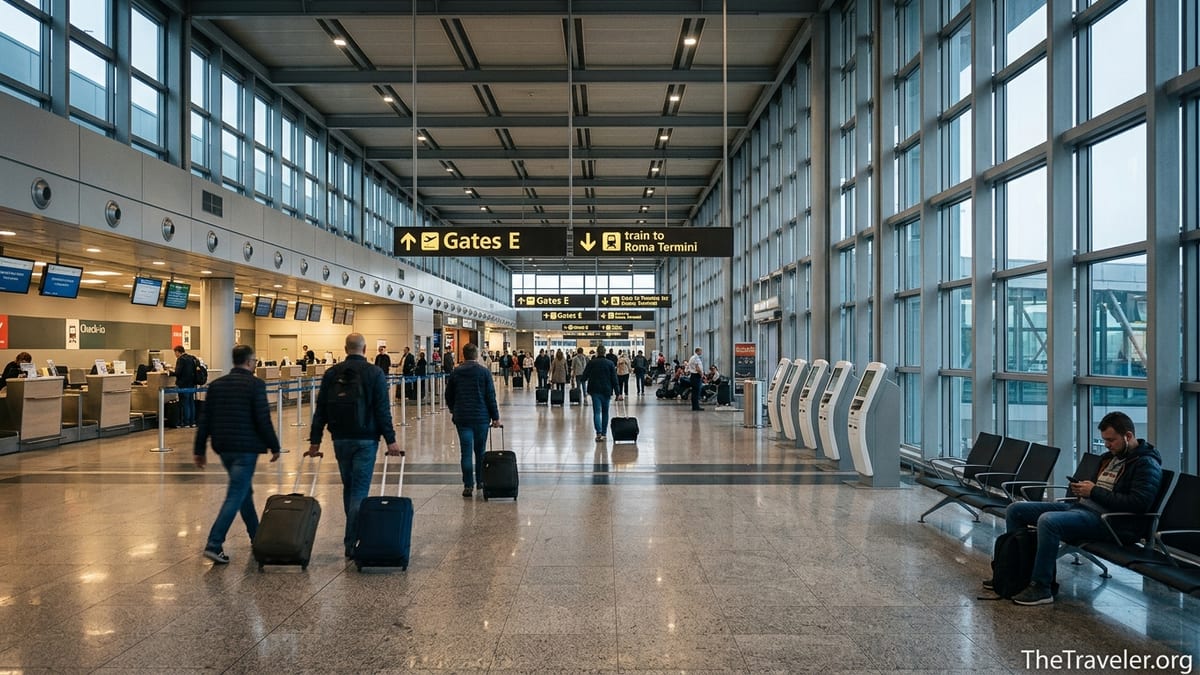
Know Your Terminal Before You Even Leave Home
On my last trip I made the classic Fiumicino mistake: I arrived assuming I could simply “follow the signs” once I got there. Rome Fiumicino currently operates mainly with Terminal 1 and Terminal 3 for passengers, and which one you use depends strictly on your airline and route, not your preference. Terminal 3 handles most long haul and non‑Schengen flights, Terminal 1 more of the Schengen and European traffic, but there are exceptions. I spent my first 20 minutes landside walking in the wrong direction because I had not checked my airline’s terminal the night before.
Next time, I will look at both my airline email and the airport’s departure board online before leaving for the airport. If I am flying ITA Airways to Paris or Milan, for example, I will expect to use Terminal 1. If I am flying Delta, United or another carrier to North America, I will assume Terminal 3 and its E boarding areas. I will also note the check in row number shown on my booking, because at Fiumicino the rows correspond quite cleanly to specific parts of each terminal. Walking straight to the right row can easily save 10 or 15 minutes of wandering.
I also underestimated how close the terminals are once you know where you are going. Walking between Terminal 1 and Terminal 3 landside or airside is usually only a few minutes, but it feels longer when you are dragging luggage in circles. Next time, I will zoom in on the official terminal map in advance and mentally mark the path from my arrival point to either security or the train station, instead of trying to decode it with jet lag.
One more change: I will stop assuming that a “Rome” flight always uses the main terminal area. Some low cost or leisure carriers occasionally move check in to different wings at short notice. I will check my airline’s app on the morning of travel for any last minute terminal or row changes at FCO so I do not queue at the wrong counters.
Time Security Around Realistic Queues and QPass
The single most stressful part of my last Fiumicino departure was security. I arrived just over two hours before my flight, thinking that an early May weekday would be calm. Instead, I hit the morning peak between 7 and 9 a.m. and found myself in a slow moving line that snaked across Terminal 3. It took close to an hour to clear security alone, leaving me rushing through passport control to reach my gate as boarding started.
Security waits at FCO can vary a lot by time of day and season. Recent queue data suggests that the worst window is early morning, roughly 5 to 9 a.m., particularly in summer when short haul European flights and transatlantic departures all stack up. Midday and late evening can be significantly quieter, and midweek days like Tuesday and Wednesday generally see lighter loads than peak weekend mornings. In practice, that means I will now aim to be at the airport a full three hours early for a non Schengen or UK flight that departs between 7 and 10 a.m., and at least two and a half hours early for most other departures.
More importantly, I completely ignored one of Fiumicino’s best features: QPass. This is a free, bookable time slot system that gives you access to a dedicated security lane in Terminals 1 and 3. You choose a 15 minute window online in the week before your flight, show the QR code at the QPass entrance, and join a much shorter queue. It is not available for flights to the United States or Israel, but for most European and many long haul routes it can turn a 40 minute security wait into well under 15 minutes. Next time I will always look up QPass availability as soon as I know my flight time.
I will also pack and dress with Fiumicino security in mind. Laptops and large electronics usually still come out of bags, and at busy times agents can be strict about liquids and oversized cosmetic containers. Watching families repack half their suitcase at the conveyor belt convinced me to keep all liquids in one small pouch and wear shoes that slip on and off quickly. Those small choices matter when every minute in line feels long.
Plan Your Connection Like a Train Change, Not a Simple Walk
Fiumicino is not the most complicated hub in Europe, but my recent connection there felt more like a cross city transfer than a simple gate change. I arrived from another Schengen country into Terminal 1 and needed to catch a non Schengen flight from the E gates, which are reached via the pier off Terminal 3. I assumed 60 minutes would be plenty. Between following the overhead “Transit / Connections” signs, clearing security again and then joining a long line for exit passport control, I reached my onward gate with only a few minutes to spare.
Next time I book a connection in Rome, I will treat it the way I treat train connections in a busy station. For a Schengen to non Schengen transfer at FCO, I will insist on at least 90 minutes, and two full hours if I am traveling in high summer or during school holidays when immigration lines lengthen. Even Schengen to Schengen connections can require a fair walk and a possible security check depending on the exact gates, so I will avoid anything under 60 minutes unless the flights are on a single ticket and protected by the same airline.
I also learned that Fiumicino’s airside layout can be deceptive. On the map, the E gates look like a simple extension off Terminal 3. In reality, it is a large pier reached by escalators and an elevated corridor, and walking from one end to the other with a roll aboard can take 10 to 15 minutes. If my connection involves moving from a domestic or Schengen gate in Boarding Area A or B to a long haul gate in E, I will assume roughly 25 minutes of actual walking and queuing time just to cover that distance.
Finally, I will pay much closer attention to whether my bags are checked through and whether I need to pass landside. If I am arriving on a low cost European airline and then leaving on a separate ticket on a transatlantic carrier, I will not risk a tight self made connection at FCO. It can easily take an hour to clear immigration, wait for luggage, recheck with a new airline and go back through security and passport control again. Rome is not the place where I want to gamble with a one hour do it yourself transfer.
Rethink How I Get Between the Airport and Central Rome
Coming into Rome last time, I defaulted to the most obvious option: the Leonardo Express train straight from Fiumicino Aeroporto station to Termini. It is a non‑stop service, runs roughly every 15 minutes during the day and takes about 30 to 32 minutes. The station is right inside the airport complex, a 5 to 10 minute walk from the arrivals halls of Terminals 1 and 3 via covered walkways. It is fast and convenient, but I bought my ticket in a hurry from a kiosk near the platform and paid more attention to catching the next departure than to the alternatives.
Next time, I will decide how I am getting into Rome before I even land, and I will match the option to where I am staying. If my hotel is near Roma Termini or directly on Metro Line A or B, Leonardo Express is still an obvious choice. A one way ticket typically costs in the mid teens in euros and you simply hop on any train within your ticket time window. From Termini, I can then roll my luggage a short distance to hotels in the Esquilino or Monti neighborhoods, or jump on the metro for areas like the Spanish Steps, the Vatican or the Colosseum.
If I am staying in Trastevere, Ostiense, Tiburtina or another neighborhood served by the FL1 regional train, however, I will seriously consider that line instead. The FL1 runs from Fiumicino through several local stations around Rome. It is usually cheaper than Leonardo Express and avoids the congestion of Termini completely. For example, getting off at Trastevere station puts you close to many guesthouses and apartments on the west side of the Tiber, and it is easy to connect to a tram or short taxi ride from there.
I will also be more strategic about taxis. Official white taxis from Fiumicino have a fixed city center fare, which can make sense late at night, with heavy luggage or when traveling as a group. What I will avoid is grabbing an unlicensed driver who approaches me in the arrivals hall, or defaulting to a taxi when trains are running normally. In rare cases, disruptions on the Leonardo Express or FL1 lines can lead to long queues at Termini and the airport stations; if that happens, I will either wait for services to resume or compare the fixed taxi fare to a prebooked car transfer, instead of joining a chaotic scrum without a plan.
Use Lounges, Seating and Services Instead of Suffering the Wait
One of my most avoidable mistakes at Fiumicino was how I spent my time once I finally cleared security. I wandered aimlessly through duty free shops, perched on the edge of a noisy food court table and charged my phone at a crowded stand. Only later did I realize there were quieter seating areas, better food options and even reasonably priced pay in lounges I could have used, both in Terminal 1 and Terminal 3.
Next time, I will decide in advance how I want to spend my pre flight time. If I have more than two hours airside, I will seriously consider a lounge. Several airline and independent lounges at Fiumicino sell day access or accept common lounge passes, particularly near the E gates in Terminal 3. A few hours with comfortable chairs, decent espresso, snacks and reliable Wi Fi can completely change the feel of a long layover. I will check which lounges my ticket or credit card might already unlock so I am not figuring it out at the door.
Even without lounge access, FCO offers more than I used on my last trip. There are quieter seating zones at some distance from the busiest food areas, often near less used gates. Cafes and bars dot the terminals, and prices, while airport high, are not outrageous by big hub standards. Instead of grabbing the first pre made sandwich I see, I will walk a little further and find a bar or bakery where I can sit with a proper cappuccino and a simple panino while keeping an eye on the screens.
I will also be more aware of the airport’s practical services. Fiumicino has information desks, medical points, pharmacies and luggage wrapping kiosks if I need them. For an overnight or very early departure, I will research whether it makes sense to book the on site airport hotel or a nearby property with a shuttle, rather than trying to camp on a metal bench landside. Passengers do sleep in the public area overnight, but staff may move people around during late night cleaning, and seating is much less comfortable than the airside zones that open in the early morning.
Handling Overnight Stays and Very Early Flights
On a previous trip I landed in Rome just before midnight and had a morning flight out of Fiumicino the next day. To save money, I tried to stay overnight in the terminal. The result was a long, chilly night on public benches, intermittent announcements, cleaning machines running past and constant low level uncertainty about where I was allowed to sit. Security for my morning flight did not even open until several hours later, so I could not access the more comfortable airside seating until close to dawn.
If I find myself facing a similar schedule again, I will do things differently. First, I will check whether I can shift either the inbound or outbound flight slightly to avoid an airport night altogether; often paying a little more for a midday connection is worth it in saved stress. If that is not possible and I have a gap of more than six or seven hours overnight, I will compare the cost of a simple airport hotel to the value of real sleep and a shower. There are hotels just outside the terminal complex and within a short shuttle or taxi ride that cater specifically to overnight passengers.
If I still decide to stay at the airport, I will plan it deliberately. I will bring an extra layer or light travel blanket, use an eye mask and earplugs, and locate a quieter corner of the public area away from constant foot traffic. I will also check when my airline opens check in for early flights. At Fiumicino, some desks open around three hours before departure, which can allow you to clear security and move airside earlier than you might expect. Spending the pre dawn hours in a warm gate area with working outlets is far more pleasant than sitting under harsh lights outside the check in zone.
For very early departures, I will build in extra buffer time even if it means waking up painfully early. Trains and buses to the airport run less frequently before dawn, taxis can be in higher demand and security queues can spike unexpectedly when several early long haul flights depart. For a 7 a.m. non Schengen flight, I will aim to be physically at FCO by 4 a.m., giving myself time for check in, security, exit passport control and a coffee before boarding instead of sprinting through a half closed terminal.
The Takeaway
Rome Fiumicino is a big, busy airport that has improved a lot in recent years, but it still rewards travelers who plan ahead. On my last trip I treated it like a generic European hub and paid the price in stress, long lines and rushed connections. Next time I will know my terminal and check in row before I leave home, use QPass whenever my route allows, and give myself realistic time for security and passport control, especially at peak hours.
I will also stop treating the journey into and out of Rome as an afterthought. Choosing between Leonardo Express, the FL1 regional train and official taxis based on where I am staying will save both money and time. Inside the airport, making deliberate use of lounges, quieter seating, services and, when needed, nearby hotels will turn long layovers and awkward overnights into something far more manageable.
The airport that felt chaotic and confusing on my last visit is much easier to handle when you understand its rhythms. With a bit of preparation and a willingness to spend a few extra minutes checking terminals, train options and security tools, Fiumicino can become a straightforward gateway to Rome instead of the most stressful part of your trip.
FAQ
Q1. How early should I arrive at Rome Fiumicino for an international flight?
For long haul or non Schengen flights, especially in the morning peak, plan to be at the airport around three hours before departure. In the busiest summer months or if you need to check bags and clear exit passport control, adding an extra 30 minutes is sensible.
Q2. Is the Leonardo Express the best way to get from Fiumicino to central Rome?
Leonardo Express is the fastest and simplest option if you are heading to or near Roma Termini, thanks to its non stop service and frequent departures. If your accommodation is closer to neighborhoods like Trastevere or Ostiense, the FL1 regional train or a combination of train and tram can be more direct and often cheaper.
Q3. How long does it take to walk from the terminal to the train station at FCO?
From the arrivals halls of Terminals 1 and 3, most travelers reach the Fiumicino Aeroporto station in about 5 to 10 minutes using the covered walkways. Allow a bit longer if you are traveling with small children, heavy luggage or mobility issues.
Q4. What is QPass and should I use it?
QPass is a free service offered at Fiumicino that lets you book a specific time slot for a dedicated security lane in Terminals 1 and 3. If your flight is eligible and you can commit to a time window, using QPass can significantly reduce your security waiting time.
Q5. Are connections at Fiumicino difficult?
Connections are manageable but can feel long because of walking distances and passport control. Schengen to non Schengen transfers usually require both security and exit passport checks, so planning at least 90 minutes, and up to two hours in peak season, is wise.
Q6. Can I sleep at Fiumicino Airport overnight?
Yes, passengers do stay overnight in the public areas of the terminals, but seating is basic and the environment can be noisy and bright. For a more restful night and a shower, many travelers prefer booking a nearby hotel that offers early morning shuttles back to the airport.
Q7. Are taxis from Fiumicino to Rome safe and fairly priced?
Official white taxis with a city license are regulated and offer a fixed fare to central Rome, which is clearly displayed inside the vehicle. To avoid problems, ignore informal drivers who approach you in the arrivals hall and use only the official taxi rank outside the terminal.
Q8. What can I do during a long layover at Fiumicino?
During a layover of several hours, you can relax in an airline or pay in lounge, find a quieter seating area near your gate, enjoy an espresso or meal at one of the cafes and browse shops. With enough time and the right visa status, you may also consider a quick train or taxi trip into the city, but you must allow plenty of time to return and clear security again.
Q9. How busy is security at FCO during the summer?
In the peak months of June through August, early morning and weekend departures can see long security and passport queues. While not every day is crowded, travelers in summer should assume that lines will be slower than in low season and arrive earlier to compensate.
Q10. Is Fiumicino a good airport for travelers with limited mobility?
Fiumicino offers assistance services for passengers with reduced mobility, including wheelchairs and escorted support through security and boarding. It is essential to request this help in advance through your airline so staff can meet you at check in or the arrivals area and guide you smoothly through the airport.