


Malaysia remains one of Southeast Asia’s best value destinations, but 2026 price rises for trains, airport links, domestic flights and attractions mean travelers planning a 2027 trip need up to date numbers, not pre‑pandemic assumptions. This guide pulls together current 2026 prices and the latest announced 2027 fares to build realistic seven‑day budgets for Kuala Lumpur, Penang and Langkawi, and to show how transport choices, neighborhood selection and taxes shape what you actually spend.
Get the latest updates straight to your inbox!
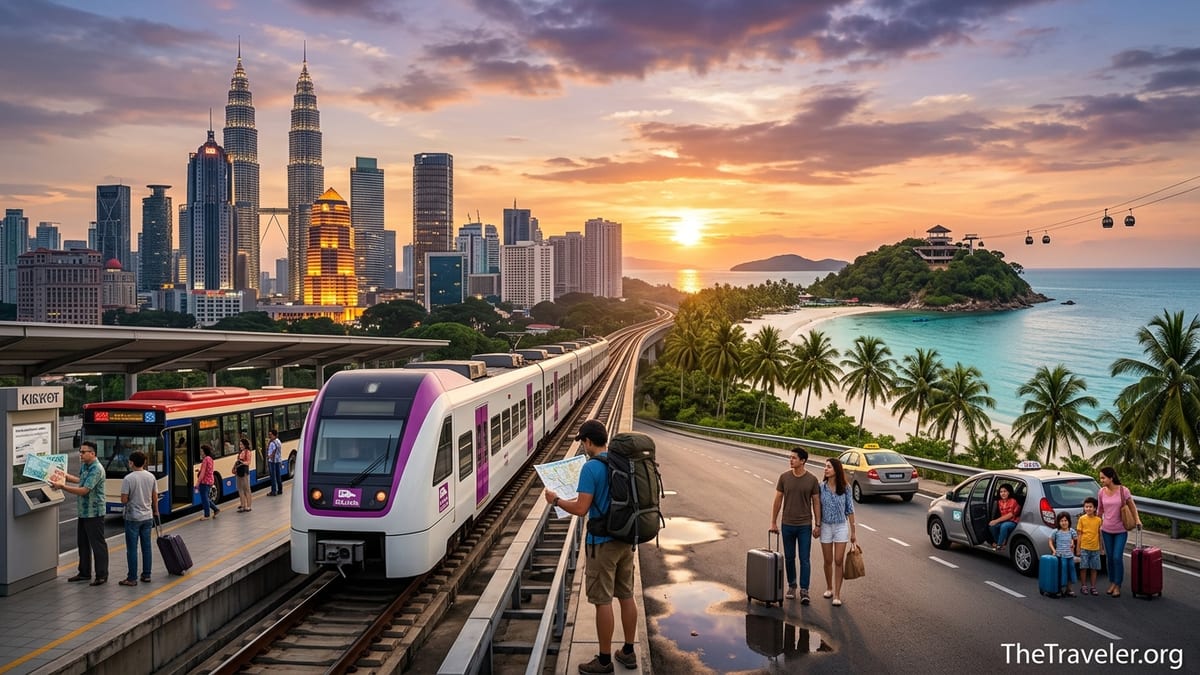
Seven-day snapshot budgets for 2027
To anchor the numbers, all budgets below are for seven days on the ground, excluding international flights into Malaysia. They cover accommodation, food, domestic transport, selected attractions, mobile data and mandatory tourism taxes. Exchange rates move, but in late 2026 one US dollar buys roughly 4.7 Malaysian ringgit, one euro about 5.0 ringgit and one British pound about 5.5 ringgit. Figures in foreign currencies are approximate and for planning only.
For a solo budget backpacker splitting time between Kuala Lumpur and Penang and relying heavily on public transport, a realistic seven-day total is around RM1,400 to RM1,700, or roughly 300 to 360 US dollars. That assumes hostel beds in Chinatown or Bukit Bintang and guesthouses in George Town, hawker-center food, city trains and buses, one long-distance train or bus between the cities, and a handful of paid attractions such as the Petronas Twin Towers.
A midrange couple combining Kuala Lumpur and Langkawi with three-star hotels or well-reviewed budget boutiques will typically spend RM3,800 to RM4,800 over seven days, around 800 to 1,020 US dollars per couple. This assumes private ensuite rooms in Bukit Bintang or KL Sentral, a midrange hotel near Pantai Cenang, several Grab rides or short car hire on Langkawi, and paid highlights like the Langkawi cable car.
A family of four (two adults, two children) aiming for comfortable hotels in Penang and Langkawi, with occasional resort facilities and a few organized tours, should plan for RM6,500 to RM8,500 over a week, or around 1,380 to 1,800 US dollars. This allows a larger room or two interconnecting rooms in George Town, a family-friendly resort around Pantai Cenang or Kuah, domestic flights for everyone, car rental on Langkawi and island-hopping or mangrove tours.
Where you stay: KL, Penang and Langkawi neighborhoods
In Kuala Lumpur, Bukit Bintang remains the classic tourist base. It is intensely walkable for shopping malls, cafes and nightlife, with monorail and MRT stations such as Bukit Bintang and Pavilion Bukit Bintang putting most of the city within a short train ride. As of late 2026, basic guesthouses and simple rooms in this area are commonly advertised from around RM70 per night, while three-star hotels tend to fall in the RM130 to RM220 range for advance online bookings. Prices climb quickly for properties directly on Jalan Bukit Bintang or attached to major malls.
Chinatown, centered on Petaling Street and the Pasar Seni area, offers a denser mix of heritage shophouses, bars and cafes. It is less polished than Bukit Bintang but well connected by LRT and MRT at Pasar Seni. Mid-tier boutique hotels here often list rates around RM180 to RM250 per night for a double room if booked ahead, with cheaper capsule hostels and guesthouses bringing costs down for backpackers. Some streets can be noisy late into the night, so travelers who value quiet may want to look a block or two away from the main market lanes.
KL Sentral is less atmospheric but highly practical. Hotels such as budget three-stars around the station give direct access to airport trains, intercity rail and multiple LRT and MRT lines within a few minutes’ walk. Typical three-star hotels here are frequently advertised in the RM150 to RM230 bracket per night for two, while international four and five-star chains attached to the station command substantially more. For short stays or late-night airport arrivals, the savings in time and airport transfers can outweigh the higher room price.
In Penang, most independent travelers choose George Town. A mix of hostels, heritage guesthouses and modern midrange hotels keeps options broad, with simple private rooms for two often available from about RM100 to RM180 per night and midrange hotels commonly between RM230 and RM320. You can walk from many George Town properties to hawker centers, clan jetties and street art, while ride-hailing fills gaps. On Langkawi, Pantai Cenang concentrates the island’s busiest beach strip and many restaurants; recent price checks for this area show basic rooms from roughly RM80 and mainstream three-star hotels commonly above RM200 per night. Kuah, the main town and ferry port, tends to offer slightly lower hotel rates and is convenient for duty-free shopping, but it is less of a beach destination.
Urban and domestic transport: where the ringgit goes
Kuala Lumpur’s rail and bus network keeps city transport affordable if you tap in with Touch ’n Go or similar stored-value cards. Across the LRT, MRT and monorail lines, short hops of one or two stations typically cost a little over RM1, cross-city rides often fall in the RM2 to RM4 range and the longest MRT journeys peak around RM6 per trip. A heavy sightseeing day that chains together several rides usually lands in the RM8 to RM12 range per person. There are also monthly passes, but visitors on short stays rarely use them enough to save money.
Airport access is a bigger budget item. From January 1, 2027 the KLIA Ekspres and KLIA Transit airport trains are scheduled to charge RM65 for a standard one-way adult fare between KL Sentral and Kuala Lumpur International Airport Terminals 1 or 2, following a 2026 announcement of a fare adjustment from RM55. Promotions still exist for group tickets and advance online purchases, but anyone budgeting for 2027 should treat RM65 as the baseline per adult per direction. In contrast, airport buses into central Kuala Lumpur are typically far cheaper, with recent fares around RM15 to RM18 one-way, at the cost of longer journey times and susceptibility to traffic.
Ride-hailing with Grab fills many gaps. For an airport run from KLIA to central Kuala Lumpur in 2026, travelers commonly report base fares around RM60 to RM70 for a standard car, plus several ringgit in highway tolls. Short inner-city rides of a few kilometers usually sit between RM6 and RM15 depending on traffic, time of day and demand. This can be cost-effective for couples or groups compared with four individual train tickets, especially when hotels are not directly at a rail station.
In Penang, Rapid Penang buses remain a practical backbone. Current published fare bands for core routes such as 101 (George Town to Batu Ferringhi and Teluk Bahang), 102 (airport to Teluk Bahang) and 401E (George Town and Komtar to the airport) run roughly from RM1.40 for short stages to around RM5 for the longest rides, with service frequencies between 10 and 75 minutes depending on the route. George Town also benefits from a free or low-cost central-area shuttle, helping cut taxi usage for short hops between the jetties, Komtar and heritage streets.
Langkawi’s transport gap: why cheap rooms can become expensive
Langkawi’s key budget complication is the lack of conventional public transport. There is no island-wide public bus network comparable to Kuala Lumpur or Penang, and travelers who rely on point-to-point taxis or ride-hailing from a budget resort can see their daily spend rise sharply. A single taxi ride from Pantai Cenang to Kuah, or from many resorts to the Langkawi Cable Car at Oriental Village, can cost enough that two or three such trips in a day rival the price difference between a simple room and a midrange one.
Most visitors solve this with short-term vehicle rental. Rental counters and small agencies around Pantai Cenang and the airport commonly advertise small cars at daily rates that, in late 2026, often start somewhere in the RM80 to RM120 range for basic models, with scooters cheaper but subject to license and safety considerations. Fuel costs are modest compared with many countries, so even conservative driving budgets rarely exceed RM10 to RM20 of petrol per full day of island exploring. For couples or families, a rented car used for several days usually works out cheaper than stacking multiple taxi fares.
The flip side is that if you do not want to drive, it may be worth paying more for a hotel that is walkable to a beach, restaurants and simple shops. Around Pantai Cenang, that can mean stepping up from a RM90 guesthouse to a RM230 or RM280 hotel but then walking to dinner and using taxis only for occasional excursions. Conversely, a cheaper property in a quieter pocket of the island might need two or three RM25 to RM40 taxi rides most days once you add up beach runs, restaurant trips and sightseeing, pushing the total spend well above the apparent room saving.
For Penang to Langkawi connections, it is also important to factor in mainland transfers. The once-popular direct passenger ferry between Penang’s Swettenham Pier and Langkawi’s Kuah Jetty has not resumed since its pandemic suspension and was still listed as suspended in transport checks during late 2026. Travelers now usually either fly directly between Penang and Langkawi on short domestic hops or travel via the mainland to Kuala Kedah or Kuala Perlis, then take a ferry onward, which adds bus or train legs and local taxis.
Domestic flights, intercity trains and buses
On many Malaysia itineraries, the main long-distance choices are Kuala Lumpur–Penang and Penang–Langkawi. Between Kuala Lumpur and Penang, travelers can take a fast ETS intercity train from KL Sentral or Kuala Lumpur station to Butterworth, then connect to George Town by ferry or the Penang bridge, or opt for intercity buses and domestic flights. Train fares vary by class and timing, but economy tickets booked in advance often represent good value for the roughly four-hour journey, while budget airlines sell Kuala Lumpur to Penang flights that regularly go on sale for very low base fares before adding luggage and seat selection fees.
On Penang–Langkawi, the current pattern is a patchwork. Direct flights link Penang International Airport with Langkawi and can be surprisingly affordable when booked ahead, especially on low-cost carriers during non-peak dates. Travelers who prefer ferries now usually travel from Penang to the mainland bus terminal, take a bus or train north to Kuala Perlis or Kuala Kedah, then board ferries that typically take around 75 to 90 minutes to reach Langkawi. Ferry fares from Kuala Perlis, for example, have recently been quoted in the RM18 range one-way, though operators have adjusted prices within the last few years and may do so again by 2027.
When comparing these modes, time as well as money matters. A Kuala Lumpur–Penang domestic flight may have a short airborne time but involve airport transfers, check-in and potential delays; a through-train from KL to Butterworth can be more predictable door-to-door, especially if your hotel in George Town is near the ferry or bridge pickup point. Similarly, a direct Penang–Langkawi flight often beats the combined cost and complexity of bus plus mainland ferry for short trips, whereas overland routes can make sense for those with more time, tight budgets and a strong preference for surface travel.
Seasonality also matters. Malaysia’s national holidays and school breaks in May, August, late October and around the end-of-year festive period see both airfares and many bus tickets rise in price or sell out early. In those weeks, even low-cost carrier fares for trunk routes can be several times higher than off-peak prices, and popular ferry departure times may need to be booked ahead to avoid long waiting periods in mainland terminals.
Food costs: hawker centers to beach restaurants
Food can be one of the biggest sources of savings or splurge. In Kuala Lumpur and Penang, hawker centers, mamak restaurants and kopitiams still offer substantial meals for modest prices. In 2026, a plate of nasi lemak, char kway teow or chicken rice at a neighborhood stall often comes in around RM8 to RM15 in central areas, with drinks like teh tarik or iced kopi adding a few ringgit. Simple roti canai breakfasts with a drink can be even cheaper. Air-conditioned food courts in malls charge slightly more, but meals for RM10 to RM20 are widely available.
In George Town, well-known hawker clusters near Komtar, along Penang Road and around Gurney Drive remain excellent value. A traveler who mostly eats at hawker centers and mamak outlets can keep daily food costs around RM40 to RM60 per person, including drinks and occasional snacks, while mixing in one cafe brunch or a midrange sit-down dinner may lift that to the RM70 to RM90 bracket. Supermarkets and convenience stores are good sources of inexpensive fruit, water and snacks and help keep breakfast costs low if your accommodation does not include it.
On Langkawi, prices at tourist-facing beach restaurants along Pantai Cenang and other resort strips are generally higher than hawker centers on the mainland. Seafood dinners, Western menus and bars with sunset views often charge closer to international resort levels, so two adults ordering mains, shared sides and drinks can easily spend RM80 to RM150 on a single evening meal. However, if you venture a few streets back from the main strip or head into Kuah town, you will still find local eateries and simple rice-and-noodle shops where meals land closer to RM10 to RM20 per plate.
When budgeting for food, a cautious rule for 2027 is approximately RM60 per day per person for a backpack-style trip that leans heavily on hawker food and supermarket snacks, RM90 to RM120 per day for midrange travelers mixing street food with cafes and restaurant dinners, and RM150 or more for those frequently choosing hotel restaurants, waterfront venues and imported wines or craft cocktails.
Taxes, fees and attraction prices in 2027 planning
Malaysia’s national tourism tax is a flat RM10 per room per night, payable by foreign tourists staying at most registered accommodation. A federal rate order published in December 2025 confirmed the RM10 rate, which applies regardless of hotel star rating but only to eligible premises. Malaysian citizens are exempt, and some categories such as homestays registered under specific rural programs may also be excluded. This tax is on top of room rates and any separate state or local levies.
How the tax is collected depends on how you book. Guidance from Malaysia’s Royal Customs Department explains that registered digital platform service providers are required to collect tourism tax on eligible bookings at the point of sale, charging RM10 per room per night along with your accommodation cost. In other cases, hotels and guesthouses add the tax on arrival or at check-out, which is why booking engines sometimes show “taxes not included” line items for Malaysia stays. Penang and Langkawi may also impose modest local government fees per room per night, collected separately by the property.
For attractions, current 2026 prices can be used as a working basis for 2027 budgets but should be rechecked close to travel. At the Petronas Twin Towers in Kuala Lumpur, the official ticket price for a non-Malaysian adult is presently around RM127 on weekdays and RM137 at weekends, with lower rates for children and seniors. Batu Caves itself is free to enter, but you will spend a few ringgit each way on train or bus fares from central Kuala Lumpur and may choose to pay for guided tours or nearby attractions.
In Penang, admission fees for heritage houses, museums and the Penang Hill funicular are modest compared with many global cities but can add up over several days. Langkawi’s signature Langkawi Cable Car, or SkyCab, currently lists standard tickets for international visitors at about RM85 per adult and RM65 per child, including the return cable car ride and entry to several base attractions, with separate optional charges for the SkyBridge, glass walkways or express-lane upgrades. Popular island-hopping trips and mangrove tours around Langkawi’s UNESCO Global Geopark run at various price points, so for budgeting, allocating RM150 to RM250 per person for one or two organized excursions over a week is reasonable.
Three complete seven-day example budgets
For a backpacker spending four days in Kuala Lumpur and three in Penang, assume hostel beds in Chinatown at RM60 per night and a simple guesthouse in George Town at RM70. Seven nights of accommodation totals roughly RM460. Add the tourism tax of RM10 per room per night; if you are in a dorm bed where the property charges per bed-night, budget around RM70 for the week. Daily food at hawker centers averaging RM60 comes to RM420 for seven days. Urban transport on trains and buses at RM10 per day is RM70, with one airport bus at RM18 and a train or bus between KL and Penang at around RM60 to RM90. Add RM150 to cover attractions such as the Petronas Twin Towers, Penang Hill and a few museum or temple entries, and RM60 for a local SIM or eSIM plus top-ups. That totals in the region of RM1,300 to RM1,500, leaving a small margin for coffees and occasional Grab rides to reach the earlier RM1,400 to RM1,700 planning band.
For a midrange couple spending three nights in Kuala Lumpur and four on Langkawi, imagine a three-star hotel in Bukit Bintang at RM220 per night (three nights = RM660) and a comfortable hotel within walking distance of Pantai Cenang at RM260 per night (four nights = RM1,040). Room costs reach RM1,700, plus the tourism tax of RM10 per room per night for seven nights (RM70). Food at RM200 per day per couple, mixing street food lunches with restaurant dinners and a few drinks, comes to RM1,400. Domestic flights from Kuala Lumpur to Langkawi and back for two might average RM500 to RM800 in total in 2027 outside peak weeks if booked ahead. Add KLIA Ekspres or airport buses, airport–hotel transfers, and several Grab rides in KL and taxis on Langkawi, totaling perhaps RM500 including one or two days’ car rental. Attractions such as the Langkawi Cable Car for two, small entrance fees elsewhere and a shared island-hopping tour may add RM500 to RM700. Include RM120 to RM160 for mobile data and contingencies, and this midrange couple’s seven days sit roughly in the RM3,800 to RM4,800 band excluding international airfare.
For a family focusing on Penang and Langkawi with comfortable accommodation, consider four nights in George Town and three on Langkawi. A family-sized room or two interconnecting rooms in George Town at an average of RM450 per night for four nights totals RM1,800; a family-friendly Langkawi resort at RM600 per night for three nights adds RM1,800, for RM3,600 in room costs. The national tourism tax at RM10 per room per night might mean RM140 if booking two rooms for seven nights. Daily food at around RM350 for the family, allowing for hawker lunches, cafe treats and restaurant dinners, reaches RM2,450 over seven days. Domestic flights for four between Penang and Langkawi and to or from Kuala Lumpur can easily reach RM1,200 or more in peak periods. Add one week of mixed transport, including airport transfers, taxis in Penang, and three or four days of car rental plus fuel on Langkawi at perhaps RM900 to RM1,200 in total. Attractions including the cable car, Penang Hill, a heritage house or two and one or two paid tours could add RM800 to RM1,200, with RM200 or so for mobile data and small extras. Summed, this sits comfortably in the RM6,500 to RM8,500 bracket for a week, with the higher end reflecting peak-season and more activities.
In all three cases, the structure of spending is similar: accommodation and domestic transport form the backbone, food can be controlled through venue choices, and attractions plus optional tours top up the total. Understanding that pattern lets you dial budgets up or down without constant surprise charges.
Peak periods, value strategies and 2027 planning tips
Malaysia’s school holidays and major festivals such as Chinese New Year, Hari Raya, the year-end period around Christmas and New Year, and domestic long weekends typically bring noticeable price spikes. Hotel rates in Bukit Bintang, George Town and Pantai Cenang can climb 30 percent or more, some budget properties will sell out entirely, and attractive time slots for attractions like the Petronas Twin Towers or Langkawi Cable Car book out earlier. Domestic flights on trunk routes like Kuala Lumpur–Penang and Kuala Lumpur–Langkawi are especially sensitive to these peaks, with fares sometimes several times off-peak levels.
To maximize value in 2027, consider booking your first and last nights near major transport hubs such as KL Sentral or George Town’s ferry and bus terminals, using airport buses instead of premium trains when time allows, and clustering high-fare activities into a limited number of days. In Kuala Lumpur and Penang, relying on trains and buses for most journeys while using Grab only sparingly for late nights or awkward connections can keep transport costs modest. In Langkawi, running the numbers on car rental versus taxis before you book your hotel can prevent a cheap but isolated resort from becoming the most expensive option.
On the accommodation side, flexible travelers can mix one or two nights in a splurge property with several nights in simpler rooms, especially in areas like George Town where well-located guesthouses deliver character and walkability. Booking platforms may quote room rates without clearly including the national tourism tax or state fees, so when comparing two properties, always add RM10 per room per night plus any listed local government charges to the nightly rate to get your real cost.
Finally, treat 2026 prices and announced 2027 fares as a planning baseline rather than a guarantee. Airport rail fares, domestic air ticket promotions, and attraction entry fees have all risen in recent years and may adjust again. Before you lock in a final budget, recheck a few sample hotel dates in Bukit Bintang, George Town and Pantai Cenang, confirm airport train or bus fares and verify attraction prices directly with operators. With that done, Malaysia should remain a country where even cautious budgets still stretch to excellent food, efficient transport and a mix of city skylines, heritage streets and island sunsets.