


Montenegro is no longer the ultra-cheap Adriatic secret it was a decade ago, but in 2027 it still delivers good value if you understand how seasons, locations and transport choices shape costs. Using late‑2026 price data and cautious projections, this guide sets out realistic one‑week budgets for Kotor, Budva and inland hubs like Cetinje and Žabljak, then drills into accommodation, transport, activities and beach spending so you can match your plans to your wallet.
Get the latest updates straight to your inbox!
Seven‑day budget benchmarks for 2027
International flights are not included in the budgets below, partly because visitors reach Montenegro via very different routes: regional low‑cost flights into Tivat or Podgorica, overland buses from Croatia or Albania, or long‑haul itineraries via hubs like Vienna and Istanbul. The figures focus on on‑the‑ground costs in euros for a typical July or early September 2027 trip, using late‑2026 prices as a baseline with a modest upward adjustment.
For a solo budget backpacker relying on buses, dorm beds and self‑catering, a realistic seven‑day total in 2027 is around 420 to 520 euros. That assumes hostel dorms in Kotor or Budva from about 35 to 45 euros in July and August, based on 2026 high‑season quotes of 40 to 50 euros per night in Kotor Old Town hostels, plus simple bakery breakfasts, supermarket lunches and a mix of cheap grills and occasional sit‑down dinners. It also covers local buses between Kotor and Budva, a Perast boat excursion, at least one national park visit and modest nightlife.
A midrange couple staying in studios or three‑star hotels around the Bay of Kotor and in Budva should expect a seven‑day total of roughly 1,200 to 1,500 euros in high season. This assumes accommodation of 80 to 130 euros per night for two in Kotor Bay or Budva, which aligns with late‑2026 prices where three‑star and four‑star hotels in Budva cluster around 80 to 130 euros per night, and midrange Kotor Old Town or Dobrota apartments in summer typically range from about 90 to 150 euros depending on views and finish. Add restaurant meals, boat tours, fortress and cable car tickets, beach spending, local buses, tourist taxes and some contingency for taxis and coffees.
Comfort‑focused travelers in 2027, especially those renting a car and splitting time between the coast and inland areas such as Cetinje and Žabljak, should plan on 1,800 to 2,300 euros for two people for seven days in July or August. This level assumes a mix of quality four‑star hotels in Budva or Bečići from roughly 150 to 250 euros per night in peak season based on 2026 price lists, comfortable boutique stays in Kotor Old Town or on the waterfront around Dobrota that can easily top 180 euros in August for premium sea‑view rooms, plus a modern rental car, fuel, parking, higher restaurant spend and multiple organized excursions.
Where you sleep: Kotor, Budva, Perast and the mountains
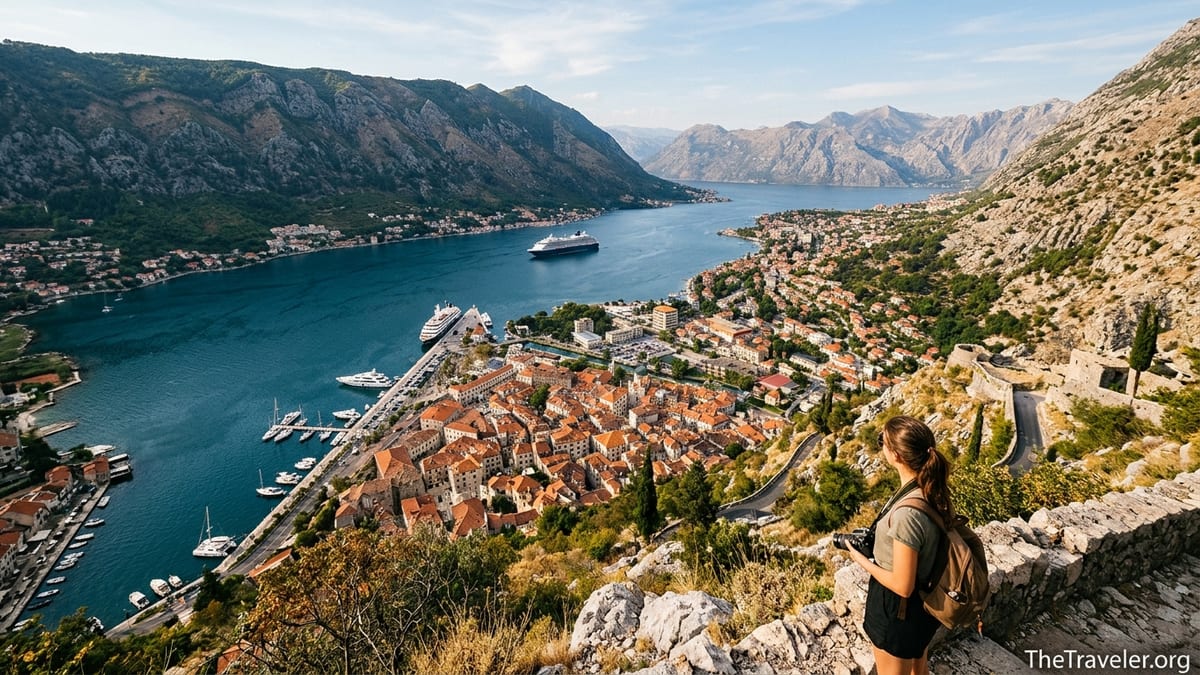
Within Kotor, accommodation costs vary sharply across neighborhoods. In 2026, a bed in a mixed dorm in a central Kotor Old Town hostel runs about 40 to 45 euros in July and around 45 to 50 euros in August, with May and October closer to 20 to 25 euros and June and September in the 30 to 40 euro range. Private double rooms or studios within the walls often start near 100 euros in July and can reach 150 to 180 euros for stylish apartments with views of the cathedral or bay, especially when cruise schedules show multiple ships in port.
Staying around the bay, Dobrota and Muo usually undercut the Old Town by 15 to 30 percent outside the peak weeks, particularly in May, early June and late September. Simple studios without direct waterfront in Dobrota can still be found around 60 to 80 euros per night for two in shoulder season, rising to roughly 90 to 120 euros in July and August. Waterfront hotels and apartments with private jetties and sun loungers often exceed 140 to 180 euros in August, reflecting the premium on direct sea access and limited inventory along the narrow road.
Budva and nearby Bečići have a broader spectrum. Live late‑2026 data shows basic hotels in Budva starting around the high‑30s per night, with a cluster of three‑stars around 80 euros and many four‑stars for two people between roughly 120 and 140 euros for central dates outside the absolute peak. Beachfront resorts in Bečići and Rafailovići, particularly full‑service four‑star properties, typically quote 150 to 250 euros per night in July and August, sometimes more for sea‑view suites or half‑board packages, while the same rooms can drop under 120 euros in May or late September.
Inland, Cetinje and Žabljak are noticeably cheaper, though demand spikes on sunny summer weekends. Guesthouses in Cetinje often quote 35 to 60 euros per double in 2026, with simple but clean rooms in restored townhouses. In Žabljak, which is the main base for Durmitor National Park, late‑2026 listings show family‑run lodges and cabins from about 40 to 80 euros per night for two in July, with more upscale chalets or spa hotels approaching 120 euros. These ranges mean that in 2027 you can still plan on under 70 euros per night for a straightforward double in the mountains if you book a few months ahead and avoid the busiest holiday weekends.
Seasonality, cruise ships and when prices jump
Montenegro’s coastal prices are tied closely to when people arrive. Kotor receives heavy cruise traffic in July and August, and accommodation platforms consistently show notable price differences versus May, June and late September. The same Kotor Old Town apartment that lists around 70 to 80 euros per night in mid‑May often climbs towards 120 to 150 euros in late July, especially on days when two or three large ships are scheduled. In August, hosts frequently apply higher minimum stays and peak‑season supplements.
A similar pattern plays out in Budva and Bečići. Beach hotels that sell standard doubles in early June for 80 to 110 euros often list those rooms around 140 to 200 euros in early August once domestic holidaymakers and regional visitors arrive. At the top end, resort‑style hotels publish detailed 2026 price tables indicating narrow main‑season windows where nightly rates are 30 to 50 percent higher than in late May or late September. For 2027, it is reasonable to expect this structure to continue, with any inflation layered on top.
Perast is a small village with a UNESCO‑listed waterfront and its own micro‑economy. Because there is no beach strip and limited building space, nearly all stays here are in renovated stone houses and boutique hotels. In high season, a romantic sea‑view room in Perast regularly approaches or exceeds 200 euros per night, compared with 120 to 160 euros for comfortable waterfront lodgings in Dobrota or Muo. Shoulder‑season prices soften, but because Perast has fewer beds, it often sells out quickly for June weekends and late‑September weddings.
The mountains follow a different rhythm. Žabljak’s prices are driven more by weather and school holidays than cruise calendars. Sunny July and August weekends see higher cabin rates and tighter availability, particularly for chalets suited to groups, but midweek and in June or September you can still find doubles around 50 euros. Lovćen’s access roads and viewpoints near Cetinje also attract day trippers, yet the limited volume of overnight stays means that Cetinje’s guesthouse prices are typically stable across summer, with only modest surges during festivals.
Transport, car rentals and when distance cancels savings
Airport access is a key line in any Montenegro budget. Tivat Airport sits only about 10 kilometers from Kotor and 23 kilometers from Budva. In late 2026, travelers report taxi quotes from Tivat Airport to Dobrota near Kotor around 30 euros, and similar or slightly higher amounts to Budva, depending on time of day and pre‑booking. Shared shuttles and pre‑arranged transfers can lower per‑person costs for couples or groups, but solo visitors often find that a standard taxi remains the simplest option. Podgorica Airport is farther; private transfers to Kotor and Budva regularly sit in the 70 to 100 euro range for a car, although occasional bus connections and rail links to the coast keep the absolute lowest costs much cheaper for those willing to endure indirect routes.
Intercity buses remain the backbone of budget travel. In 2026, the Kotor to Budva bus journey, roughly 25 kilometers around the bay and over the hills, usually costs about 4 to 6 euros one way depending on operator and time, with several departures spread through the day. Buses from Kotor to Cetinje and from Budva to Cetinje generally run in the 5 to 8 euro range. Longer routes from the coast to Žabljak via Nikšić are more expensive and involve changes, yet still keep costs manageable for backpackers compared with car rental.
Car rentals in Montenegro in late 2026 typically start at around 30 to 40 euros per day for basic manual economy models in shoulder season, but high‑season rates for automatic cars with full insurance often climb into the 55 to 80 euro range, especially when picked up at Tivat or Podgorica airports. Fuel prices fluctuate, but budgeting roughly 1.5 to 1.8 euros per liter gives a solid working figure for 2027. Daily parking in Kotor’s official lots can approach 1 to 2 euros per hour in peak months, and waterfront properties with private parking often charge a small nightly fee.
Staying outside town to “save” money only makes sense if transport is easy. A Dobrota or Muo apartment that costs 20 to 30 euros less per night than a Kotor Old Town room can lose its advantage once you factor in taxis if you are far along the bay. Local buses around the bay exist but are not especially frequent or predictable in late evenings, so a couple staying 4 or 5 kilometers away might easily spend 15 to 25 euros per day on taxis there and back. Over a week, this can erase 100 to 150 euros of accommodation savings, making a more central hotel financially comparable while saving time and hassle.
Tourist taxes, fortress tickets and other paid experiences
Montenegro levies a tourist tax, known locally as boravišna taksa, which is charged per person per night and varies by municipality. Legal overviews updated in late 2026 note that many coastal and tourism‑heavy municipalities, including Budva, Kotor, Tivat, Cetinje and Žabljak, set the tax at or near 1 euro per adult per night. In practice, registered hotels, hostels and licensed apartments usually add this automatically to your bill and handle the registration; in private stays or informal rentals, guests may be asked to visit a local tourist office to register and pay, though in recent years authorities have encouraged all providers to collect it on behalf of guests.
Among Kotor’s core attractions, the historic fortress hike and the newer cable car represent distinct types of spending. In 2026, the official Kotor fortress path accessed from Old Town gates charges roughly 8 euros per person in the main season, with occasional early‑morning sellers checking tickets at the lower gate. Meanwhile, the Kotor – Lovćen cable car, which runs from a base station near the bay up to Lovćen’s high viewpoints in about 11 minutes, lists standard adult return tickets on its online calculator around the mid‑20s in euros, with seasonal promotions and bundled experiences such as alpine coasters or adventure attractions available at higher prices.
Perast’s main paid experiences revolve around the short boat ride out to Our Lady of the Rocks island and entrance to the small church and museum. In 2026, stand operators on Perast’s waterfront frequently quote boat transfers in the range of 5 to 10 euros per person return on shared boats, with higher prices for private hire. Once on the island, a small museum and church donation of a few euros per person is typical. Back in Kotor Bay, straightforward boat trips from Kotor or Dobrota that include Perast and the Blue Cave often run about 25 to 40 euros per person for half‑day group outings.
National park access also belongs in the budget. Lovćen National Park and Durmitor National Park both charge entrance fees that in recent years have been set in the low single‑digit euros per person per day. Environmental reviews and park authority data published up to 2024 point to increasing revenues and visitor numbers, suggesting some pressure to raise fees, but for 2027 it is still reasonable to plan on single‑digit euro entries for most Montenegrin parks, with any increases modest relative to other trip costs.
Beaches, sunbeds, cafés and nightlife spending
One of the most frequent budget surprises on the Adriatic is the cost of sunbeds and umbrellas at private beach concessions. Along Budva’s Slovenska Plaža, Mogren and the long strand in Bečići, pairs of loungers with an umbrella often cost around 10 to 20 euros per day in late June, with some premium sections and beach clubs charging upwards of 25 to 30 euros in July and August. Around the Bay of Kotor, waterfront platforms in Dobrota, Prčanj and Muo sometimes rent a lounger for 5 to 10 euros, though many jetties belong to hotels and are reserved for guests.
Almost all towns maintain some free public beach space where you can lay a towel without paying for equipment, but on narrow coves these areas can become crowded by mid‑morning in high season. The key budget decision is whether you will regularly pay for comfort and service. A week of hiring a 20 euro set in Budva for a couple every day adds about 140 euros to the holiday, which is as much as a couple of nights in a shoulder‑season guesthouse in Cetinje or Žabljak.
Food and drink costs remain moderate by western European standards but have crept upward. Simple bakery breakfasts in 2026 in Kotor or Budva hover around 1 to 2 euros for burek or pastries and perhaps 1.5 to 2 euros for a coffee from a non‑waterfront café. Casual restaurants serving grilled meats or pasta away from the prime promenades often price mains around 8 to 12 euros, while seafood platters or fresh fish on the waterfront can run 18 to 30 euros per person, especially in Perast or on Budva’s seafront. A glass of local wine in a bar typically falls between 3 and 6 euros, with cocktails in old town lanes or beach clubs frequently 8 to 12 euros.
Nightlife varies by town. Budva’s summer clubs, beach parties and bars can quickly inflate budgets: cover charges for big‑name venues, premium drink prices and late‑night taxis all add up. In contrast, evenings in Kotor Old Town often focus on wine bars, live music in small squares and relaxed café terraces, where a couple might spend 25 to 40 euros over a few drinks and snacks. Inland, evenings in Žabljak and Cetinje tend to be quieter and cheaper, with home‑style meals and simpler bars where dining and drinks for two may stay under 30 euros.
Three sample seven‑day itineraries and budgets
For a budget‑minded solo backpacker, imagine a seven‑day July itinerary split between Kotor and Budva using buses. In Kotor, four nights in an Old Town hostel dorm at around 45 euros per night totals 180 euros, plus three nights in a Budva dorm at perhaps 35 to 40 euros per night for another 110 to 120 euros. Tourist tax at 1 euro per night adds 7 euros. Intercity buses between Kotor and Budva and local buses should come to around 25 euros, with airport transfers another 30 to 40 euros if arriving via Tivat. Daily food costs of 20 to 28 euros, mixing bakeries, supermarket snacks and occasional sit‑down dinners, add roughly 150 to 190 euros. Activities such as the Kotor fortress, a budget boat trip to Perast and Our Lady of the Rocks, and one organized half‑day tour or pub crawl might total another 70 to 90 euros. Altogether, this brings a realistic spend in the 450 to 520 euro range for the week.
A midrange couple could base themselves around the bay and add selected excursions. For example, three nights in a Dobrota waterfront apartment in late June at about 110 euros per night and four nights in a midrange Budva hotel at 120 euros per night gives an accommodation total near 910 euros. Tourist tax at around 1 euro per person per night adds 14 euros. Intercity and airport transfers without renting a car might run 120 to 150 euros for two. Dining with one restaurant meal per day, one café stop and one lighter self‑catered meal might average 70 euros per day, or 490 euros over the week. Add 120 to 160 euros for a Kotor Bay boat trip, Kotor fortress, cable car tickets and a day excursion up to Lovćen or Cetinje by organized tour or taxi share. Occasional paid sunbeds in Budva and Bečići might add 60 to 100 euros across several days. This kind of week easily totals around 1,700 to 1,900 euros for two, still notably cheaper than equivalent weeks on the Amalfi Coast or in the south of France.
For a comfort‑oriented self‑drive itinerary, a couple might spend three nights in a four‑star hotel in Budva or Bečići at 180 to 220 euros per night, two nights in a high‑quality Dobrota or Kotor Old Town hotel at a similar level, and two nights in a cozy Žabljak lodge at 80 to 120 euros per night. That yields an accommodation bill around 1,200 to 1,400 euros. A seven‑day rental car at 60 euros per day, including full insurance in high season, totals about 420 euros, with fuel for coast‑to‑mountain loops and local drives perhaps 120 to 160 euros more. Parking in towns and at attractions might add another 40 to 70 euros in total. Meals with frequent seafood dinners, craft cocktails and café stops are likely to reach 100 to 140 euros per day, or 700 to 980 euros over seven days. Layer on roughly 200 to 250 euros for national park fees, cable car tickets, guided rafting or hiking experiences around Durmitor and premium beach club days. The overall spend lands comfortably between 2,600 and 3,000 euros for two, similar to or slightly below what the same travelers might expect in peak‑season Croatia or Italy with equivalent standards.
Crucially, this third itinerary illustrates how a supposedly cheap apartment can become more expensive than a central hotel once car dependency is factored in. Choosing a remote mountain cabin because it is 25 euros cheaper per night than a guesthouse in central Žabljak might require several extra hours of driving, higher fuel usage and repeated parking fees closer to trailheads. On the coast, a budget apartment up steep hills above Budva or several kilometers along Kotor Bay may demand daily taxi rides back from beaches and dinners if evening buses are scarce, tipping the total cost above that of a more central place whose higher nightly rate hides lower transport friction.
Practicalities: cards, cash, congestion and ferries
Montenegro uses the euro, which simplifies budgeting for travelers from the eurozone and makes mental conversions manageable for others. By late 2026, card acceptance is widespread in hotels, midrange restaurants, supermarkets and many cafés, especially in Kotor, Budva and the main resorts. However, cash still matters for small bakeries, informal bars, market stalls, short taxi rides and some privately run boat services around Kotor Bay and Perast. ATMs are plentiful in coastal towns and larger inland centers, though independent machines sometimes charge higher fees than bank‑branded ones, so it is sensible to withdraw larger sums less often.
Summer congestion can affect both travel times and costs. The narrow coastal road around the Bay of Kotor and the main Budva to Kotor highway experience heavy traffic in July and August, particularly on weekends and late afternoons when day trippers and cruise passengers are moving at once. This congestion increases taxi meters, leads to longer bus journeys and can add stress for self‑drivers unused to tight bends and assertive local driving styles. Time buffers in your schedule, especially when connecting to flights from Tivat or Podgorica, are essential.
The small vehicular ferry that crosses the narrowest point of the Bay of Kotor between Kamenari and Lepetane can be a useful shortcut. It allows drivers to avoid the longer road around the inner bay when moving between Kotor and the Herceg Novi side. Fares in recent years have remained in the low single‑digit euros for cars and a small charge per passenger, keeping this an economical alternative to the detour, although queues can form at peak hours. For bus‑based travelers, the ferry rarely features directly in budgets as many longer‑distance buses simply incorporate the crossing into their ticket price.
Road quality inland is mixed. The main routes to Cetinje and Žabljak are paved and generally in decent condition, but mountain sections are twisty and require cautious speeds. These slower routes rarely increase direct costs beyond the extra fuel used, but they do limit how many paid activities you can realistically fit into a day. For budgeters, recognizing that a long driving loop across Lovćen and Durmitor in one day might be unrealistic encourages better pacing and helps avoid overpaying for excursions you are too rushed to enjoy.
Regional price comparison and Montenegro’s 2027 verdict
Within the wider Adriatic region, Montenegro in 2027 remains a relative value, though no longer a bargain outlier. Broadly, accommodation and meal prices in Kotor and Budva align with mid‑tier Croatian destinations outside Dubrovnik, while inland bases like Cetinje and Žabljak are closer in price to rural Bosnia and Herzegovina or northern Albania. Premium segments such as Perast’s boutique hotels, Budva’s top clubs and Kotor’s most atmospheric Old Town rooms now price themselves squarely against better‑known Mediterranean rivals.
Season and location are the levers travelers can still pull. Visiting in May, early June or the latter half of September usually trims 20 to 40 percent off peak accommodation rates on the coast while still offering good weather. Choosing Dobrota, Muo or Prčanj over Kotor Old Town, and inland towns over coastal resorts for part of the trip, lets midrange travelers upgrade their standard of lodging or stretch stays. At the same time, disciplined choices about sunbeds, nightlife, excursions and car rental can keep budgets under control.
For 2027 planning, it is sensible to treat the late‑2026 prices cited here as a floor and allow for moderate increases by the time of travel, particularly in response to strong summer demand. Montenegro’s authorities and tourism sector have also signaled interest in capturing more value from visitor numbers, which could translate into slightly higher national park fees or refined tourist taxes rather than drastic hikes in daily costs.
Overall, a careful traveler who books early, avoids the highest‑demand weeks of late July and early August, and stays flexible about exact locations can still enjoy a richly varied seven‑day Montenegro itinerary for far less than the cost of similar experiences in Italy, France or Spain. Montenegro in 2027 is best seen not as a shoestring paradise, but as a still‑affordable Adriatic with a growing range of prices: from honest mountain guesthouses and simple bayfront rooms to polished coastal resorts, all within a compact, dramatically scenic country.