


More news on this day
As the world marks the 25th anniversary of the September 11 attacks, communities across Canada that once hosted thousands of suddenly diverted airline passengers are back in the spotlight, reflecting on the unprecedented airlift that turned quiet airports and small towns into temporary waystations for a stranded global population in flight.
Get the latest news straight to your inbox!
When North American Skies Went Quiet
On September 11, 2001, within minutes of the attacks in the United States, North American airspace was effectively shut to incoming international traffic. Commercial flights from Europe and Asia already over the Atlantic were ordered to divert, triggering a massive rerouting operation coordinated by Canadian authorities and aviation partners. Publicly available records describe how the initiative, later known as Operation Yellow Ribbon, funneled hundreds of aircraft toward Canadian airports from Newfoundland to British Columbia.
In total, government statements and historical summaries indicate that more than 200 flights carrying in excess of 33,000 passengers were redirected to Canadian soil that day and in the hours that followed. Large hubs such as Halifax and Vancouver accepted diverted traffic, but it was smaller airports along traditional transatlantic corridors that became most closely associated with the emergency. Runways designed for technical fuel stops and contingency landings suddenly became the final destination for widebody jets full of travelers who had no idea where they were headed when their pilots first announced a change of course.
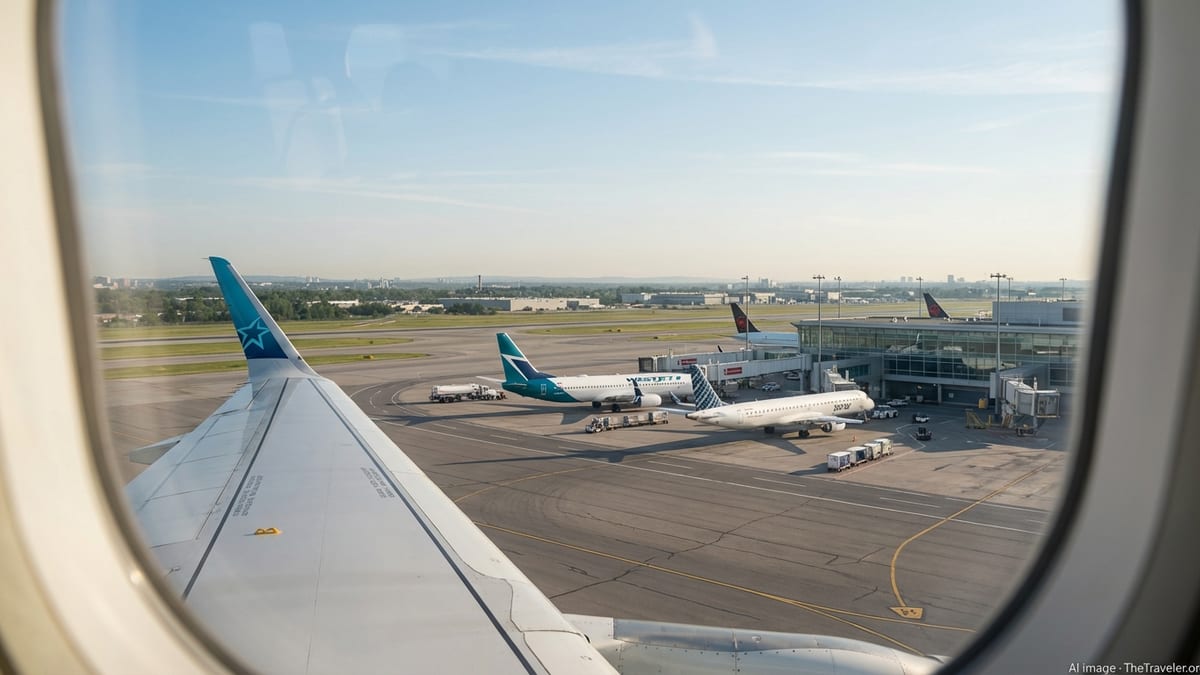
The closures left passengers confined to aircraft for extended periods while security checks were completed and housing plans were improvised on the ground. Aviation accounts from the period describe packed aprons where long-haul jets were parked wingtip to wingtip under tight military and police oversight. For many travelers, the first view of Canada was a remote airfield ringed with parked aircraft and emergency vehicles, a stark illustration of how quickly global aviation can be reshaped by a single security decision.
Gander’s Population Almost Doubles Overnight
No place has become more emblematic of that day’s diversions than Gander, Newfoundland and Labrador. Historical data compiled by aviation agencies and memorial organizations show that 38 commercial aircraft, many of them widebody jets on transatlantic routes, landed at Gander International Airport on September 11. They were carrying roughly 6,000 to 6,600 passengers and crew into a town whose population at the time was around 10,000.
For several days, Gander and surrounding communities turned schools, churches, service clubs, and private homes into ad hoc dormitories. Government summaries and local histories recount how residents organized transportation, cooked meals, and set up medical and counseling support for people from around the world. Buses shuttled passengers from the airfield to community centers as officials worked through the logistics of identifying travelers and coordinating with airlines about when, or even whether, flights could resume.
The experience in Gander has since been chronicled in books, documentaries, and the musical “Come From Away,” which helped transform a little-known aviation waypoint into a global symbol of hospitality. Many of the stranded passengers, often referred to collectively as “come from aways,” have returned multiple times over the years for reunions and memorials, maintaining friendships with the families who took them in during the shutdown of North American airspace.
This anniversary year, municipal notices and national coverage highlight a renewed influx of visitors to Gander. Commemorative programs include a formal 25th anniversary service, reflection events at the town’s central memorial, and special access to Gander International Airport’s historic terminal spaces that featured prominently in many travelers’ memories. The focus, organizers emphasize in public information, is as much on the relationships forged during those days as on the operational feat that brought so many aircraft safely to the ground.
Across Newfoundland, Communities Remember “Unexpected Guests”
While Gander has become the best-known story, the diversions on September 11 spread well beyond a single airport. Archival accounts and provincial retrospectives describe how airports in St. John’s, Stephenville, and other Newfoundland communities also accepted diverted flights, together handling dozens of aircraft and many thousands of passengers. The combined arrivals temporarily transformed the province into one of the busiest international gateways in the world.
Local histories and contemporary coverage emphasize how the response extended deep into neighboring towns. Communities such as Appleton and Lewisporte, for example, opened schools, lodges, and private residences to accommodate travelers whose aircraft were parked on Gander’s crowded ramps. Similar scenes played out around other Newfoundland airports, where volunteers organized clothing drives, converted sports facilities into dormitories, and coordinated with local businesses to keep cafeterias and kitchens supplied.
Twenty five years later, commemorations across Newfoundland are highlighting this province-wide effort. Broadcast schedules and community notices outline live coverage from memorial events, quiet observances at airports that received diverted jets, and informal gatherings where residents reflect on how a global crisis brought unfamiliar faces to their doorsteps. Social media posts and public letters of thanks from former passengers in 2026 underline how enduring those memories remain.
The province’s story also sits within a broader Canadian narrative. Government statements issued for the 25th anniversary once again note that the country as a whole received hundreds of diverted flights and more than 33,000 passengers, many of whom were dispersed among mid-sized airports across Atlantic and central Canada. Yet for many observers, Newfoundland’s experience continues to stand out as a case study in how small communities can adapt with little warning to a surge of stranded travelers.
National Tributes and a Focus on Civil Aviation
The 25th anniversary has prompted new national-level reflection in Canada on the civil aviation dimension of September 11. Recent statements by federal officials and the office of the Governor General refer to the diversion of hundreds of flights to Canadian airports and the role of air traffic controllers, military personnel, and airport staff in orchestrating a safe and orderly shutdown of the skies. These public messages call attention to the fact that, despite the extraordinary strain on the system, no diverted aircraft were lost and no serious injuries were reported as a result of the rerouting itself.
Gander again provides a focal point for those acknowledgments. The program for this year’s commemorative service includes participation by national representatives, who are using the occasion to emphasize the contributions of civilian and military aviation units that helped receive, screen, and support diverted flights. Descriptions of the ceremony highlight wreath-layings, readings, and musical performances honoring both the nearly 3,000 people killed in the attacks and those who worked to protect passengers caught in the unfolding crisis.
Aviation experts and historians, writing in public forums ahead of the anniversary, note that the events of September 11 reshaped global airline procedures, from cockpit security to transatlantic routing protocols. They point out that the diversions to Canada provided an early demonstration of how air traffic networks can be rapidly reorganized in response to security threats, natural disasters, or technical failures. The logistical lessons learned in 2001 have since influenced contingency planning exercises around the world.
At the same time, the anniversary coverage has brought renewed attention to the emotional and psychological impact on the travelers themselves. Many who were diverted recall the uncertainty of waiting on tarmacs without clear information, followed by the relief of being welcomed into unfamiliar communities. Their experiences continue to shape how aviation and emergency planners think about communication, humanitarian support, and the human side of large-scale airspace closures.
A Legacy of Hospitality in a Changed Travel World
Two and a half decades after the attacks, commercial aviation operates in a security environment transformed by September 11, but the diversions to Canada remain a distinctive chapter in that history. Memorial organizations and travel writers frequently point to Gander and its neighboring towns as examples of how communities far from major hubs can nonetheless sit at the crossroads of global air travel, ready to become temporary homes for passengers when plans collapse.
For today’s travelers, many of whom have grown up in a post 9/11 era, the 25th anniversary is also a reminder of how quickly border and aviation policies can change. On that day in 2001, transatlantic passengers expecting routine arrivals in New York, Chicago, or Atlanta instead found themselves routed to places they had never heard of. The upheaval illustrated both the vulnerability and the resilience of a system that moves millions of people every week.
Canadian communities that hosted diverted flights are using this milestone to underline an enduring message: even in moments of global fear, local hospitality can shape how history is remembered. The stranded passengers of 2001 have long since reached their original destinations, but many are returning in 2026 as visitors by choice, reconnecting with hosts who once took them in without warning or obligation.
As ceremonies conclude and airports return to their usual schedules, the story of those diverted flights continues to resonate across the travel world. It is a story about logistics and air traffic control, but also about what happens when thousands of people suddenly land far from home and discover that, at least for a few days, they have another community ready to claim them.