


I thought I knew winter vacations. I had packed for another week of timed pistes, crowded gondolas and après-ski playlists on repeat. Instead, a week of skiing in Finnish Lapland rearranged every expectation I had about cold-weather travel. On these low Arctic fells, winter is not a backdrop for the sport but a full, slow experience that follows you from the dim blue mornings to the crackle of the sauna stove at night.
Get the latest updates straight to your inbox!
Discovering That “Small” Ski Hills Can Feel Immense
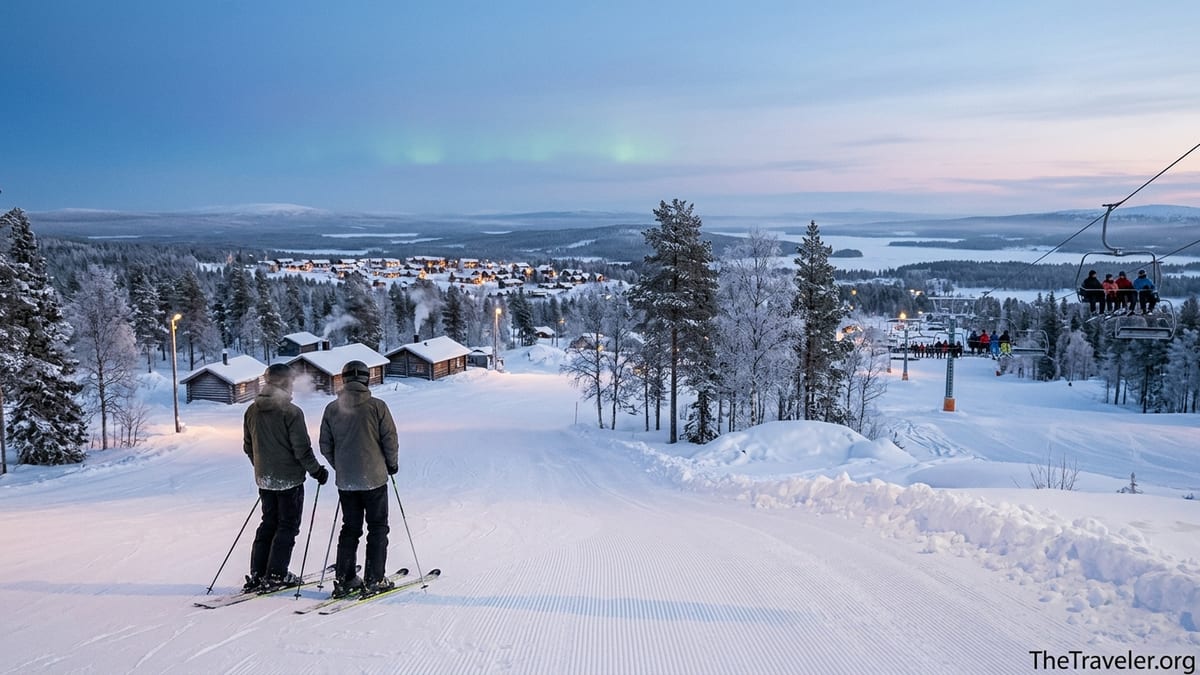
If your idea of a proper ski trip is shaped by the Alps or Rockies, Lapland’s numbers look modest at first. Levi, Finland’s largest ski resort, tops out at 531 meters, and neighboring Ylläs rises to 718 meters, with vertical drops far below what you find in Chamonix or Whistler. Yet standing at the top of Levi’s front slopes just after lunch on my first day, the view felt anything but small. The fells roll away in every direction, a low white sea of forest and frozen lakes under an enormous sky that never fully brightens in midwinter.
I based myself in Levi, a fell village in Kittilä municipality that functions as Lapland’s all-in-one ski hub. It has around 40 plus slopes, modern lifts and everything from beginner greens to blacks that host an annual Alpine Ski World Cup slalom race. You can ride a gondola up from the compact center, ski a few fast reds and be back in your cabin in time for an early sauna. Compared with the long transfer times between valleys in big mountain destinations, the scale here is human. Nothing is far. You begin to measure the resort not in kilometers of runs, but in how many small adventures you can string together in a single cold, blue-tinted day.
Prices were another surprise. For the 2025 to 2026 winter season, a six-day adult ski pass in Levi sits around 250 to 260 euros, with a three-day pass roughly in the mid-150 euro range depending on when and how you book. Children’s passes are notably cheaper, and kids under a certain age ski free with a helmet and paying adult. It is not a budget destination, but compared with major Alpine resorts where a week’s pass can push above 400 euros, Lapland’s lift tickets felt relatively gentle, especially when you factor in how much more than skiing you get in return.
The snow itself may be the biggest luxury. By early December the slopes are usually covered, and the season stretches well into April. Temperatures regularly dip below minus 10 degrees Celsius, which sounds hostile but keeps the snow dry and grippy. I spent one afternoon on a tree-lined red run, carving on squeaky, chalky snow that never turned slushy, even after dozens of laps. That reliability shapes everything about how people here approach winter: they do not race the thaw, they settle in for months of it.
Trading Après-Ski for Arctic Quiet
On my first evening in Levi I went looking for the après scene I assumed every ski resort must have: packed bars, live music, the hum of people walking in from the lifts still in helmets. The village does have nightlife, especially on weekends and during holiday weeks, but what I found instead was a softer ritual. Locals were heading not for shots and dance floors, but for the sauna.
I rented a compact log cabin a ten-minute walk from the center, part of a cluster of chalets with their own electric saunas and small terraces buried in snow. By 6 p.m., the sky was deep navy and the temperature had fallen below minus 15. I lit a candle in the window, turned on the sauna stove and watched the snow glow orange under the streetlight while the room warmed. Instead of crowded après bars, many visitors move between cabin, sauna and the occasional quiet restaurant. It is a social rhythm, but one set to the sound of snow squeaking under boots and the hiss of water on hot stones, rather than bass lines.
One night I swapped my fleece mid-layer for something more presentable and walked into the center for dinner at a Lappish-style restaurant, the kind you now see replicated across Lapland’s main resorts. Menus typically lean on local ingredients: slow-cooked reindeer with buttery mashed potatoes, Arctic char, creamy salmon soup and lingonberry desserts. A main course runs around 25 to 40 euros, and a glass of wine 10 to 13 euros. It is not cheap, but the food is hearty and portions are generous. After an early sitting, diners drift back into the cold by 9 p.m., their breath clouding in the air as they crunch home through snowbanks. The mood is closer to a winter retreat than a party destination.
For travelers used to ski weeks that blur into late nights, this quieter, more domestic après can be an adjustment. Instead of a bar crawl, I found myself planning which evening to sit in the outdoor hot tub at a small spa hotel, when to book a torchlit snowshoe walk through the forest, and how to time my sauna so I could roll in the snow afterward. It is not that nightlife does not exist; rather, it ceases to be the center of the experience. The main show here is outdoors, in the silence of the forest and the low northern sky.
When Skiing Becomes Just One Winter Activity Among Many
By the third day, my routine shifted. I still skied every day, but skiing was no longer the anchor of the trip. In Lapland, the snow is a platform for a web of other experiences that do not feel like add-ons so much as the point of coming. Husky safaris, reindeer sleigh rides, snowmobile outings and snowshoe tours are marketed heavily, but once you are there, they stop being bucket-list items and start to feel like everyday ways of moving through the landscape.
On a clear midweek morning I joined a small-group husky safari on the edge of Levi, booked through a local operator that capped groups at a handful of sleds. After a short safety briefing we learned to stand on the runners, brake and lean into corners, then the dogs surged forward and the only sounds were the sled skimming over compacted snow and the occasional bark. A typical two to three-hour husky tour, including transfers and warm gear, runs around 150 to 220 euros per adult in the current season, with shorter family-friendly outings for less. It is a serious expense, but the memory of steering a team of huskies through birch forest and across a frozen marsh, pale dawn light barely touching the horizon, is what I remember most distinctly from the trip.
Another afternoon I visited a small reindeer farm a short drive from the resort. Reindeer experiences usually combine a gentle sleigh ride with coffee around an open fire and a chance to hear about Sámi culture and herding traditions, with prices often between 80 and 150 euros depending on length and inclusions. Sliding slowly through static, snow-laden forest behind a pair of reindeer is the polar opposite of skiing’s speed, yet it is equally thrilling. You become acutely aware of the small creaks of the wooden sleigh and the muffled sound of hooves in deep snow.
Even the more mechanical activities feel different here. Snowmobile safaris head out into frozen marshland, lakes and fells that seem endless in every direction. In Ruka and Saariselkä, for instance, evening Northern Lights snowmobile tours of around three hours are typically priced around 180 to 210 euros per adult, including thermal clothing and a guide. I booked a similar outing from Levi. Riding a snowmobile across a frozen river under a faint glow of aurora, with no road noise and only a string of headlights in single file ahead of you, feels a world away from the controlled environment of a ski run.
Because so much is available, a week can easily turn into a sampler of Lapland life. Inari and Saariselkä, further north, are known for slightly quieter resorts with excellent cross-country trails and aurora viewing. Ruka, technically just south of Lapland, offers a similar mix of downhill and activities with a compact village feel. Many travelers link a few nights in a cabin with one or two organized excursions and several unscheduled days for simple pleasures: walking out onto a frozen lake to listen to the silence, trying ice fishing with a local guide or learning how to build a fire in deep snow.
The Strange Beauty of Arctic Light and Real Cold
I landed in Kittilä on a late-January afternoon, stepping off the plane into air that felt startlingly dry and shockingly cold. The airport is a small, efficient gateway for Levi and Ylläs, reachable in about 90 minutes by domestic flight from Helsinki. From Kittilä, the transfer to Levi takes roughly 15 minutes by shuttle or taxi. It is one of several Lapland airports, along with Rovaniemi for Santa-themed trips and Ivalo for the far north, that knit this sparsely populated region to the rest of Europe.
What altered my expectations most was not the logistics but the quality of light. During deep winter, the sun in Lapland hovers close to the horizon, and even midday feels like an extended golden or blue hour. I skied runs at 11 a.m. that looked like late afternoon, the snow glowing soft pink on open slopes. By 2 p.m. the world was dim again. Resorts compensate with extensive floodlighting. In Ruka, for example, the majority of slopes are lit for night skiing, and Levi’s front slopes glow like a small city after dark. But away from the lifts, the darkness is profound. You quickly learn to carry a headlamp and to trust that your eyes will adjust.
The cold itself reshapes your behavior. Temperatures in midwinter often slide below minus 20 degrees Celsius, with occasional dips lower, yet the air is so dry that it can feel more manageable than a damp zero degrees in a big city. Still, you adapt your packing list. I abandoned the fashionable wool coat I use in the Alps and relied instead on a long down parka, insulated ski pants, a thin merino base layer, mid-layer fleece and a windproof shell, plus glove liners, thick mittens and a balaclava under my helmet. Rental providers across Lapland, from Rovaniemi to Ylläs, supply thermal overalls and boots for activities, which is worth factoring in when deciding how much to bring from home.
This climate changes how you pace your days. Instead of skiing from first lift to last, I broke the day into blocks: a late morning session after a slow breakfast indoors, a warming lunch of salmon soup in a slope-side cafe, an hour back in the cabin as the sky darkened, then maybe another hour of night skiing on the floodlit runs. On the coldest days, I took frequent warm-up breaks in lift station cafes, where hot chocolate costs around 4 to 6 euros and coffee is treated almost as a survival tool. Far from feeling like a limitation, these pauses became part of the pleasure, a reminder that winter here is to be moved through thoughtfully, not conquered.
Staying in Cabins, Glass Igloos and Other Lapland Originals
Accommodations in Lapland quickly challenge the standard ski-trip hierarchy of slope-side hotels and crowded apartments. In Levi and Ylläs, you find those too, but the defining stays are cabins and a growing number of specialty options: glass-roofed igloos, treehouse suites and remote lodges with minimal light pollution. They are designed around the idea that your room is not just a place to sleep, but a vantage point on winter itself.
For my week, I chose a mid-range log cabin within walking distance of Levi’s lifts. It had a small living room with a wood stove, a basic kitchen, a loft sleeping area and a private sauna. In high season, a similar cabin for two to four people can easily cost 200 to 350 euros per night, depending on location and facilities. At first that felt steep, but sharing the space with a friend brought the nightly rate close to what we might pay for an ordinary Alpine hotel room. More importantly, the cabin gave us a small, private world. We could dry gear above the heater, cook simple dinners and step outside at night to check the sky for aurora without seeing more than a few other cabins through the trees.
Elsewhere in Lapland, accommodations become experiences in themselves. Near Rovaniemi, the Arctic TreeHouse Hotel and similar properties offer sleek, timber-clad suites with floor-to-ceiling windows facing the forest and sky, allowing you to watch snowfall or potential Northern Lights from bed. In Saariselkä and Inari, glass igloo villages and dome-style cabins dot the hillsides, each with heated, transparent roofs to maximize sky views even at minus 25. These specialty stays often start at 400 euros per night and climb quickly in peak dates, so many travelers combine one or two splurge nights with more traditional cabins or hotels.
The variety lets you shape a week to your own rhythm. Families often pick full-service holiday villages close to lifts, where kids can run between sledding hills and indoor pools. Couples might spend most of their time in a quiet riverside cabin, venturing into town only for groceries and a couple of restaurant meals. Solo travelers, who are increasingly visible in Lapland, gravitate toward hostel-style lodges in Rovaniemi or shared cabins around Levi and Ylläs, where it is easy to join group excursions. Whatever you choose, the accommodation starts to feel less like a base for skiing and more like a cocoon from which you experience the Arctic slowly, in small windows between outings.
Getting There, Getting Around and Getting Comfortable With the Dark
Reaching Lapland from outside Finland usually means flying into Helsinki and then onward by domestic flight or overnight train. From the capital, Finnair and other carriers run frequent winter flights to Rovaniemi, Kittilä and Ivalo, with flight times of about 1.5 hours. For my trip, I flew into Helsinki in the afternoon, overnighted at an airport hotel and caught a morning flight to Kittilä, stepping off the plane and onto a shuttle that had me in Levi before lunch. Others opt for the Santa Claus Express overnight train from Helsinki to Rovaniemi, or the night train to Kolari, which puts you within easy reach of Levi and Ylläs by bus or taxi.
Once you arrive, getting around is straightforward if you plan for winter conditions. In Levi and Rovaniemi, ski buses run regular loops between the main accommodations, slopes and activity centers, with day tickets priced just a few euros, and often discounted or included with multi-day ski passes. Taxis are readily available but pricey. Many visitors rent cars for flexibility, particularly if they want to explore multiple resorts or reach quieter cabins. Winter tires are standard, and roads are well maintained even in heavy snow, but driving in the dark on icy two-lane highways demands caution. Speeds are lower, and locals think nothing of taking twice as long as a summer drive might require.
For an American used to brightly lit suburbs and 24-hour convenience, Lapland’s darkness took adjustment. In December and January, you might see only a few hours of daylight, and that light is diffuse. Streetlights line main roads and resort centers, but step into the forest and you are in deep shadow almost immediately. I brought a compact headlamp and a reflective vest, both of which proved invaluable walking between my cabin and the village in the early evening. Over time, the darkness stopped feeling oppressive and instead became a canvas for small points of light: a lit window, a flicker of aurora, the beam of a snowmobile headlight crossing a frozen river.
Practicalities are reassuringly simple. Card payments are accepted essentially everywhere, even for small purchases like a coffee at a remote trail cafe. Tipping is not customary, though rounding up in restaurants and for guides is appreciated. English is widely spoken in tourist areas, from Helsinki Airport staff to ski instructors in Levi to husky guides in Inari. The main challenge is not communication but layers: remembering to slip a thin liner glove under your mittens so you can handle your phone without freezing your fingers.
The Takeaway
After a week of skiing in Lapland, I realized that what had changed my expectations about winter vacations was not a single spectacular moment, but a steady accumulation of small, specific experiences. Waking early to a sky the color of steel and watching it never quite turn fully bright. Gliding behind a team of huskies as they breathe plumes of steam into minus 18-degree air. Sitting in a cabin sauna while snow piles quietly against the window. Stepping outside at midnight to find a faint curtain of green aurora between the silhouettes of pine trees.
I left with the sense that Lapland is less a ski destination and more a winter culture that happens to have ski resorts woven into it. You can come here for the slopes and leave satisfied, especially if you enjoy uncrowded runs, reliable snow and a more relaxed pace than the big mountain centers. But the real gift of a week in Lapland is how it stretches your idea of what a cold-weather trip can be. Winter becomes not an obstacle to be escaped, nor a mere setting for alpine sport, but something to inhabit fully: a long, quiet season defined by light, cold, and the many different ways people have learned to move through both.
FAQ
Q1. When is the best time to ski in Lapland for good snow and some daylight?
For most travelers, late January to early March offers the best balance of reliable snow, moderate cold and usable daylight, with long seasons often running from November into April.
Q2. Which Lapland ski resort should I choose for a first visit?
Levi works well for first timers thanks to its varied slopes, compact village and good activity options, while Ylläs and Saariselkä are quieter choices with excellent cross-country trails.
Q3. How expensive is a week of skiing in Lapland compared with the Alps?
Lift passes are often slightly cheaper than in major Alpine resorts, but accommodation, activities and restaurant meals can be similar or a bit higher, especially in peak holiday weeks.
Q4. Do I need a car, or can I rely on buses and transfers?
You can manage comfortably without a car in Levi, Ylläs, Rovaniemi and Saariselkä using airport transfers, ski buses and organized excursions, though a rental car adds flexibility for exploring.
Q5. How cold does it really get, and what should I pack?
Winter temperatures often sit between minus 5 and minus 20 degrees Celsius, so pack layered merino base layers, a warm insulated jacket, windproof shell, insulated pants, thick mittens and proper winter boots.
Q6. Is Lapland suitable for beginner skiers and families with kids?
Yes, resorts like Levi, Ruka and Ylläs have gentle beginner areas, English-speaking ski schools and family-friendly services, plus non-ski activities such as sledding, reindeer visits and indoor play spaces.
Q7. Can I see the Northern Lights during a ski week in Lapland?
From roughly September to early April, clear dark nights give a reasonable chance of seeing aurora, especially if you stay somewhere with low light pollution or join an aurora-focused tour.
Q8. Do I need to book husky and reindeer safaris in advance?
In peak periods such as Christmas, New Year and school holidays, it is wise to reserve popular activities before you arrive, while outside those dates you can often book a day or two ahead.
Q9. Is it safe to drive in Lapland in winter as a visitor?
Roads are generally well maintained and rental cars come with winter tires, but you should be comfortable driving slowly on snow and ice, avoid sudden maneuvers and allow extra time for all journeys.
Q10. How far in advance should I plan and book a Lapland ski trip?
For high-demand weeks and specialty stays like glass igloos, booking six to twelve months ahead is sensible, while shoulder-season trips can sometimes be arranged just a few months before travel.