


Lapland has quietly become one of Europe’s most distinctive ski destinations, combining reliable Arctic snow with Northern Lights, husky safaris and remote fell landscapes. Whether you are a first-time skier looking for gentle slopes and family-friendly services or an expert chasing midnight-sun corn snow above the Arctic Circle, Lapland’s resorts offer a surprisingly broad range of terrain and atmospheres. This guide looks at key Lapland ski areas, how their slopes and services compare, when to visit, and what practical details to understand before you commit to a trip.
Get the latest updates straight to your inbox!
Understanding Lapland as a Ski Destination
When people talk about skiing in Lapland, they usually mean the northernmost parts of Finland and Sweden, above or close to the Arctic Circle. The landscape is defined by rounded fells rather than steep Alpine peaks, which means vertical drops are modest but snow cover is typically long-lasting. Resorts like Levi and Ylläs in Finnish Lapland, and Riksgränsen and Björkliden in Swedish Lapland, build their appeal around long seasons, extensive cross-country networks and Arctic experiences such as reindeer visits or aurora viewing, rather than extreme elevation.
For downhill skiers, expectations matter. You will not find the 1,500-meter verticals of the Alps, but you will find modern lift systems, night skiing on floodlit slopes and long transition runs suitable for progressing intermediates. Ruka, near Kuusamo in eastern Finland, operates over 40 pistes and typically aims to open in October, giving it one of the longest ski seasons in Europe, often running into early May depending on conditions. Many Finnish visitors treat Lapland as a full winter-holiday base, combining short daily ski sessions with snowmobiling, saunas and evening meals in cabin-style restaurants.
Tourism bodies report that Lapland has recorded record winter seasons in recent years, with destination towns like Rovaniemi and Kittilä (for Levi) registering noticeable growth in overnight stays in winter 2024–2025. For travelers, this means improved services and more flight connections but also busier peak weeks around Christmas, New Year and school holidays. Planning ahead is increasingly important, especially if you want a particular style of accommodation such as glass igloo cabins or ski-in/ski-out apartments.
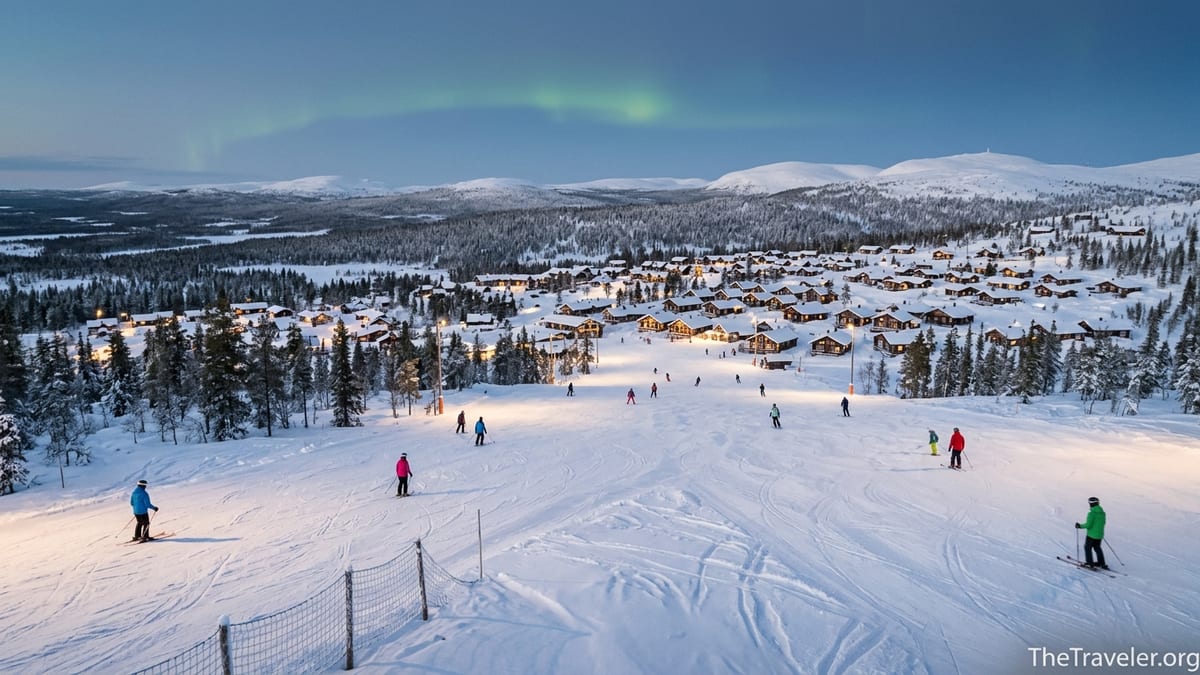
Another point that distinguishes Lapland from many European regions is the interplay of light and darkness. From late November into January, the polar night brings a few hours of blue twilight rather than full daylight, and resorts respond with extensive floodlighting on slopes. From March onward, days lengthen rapidly, and by late spring at the northernmost Swedish resorts lifts may operate under the midnight sun. Choosing when to go is as much about the atmosphere you prefer as about snow conditions.
Finnish Lapland’s Major Ski Resorts
Levi is the largest and best-known ski resort in Finland, located near the village of Sirkka in Kittilä municipality. It offers a dense network of lifts that include gondolas and chairlifts, plus beginner-friendly carpets and rope tows at the base areas. On the front slopes at the main Zero Point base, families find a dedicated kids’ area with gentle gradients and an easy-access poma lift, while more advanced skiers can head to steeper runs on the north and west faces of the fell. The resort has hosted FIS Alpine World Cup slalom races, so experienced skiers can test themselves on race-style pistes while still having long blue runs to cruise back towards the village.
Ylläs, about an hour’s drive from Kittilä, is often described as more wilderness-oriented than Levi, with its slopes spread across two base villages, Äkäslompolo and Ylläsjärvi. It is the second-largest resort in Lapland by lift and run count, and it also serves as a gateway to Pallas-Yllästunturi National Park. Visitors who like to mix downhill with cross-country will find hundreds of kilometers of maintained ski tracks in the surrounding fells, many lit for evening use. Compared with Levi’s lively après-ski and nightlife reputation, Ylläs tends to feel quieter and more nature-focused, making it popular with families and older couples.
Further north, Saariselkä sits close to the treeline in the Inari region and is often recommended for beginners and families who value a compact, relaxed ski hill. The downhill area is smaller than Levi or Ylläs, but the slopes are wide, uncrowded outside the busiest weeks, and the village doubles as a base for wilderness excursions into Urho Kekkonen National Park. Many Finnish and international visitors come primarily for aurora viewing and glass-roofed cabins, adding a few afternoons of skiing as part of a broader Arctic trip.
Other Finnish Lapland resorts worth noting include Pyhä and Luosto in the Pyhä-Luosto area, which are often described as quieter alternatives with a local feel. Pyhä offers varied terrain and tree skiing suited to confident intermediates and advanced riders, while nearby Luosto has a smaller, traditional ski hill with easy access to forest trails. Collectively, these destinations give travelers a choice between larger, service-heavy hubs like Levi and more laid-back, small-resort atmospheres where the focus is just as much on snowshoeing, sauna and silence as on the lifts.
Swedish and Norwegian Lapland: Riksgränsen, Björkliden and Beyond
Across the border in Swedish Lapland, the duo of Riksgränsen and Björkliden offers a completely different flavor of Arctic skiing. These resorts sit in the far northwest of Sweden, near the Norwegian border, and have long been known among Scandinavian skiers for their dramatic mountain scenery and late-season conditions. Riksgränsen is often cited as one of the world’s northernmost dedicated ski resorts, lying around 200 kilometers north of the Arctic Circle, with a ski season that typically starts in February and can extend into June. From late May onward, lifts may run under the midnight sun, allowing skiers to carve turns on soft spring snow at midnight with the sun still above the horizon.
One of Riksgränsen’s notable quirks is that some pistes cross the national border into Norway and back into Sweden, with no practical border control thanks to the Schengen travel area. The terrain is compact but steep in places, and the surrounding mountains offer famous off-piste lines, ski-touring routes and heli-skiing over dozens of skiable peaks when conditions and guiding services permit. Visitors who prioritize backcountry access and a raw mountain atmosphere often place Riksgränsen high on their wish list, accepting that weather can be variable and that wind or fog can temporarily limit lift operations, particularly in late season.
Just to the south, Björkliden provides a slightly calmer take on the same landscape. The resort looks out over Lake Torneträsk and the distinctive U-shaped valley of Lapporten, one of Sweden’s most photographed mountain vistas. Its downhill area is smaller than major Alpine resorts, but it pairs well with extensive touring and off-piste opportunities. A regular transfer bus connects Björkliden and Riksgränsen, and many visitors purchase passes that cover both, allowing them to choose conditions each day. The area also serves as a base for trips to Låktatjåkko Mountain Lodge, known as one of Sweden’s highest restaurants, which can be reached by snowcat or touring skis depending on the season.
On the Norwegian side of the border, ski areas around Narvik complement the Swedish Lapland resorts with impressive fjord views and lift-accessed off-piste that drops almost to sea level. Some skiers organize trips that combine Narvik, Riksgränsen and Björkliden in a single journey, using regional trains and buses to move between them. This circuit appeals most to experienced skiers and snowboarders comfortable with variable maritime snow and rapidly changing weather, who see the region as an adventure destination rather than a traditional resort holiday.
Slopes, Terrain and Seasons: What to Expect
Lapland’s fells produce a style of skiing quite different from that of the Alps or Rockies. Vertical drops are often in the range of 250 to 500 meters, so individual runs are moderate in length but can be linked into enjoyable top-to-bottom laps. In Levi and Ylläs, for example, you can start near the fell summit and follow long blue or red routes that snake through the forest back to base areas, ideal for intermediates who enjoy scenic cruising rather than extreme steeps. Ruka’s 41 slopes include park lines, mogul runs and family zones, and its extensive snowmaking helps it open early in the season, sometimes as soon as October if temperatures cooperate.
Snow quality varies with location and time of winter. In inland Finnish Lapland, December and January often bring very cold, dry snow, with temperatures that can fall well below -15 degrees Celsius. These months are magical for those seeking polar night ambience and Northern Lights, but actual slope time may be shorter due to the cold and limited daylight. By March and April, air temperatures become milder and days much longer, making them popular months for family ski trips and locals’ holidays. In maritime-influenced Swedish and Norwegian Lapland, such as Riksgränsen and Narvik, snow in late spring can shift toward soft, corn-like conditions on sunny days, with firmer snow on shaded aspects.
Season lengths reflect this climate. Many Finnish resorts aim to open in late November and run through April, with high-season pricing typically focused on Christmas, New Year, February school holidays and Easter. Ruka, thanks to aggressive snowmaking and its location, frequently runs one of the country’s longest seasons, starting in autumn and stretching into spring. Riksgränsen, by contrast, embraces its late-season identity, often remaining closed mid-winter and opening from February into early summer, specifically marketing the novelty of skiing under the midnight sun in May and early June.
Terrain for beginners is generally good across the region, with wide blue runs, magic carpets and gentle learning areas at most major resorts. Levi has multiple beginner zones near the village, including slopes served by easy surface lifts where first-timers can focus on basics without the stress of higher, steeper runs. Saariselkä’s smaller ski hill means that families can keep track of each other easily, and children can progress gradually from nursery slopes to mellow top-to-bottom green and blue pistes. More advanced skiers seeking challenges gravitate toward steeper sectors at Levi, off-piste routes at Pyhä, or the freeride and touring options surrounding Riksgränsen and Björkliden.
Ski Passes, Lessons and On-the-Ground Costs
Trip budgets to Lapland depend heavily on when you travel and how much time you actually plan to spend on the slopes. In Finnish resorts like Levi, recent price lists for the 2025–2026 winter season show that a multi-day adult ski pass is generally priced in line with mid-sized European resorts, with discounts for children and families and the option to bundle ski bus access into the pass. Many visitors who are not skiing full days every day choose shorter two or three-day passes, or opt for a few hours of lift access while spending the rest of their time on snowmobile safaris, reindeer experiences or spa visits.
Lessons are widely available in English at major Finnish resorts, including Levi, Ylläs and Ruka, and ski schools publish clear price lists for private and group instruction. In Levi, for instance, the ski school offers private lessons for children as young as four, with short 40-minute sessions tailored to very young beginners and longer lessons for older kids and adults. These lessons must be combined with an appropriate lift ticket, which can sometimes be a beginner-area pass if you are staying on the lowest slopes. Booking ahead is recommended for peak weeks, as instructors are in high demand during Christmas and February holidays.
In Swedish Lapland, pass products can include access to multiple resorts under a single ticket. The Arctic Ski Pass, for example, gives holders entry to the combined terrain of Riksgränsen, Björkliden and an additional regional ski area, covering more than 40 groomed runs plus extensive off-piste opportunities. This kind of pass appeals particularly to experienced skiers planning to split their time between several mountain bases. Pricing varies by length of stay and age group, and many visitors take advantage of shoulder-season deals in April and May when daylight is long but demand is lower than at Easter.
Daily costs for food and activities tend to be higher than the European average, especially in remote Lapland villages where everything must be transported long distances. A simple lunch at a slopeside cafeteria can easily approach central European mountain prices, while dinners in resort restaurants range from casual pizza and burgers to multi-course Lappish menus featuring reindeer, Arctic char and local berries. Self-catering cabins and apartments are a cost-control strategy many families adopt, using well-stocked village supermarkets for breakfast and dinner supplies and eating out more selectively.
Getting There, Moving Around and Staying Warm
For most international visitors, access to Finnish Lapland starts with a flight into Helsinki, then a domestic connection to airports such as Kittilä for Levi and Ylläs, Kuusamo for Ruka, Ivalo for Saariselkä or Rovaniemi for southern Lapland and Santa-themed attractions. In Sweden, travelers often fly via Stockholm and connect north to Kiruna, then continue by train or bus to Björkliden and Riksgränsen. From Norway, Narvik serves as a hub for regional rail and road links into the cross-border ski region. Winter train travel can be a scenic alternative to flying for those already in Scandinavia, and overnight sleeper services allow travelers to arrive rested in the north.
Once in resort, you typically move between accommodation, slopes and other activities using a mix of ski buses, local taxis and on-foot walking routes. In Levi, a ski bus network links different base areas and outlying cabins to the central slopes, often included with certain ski passes for a small surcharge. In Saariselkä and smaller villages, many accommodations sit within walking distance of the lifts, which is convenient in very cold weather when waiting for buses can feel long. In the Swedish Lapland cluster, dedicated transfer buses run between Björkliden and Riksgränsen, letting visitors explore both areas without renting a car.
Cold management is a practical concern in Lapland and should shape your packing list. Temperatures in mid-winter can be much colder than typical Alpine resorts, and wind chill on chairlifts can be severe. Most experienced visitors rely on a layered clothing system: moisture-wicking base layers, insulating mid-layers such as fleece or wool, and a windproof, waterproof outer shell. Accessories matter as much as jackets; a thin balaclava or buff under a helmet, insulated mittens instead of gloves, and toe warmers for ski boots can make the difference between an enjoyable two-hour session and retreating early to the café. Rental shops at major resorts stock high-quality skis, snowboards and boots, but technical outerwear rental is less common, so it is worth bringing proper clothing from home or renting in a major city before heading north.
Road conditions in winter are generally well managed but can feel intimidating for drivers unused to snow and ice. If you plan to rent a car to move between resorts or explore beyond the ski slopes, expect studded or winter tires as standard and be prepared to drive more slowly than you might at home. Darkness, drifting snow and reindeer on the roads all demand extra caution. Many visitors decide to avoid driving entirely during the core winter months and instead rely on pre-booked airport transfers and resort transport, which adds to trip cost but reduces stress.
Sustainability, Culture and Respecting the Arctic Environment
The rapid rise of winter tourism in Lapland has brought economic benefits to remote communities but also raised concerns about environmental impact and pressure on traditional livelihoods. Recent reporting from European outlets has highlighted how the growth of ski resorts, cabin villages and related infrastructure fragments natural habitats and competes with other land uses such as reindeer herding. For travelers, this context is a reminder to treat Lapland not simply as a theme park for snow experiences but as a living region with its own cultures and environmental limits.
Many resorts now advertise sustainability initiatives, from energy-efficient snowmaking systems to waste separation and locally sourced food in restaurants. While some of these efforts are still evolving, visitors can support positive trends by choosing operators that demonstrate concrete steps to reduce impact. Staying in existing village centers rather than new remote developments, using public or shared transport where possible, and limiting the number of high-speed motorized excursions such as repeated snowmobile safaris all help reduce pressure on the Arctic landscape.
Lapland is also home to the Indigenous Sámi people, whose traditional territories span northern Finland, Sweden and Norway. In some areas, tourism intersects directly with reindeer migration routes and grazing lands. When booking reindeer experiences or cultural tours, it is worth seeking out Sámi-owned or Sámi-led businesses that present their own culture on their own terms. These experiences often provide deeper insight into the realities of life in the north today, beyond standard tourist narratives about Santa Claus and generic “Arctic” activities.
Simple on-the-ground behaviors matter too: staying on marked trails, respecting closed off-piste areas, giving right of way to reindeer herds on roads and tracks, and keeping noise levels down in otherwise silent forests. Because the environment is fragile and slow to recover, off-trail driving and walking can leave marks that last for seasons. As Lapland’s popularity grows, a respectful attitude from visitors will play a crucial role in preserving the qualities that make the region special in the first place.
FAQ
Q1. When is the best time to ski in Lapland?
The most popular months for skiing in Lapland are February, March and early April, when daylight is long, temperatures are milder than mid-winter, and snow coverage is typically reliable. Earlier in the season, around December and January, the atmosphere is magical but days are short and very cold, while late April and May can bring softer spring snow in some resorts.
Q2. Which Lapland resort is best for beginners and families?
Levi, Ylläs and Saariselkä in Finnish Lapland are often recommended for beginners and families thanks to wide, gentle slopes, good ski schools and plenty of non-ski activities. Levi in particular has several dedicated beginner areas and English-speaking instructors, while Saariselkä’s compact size makes it easy to keep track of children and meet up between runs.
Q3. Are Lapland ski resorts suitable for advanced skiers?
While Lapland does not offer the extreme vertical of the Alps or Rockies, there are still challenges for advanced skiers. Steeper runs at Levi and Pyhä, off-piste terrain in Ruka, and the backcountry and heli-ski options around Riksgränsen and Björkliden in Swedish Lapland attract experienced skiers who are comfortable on variable snow and seeking a different kind of Arctic adventure.
Q4. How expensive is skiing in Lapland compared with other European resorts?
Ski pass prices in major Lapland resorts tend to be broadly comparable with mid-sized European areas, though not usually cheaper than budget Alpine destinations. Where costs add up is accommodation and food, which can be higher than average due to the remote location and short peak season. Self-catering apartments and careful planning of restaurant meals help many visitors manage budgets.
Q5. Can I see the Northern Lights while on a ski holiday in Lapland?
Yes, it is possible to see the Northern Lights on a Lapland ski trip between roughly September and early April, provided skies are clear and there is solar activity. Resorts like Levi, Ylläs, Saariselkä, Björkliden and Riksgränsen all promote aurora viewing, and many accommodations are designed with large windows or glass roofs specifically for this purpose, although sightings can never be guaranteed.
Q6. Do I need a car to get around Lapland ski resorts?
You do not strictly need a car at most major resorts, as ski buses, airport transfers and local taxis are widely used. In Levi, for example, ski buses link outlying cabins to the main slopes, and in Saariselkä many hotels sit within walking distance of the lifts. However, a rental car can be useful for visiting multiple resorts or exploring beyond the ski areas, provided you are comfortable driving in winter conditions.
Q7. What kind of clothing should I bring for skiing in Lapland?
Pack for very cold, potentially windy conditions: thermal base layers, warm mid-layers such as fleece or wool, a windproof and waterproof outer shell, insulated mittens, a balaclava or neck gaiter, and warm socks. Temperatures can be significantly lower than in central European resorts, especially in December and January, so prioritizing high-quality cold-weather gear is important even if you only plan to ski a few hours a day.
Q8. How far in advance should I book my Lapland ski holiday?
For peak times such as Christmas, New Year, and school holidays in February and March, it is wise to book flights, accommodation and ski lessons several months in advance. As Lapland’s winter tourism has grown, popular glass-roofed cabins, ski-in/ski-out apartments and family rooms at central hotels increasingly sell out early, while last-minute options can be limited or costly.
Q9. Are there good options for non-skiers in Lapland resorts?
Yes, many visitors come to Lapland without planning to ski every day. Common alternatives include husky and reindeer sleigh rides, snowmobile tours, snowshoeing, ice fishing, saunas and spa visits, and aurora excursions. Resorts like Levi, Ruka and Saariselkä are set up for mixed groups, where some travelers focus on skiing and others prioritize these non-ski activities.
Q10. Is Lapland skiing a good choice for a short trip from outside Europe?
For travelers coming from farther afield, such as North America or Asia, Lapland can work for a focused four to six-night trip that combines a few ski days with signature Arctic experiences. However, the journey typically involves at least one connection and sometimes an overnight stay en route, so it is most rewarding if you value the full winter package of skiing, Northern Lights chances and cultural activities rather than just maximizing time on big-mountain terrain.