


If you are planning a trip to Athens, you will almost certainly visit the Acropolis and the Parthenon. Many visitors use the two names interchangeably, which makes sense until you are standing under the blazing Greek sun, ticket in hand, trying to understand what exactly you are looking at. This explainer breaks down the difference between the Acropolis and the Parthenon, what you actually see on the hill, and how to make the most of your visit, with practical examples from real visitor experiences.
Get the latest updates straight to your inbox!
Acropolis vs Parthenon: What Is the Actual Difference?
The simplest way to understand it is this: the Acropolis is the hill and the entire fortified complex on top of it, while the Parthenon is one temple within that complex. When you buy a ticket for the Acropolis, you are paying to enter the whole archaeological site on the limestone hill that rises above central Athens. Inside that site, the Parthenon is the largest and most famous building, but it is only one of several major monuments.
The Acropolis of Athens has been inhabited since prehistoric times and became a sacred, fortified citadel lined with temples and civic structures. Today, when people say they are “going up to the Acropolis,” they mean climbing the hill through one of the main gates and walking among ruins that include the Propylaea (monumental entrance), the Erechtheion with its Caryatid statues, and the Temple of Athena Nike, as well as the Parthenon itself. By contrast, the Parthenon is specifically the large Doric temple dedicated to Athena Parthenos that dominates the plateau.
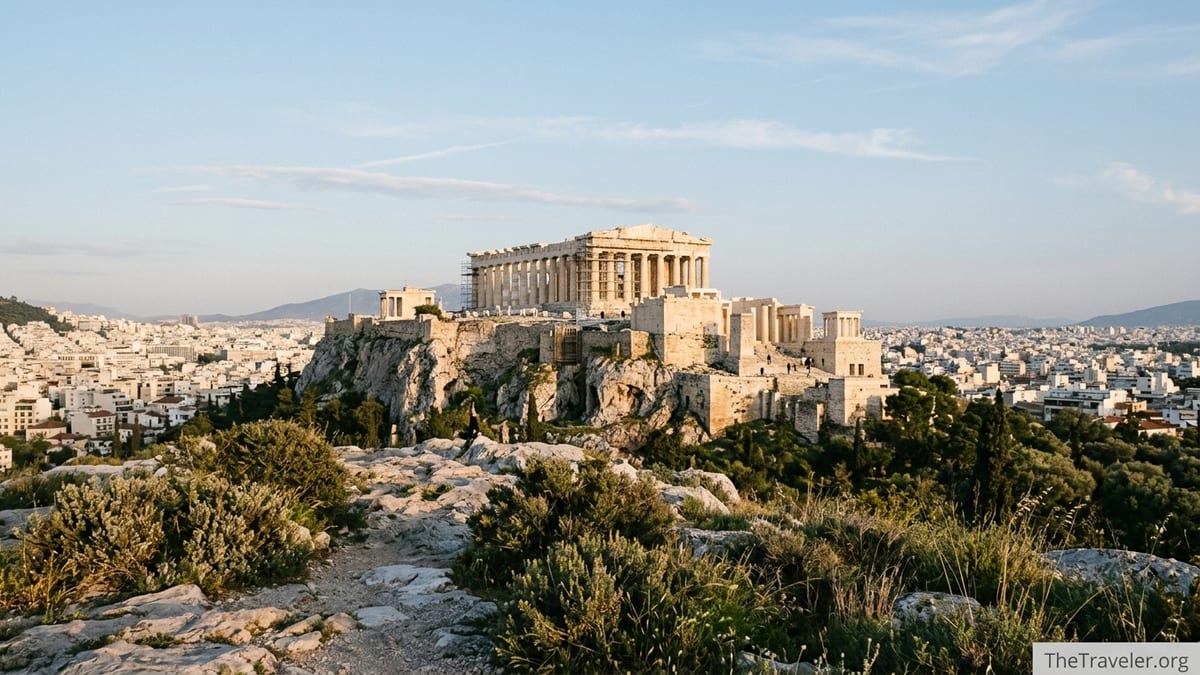
This distinction matters in practice. For example, if a walking tour advertises “sunset views of the Acropolis,” it usually means you will admire the entire illuminated hill with all its monuments from a viewpoint like Philopappos Hill or a rooftop terrace. If a brochure promises a “guided Parthenon tour,” you should expect commentary focused on the temple’s architecture, history and recent restoration, while you stand on the Acropolis plateau next to the building.
Another point of confusion is that international media often use a photo of the Parthenon to symbolize the whole Acropolis. News images about Greek politics or the European economy frequently show the Parthenon framed on its rocky outcrop, so travelers arrive thinking the Acropolis is just that one rectangular temple. Once on site, they quickly discover a much larger archaeological park that rewards slow exploration.
What You Actually See When You Visit the Acropolis
Most visitors enter the Acropolis through the main entrance on the western side, near the base of the hill above the pedestrian street Dionysiou Areopagitou. After ticket control, you walk uphill on a stone path and stairs for about 10 to 15 minutes. The first major structure you reach is the Propylaea, the monumental gateway with large marble columns. This feels like stepping through a grand front door into the sacred heart of ancient Athens, and it is usually where crowds begin to thicken.
Once you pass through the Propylaea, the plateau opens in front of you and the Parthenon dominates the right-hand side. Its creamy marble columns are partially covered in scaffolding and cranes because long-term conservation work continues, including a prominent restoration on the western side that has made that facade look more complete in 2026 than it has in centuries. Even with the equipment, most visitors find the first full view of the Parthenon unforgettable and immediately take photos from the central walkway.
To your left as you walk onto the plateau is the smaller Temple of Athena Nike, perched on a bastion with commanding views over the modern city. Further along, slightly downhill from the Parthenon on the north side, is the Erechtheion, recognizable by the famous Caryatids: sculpted female figures that serve as columns. The statues standing outside today are high-quality replicas; the originals are preserved in the Acropolis Museum and the British Museum. Many travelers are surprised to learn this on site, because guidebooks often show close-ups of the originals without explaining that they are now indoors.
From the edges of the plateau you can also look down onto other ancient sites: the Theater of Dionysus on the southern slope, where classical drama was performed; the Odeon of Herodes Atticus, still used for summer concerts; and the Agora area to the northwest. A typical unhurried visit lasts 1.5 to 2 hours, but those who stop to read information boards, examine the stonework, and enjoy the views can easily spend half a day on the hill before descending for a visit to the Acropolis Museum.
History Basics: How the Acropolis and Parthenon Came to Be
The Acropolis has layers of history stretching back thousands of years. Early shrines and palaces once stood here, but many were destroyed during the Persian invasion of 480 BCE. After this devastation, the Athenians, enriched by maritime trade and tributes from the Delian League, decided to rebuild the hill as a symbol of their power and devotion to the goddess Athena. Under the statesman Pericles, an ambitious building program began in the mid 5th century BCE, with the Parthenon as its crowning achievement.
The Parthenon itself was constructed between roughly 447 and 432 BCE as a marble temple dedicated to Athena Parthenos, the city’s patron deity. Architects Iktinos and Kallikrates, along with the sculptor Phidias, designed a building famous for its harmonious proportions and subtle refinements. For instance, the temple’s columns and steps are not perfectly straight; they swell and curve slightly to counteract optical illusions and make the structure appear more balanced to the human eye. Inside, a massive gold-and-ivory statue of Athena once stood, surrounded by sculpted friezes and metopes depicting mythological scenes and civic processions.
Over the centuries, both the Acropolis and the Parthenon changed functions. The Parthenon became a church in the Byzantine era and later a mosque under Ottoman rule, complete with a minaret. In the 17th century, when the building was used as a gunpowder store, a Venetian bombardment caused a catastrophic explosion that blew out much of the central structure and many of the sculpted details. During the 19th century, with Greece’s independence and the formation of the modern state, the Acropolis was gradually cleared of later additions to highlight its classical form.
Today, the hill is both an active archaeological site and a major tourist attraction. Ongoing conservation projects carefully dismantle and rebuild sections of the Parthenon using both original blocks and nearly identical new marble from the same quarry at Mount Pentelicus. When you walk around the temple in 2026, you can see newly restored sections on the western side that give a more complete idea of the building’s original outline, while other areas remain in pieces, laid out like a giant three-dimensional puzzle on the surrounding ground.
Photo Spots: Where to Capture the Best Views
For close-up images of the Parthenon’s columns and details, your best photos will come from the central path that runs along the south side of the temple once you are on the Acropolis plateau. Arrive at opening time, especially in high season from May to September, to grab shots before the tour groups arrive. Early morning light is softer and side-lit, which helps bring out the texture in the marble and reduces harsh shadows. A smartphone with a wide-angle lens or a camera set around 24 to 35 mm equivalent works well, as the building is larger and closer than many visitors expect.
However, many of the most striking images come from outside the Acropolis. Philopappos Hill, a green hill southwest of the site, offers one of the classic postcard views: the whole Acropolis with the Parthenon on top, framed against the city and often a pastel sunset. It takes about 20 minutes to walk up from the area near the Acropolis Museum, and there is no entrance fee. Travelers often time their hike for late afternoon, watch the sun dip behind the hills, and stay as the floodlights on the Parthenon switch on. This is popular with photographers carrying tripods as well as casual visitors with smartphones.
Areopagus Hill, a rocky outcrop immediately northwest of the Acropolis main gate, is another favorite. You reach it via metal steps and a short climb, and from the flat rock at the top you can look almost directly across to the Parthenon’s western side, as well as down over the rooftops of the Plaka district. The rock can be slippery, especially after rain or when polished by many feet, so comfortable shoes are essential. Because it is just outside the ticketed area, some travelers come here the night before their Acropolis visit to see the hill lit up and get a sense of the layout.
For a different angle, rooftop bars and hotel terraces in central Athens offer framed views of the Parthenon paired with cocktails or dinner. Many midrange and upscale hotels in neighborhoods like Koukaki, Plaka, and Monastiraki advertise “Acropolis view rooms,” and the best ones allow you to photograph the temple rising above the city from your balcony or rooftop pool. While these spaces can be busy and sometimes require reservations, they provide a comfortable way to capture night shots of the illuminated hill without dealing with crowds on public viewpoints.
Common Tourist Confusion and How to Avoid It
One of the most frequent sources of confusion is that tickets and tours are labeled “Acropolis,” while many visitors mainly want to see the Parthenon. When you buy a basic Acropolis ticket, you are not buying a separate Parthenon ticket; there is no distinct entrance or extra fee to stand near the Parthenon. Everything on the hill is covered by the same ticket. This leads some travelers to worry at the gate that they have accidentally purchased access only to the hill and not to the famous temple, when in fact it is all the same site.
Another point that surprises many people is how much of the Parthenon is fenced off. You cannot walk inside the temple or climb its steps. Visitors are kept at a respectful distance behind ropes to protect both the monument and the ongoing restoration. This means your iconic photo with the columns rising behind you will be taken from the surrounding walkway rather than within the colonnade. Tour guides often remind groups of this early on, yet it is still common to see travelers disappointed on arrival because popular culture images sometimes show the temple without barriers.
Names can also be confusing. The term “Acropolis” simply means a high city or citadel, and there are other acropoleis in Greece, but the Acropolis of Athens is by far the most famous. Similarly, replicas of the Parthenon exist elsewhere in the world, such as a full-scale copy in Nashville, Tennessee, so some visitors come with expectations shaped by seeing those reconstructions. The original in Athens is older, more fragile, and more heavily damaged; its power lies in its authenticity and setting rather than completeness.
Finally, visitors are sometimes taken aback by the scaffolding, cranes, and stacks of marble blocks scattered around the plateau. Some assume this means they have come at a bad time or that the monument is “under construction” in a modern sense. In reality, the Acropolis is in a permanent state of careful restoration that will likely continue for decades. Rather than seeing this as a drawback, it can be fascinating to watch conservators at work and realize that gratitude for ancient heritage today involves constant maintenance, not just passive admiration.
Planning Your Visit: Tickets, Timing, and Practical Tips
Ticketing for the Acropolis can feel complicated at first glance, but a few practical examples make it clearer. There is a standard single-site ticket for the Acropolis itself, with prices that vary between high and low season. In summer, expect to pay in the region of several dozen euros for an adult ticket, with discounts for children, students with valid ID, and seniors from some countries. There is also a combined ticket that includes the Acropolis plus several other archaeological sites in Athens, which is good value if you plan to visit the Ancient Agora or the Temple of Olympian Zeus within a five-day period.
Opening hours vary by season but generally start early in the morning and finish in the early evening. In the height of summer, gates may open as early as 8 am. Many experienced travelers aim to be at the entrance shortly before opening to avoid long security lines and intense midday heat. Others prefer late afternoon, when the light is warm and tour groups thin out, though in summer it can still be hot. Check the official schedule shortly before your trip, as hours are occasionally adjusted for weather alerts or special events.
Heat and crowd management are important considerations. During peak months, especially July and August, cruise ship excursions can mean thousands of people arriving in waves. If you are sensitive to heat or traveling with young children, consider visiting in shoulder seasons like April, May, late September, or October. Carry water, a hat, and sunscreen, and wear shoes with good grip for the uneven marble and stone surfaces. The paths are a mix of smooth rock, steps, and gravel, and many people find lightweight trainers or walking sandals better than flat fashion shoes.
For a deeper understanding of what you are seeing, a guided tour or audio guide can be worthwhile. Small-group tours often start around mid-morning and last two to three hours, combining the Acropolis with the Acropolis Museum. If you prefer to explore independently, information boards at key monuments explain the main features and history in clear language. Pairing an early-morning hill visit with a late-morning or afternoon museum visit creates a full day that connects the ruins with the original sculptures and artifacts now housed in climate-controlled galleries.
The Takeaway
In everyday conversation, people often say “Parthenon” when they mean the Acropolis, and vice versa. For travelers on the ground in Athens, though, understanding the difference makes your visit far richer. The Acropolis is the entire rocky citadel and archaeological park; the Parthenon is the star temple on its summit. When you climb the hill, you are stepping into a layered landscape of gates, shrines, theaters, and sweeping viewpoints, with the Parthenon as the focal point rather than the whole story.
Approaching the site with realistic expectations is just as important. You will not be able to walk inside the Parthenon, but you will be able to circle it, study its details, and see new restoration work that has made some sections look more complete than at any time in generations. You will also find quieter corners, like the Erechtheion’s shaded side or the edge of the plateau overlooking the theaters, that provide moments of reflection away from the crowds.
Combining time on the hill with walks to nearby viewpoints and a visit to the Acropolis Museum helps connect the dots between what you see in situ and what has been moved indoors for protection. Whether you choose to frame the Parthenon from Philopappos Hill at sunset, sip coffee with an Acropolis view from a city rooftop, or simply sit on a low wall on the plateau watching the light change on the marble, understanding where the Acropolis ends and the Parthenon begins will help every one of those moments mean more.
FAQ
Q1. Is the Acropolis the same thing as the Parthenon?
The Acropolis is the entire hilltop complex of ancient buildings, while the Parthenon is one specific temple on that hill, although it is the most famous part.
Q2. Do I need a separate ticket to see the Parthenon?
No. A standard Acropolis ticket covers the whole archaeological site, including access to walk around the Parthenon from the outside.
Q3. Can I go inside the Parthenon?
Visitors cannot enter the interior of the Parthenon or climb its steps. You view it from marked paths and platforms around the outside for safety and preservation reasons.
Q4. Why is there scaffolding on the Parthenon?
The Parthenon is undergoing long-term conservation. Scaffolding and cranes are part of careful restoration work that stabilizes and, where possible, reconstructs damaged sections.
Q5. What is the best time of day to visit the Acropolis?
Early morning at opening time usually offers cooler temperatures, softer light, and smaller crowds. Late afternoon can also be pleasant but may still be busy in high season.
Q6. Where can I get the best photos of the Acropolis and Parthenon?
Excellent views come from Philopappos Hill and Areopagus Hill outside the site, as well as from the south side of the Parthenon once you are on the Acropolis plateau.
Q7. Is the Acropolis suitable for visitors with mobility issues?
The hill involves slopes and uneven surfaces, but there is an elevator and some accessible routes. Check current accessibility details before visiting and allow extra time to move around.
Q8. How long should I plan to spend at the Acropolis?
Most visitors spend between 1.5 and 2 hours exploring the Acropolis itself. If you also visit the Acropolis Museum, plan for at least half a day in total.
Q9. Are there still original sculptures on the Parthenon?
Many original sculptures have been removed for protection and are displayed in museums. The Parthenon still has some original elements in place, but others are high-quality replicas.
Q10. Can I see the Acropolis without paying an entrance fee?
You cannot enter the archaeological site without a ticket, but you can enjoy excellent free views of the Acropolis and Parthenon from public spots like Philopappos Hill and Areopagus Hill.