


Stepping out of the Acropolis after a morning among the temples, most visitors have the same question: what now, and in which direction should I walk? Athens’ historic center is compact, but its maze of lanes can feel confusing when you are hot, tired, and hungry. This guide lays out a clear, real-world walking route from the Acropolis to Plaka, Anafiotika, Monastiraki and the Ancient Agora, with concrete suggestions for where to pause for coffee, a taverna lunch, sunset views and an easy evening in the city.
Get the latest updates straight to your inbox!
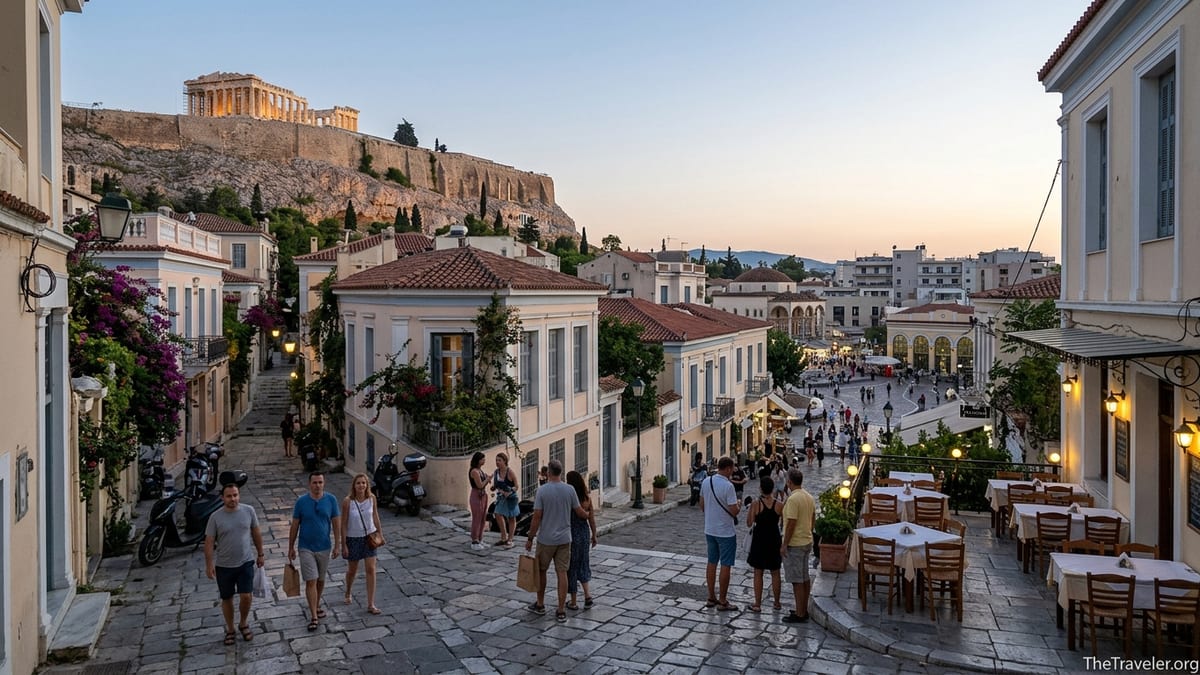
Overview: How Much Can You Walk After the Acropolis?
Most people spend 1.5 to 2.5 hours on the Acropolis hill itself, often finishing between late morning and early afternoon. From the main exit near the western Propylaea, you are roughly a 5 to 10 minute walk from the upper lanes of Plaka and about 15 minutes from Monastiraki Square at a relaxed pace. The historic core is walkable, and typical distances between major points are around 500 to 800 meters, so you can comfortably link several neighborhoods in one continuous stroll if you do not rush.
The route described here assumes you have already visited the Acropolis and are leaving from the main exit by the Propylaea, heading toward Plaka. It combines upper Plaka and Anafiotika, then curves down through lower Plaka, past the Roman Agora and into Monastiraki, with an optional detour into the Ancient Agora if you hold the combined archaeological ticket. You can easily fill the rest of the day with this walk, finishing with dinner and drinks around Monastiraki or nearby Psyrri.
Surfaces on this walk are a mix of stone paving, cobbles and smooth marble. Good walking shoes are essential, especially on Theorias and the narrow stairways of Anafiotika where the stone can be slippery. In summer months, consider starting the Acropolis early, around opening time, and planning the walking route for late morning to evening when more shade is available in the lanes.
As you move, keep in mind a few anchor names: the pedestrian ring of Dionysiou Areopagitou and Apostolou Pavlou runs around the south and west sides of the Acropolis, while Plaka hugs the north and east slopes. Monastiraki and the Ancient Agora sit to the northwest. Watching for these names on street signs helps you stay oriented even without a map.
Step One: Exiting the Acropolis and Dropping into Upper Plaka
When you leave the Acropolis via the main west exit, you walk down a broad stone path that feeds into a network of pedestrian lanes. Within about 5 minutes, look for signs to Theorias Street and Plaka. Theorias is a narrow, often shaded lane that traces the north side of the Acropolis hill and gently descends into upper Plaka. It is one of the nicest transitions from the archaeological site to the living city because you still have glimpses of the walls and olive trees above while the tiled roofs of Plaka appear below.
On this first stretch, there are usually a few simple kiosks selling bottled water, soft drinks and ice creams at typical central Athens prices, often around 1 to 1.50 euros for a small water and 2 to 3 euros for a soft drink. This is a good moment to rehydrate before you reach the cafe-filled squares. Benches are limited, but low stone walls and the base of trees often double as resting points for a few minutes if you need a break from the heat.
As you continue down Theorias and neighboring alleys, small side stairways pull you into upper Plaka. This area is more residential, with bougainvillea-draped balconies, small Orthodox chapels and cats sunning themselves on whitewashed steps. It feels far from the busy roads only a few hundred meters away. The streets here usually have names like Prytaneiou, Epicharmou or Mnisikleous. Do not worry about following a precise sequence. The key is simply to keep angling downhill and north or northeast, and you will naturally filter into the heart of Plaka within 10 to 15 minutes.
If your legs are tired directly after the Acropolis, an alternative is to head first toward the Acropolis Museum and Dionysiou Areopagitou pedestrian street, then enter Plaka from the south. However, using Theorias keeps you higher up on the hill and is the most natural connection to the quiet upper lanes and Anafiotika.
Anafiotika: Island Atmosphere on the Slopes of the Acropolis
Just above upper Plaka, Anafiotika is a tiny cluster of whitewashed houses built by migrants from the Cycladic island of Anafi in the 19th century. Reaching it from Theorias or upper Plaka involves climbing a short series of stepped alleys. Look for signs to Anafiotika or keep an eye out for the sudden shift to bright white walls, flat-roofed houses and very narrow stairways that resemble a Greek island village.
There are no large cafes or restaurants within Anafiotika itself, and that is part of its appeal. You will find mostly residential doorways, small pots of basil and geraniums, and laundry hanging above head height. This makes it a quiet interlude rather than a refreshment stop. Plan 20 to 30 minutes to wander calmly through the zigzagging steps, pausing at small openings where the view north takes in the city roofs, Mount Lycabettus and the domes of nearby churches.
Anafiotika’s steps can be very polished from decades of foot traffic, especially after rain, so move carefully and use the walls for balance where needed. This is not an ideal section for strollers or people with significant mobility issues. If you prefer to avoid steep stairs, you can simply stay in upper Plaka, skirting beneath Anafiotika and then descending slowly into the lower, flatter part of the neighborhood.
From the uppermost points of Anafiotika, you are only a few minutes from some of Plaka’s most photographed stairway cafes. As you exit downhill, aim for Mnisikleous Street, where the stepped street becomes a cascade of taverna terraces. This makes a natural late-morning coffee or early lunch stop, with views back toward the rock above.
Exploring Plaka: From Stairway Cafes to Quiet Backstreets
Plaka is often described as the “neighborhood of the gods” because it lies directly under the Acropolis, but for visitors the more relevant fact is that it offers a dense concentration of cafes, tavernas, small museums and souvenir shops in a very compact zone. As you come down from Anafiotika onto streets like Mnisikleous, Kidathineon or Adrianou, you will see menus everywhere, many in multiple languages. Typical cafe prices in 2026 hover around 3 to 4 euros for an espresso or freddo coffee and 5 to 8 euros for a glass of local wine in the more touristic lanes.
If you are ready for lunch at this point, the stepped cafes around Mnisikleous Street are convenient, with many serving classic dishes such as moussaka, grilled souvlaki, Greek salads and baked casseroles. Portions here often run 9 to 14 euros for a main course. Service can be brisk during busy months, and there may be a small cover charge for bread and water. Slightly away from the main stairs, on quieter side streets, you will often find more relaxed tavernas with similar pricing but fewer touts trying to pull you in.
After eating, allow time simply to wander. Lower Plaka toward Kidathineon and Filomouson Eterias Square has a more open, square-like feeling, with plane trees and families strolling in the early evening. Here you will find small specialty shops selling items like handmade sandals, locally sourced natural cosmetics, and ceramics painted with Acropolis motifs. Prices can vary widely, but simple leather sandals frequently start around 25 to 35 euros, while high-quality handmade versions can cost more.
Plaka also houses several small museums which can be useful in the heat of the afternoon, such as collections of Greek folk art or musical instruments in restored neoclassical buildings. These are optional for this route, but if you have the energy, they provide a contrast to the ancient stones of the Acropolis and Agora. Many close by early evening, so check hours earlier in the day if there is a specific collection you want to see.
From Plaka to the Roman Agora, Ancient Agora and Monastiraki
From the heart of Plaka, the natural walking direction is downhill and northwest toward the Roman Agora and Monastiraki. Streets like Adrianou, Pandrossou and little lanes around the Tower of the Winds guide you there. If you hold a combined ticket that includes the Acropolis and surrounding sites, you can choose to enter the Roman Agora or simply walk its perimeter, where you will see the Gate of Athena Archegetis and the octagonal Tower of the Winds through the railings.
Continuing a little further west brings you to the entrances of the Ancient Agora, one of the most atmospheric sites in the city. Many travelers choose to visit it in the later afternoon when the light is softer and the crowds thinner than at the Acropolis. Inside, shaded paths wind between ruins, with the well-preserved Temple of Hephaestus on a small hill and the Stoa of Attalos housing a museum of everyday objects from classical Athens. Expect to spend 60 to 90 minutes if you decide to enter, including short breaks on benches under the trees.
If you prefer to leave more archaeological visits for another day, you can simply follow Adrianou Street along the north edge of the Agora fenced area. This section of Adrianou is lined with casual cafes and tavernas, many with outdoor seating and direct views of the ruins and the Acropolis above. It is a pleasant place for an afternoon drink, with coffees and soft drinks at similar prices to Plaka, and sometimes slightly better value for simple snacks like pita gyros or meze plates.
As Adrianou continues west, it feeds directly into Monastiraki Square and its wider commercial grid. Within a few minutes you move from the relatively low-key lanes of Plaka and the Agora to one of the busiest squares in Athens, framed by a small church, the Tzistarakis Mosque and the entrance to the metro. This is the ideal moment to switch your focus from monuments to markets and street life.
Monastiraki: Flea Market Energy, Shopping and Street Food
Monastiraki Square and its surrounding streets are the commercial counterpoint to Plaka’s more romantic profile. Where Plaka offers neoclassical facades and small squares, Monastiraki gives you dense rows of shops, street vendors calling out their offers and a constant churn of both locals and tourists. Main arteries like Pandrossou and Ifestou are packed with stalls selling leather goods, T-shirts, replica helmets, army surplus items, used books and more.
This is a good zone to pick up affordable souvenirs. A basic cotton T-shirt printed with the Parthenon might cost around 8 to 12 euros, while small magnets, keychains or postcards are often 1 to 3 euros each. Bargaining is sometimes possible, particularly if you buy several items from the same stall, though it is less formal than in some other countries. Keep small notes and coins handy to avoid delays at crowded tills.
For food, Monastiraki is excellent for quick, casual options. Around the square and on side streets such as Mitropoleos or Aiolou you will find well-known souvlaki and gyro counters where a hearty pita stuffed with meat, fries and salad typically costs between 3 and 5 euros. These spots are ideal if you used your earlier time in Plaka for museums rather than a long lunch, or if you want something simple before heading back to your hotel to rest before the evening.
The square itself is also a viewing platform. From its slightly raised corners, you can look back and see the Parthenon lit by late-afternoon light, while to the west the green slopes of the Ancient Agora are visible behind the railings. Musicians often perform here in the early evening, adding to the atmosphere. If it feels too intense, remember that quieter streets are only a block or two away in any direction, particularly toward the Ancient Agora or up toward the Metropolitan Cathedral area.
Evening Plans: From Sunset Views to Dinner and Drinks
After a full day that started on the Acropolis and wound through Plaka and Monastiraki, evening is the time to slow down, choose one area and settle in. One popular option, especially in warmer months, is to return slightly uphill from Monastiraki toward the viewpoints around the Ancient Agora and Areopagus Hill for sunset. From near the Temple of Hephaestus or the rocky outcrop of the Areopagus, you can watch the city turn golden and then see the Acropolis gradually light up. Allow around 15 to 20 minutes on foot from Monastiraki back up to these viewpoints, depending on your pace.
For dinner, several choices make sense along this route. If you prefer to stay in Monastiraki’s orbit, you will find both traditional tavernas serving grilled meats and more contemporary bistros with modern Greek cuisine in the grid between Monastiraki and nearby Psyrri. In this area, expect main dishes in sit-down restaurants to range from roughly 12 to 20 euros, with house wine by the carafe remaining a relatively economical option. Terraces with Acropolis views often command a small premium, but many travelers find the illuminated skyline worth the extra few euros.
Alternatively, you can drift back toward Plaka for a quieter, more village-like atmosphere after dark. The stepped lanes around Mnisikleous and small squares near Kidathineon fill with people dining outdoors in summer, while in cooler seasons indoor rooms with old tiled floors and framed photos offer a cozy backdrop. Walking back from Monastiraki to Plaka takes about 10 to 15 minutes, partly uphill but not strenuous if you take it slowly. This is also a pleasant way to see familiar buildings in very different evening light.
If you are staying near the Acropolis Museum or along Dionysiou Areopagitou, another evening option is to follow the Apostolou Pavlou pedestrian path from near Thissio up toward the western flank of the Acropolis and then back along Areopagitou. Couples and families often stroll here at night, and informal street performers sometimes set up along the route. From Monastiraki, reaching this promenade is a simple matter of walking west along the Ancient Agora perimeter for around 10 minutes and then turning left toward Thissio station and the paved pedestrian belt.
Practical Tips for Timing, Tickets and Comfort
To make the most of this route, it helps to think of the day in blocks. A common pattern is to book an early entry to the Acropolis, for example around opening time in the morning, finish by late morning and then move directly into upper Plaka and Anafiotika before midday heat peaks. You can then aim for a longer lunch in Plaka or the Adrianou cafes by the Ancient Agora in the early afternoon, followed by a siesta at your hotel, and finally return to Monastiraki and the pedestrian belt for the cooler evening hours.
If you plan to visit multiple archaeological sites, consider the combined ticket that typically grants access to the Acropolis, Ancient Agora, Roman Agora and several other sites within a set number of days. The exact price changes over time, but it is usually structured to be more cost-effective than buying each entry separately if you intend to see at least three or four of the included sites. Keep your ticket handy as you move between the Acropolis, Agora and Roman Agora gates to avoid rummaging in your bag at turnstiles.
Weather and heat management are crucial, especially between June and early September, when midday temperatures in Athens frequently rise above 30 degrees Celsius. Carry a refillable water bottle and note that small supermarkets and kiosks around Plaka and Monastiraki sell chilled bottled water at predictable prices, usually around 0.50 to 1 euro for standard small bottles. Lightweight clothing, a hat and sunscreen will make the long walking route much more comfortable.
Finally, pay attention to your own limits. While the total walking distance from the Acropolis exit through Anafiotika, Plaka, the Agora and Monastiraki is realistic for many visitors, you can always shorten it. At several points the route passes near metro stations such as Acropolis, Monastiraki and Thissio, as well as taxi stands near main roads. If fatigue or heat becomes too much, it is better to cut the walk short and return another day than to push through and stop enjoying the experience.
FAQ
Q1. How long does it take to walk from the Acropolis to Monastiraki via Plaka?
Most travelers take around 45 to 90 minutes of actual walking time from the Acropolis exit to Monastiraki Square via Anafiotika and Plaka, not counting longer stops for meals, museums or shopping.
Q2. Is the route from the Acropolis through Plaka and Anafiotika suitable for young children?
The basic route is manageable with school-age children who are used to walking, but the narrow, stepped alleys of Anafiotika can be challenging for strollers. Families with very young children may prefer to skip the steepest stairways and stick to the broader lanes of Plaka and the pedestrian streets around the Ancient Agora.
Q3. Can I visit the Ancient Agora on the same day as the Acropolis and this walking route?
Yes, many visitors combine the Acropolis, the walk through Plaka and Anafiotika, and a visit to the Ancient Agora in one day, especially if they start early. Expect the full day to feel full but rewarding, and plan time to rest in shaded cafes along the way.
Q4. Are there plenty of places to eat along this route?
There are numerous tavernas, cafes and snack bars throughout Plaka, along Adrianou Street by the Ancient Agora and in Monastiraki. You can find everything from quick gyros and street food to longer sit-down meals with Acropolis views at a range of price levels.
Q5. What kind of shoes should I wear for this walk?
Closed, comfortable walking shoes with good grip are strongly recommended. Surfaces around the Acropolis, in Anafiotika and on older stone streets like Theorias and parts of Plaka can be smooth and slippery, especially if there has been recent rain.
Q6. Is the walking route well signed, or do I need a map?
Key areas such as the Acropolis, Plaka and Monastiraki are signposted, and street signs help you confirm where you are. However, carrying an offline map on your phone or a simple printed map makes it easier to navigate the maze of small Plaka streets without stress.
Q7. Are there public restrooms on this route?
Public restrooms are limited once you leave the Acropolis site, but many cafes and tavernas provide facilities for customers. It is common to plan restroom breaks around coffee or meal stops in Plaka, Adrianou or Monastiraki.
Q8. Is it safe to walk this route in the evening?
The Acropolis itself closes before nightfall, but the surrounding neighborhoods of Plaka and Monastiraki remain active into the evening and are generally considered safe, with normal city precautions such as watching your belongings and avoiding very dark, deserted corners.
Q9. Can I do this walk in reverse, starting from Monastiraki and ending at the Acropolis?
Yes, you can begin in Monastiraki, walk up through the markets, Adrianou and Plaka, then continue to Anafiotika and finish at the Acropolis entrance area. The overall experience is similar, though the climbs feel steeper in this direction, so plan extra time and water.
Q10. What is the best season to follow this walking route?
Spring and autumn are ideal, with milder temperatures and generally comfortable walking conditions. In summer, an early start and a long midday break are wise, while in winter it is important to check weather forecasts and bring layers in case of wind or rain.