


More news on this day
An Air India Boeing 777 operating a long-haul flight from Delhi to San Francisco on May 27, 2026, returned to its departure airport after a reported traffic collision avoidance system malfunction while crossing Chinese airspace, triggering a lengthy diversion that left passengers back where they started after nearly nine hours in the air.
Get the latest news straight to your inbox!
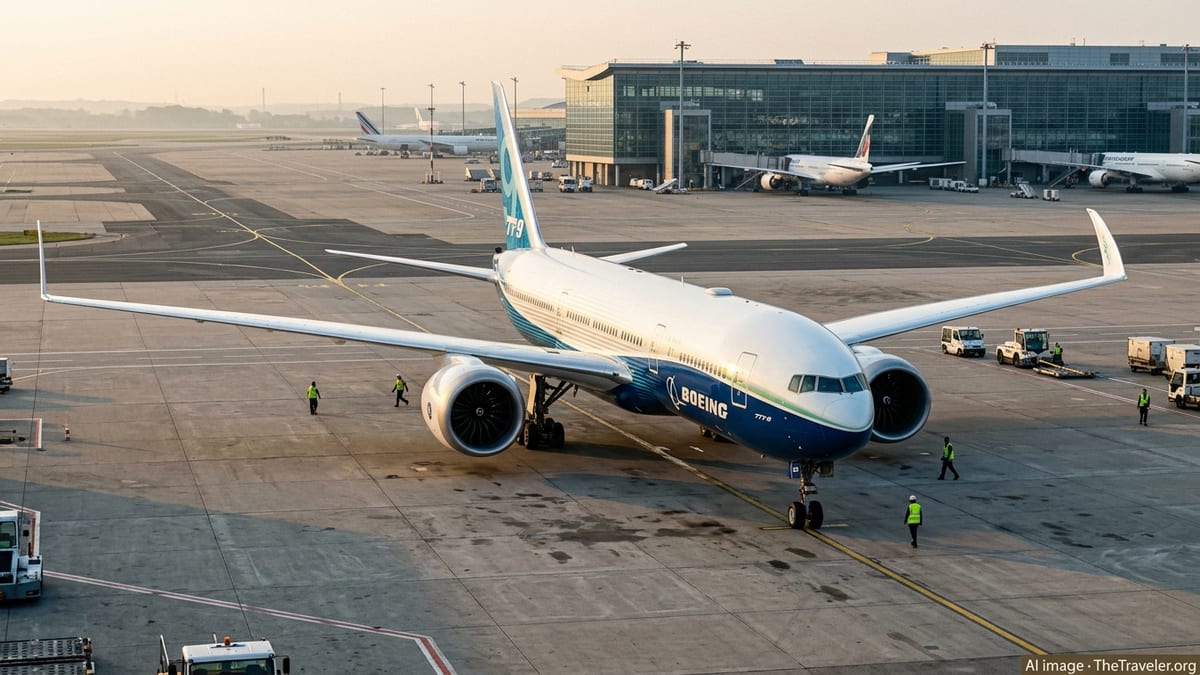
Long-Haul Flight Turns Back Midway Over China
Publicly available flight-tracking data and passenger accounts indicate that the aircraft, a Boeing 777-300ER on the Delhi to San Francisco route, departed Indira Gandhi International Airport in the early hours of May 27 before routing northeast across Central Asia and into Chinese airspace. The flight maintained a routine cruise profile for several hours before initiating a turn that eventually took it back toward India.
Reports on aviation tracking platforms show the jet already well inside Chinese airspace when its course began to arc back toward Delhi, suggesting the decision to return was made after the aircraft had completed a significant portion of the transcontinental leg. Community reconstructions of the route suggest a total airborne time of around eight to nine hours between departure and the eventual landing back in Delhi.
Passenger posts on social media and aviation forums describe an initially uneventful flight that later included announcements about a technical issue and a planned return to the origin airport. While cabin conditions were reported as calm, travelers expressed frustration at completing a near-transpacific-duration flight only to disembark at the same airport from which they had departed.
Airline communication shared in public reporting referenced a technical snag rather than an in-flight emergency, and there have been no indications of injuries among the occupants. The aircraft landed back in Delhi under its own power and was expected to undergo detailed technical checks before being released back into service.
Focus on Reported TCAS Malfunction
Discussion among passengers and aviation enthusiasts quickly centered on the aircraft’s traffic collision avoidance system, or TCAS, after multiple public posts referenced a problem with the equipment. According to these accounts, the system was reported as malfunctioning while the aircraft was en route over China, prompting an operational reassessment of whether the flight could safely and legally continue across subsequent oceanic airspace.
TCAS is designed to provide real-time alerts and guidance to flight crews to prevent midair collisions by monitoring the position and altitude of nearby transponder-equipped aircraft. International procedures and regional regulations typically require fully functional collision-avoidance equipment for aircraft operating at high altitudes on long-haul routes, particularly in busy or less radar-intensive environments where airborne systems form a critical last line of defense.
Publicly accessible commentary by pilots and experienced observers online noted that if TCAS performance was degraded or unreliable, continuing into oceanic sectors with limited air traffic control surveillance would likely fall outside company procedures and regulatory allowances. Under such circumstances, a return to an airport with robust maintenance support is considered standard risk management, even if other onboard systems appear to function normally.
Technical investigations into avionics malfunctions such as TCAS issues often involve downloading fault logs from the aircraft’s systems and, if necessary, consulting component manufacturers and maintenance providers. While detailed findings had not yet been made public by the evening of May 27, reports suggest the aircraft was due for comprehensive diagnostics before returning to long-haul service.
Passenger Disruption and Operational Repercussions
The diversion created substantial disruption for the several hundred passengers on board, who faced missed connections, visa and entry complications, and the challenge of rebooking on an already busy India–North America corridor. Accounts shared online describe extended waits on arrival back in Delhi as ground teams organized hotel arrangements, meal vouchers, and revised itineraries where possible.
Travelers reported that re-accommodation options were constrained by high seasonal demand on nonstop and one-stop services between India and the United States. Some passengers indicated they were rebooked onto later Air India departures, while others sought seats on other carriers via alternative hubs. For many, the return to Delhi translated into arrival in San Francisco a full day or more behind schedule.
From an operational perspective, the unplanned turnback tied up both aircraft and crew for significantly longer than scheduled, placing added pressure on the airline’s long-haul rotation. Publicly available fleet-tracking data show Air India already running tight utilization on its Boeing 777 and 787 fleets as it balances high-demand transpacific and transatlantic routes with ongoing maintenance commitments.
Industry analysts note that such long diversions can cascade into further schedule disruptions, particularly when replacement widebody aircraft or rested crews are not immediately available. Airlines often respond with short-term schedule adjustments, temporary downgrades in capacity on other routes, or swapping of aircraft types to maintain overall network reliability.
Safety Culture and Recent Scrutiny of Indian Carriers
The return of the Delhi–San Francisco flight over a TCAS snag comes at a time of heightened attention on safety oversight and operational discipline in India’s rapidly expanding aviation market. Recent months have seen several Indian carriers highlighted in domestic and international coverage for technical incidents, precautionary returns, and questions around maintenance standards.
Aviation safety commentators point out that precautionary diversions for system anomalies are generally viewed as a positive reflection of risk-averse decision-making, even when they are inconvenient for travelers. In the case of the May 27 flight, public information suggests that the crew and operations center chose a conservative course of action by returning to a major maintenance base rather than accepting increased risk on a long transoceanic leg with a key safety system potentially impaired.
Regulatory authorities in India have in recent years emphasized upgrades to oversight processes, data-driven monitoring of airline performance, and closer alignment with international best practices. Published analyses note that the country’s carriers are simultaneously contending with rapid traffic growth, ambitious fleet expansion, and the operational complexities of far-flung long-haul networks that depend heavily on robust technical reliability.
While there is no indication that the May 27 incident is linked to systemic issues, it adds to a portfolio of events that will likely feed into ongoing safety reviews and risk assessments. Observers suggest that transparent handling of the episode, including clear explanations to passengers and prompt rectification of any identified technical shortcomings, will be important for maintaining confidence in India’s flagship long-haul services.
Broader Questions on Reliability of Long-Haul Travel
The Delhi turnback highlights the inherent fragility of ultra-long-haul itineraries, in which a single technical fault can disrupt not only one sector but also multiple downstream travel plans. With flight times approaching 16 hours on nonstop India–US routes, any major in-flight issue that forces a return or diversion effectively consumes an entire operating day for both aircraft and passengers.
Travel experts note that such events, while uncommon, underline the importance of contingency planning for long-haul passengers, including flexible accommodation at destination, comprehensive travel insurance, and allowing extra buffer time when travel is linked to fixed-date commitments. The May 27 incident is likely to be cited in future consumer guidance as a reminder that even technologically advanced aircraft and mature routes remain susceptible to occasional high-impact disruptions.
For airlines, the episode reinforces the operational and financial stakes attached to avionics and safety-critical system reliability. A malfunction in a single component such as the traffic collision avoidance system can translate into hundreds of stranded passengers, complex re-accommodation efforts, and the temporary loss of a major long-haul asset. Carriers increasingly rely on predictive maintenance tools and real-time data monitoring to reduce the likelihood of such events, though they cannot be eliminated entirely.
As investigations into the precise nature of the TCAS issue progress, industry attention is expected to focus on whether the problem reflects an isolated equipment fault, a maintenance lapse, or a broader reliability concern affecting similar aircraft. For travelers, the most visible legacy of the May 27 flight will be a renewed awareness that precautionary decisions in the cockpit, however disruptive, are central to the safety margins that underpin modern long-distance air travel.