


More news on this day
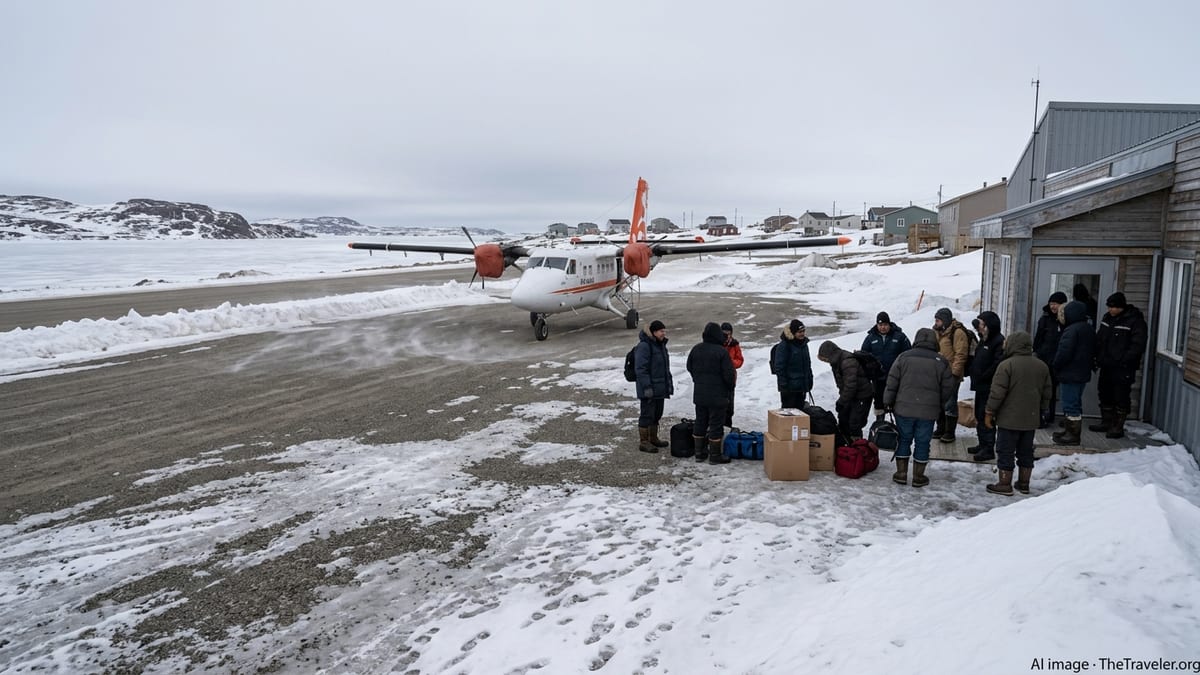
Travelers in Nunavik faced hours of uncertainty after four Air Inuit flights serving Kangirsuk were grounded, disrupting key connections to Quaqtaq, Kuujjuaq and other remote northern Quebec communities.
Get the latest news straight to your inbox!
Chain Disruptions Along a Critical Nunavik Air Corridor
Reports from flight tracking platforms and publicly available scheduling data indicate that a cluster of Air Inuit services touching Kangirsuk Airport were canceled or not operated as planned, affecting at least four rotations on a corridor that links several villages with the regional hub of Kuujjuaq. The affected services include segments commonly flown by De Havilland turboprop aircraft that connect Salluit, Kangiqsujuaq, Quaqtaq, Kangirsuk and Kuujjuaq in a single multi-stop route.
Flights such as 3H825, which typically runs between Salluit and Kuujjuaq with intermediate stops including Quaqtaq and Kangirsuk, are part of a tightly coordinated schedule that underpins mobility across Nunavik. When multiple departures in this chain are grounded on the same day, travelers in one community can be left waiting without clear alternatives as aircraft and crews are repositioned.
Publicly available timetable information shows that Air Inuit has been revising its regular schedule for the Ungava Coast, including Kangirsuk, Quaqtaq and Kuujjuaq, for the spring and summer period. On the day of the disruption, however, passengers at Kangirsuk reported that several departures did not operate, effectively halting through-travel toward Kuujjuaq and on to southern Quebec.
The cancellations are particularly impactful because Kangirsuk, situated on the northern shore of the Payne River and accessible primarily by air, relies on these flights for medical travel, schooling, government services and family visits. In late summer, some resupply is possible by boat, but during much of the year aircraft provide the only practical connection in and out of the community.
Stranded Passengers Highlight Vulnerability of Remote Routes
Accounts from travelers describe a scene of mounting frustration inside the modest terminal at Kangirsuk Airport as departure boards remained static and aircraft failed to appear. With four flights grounded, some passengers faced the prospect of missing onward connections in Kuujjuaq, while others worried about running out of necessary supplies during an unplanned extended stay.
Observers note that, unlike in larger southern airports where multiple carriers operate overlapping routes, travelers at Kangirsuk have limited fallback options when a regional airline cancels several flights at once. Chartering a private aircraft can be prohibitively expensive, and overland travel is not feasible. As a result, even a single day of multiple cancellations can translate into multi-day delays as the airline works through a backlog of displaced passengers.
Travel forums and social media discussions about northern aviation frequently highlight how weather, mechanical issues and crew availability can quickly cascade into longer disruptions. The cluster of cancellations at Kangirsuk appears to fit this pattern, with travelers reporting that information about rescheduling and rebooking arrived slowly and sometimes with little advance warning.
Some passengers affected by the grounded flights were reportedly traveling for medical appointments and essential services in Kuujjuaq or beyond. For these travelers, delays can have consequences that go beyond inconvenience, underscoring how air-service reliability in Nunavik has direct implications for health care access and community well-being.
Operational Pressures on Air Inuit’s Nunavik Network
According to the airline’s published conditions of carriage and schedule materials, Air Inuit operates an intricate network across Nunavik using turboprop aircraft such as De Havilland Dash 8 and Twin Otter models. These planes are specifically suited to the short, often gravel runways that serve communities like Kangirsuk and Quaqtaq, but the limited size of the fleet makes the system sensitive to disruptions.
Recent schedule documents and corporate updates show that Air Inuit has been adjusting its regular schedule along the Ungava Coast, with attention to routes linking Kuujjuaq to surrounding communities including Kangirsuk and Quaqtaq. Any change in aircraft availability, whether from maintenance needs or weather diversions, can ripple through this network and result in same-day cancellations and revised timings.
Publicly available tariff information outlines how the airline manages delays and cancellations, distinguishing between factors within its control and those driven by external forces such as severe weather or airport constraints. While specific reasons for the four grounded flights at Kangirsuk were not immediately detailed in public reports, the incident comes amid broader scrutiny of reliability on long regional routes in northern Canada.
Regional transportation reports from Nunavik authorities have also highlighted ongoing infrastructure challenges at small airports, including limited ground-handling resources and winter operations that demand close coordination with carriers like Air Inuit. In such an environment, even routine maintenance or staffing issues can reduce operational flexibility and contribute to the type of multi-flight disruption seen at Kangirsuk.
Essential Links Between Kangirsuk, Quaqtaq and Kuujjuaq
The air route that ties Kangirsuk to Quaqtaq and Kuujjuaq is far more than a convenience. Public information from airline and regional websites describes it as a backbone for everyday life, enabling residents to attend school and training programs, access specialized medical care, participate in regional meetings and maintain family connections across Nunavik.
Flight schedules show that Kangirsuk typically has multiple weekly links to Kuujjuaq, sometimes as part of multi-stop “milk run” services that also call at Quaqtaq and other coastal communities. These routes consolidate passenger demand and cargo into single aircraft movements, which is economical in sparsely populated regions but also concentrates risk when flights are canceled.
Travel planning tools that aggregate airline timetables show near-daily services between Kangirsuk and Kuujjuaq in the current season, emphasizing how central this corridor is for residents. The grounded flights temporarily broke this pattern, leaving some travelers uncertain about when they would next be able to depart or return home.
Community-focused programs advertised by Air Inuit, including outreach tours in Nunavik communities such as Quaqtaq, Kangirsuk and Kuujjuaq earlier in 2026, underscore the airline’s role as a connector for the region. The incident at Kangirsuk Airport provides a stark reminder of how disruptions on this lifeline can reverberate through social, economic and cultural activities across multiple villages.
Calls for Clearer Communication and Long-Term Resilience
In the wake of the cancellations, online commentary from travelers and residents has concentrated on the need for clearer, more timely communication when multiple flights are grounded. Passengers described relying on a combination of airport announcements, online flight-status tools and word of mouth to piece together what was happening.
Consumer advocates focusing on northern travel note that regional airlines serving remote communities face unique constraints, from harsh weather to limited infrastructure, but argue that transparent information and predictable rebooking processes are critical when disruptions occur. For many Nunavik travelers, access to real-time digital tools may also be limited, making on-the-ground communication at small airports particularly important.
Discussion around the Kangirsuk disruptions has also raised broader questions about resilience in northern air networks. Suggestions include strengthening backup aircraft capacity on critical routes, improving coordination between airlines and local authorities, and investing in airport infrastructure to reduce weather-related vulnerabilities.
For now, schedules indicate that Air Inuit continues to serve Kangirsuk, Quaqtaq and Kuujjuaq with its regular pattern of turboprop flights. Travelers and communities watching the aftermath of the four grounded services will be looking for signs that lessons are being applied, in the hope that future disruptions along this vital corridor can be minimized or better managed.