


More news on this day
Airlines are cautiously rebuilding their Middle East networks after the Iran conflict disrupted key hubs and air corridors, gradually restoring routes while keeping contingency measures in place and warning travelers that schedules remain subject to rapid change.
Get the latest news straight to your inbox!
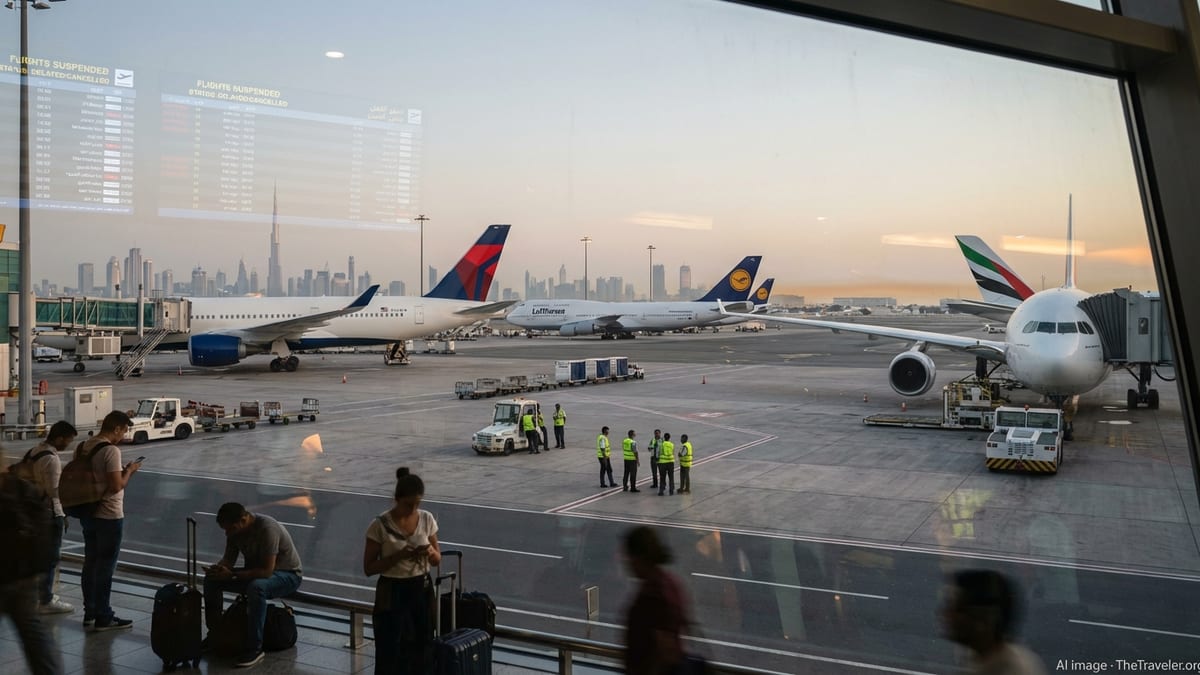
From Shutdowns to a Patchwork Recovery
When airspace closures rippled across the Gulf and wider region in March after U.S. and Israeli strikes on Iran, hundreds of flights a day were rerouted or canceled, cutting some of the world’s busiest long-haul corridors linking Europe, Asia and Africa. Published coverage indicates that major hubs such as Dubai, Doha and Abu Dhabi saw traffic collapse as airlines avoided conflict zones and navigated a fast-moving security picture.
By mid-July, reports show that the region has shifted from near-standstill to a patchwork restart. Gulf carriers have been first to rebuild, using their home bases as staging points for limited services into surrounding markets and adding capacity on alternative long-haul routes that bypass restricted airspace. At the same time, many non-Middle Eastern airlines still operate on elongated routings around the Gulf, adding up to an hour or more to typical Europe–Asia journeys.
Industry data and airline statements suggest that total regional capacity remains well below pre-war levels even as schedules are reintroduced. Analysts cited in trade and financial media describe a two-speed recovery: Middle Eastern airlines restoring more of their networks to protect hub status, while European and Asian carriers proceed more cautiously on non-essential routes.
Travelers are feeling the effects through longer flight times, fewer nonstops and changing connection patterns. According to publicly available data from aviation analytics firms, detours via Central Asia, the eastern Mediterranean and North Africa have become more common as airlines seek stable, scalable alternatives to traditional Gulf corridors.
Which Airlines Are Coming Back, and Where
Recent factbox-style updates from international news outlets show that an increasing number of airlines are re-entering key Middle Eastern markets, but with trimmed schedules and delayed resumptions for the most exposed destinations. European carriers including Lufthansa Group brands, Air France–KLM and British Airways have focused initially on reopening limited services to major cities such as Tel Aviv, Dubai and Doha, often with fewer weekly frequencies than before the conflict.
Asian airlines are following a similar pattern. Coverage of schedule filings indicates that carriers from India, Japan and Southeast Asia have reintroduced selective flights to the Gulf and Levant, while keeping suspensions in place for routes deemed higher risk or less commercially critical. In some cases, airlines are restarting one daily flight where they previously operated multiple daily services, leaving less choice on departure times for both business and leisure travelers.
Low-cost and leisure-oriented airlines appear to be returning more slowly. Reports highlight that some budget carriers have indefinitely postponed planned launches to cities such as Tel Aviv and Beirut, or pushed back restart dates into late summer and early autumn. The combination of security concerns, higher insurance and fuel costs, and weaker near-term demand on discretionary routes is widely cited as driving this more conservative stance.
Within the region, Gulf-based operators have expanded frequencies on stable markets to absorb displaced demand. Trade press coverage notes increases on flows between the Gulf and Europe, South Asia and Australia, partly compensating for suspended or curtailed services into conflict-adjacent destinations. This has intensified competition on a narrower set of routes even as overall Middle East capacity remains constrained.
Detours, Costs and the New Geography of Long-Haul Travel
Although some airspace has reopened under stricter overflight rules, many carriers continue to route around the Gulf, Iraq and western Iran, reshaping the geography of long-haul travel between Europe and Asia. Aviation analysts quoted in recent reports describe a pronounced shift of traffic toward corridors over Türkiye, the eastern Mediterranean and Central Asia, putting pressure on air navigation systems that were not designed for such volumes.
The operational impact is visible in longer block times, higher fuel burn and more complex crew scheduling. Several airlines have disclosed that they are adding technical stops on ultra-long sectors or capping passenger loads to manage payload restrictions on extended routings. These measures add cost and can reduce the number of seats available on popular city pairs, contributing to firmer fares through the peak northern summer season.
Publicly available financial commentary links these route changes with broader cost pressures tied to the Iran conflict, particularly elevated jet fuel prices and war-risk insurance. Some carriers have introduced temporary surcharges on affected routes, while others have adjusted capacity plans and profit forecasts for 2026. Industry bodies and research groups suggest that, even as traffic recovers, margins on Middle East-linked flying are likely to be thinner than pre-war until fuel markets and insurance premiums stabilize.
For passengers, the most visible result is extra time in the air and busier connecting banks at alternative hubs. Travel advisories from governments and airlines continue to recommend checking itineraries frequently, as last-minute routing changes remain possible when security conditions shift or new restrictions are introduced on short notice.
Travelers Face Persistent Uncertainty Despite Reopenings
While the overall direction of travel is toward normalization, the experience on the ground remains uneven. Consumer-facing reports and social media posts describe a mix of relatively smooth journeys through certain hubs and significant disruption on others, with missed connections and short-notice rebookings still a feature of long-haul itineraries touching the region.
Published guidance from airlines and travel agencies encourages passengers to build in longer connection times, especially when itineraries involve multiple carriers across different alliances. Flexible tickets and rebooking options, which became more widely used during the pandemic years, are again being marketed as a hedge against sudden schedule changes driven by security developments.
For corporate travel planners, the gradual restoration of flights brings both relief and new complexity. On one hand, more direct options into major business centers such as Dubai, Doha and Riyadh are returning, making it easier to schedule essential trips. On the other, risk management teams are weighing evolving government advisories, insurance requirements and duty-of-care obligations, often steering travelers away from marginal or newly reinstated routes.
Leisure demand is recovering more unevenly. Tourism boards in relatively insulated destinations around the region are working to reassure visitors, but booking data cited in industry coverage still shows weaker interest in holidays involving multiple transits or stays near conflict-affected areas. That has knock-on effects on airlines whose Middle East services are heavily reliant on seasonal tourism flows.
Outlook: Gradual Normalization with Lingering Risks
Forward-looking commentary from airline executives and industry analysts points to a slow, risk-managed return to more typical Middle East flight patterns through late 2026. As ceasefire arrangements hold and navigation authorities refine safe corridors, more carriers are expected to restore additional frequencies and destinations, particularly on high-yield business routes.
However, many observers stress that the conflict has altered perceptions of geopolitical risk along key air corridors, and that some reroutings may become semi-permanent. Airlines that have successfully built alternative networks around new hubs or detours could decide to keep a portion of that capacity in place, reducing their dependence on any single region for connecting traffic.
The episode has also sharpened focus on resilience across the global aviation system. Airport operators, air navigation providers and carriers are reassessing contingency planning for large-scale airspace closures, running simulations and exploring additional data-sharing on risk assessments. Travel media and specialist publications note growing interest in how quickly the industry can reconfigure itself in response to sudden regional shocks.
For now, travelers heading to, from or over the Middle East are entering a landscape that is more stable than at the height of the Iran conflict but still far from fully settled. Flight options are expanding week by week, yet the possibility of renewed disruption means that flexibility, up-to-date information and a measure of patience remain essential companions on any itinerary touching the region.