


More news on this day
Flights across the United States were thrown into disarray on Friday after the Federal Aviation Administration ordered a rare nationwide halt to most departures, disrupting nearly 500 take offs within hours and leaving thousands of passengers stranded at airports from Los Angeles to New York.
Get the latest news straight to your inbox!
Communication failure triggers first nationwide halt in years
Publicly available FAA information and multiple news reports indicate that the ground stop began on Friday afternoon Eastern time, after a telecommunications failure affected the private network that links air traffic control centers across the country. The outage hit all 22 Air Route Traffic Control Centers, which manage aircraft as they travel between metropolitan areas at high altitude, forcing controllers to rely on backup procedures and sharply limiting the system’s capacity.
According to coverage citing internal briefings, an update to the communications network led to overloaded routers and inconsistent data flowing between facilities. That in turn prompted the FAA to order a halt to most departures nationwide while specialists attempted to stabilize the system. Homeland security and transportation officials later stated in public briefings that there was no indication of a cyberattack and no evidence that the disruption was related to a separate global outage affecting Microsoft services.
The order represented the most sweeping restriction on U.S. air travel since a January 2023 system failure and was comparable in scale to emergency actions taken in the aftermath of the September 11, 2001 attacks, according to historical summaries of FAA ground stops. Aviation analysts noted that while localized technical glitches and weather-driven pauses are common, a blanket halt on nearly all departures across the continental United States remains an extraordinary step.
By early evening, the FAA announced that the ground stop had been lifted and that some domestic flights were being cleared for departure. However, the restart occurred into an already saturated system, with planes and crews scattered far from their planned positions, setting the stage for continuing disruption well into the weekend.
Hundreds of departures disrupted and thousands stranded
Aviation analytics firm Cirium, cited in international and U.S. media coverage, estimated that by about 4:40 p.m. Eastern time on Friday, nearly 481 flights had been canceled outright or had failed to depart within three hours of their scheduled departure time as a direct result of the order. Those figures captured only the early phase of the disruption; as the evening wore on, data from flight-tracking services such as Flightradar24 showed thousands more flights experiencing significant delays.
At the time the halt was imposed, more than 3,500 aircraft were already in the sky over the United States, with over 4,000 flights en route to U.S. destinations, according to figures published by major broadcasters that drew on live tracking feeds. Arrivals were allowed to continue, but with departures largely frozen, major hubs quickly became gridlocked, as incoming aircraft found gates occupied by planes that were unable to leave.
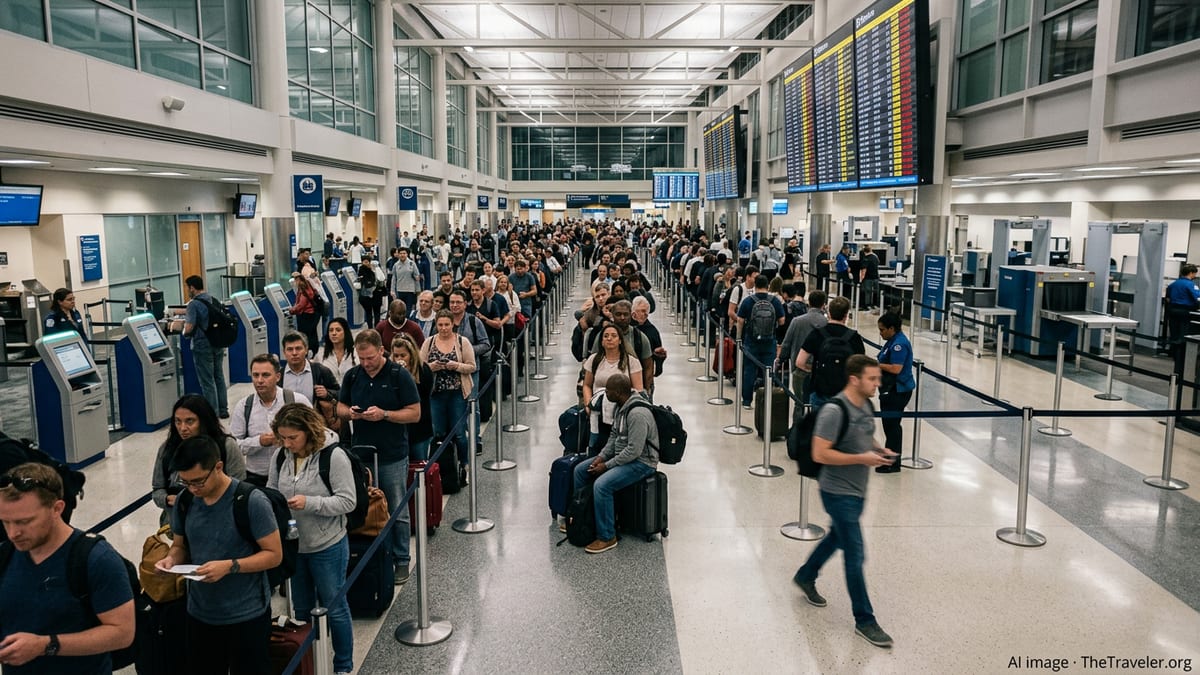
Images and reports from airports including Chicago O’Hare, Los Angeles International, Atlanta, Dallas Fort Worth and New York’s LaGuardia showed departure boards filled with red cancellation and delay notices. Passengers described spending hours in terminal queues waiting to rebook or obtain hotel and meal vouchers, while others reported sitting on aircraft that had pushed back from gates only to be ordered to return when the ground stop took effect.
Because the ground stop lasted more than four hours at many airports, analysts warned that the overall impact would extend far beyond the initial 500 disrupted departures. NBC-affiliated outlets reported estimates from academic aviation specialists suggesting that between 300,000 and 400,000 passengers may have been stranded or significantly delayed on Friday alone, with knock-on effects expected on Saturday and Sunday as airlines attempt to reposition aircraft and crew.
Airlines cancel schedules and warn disruption will spill into weekend
Major carriers moved quickly to trim schedules and rework operations once the extent of the outage became clear. According to published airline statements, United Airlines told customers that domestic flights would not depart during the suspension, while some international departures would be coordinated with regulators on a case by case basis. American Airlines advised travelers that disruption was expected to continue for the rest of Friday and encouraged passengers to monitor their flight status and use mobile apps or websites to rebook where possible.
In a memo referenced by several outlets, JetBlue Airways indicated it would cancel almost all remaining domestic departures for Friday evening, maintaining only certain transatlantic services. In Canada, Air Canada announced that it had canceled all flights to and from the United States for the remainder of the night because of the FAA restrictions and cautioned that some flights between Canada, the Caribbean and South America that rely on U.S. airspace could be affected.
Parcel carriers and cargo airlines were also affected. Statements from FedEx, cited in national business coverage, indicated that the company was monitoring the situation and preparing contingency plans to minimize delivery delays, including rerouting shipments and adjusting aircraft assignments once clearance to operate was restored. Logistics analysts noted that even brief interruptions to the overnight cargo network can ripple into delays for e commerce deliveries and time sensitive shipments.
By Saturday morning, data compiled by U.S. network affiliates showed more than 2,000 flights canceled nationwide as airlines continued to “dig out” from the disruption. The cancellation totals, measured from Friday afternoon through Saturday, make the incident one of the most severe non weather operational shocks to hit the U.S. system in the past several years.
International knock on effects and sports travel turmoil
The disruption quickly spilled beyond U.S. borders. According to wire service reports and summaries carried by several American newspapers, Europe’s aviation regulator temporarily suspended most U.S. bound departures at the FAA’s request from late Friday afternoon local time, creating new bottlenecks at major transatlantic hubs. Air Canada’s sweeping cancellations of U.S. routes further underlined how closely integrated North American airspace has become.
Travelers connecting through U.S. hubs to Latin America, the Caribbean and the Pacific also faced uncertainty, particularly those on evening departures that rely on tight aircraft utilization. While flights within Alaska and Hawaii were allowed to continue in some cases, and certain international flights departing Honolulu and a handful of other gateways were cleared, the majority of connecting itineraries involving the continental United States encountered significant disruption.
Published coverage by the Associated Press and regional sports outlets highlighted another visible impact: disruption to professional and college sports schedules. Multiple NBA and NHL teams, along with college football squads traveling for weekend games, were left temporarily stranded when their charter or commercial flights were grounded. Leagues indicated through public statements that they were monitoring travel conditions and coordinating with airlines to secure alternative arrangements, including delayed departures and, in some cases, overland transport.
Sports analysts noted that, while teams often build in buffer time when traveling for games, a sudden nationwide halt can compress warm up schedules, affect rest periods and force rescheduling of matchups if travel cannot be completed safely in time. As of Saturday afternoon, most major professional games for the weekend were still expected to go ahead, but with several teams arriving later than originally planned.
Renewed scrutiny of FAA technology and resilience
The latest incident has intensified questions about the resilience and modernization of U.S. air traffic control systems. Recent reporting on FAA technology upgrades, including plans to phase out decades old equipment and even legacy storage media, has emphasized the scale of the task of overhauling systems that must operate continuously while handling around 25,000 domestic flights on an average day.
Separate news features on the ground stop noted that this is at least the second time in recent years that a critical communications or information system issue has triggered a nationwide halt, following a 2023 outage involving the system used for disseminating safety notices to pilots. Policy analysts and aviation experts quoted in those reports argue that while redundancies exist, the interconnected nature of the network means that failures in shared communications backbones can still cascade rapidly across regions.
Lawmakers and industry groups have already been pressing for increased investment in both hardware and cybersecurity. This week’s events are likely to add urgency to those calls, particularly around ensuring that new artificial intelligence assisted planning tools, such as the SMART system being rolled out to analyze schedules and weather, integrate safely with existing infrastructure. Reports indicate that investigators are examining whether the rollout of newer systems exacerbated the stress on legacy communications equipment, even though early public statements from federal agencies have suggested there is no evidence of malicious interference.
For travelers, the most immediate concern remains practical: when they will be able to reach their destinations. Airlines are encouraging passengers scheduled to fly over the weekend to check their flight status frequently, allow extra time at airports, and be prepared for rebookings and last minute gate changes as the complex process of resetting the national flight network continues.