


More news on this day
Flights are largely operating on schedule again across the United Kingdom and Europe after the 8 September air traffic control outage, but many stranded travelers are now learning that normal airport operations do not automatically translate into cash refunds or generous payouts.
Get the latest news straight to your inbox!
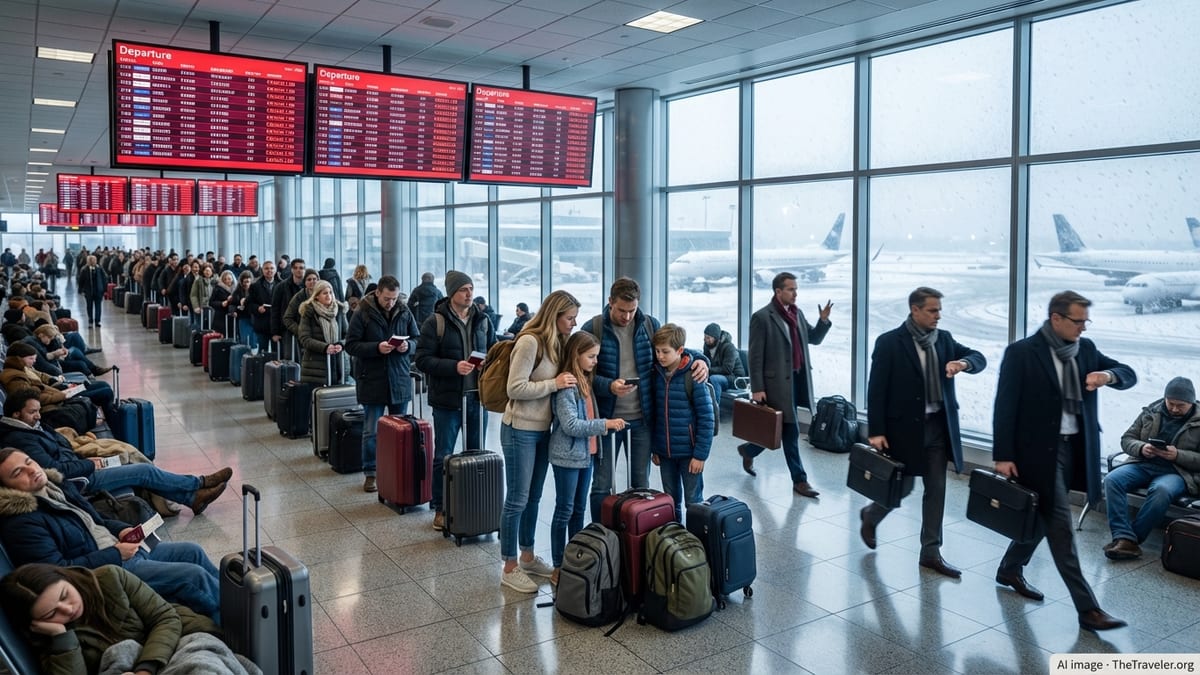
Operations Stabilize After Major UK Airspace Disruption
Flight schedules across the UK and much of Europe have been steadily returning to normal following the 8 September failure of systems at National Air Traffic Services (NATS), which briefly curtailed airspace capacity and led to waves of cancellations and delays. Published coverage indicates that more than 1,000 flights were canceled on the first day alone, with thousands more disrupted as airlines struggled to reposition aircraft and crews.
By midweek, publicly available tracking data showed that most UK airports were back to near-normal operations, with only scattered knock-on delays. Airlines focused on clearing stranded passengers from hubs such as London Heathrow, London Gatwick, and Manchester, while regional airports reported that backlogs were easing as additional recovery flights were added.
Despite the rapid operational recovery, the disruption left tens of thousands of travelers facing missed holidays, lost hotel nights, and broken connections worldwide. For many, the question has turned from when they will fly to whether they will receive any meaningful financial redress for the upheaval.
Guidance issued by regulators and governments in recent years underscores a distinction between getting passengers moving again and paying them compensation for the inconvenience. The NATS outage is now becoming a test case for how those rules apply when infrastructure rather than an individual airline is at fault.
Why a System Failure Rarely Triggers Cash Compensation
Under UK and European air passenger rights regimes, travelers are entitled to assistance and, in many cases, a refund or rerouting if their flight is canceled or severely delayed. However, compensation in the form of a fixed cash sum is only due when the disruption is not caused by what regulators classify as “extraordinary circumstances.”
According to guidance published by the UK Civil Aviation Authority following the NATS incident, a failure in the national air traffic control system is likely to fall into this extraordinary category. That interpretation mirrors previous European Commission clarifications on events considered outside an airline’s control, such as airspace closures, volcanic ash, or certain third-party technical failures.
In practical terms, this means that while passengers whose flights were canceled retain the right to choose between a refund, rerouting at the earliest opportunity, or travel on a later date, they are unlikely to receive the additional lump-sum compensation often associated with controllable airline cancellations. Consumer advocates note that this distinction can amount to hundreds of pounds or euros per person in potential lost payouts.
Legal summaries of the revised EU air passenger rights framework, which the Council and Parliament agreed in 2026, reinforce the scope of the extraordinary circumstances exemption, listing events such as unscheduled airport closures, power outages, and large-scale system failures. The NATS outage appears to align with these examples, making broad-based compensation claims challenging even as flights resume.
Refund Rights Still Apply, But With Important Limits
Even when cash compensation is off the table, passengers caught in large-scale disruptions retain several core protections. Existing EU and UK rules, which are due to be strengthened under recent legislative updates, require airlines to offer a refund if a flight is canceled and the traveler chooses not to be rerouted, or if a significantly delayed service no longer serves the purpose of the original trip.
Guidance from European institutions explains that, in addition to refunds, travelers are entitled to care in the form of meals, refreshments, and hotel accommodation where necessary, regardless of whether the underlying cause is extraordinary. In cases like the NATS outage, this can include overnight stays and local transport for passengers who are rebooked onto flights departing the following day.
However, these rights typically extend only to the disrupted flight segment. Separate reservations, such as independently booked hotels, cruises, or onward low-cost flights, remain the traveler’s responsibility unless an airline’s own policies provide additional coverage. That leaves many holidaymakers with substantial out-of-pocket losses that current regulations do not automatically cover.
In North America, refund standards follow a different model. The United States Department of Transportation states that passengers are entitled to refunds when flights are canceled or significantly changed and the traveler declines rebooking, but it does not mandate compensation for time lost during delays linked to external infrastructure problems. Recent enforcement notices emphasize that airlines must honor refund obligations, yet they also highlight that compensation beyond a ticket refund is generally limited unless specified in a carrier’s own policies.
New Rules Highlight Global Patchwork of Protections
The timing of the NATS failure coincides with a broader reshaping of air passenger rights, particularly in Europe. In June and July 2026, European Union institutions reached agreement on an updated air passenger rights regulation that codifies several new protections, including clarified obligations for rerouting at the earliest opportunity, sometimes even on other airlines or via alternative modes of transport where suitable.
Policy briefings from the European Council and Parliament explain that the updated framework seeks to close loopholes exposed by past crises, from volcanic ash to the pandemic, by defining more precisely when airlines must rebook passengers and what support airports should provide during mass disruptions. Provisions covering airport system failures, power cuts, and air traffic control issues recognize that such incidents are likely to recur as infrastructure becomes more complex and digitally connected.
At the same time, regulators have left the extraordinary circumstances exemption largely intact, preserving the principle that airlines should not pay standard compensation for events entirely outside their control. Consumer organizations argue that this maintains a gap between the scale of disruption travelers experience and the financial remedies they can claim, particularly when infrastructure failures stem from underinvestment or fragmented oversight.
Across the Atlantic, the United States continues to refine its own refund rules through regulatory processes and enforcement guidance, but has not adopted a European-style compensation model. Recent federal notices reiterate that airlines must provide cash refunds for canceled flights where passengers decline alternatives, while leaving accommodation, meals, and additional compensation largely to individual carrier policies or voluntary commitments recorded in public dashboards.
What Stranded Travelers Can Realistically Expect Now
With airport operations back on a largely even keel, the focus for many affected passengers has shifted from rebooking to paperwork. Advisory sites and consumer advocates recommend that travelers document all expenses related to the disruption, including hotel bills, meal receipts, and local transport, and submit claims directly to their airline under existing care obligations.
For those whose flights were canceled and who chose not to travel, refund requests remain a key avenue. Regulators in both Europe and the United States stress in public guidance that passengers should receive money back to the original form of payment if they decline rerouting or if schedule changes are significant enough, rather than being forced to accept vouchers or credits.
Where an airline rejects a claim for compensation on the basis of extraordinary circumstances, passengers in the UK and EU can escalate disputes to national enforcement bodies or alternative dispute resolution schemes. However, legal analyses of current rules suggest that, in the case of the NATS outage, challenges may face an uphill struggle unless new facts emerge about the chain of responsibility for the system failure.
As the latest disruption fades from departure boards and airports grow quieter again, the episode underscores a recurring reality for air travelers: operations can rebound quickly after a crisis, but the path to financial redress is often far slower, more complex, and, in many cases, blocked entirely by the fine print of passenger rights regimes.
UK Civil Aviation Authority guidance on NATS disruption
Council of the EU overview of air passenger rights
European Commission Your Europe: Air passenger rights