


More news on this day
South Korean cargo carrier AirZeta is emerging as a far larger player in Northeast Asia’s freight market after taking over Asiana Airlines’ cargo unit, with new branding, a bigger widebody fleet and a broader route network reshaping competition on key transpacific and intra-Asian lanes.
Get the latest news straight to your inbox!
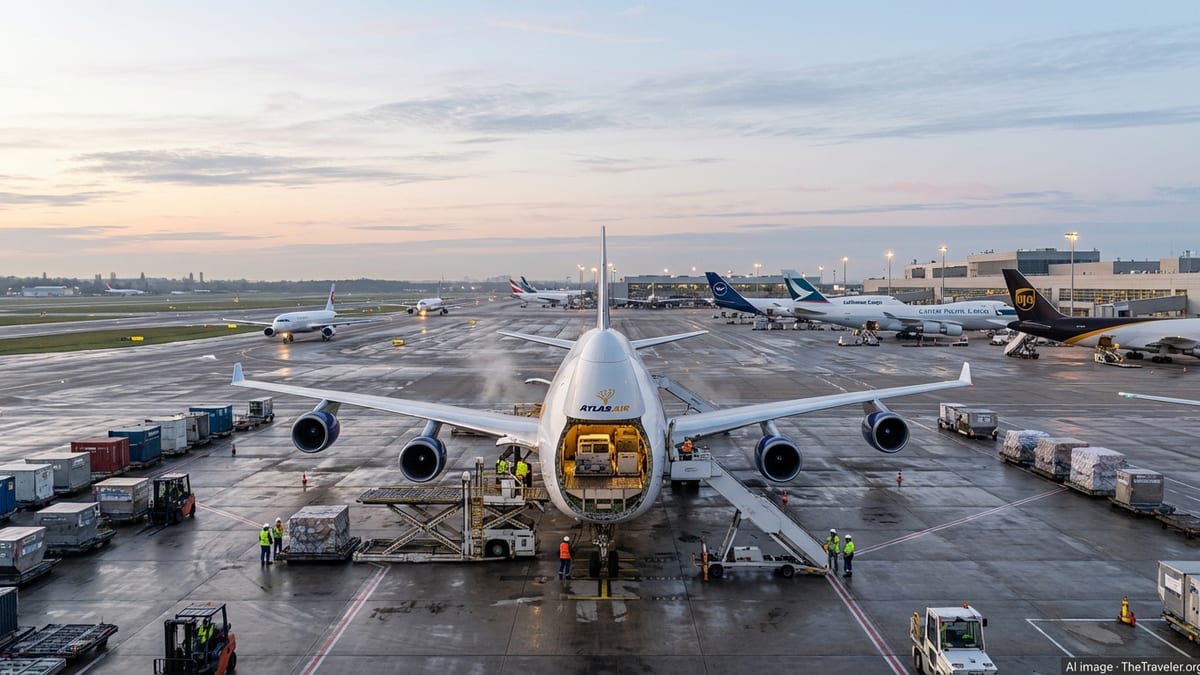
From niche operator to Korea’s number two cargo carrier
Publicly available company information shows that AirZeta, formerly known as Air Incheon, had spent a decade as a relatively small specialist freighter airline based at Incheon International Airport, operating a handful of Boeing 737 narrowbody freighters on regional routes. The acquisition of Asiana Airlines’ cargo business, finalized as part of regulatory conditions attached to the Korean Air and Asiana merger, has transformed its scale almost overnight.
Regulatory and industry reports indicate that Asiana’s standalone cargo arm brought with it a fleet of 10 Boeing 747-400 freighters and a Boeing 767-300 freighter, along with a well-developed long haul network. With the transfer completed and the airline rebranded as AirZeta in August 2025, the carrier now operates around 15 aircraft, predominantly widebodies, instantly positioning it as South Korea’s second largest cargo airline by capacity.
For the wider freight market, this shift means that rather than seeing Korean Air absorb its main domestic cargo rival, shippers now face a strengthened independent competitor operating from the same Incheon hub. Analysts following the consolidation say this structure preserves more choice on trunk routes between Northeast Asia, North America and Europe while still allowing the Korean Air and Asiana merger to move forward.
Industry coverage also notes that the European Union’s approval of the Korean Air and Asiana deal was conditional on the divestment of Asiana Cargo, which opened the way for Air Incheon to acquire the unit. In effect, the remedy designed to protect competition in cargo has given AirZeta a platform to move from a niche regional operator to a carrier with global ambitions.
Rebrand, fleet growth and network realignment
Information released through company profiles and aviation databases shows that Air Incheon formally rebranded as AirZeta on 1 August 2025, the same date on which it assumed operational control of the former Asiana freighter fleet. The rebrand included a new corporate identity and livery, signalling a break from its narrowbody-focused past and emphasizing its upgraded position in the market.
The enlarged fleet is centered on Boeing 747-400 freighters, supplemented by a 767-300 freighter and several 737-800 converted freighters that continue to serve shorter regional sectors. This mix allows AirZeta to maintain dense, high-yield long haul cargo routes inherited from Asiana while also feeding those flights with regional traffic from across Northeast Asia.
Route network data compiled by aviation intelligence providers suggest that AirZeta has retained many of Asiana’s long standing cargo connections from Incheon to North American and European gateways, including major logistics hubs. At the same time, its legacy regional network around Northeast Asia, previously focused on short haul freight such as express shipments and automotive components, is being integrated to support the larger widebody operation.
Reports in trade publications indicate that the airline is also examining further fleet development, with references to additional widebody freighter conversions under consideration. Any such moves would consolidate its new role as a key long haul cargo player and could further differentiate it from Korean low cost and hybrid carriers that primarily focus on passenger services.
Workforce expansion and operational integration challenges
The takeover of Asiana Cargo did not only involve aircraft and routes. Company disclosures and local media coverage indicate that around 800 employees from Asiana’s cargo arm transferred to AirZeta, increasing its workforce from roughly 200 people to about 1,000. That scale-up has required rapid integration of differing corporate cultures, systems and procedures.
Bringing together ground handling, maintenance, sales and revenue management teams built for a large legacy airline with those of a smaller, entrepreneurial specialist carrier presents both opportunities and risks. On one hand, AirZeta gains access to deep experience in managing complex intercontinental operations and relationships with major freight forwarders. On the other, aligning IT systems, standard operating procedures and labor structures will be a multi year process.
Reports in Korean business media highlight that integration work has focused on maintaining schedule reliability on key trunk routes, particularly during peak export seasons for South Korea’s electronics, automotive and industrial sectors. With manufacturing and e commerce supply chains highly sensitive to disruptions, AirZeta’s ability to maintain service continuity while changing ownership and branding is viewed as critical to its credibility with shippers.
At the same time, AirZeta’s expanded employee base creates new fixed costs. Successfully absorbing these while operating in a cyclical cargo market that has recently seen softer demand and lower yields in some regions will test management’s ability to balance growth with financial discipline.
Competitive landscape in a cooling cargo cycle
The timing of AirZeta’s emergence as a major cargo player coincides with a normalizing global air freight cycle after the demand spikes of the pandemic years. Industry data published by freight market analysts show that yields on some long haul lanes have come off their recent highs, even if volumes remain structurally higher than pre 2019 levels for certain e commerce and high value goods.
In this environment, AirZeta inherits both advantages and headwinds from the Asiana unit. On the positive side, the combined network and fleet offer economies of scale, better aircraft utilization and stronger negotiating power with global forwarders. The presence of 747-400 freighters gives the airline ample capacity on lanes where volume still supports large aircraft.
However, widebody freighters also bring higher fuel and maintenance costs, and older 747s are less efficient than newer twin engine designs deployed by some competitors. If rates weaken further, pressure to tightly manage capacity and possibly accelerate the renewal or conversion of aircraft will increase.
Market observers note that AirZeta must also carve out a clear commercial identity in a crowded regional field that includes state backed incumbents and fast growing private operators in China and Southeast Asia. Positioning itself as a reliable, Korea based alternative with strong connections to global electronics and automotive supply chains is widely seen as central to its strategy.
Implications for shippers and regional air logistics
For global shippers, the reconfigured Korean cargo market means that instead of a single dominant combination carrier, there are now two substantial players based at Incheon offering long haul capacity. Publicly available schedule and capacity data suggest this arrangement preserves competition on major trade lanes while still allowing Korean Air to focus on integrating Asiana’s passenger operations.
AirZeta’s larger platform could be particularly relevant for time sensitive exports from South Korea, from semiconductors and smartphones to pharmaceuticals and high value components. Freight buyers who previously split volumes between Korean Air and Asiana now have the option of directing some of that traffic to an expanded, dedicated cargo operator that is not tied to a large passenger network.
Regional logistics hubs that compete with Incheon will closely watch how AirZeta deploys its added lift. If the carrier succeeds in maintaining high service standards and selectively adding new destinations, Incheon’s role as a Northeast Asian cargo gateway could be reinforced, drawing additional warehousing and value added logistics activity to the airport’s free trade zones.
Looking ahead, analysts suggest that AirZeta’s fortunes will hinge on how effectively it can integrate Asiana’s assets, manage fleet renewal and differentiate its service offering in a more competitive and less overheated cargo environment. The acquisition has given the airline scale and visibility it lacked before; turning that into sustainable profitability will be the next test.