


More news on this day
American Airlines is facing renewed scrutiny after reports that its automated rebooking tools have been changing passengers’ flights without their consent, in some cases with little or no human oversight and limited options for travelers caught in the middle of cascading disruptions.
Get the latest news straight to your inbox!
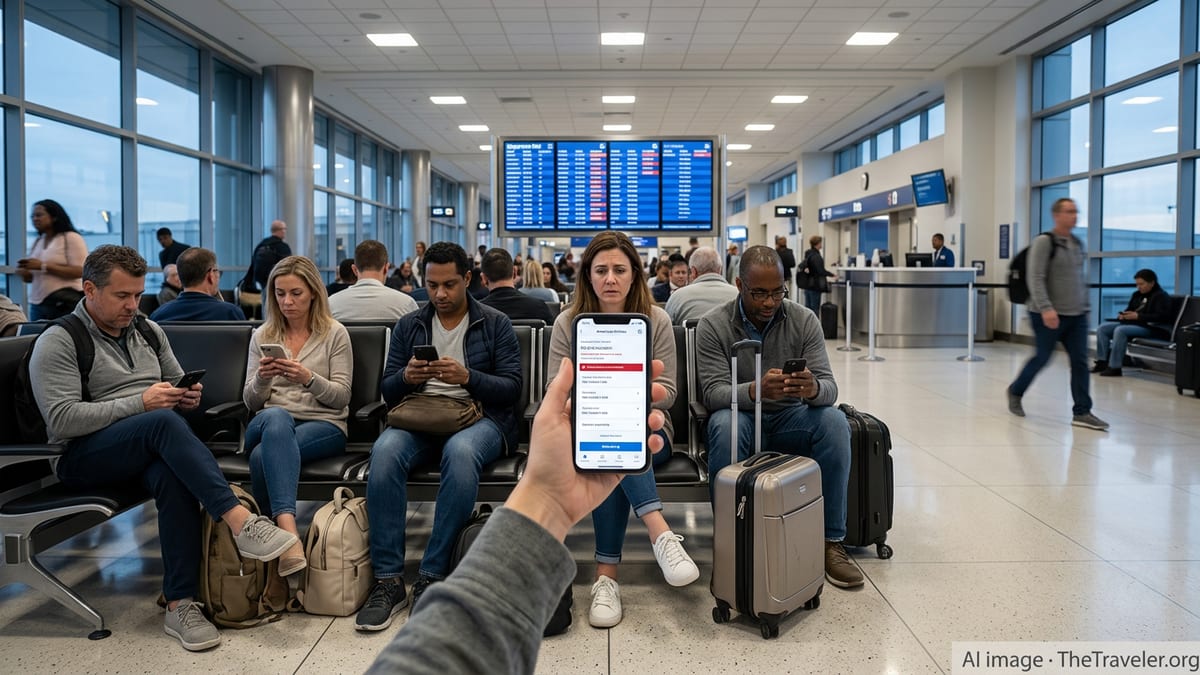
Automation Steps In As Schedules Shift
According to recent coverage of American Airlines’ operations, the carrier has increasingly leaned on automated decision systems to manage tight connections, schedule changes and irregular operations across its network. These tools are designed to predict when a traveler is likely to miss a connection and to free up scarce seats by moving those passengers to later flights preemptively.
Reports indicate that one such system, referenced in public discussion as AURA, can automatically rebook a traveler when it calculates that a misconnection risk is high. In theory, the passenger benefits from a confirmed seat on a later departure instead of scrambling for space after arriving late to the gate. In practice, some travelers say the system has removed them from flights they were still able to make, sometimes without a clear explanation at the airport.
Travelers have described situations in which they arrived at a hub airport expecting to board their connecting flight, only to find that their reservations had been altered en route. In several accounts, passengers said gate agents explained that an automated program predicted they would miss the connection and reassigned their seats before they landed, even when the original connection time still appeared feasible.
Industry analysts note that predictive tools and automated rebooking are not unique to American Airlines, but concerns have sharpened around how aggressively such systems are applied and how much discretion is left to front-line staff when the algorithm’s prediction does not match real-world conditions.
Passengers Report Unwanted Flight Changes
The shift toward automation has coincided with a wave of traveler complaints about involuntary changes to itineraries. Publicly shared accounts describe flights moved to significantly earlier departure times, connections tightened to near-impossible windows, or routings shifted through different cities entirely, sometimes without direct notification beyond updated information in an app.
In several cases, passengers discovered that their flights had been changed only when attempting to check in, either the day before travel or at the airport. Some said that they had intentionally paid more for specific departure times or routings, such as a later evening departure or an itinerary that avoided certain regions, only to find themselves switched to less desirable options without being asked.
Other travelers have reported being reassigned while already in the air on an earlier leg of their journey. Midflight notifications in airline apps or email alerts indicated that their onward flights had been canceled, downgraded or rebooked, sometimes accompanied by meal vouchers or hotel details. Passengers say these alerts were their first indication that the original plans had disappeared from their records.
These stories point to a growing tension between operational efficiency for the airline and predictability for the customer. While automated tools can help carriers respond quickly to rolling delays and weather disruptions, travelers say that being moved without consent, particularly when alternatives are less convenient, can feel like losing control of a trip they carefully arranged and paid for.
Minimal Human Oversight Raises Concerns
Passenger accounts suggest that in some situations, airline employees have limited authority to reverse or override automated changes. Travelers describe customer-service calls in which phone agents cited system rules when asked to reinstate original flights, or airport interactions where staff said they could not move other passengers to restore earlier seat assignments or routings.
Publicly available guidance about American Airlines’ schedule-change processes indicates that minor timing adjustments may flow through automated systems without requiring active acknowledgment from the customer. More substantial changes typically allow travelers to request different flights or, in some situations, a refund instead of the modified itinerary. The friction appears to arise when a system-generated decision is treated as final, even when the original flight still shows available seats or when the customer is willing to accept the connection risk.
Debate has also emerged over how much of this technology should be described as artificial intelligence. Some observers argue that what is being marketed as AI is closer to rule-based automation that follows predefined criteria, rather than adaptive machine learning. Others emphasize that, regardless of terminology, the key issue is the degree to which automated tools act without timely human review, particularly when they alter paid itineraries or create the risk of passengers being stranded.
Without clear lines of accountability, passengers say it can be difficult to know whether to challenge a decision at the gate, on the phone or through post-travel customer relations. As a result, many end up accepting unwanted changes or paying out of pocket for alternate arrangements while disputes over responsibility play out later.
What Travelers Can Do When Flights Are Changed
Consumer advocates and travel specialists point to existing passenger rights and practical steps that can help when an airline alters an itinerary. Under American Airlines’ standard contract terms and general U.S. consumer protections, a significant schedule change can, in many circumstances, entitle a traveler to request rebooking on a different flight or a refund if the new plans no longer work.
Advice commonly shared by travel-rights groups is to monitor bookings frequently in the days leading up to departure and again during connections, since many changes first appear quietly in the airline’s app or website. If a schedule shift appears, they recommend immediately checking alternative flights on the same day, documenting the original itinerary and new proposal with screenshots, and contacting reservations to request specific options rather than waiting for the system to decide.
Specialists also suggest that passengers traveling with children, older relatives or groups pay particular attention to seat assignments after any change. Automated processes may split parties across the cabin or move them away from originally selected seats. In such cases, travelers can ask to be reseated together or, if necessary, escalate to customer relations after the trip with detailed records of the disruption.
While these measures do not eliminate the risk of being caught up in a mass rebooking following severe weather or operational meltdowns, they can improve the chances of securing acceptable alternatives and documenting issues if later reimbursement or compensation is pursued.
Broader Debate Over AI and Airline Accountability
The reports surrounding American Airlines come as carriers worldwide accelerate investments in automation and predictive analytics to manage congested networks and high passenger volumes. Proponents argue that advanced systems can reduce missed connections, shorten irregular-operations recovery times and improve on-time performance overall.
Critics counter that when algorithms control critical decisions about who flies and who is bumped to later departures, airlines must provide clearer transparency and stronger safeguards. They point to situations in which passengers with valid tickets, and in some cases adequate connection time, were removed from flights to make room for others, or were reassigned to itineraries that added substantial travel time without explicit consent.
The episode has fueled calls for more explicit disclosure about how automated rebooking works, including what triggers a change, how risk thresholds are set, and what rights passengers retain to opt out or insist on their original routing. Travel observers say that as automation advances, carriers will likely face growing pressure from regulators, consumer advocates and frequent flyers alike to ensure that human judgment remains available to correct automated decisions that do not align with travelers’ expectations.
For American Airlines and its competitors, the balance between efficiency and customer trust may hinge on how quickly they can refine these systems, communicate clearly about their operation and empower staff to intervene when the algorithm’s choice does not match what a passenger actually wants.