


More news on this day
Travelers passing through Amman are facing mounting disruption after Queen Alia International Airport recorded 64 flight delays and cancellations in a short window, prompting a new travel alert for passengers using Jordan’s primary international gateway.
Get the latest news straight to your inbox!
Ripple Effects Across Amman’s Main Air Hub
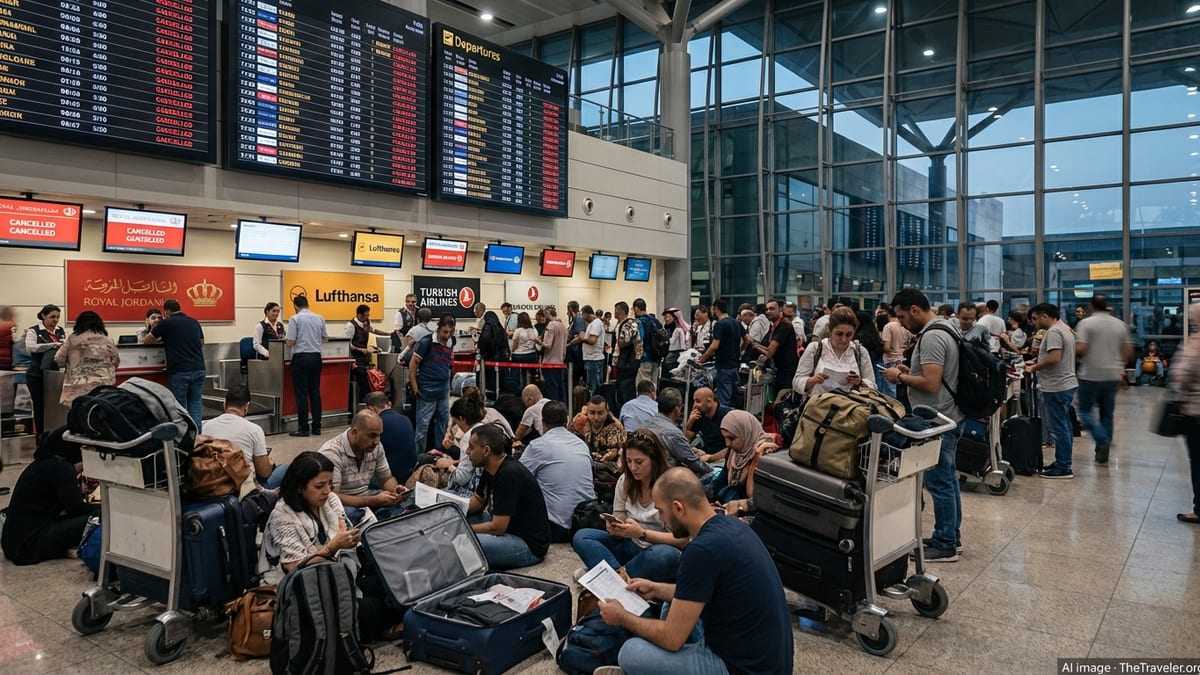
Publicly available flight-tracking boards and airport information show an unusual cluster of disrupted services at Queen Alia International Airport, with a total of 64 flights either delayed or canceled over a compressed period. The disruptions are affecting a mix of regional routes within the Middle East and longer-haul services linking Amman to Europe, North America, and Asia.
Queen Alia International Airport is Jordan’s busiest aviation hub and the primary entry point for visitors to the country. Even a temporary spike in irregular operations quickly cascades across the network, as many itineraries rely on tightly timed connections through Amman. The latest disruption has therefore had an outsized impact on both originating passengers and those transiting through the airport.
Reports indicate that the irregular operations have not been confined to a single carrier or route, but instead span multiple airlines and destinations. This pattern suggests system-wide congestion rather than an isolated technical issue on one aircraft or at one gate, increasing the likelihood of knock-on delays throughout the day.
While some affected flights have been rescheduled or re-routed, others have been withdrawn entirely from the day’s departures and arrivals, leaving travelers to rearrange plans with little notice. For those already in the terminal, fluctuating departure times have meant longer waits and heightened uncertainty at check-in counters and boarding gates.
Operational Pressures and Regional Context
Travel industry updates for the Middle East in recent weeks have pointed to intermittent strain on regional airspace and airport operations, with Jordan highlighted as generally operational but vulnerable to periodic disruption. Queen Alia International Airport has been described as resilient, but not immune to external shocks that can compress capacity and create temporary scheduling bottlenecks.
Airlines serving Amman rely heavily on precise slot times to maintain connectivity, particularly for evening and overnight waves that feed onward long-haul departures. When even a handful of flights experience extended delays, aircraft and crew rotations can quickly fall out of sequence, forcing carriers to consolidate services, substitute aircraft, or cancel weaker-performing rotations.
According to published airline performance data, several regional and Gulf carriers operating into Amman have recently experienced pockets of moderate or major delay on specific days, reflecting a broader pattern of volatility that can suddenly concentrate at a hub. The current disruption at Queen Alia appears to be one such moment when schedule buffers have been exhausted, amplifying the impact of any upstream issues.
Jordan’s aviation sector has been working within this challenging environment to maintain reliability, but the cluster of 64 delays and cancellations underlines how quickly circumstances can change. For travelers, it is a reminder that itineraries through the region may require additional flexibility, especially during peak travel weekends and holiday periods.
Impact on Travelers and Popular Routes
The disruption has been felt unevenly across the network. Short- and medium-haul routes to major Middle Eastern capitals have seen a mix of late departures and altered arrival times, complicating same-day connections. On some routes, a delayed incoming aircraft has led to revised departure times from Amman, extending wait times for onward passengers.
Long-haul services have also been affected, particularly those connecting Amman with major European and North American gateways. When these flights are delayed or canceled, rebooking options are more limited, and travelers may face extended layovers or rerouting through third-country hubs in the Gulf or Europe. In some cases, passengers have reported needing to adjust hotel stays, ground transfers, and tour departures at short notice.
Families traveling for summer holidays, students joining language and study programs, and business travelers relying on tightly scheduled meetings have all been caught up in the disruption. Crowded customer service desks and busy airline call centers are an additional consequence when several dozen flights face changes on the same day.
Despite the challenges, airport and airline operations at Queen Alia remain active, with many services still departing and arriving broadly on schedule. Travelers are therefore experiencing a patchwork of outcomes, with some journeys proceeding normally while others are significantly disrupted.
Guidance for Passengers Heading to or Through Amman
In light of the reported 64 delays and cancellations, travel alerts circulating in the industry are advising passengers bound for Amman or connecting through Queen Alia International Airport to build extra time and flexibility into their plans. Same-day tight connections, especially where separate tickets are involved, are currently considered higher risk.
Passengers are being encouraged to monitor their flight status frequently on airline and airport channels rather than relying solely on original booking confirmations. Because schedules can change multiple times in a single day, real-time updates are viewed as essential for avoiding unnecessary trips to the airport or missed connections.
Travel experts also recommend having a contingency plan, such as identifying alternative routings via other hubs in the region or adjusting travel dates where possible. Those with nonrefundable ground arrangements in Jordan, including hotel reservations and prebooked tours, may wish to contact providers early to discuss options in case of late arrival.
For travelers already in Amman, the advice is to arrive at Queen Alia earlier than usual, allowing additional time for check-in, security screening, and possible gate changes. Even when a flight currently shows as on time, the broader pattern of irregular operations means that last-minute adjustments remain a possibility.
What the Disruption Signals for the Season Ahead
The concentration of 64 delays and cancellations at Queen Alia International Airport is being viewed by industry observers as a warning sign for the remainder of the high travel season. With aircraft operating near full capacity on many routes and limited slack in airline schedules, any further disruption may quickly translate into additional waves of delays.
Travel data from recent months indicates that Amman has remained a key transit and destination market despite regional uncertainty. Visitor interest in Jordan’s cultural and natural attractions, from Petra to Wadi Rum and the Dead Sea, continues to drive demand for seats in and out of Queen Alia. This strong demand, however, also means that seats on alternative flights can be scarce when irregular operations occur.
Observers note that the airport’s performance in the coming weeks will be closely watched by tour operators, corporate travel planners, and individual travelers deciding on itineraries for late summer and early autumn. A sustained period of smoother operations would likely restore confidence quickly, while further clusters of disruptions could prompt more travelers to build in backup options or choose itineraries with longer connection times.
For now, Queen Alia International Airport remains fully open and functioning, but the latest sequence of 64 delays and cancellations is a clear signal for passengers to stay informed, remain flexible, and treat flight timings through Amman as subject to change at short notice.