


More news on this day
Passenger rail between the United States and Canada’s Pacific Northwest is entering a pivotal transition period as Amtrak’s new Airo trains arrive for testing on the Cascades corridor linking Eugene, Portland, Seattle and Vancouver.
Get the latest news straight to your inbox!
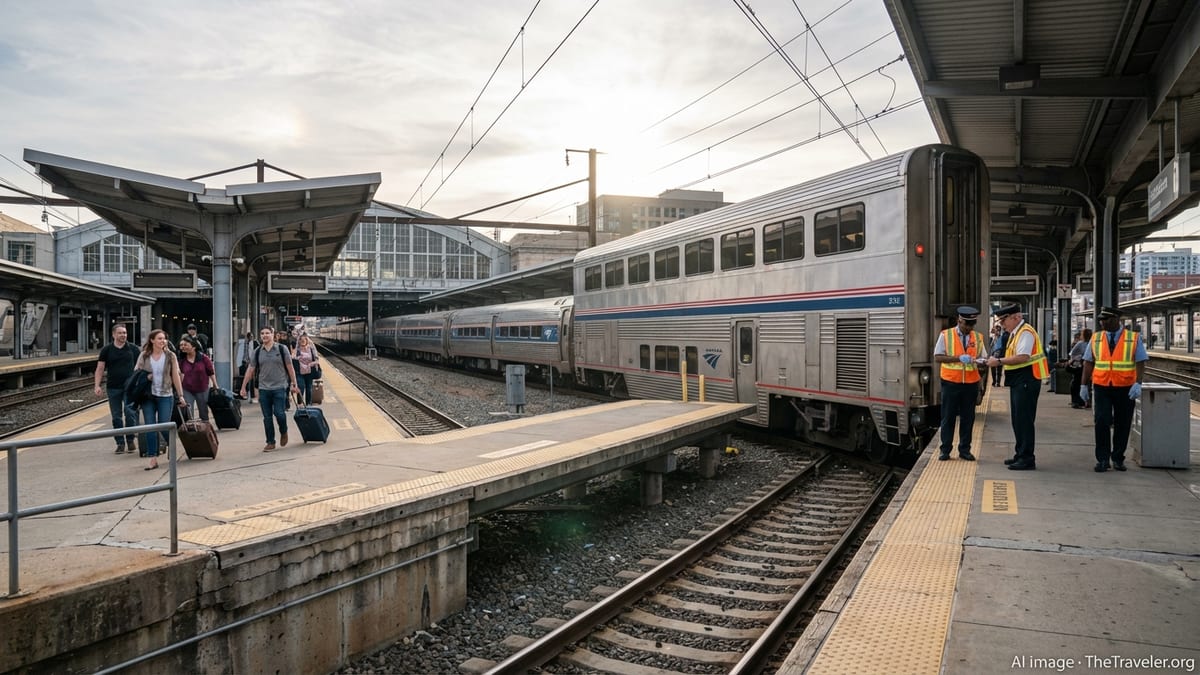
Next-Generation Fleet Arrives on the I-5 Rail Spine
Publicly available information from Amtrak and regional partners indicates that eight new Airo trainsets are being delivered to replace the aging mix of Talgo and Amfleet equipment on the state-supported Amtrak Cascades service. The 466 mile corridor, designated as a higher speed rail route, connects key city pairs from Eugene, Oregon, through Portland and Seattle to Vancouver, British Columbia, mirroring the busy I-5 highway.
Recent updates from Amtrak show the first Cascades-branded Airo trainset has now reached Seattle to begin final testing and crew training, following earlier trials at a dedicated facility in Colorado and on the Northeast Corridor. Additional sets are moving west as manufacturing at Siemens’ Sacramento plant ramps up, with the goal of placing the first trains into passenger service in the Pacific Northwest in late summer or fall 2026.
Washington and Oregon transportation departments, which sponsor the Cascades service, have signaled through planning documents that the new fleet is a cornerstone of long-term efforts to expand frequencies and improve reliability. While early Airo deployments are framed primarily as a one-for-one fleet renewal, officials in both states have outlined targets for more daily round trips between Portland, Seattle and Vancouver, British Columbia later this decade.
Across North America, passenger rail advocates view the Cascades rollout as one of the most visible early tests of Amtrak’s multibillion-dollar rolling stock modernization program. The company has ordered 83 Airo trainsets to operate on multiple regional routes, but the Pacific Northwest is scheduled to be first, giving cross-border riders an early look at the new standard for short and medium distance rail in the United States and Canada.
Faster, Smoother Journeys Along a Scenic Cross-Border Corridor
The Airo concept is designed to take better advantage of existing track and signal upgrades on the Pacific Northwest Corridor, where passenger trains can reach higher speeds on certain sections shared with freight traffic. While published analyses suggest that maximum speeds will not immediately rival European or Asian high speed rail, the combination of quicker acceleration, improved braking and reduced dwell times at stations is expected to trim schedules modestly and, just as importantly, make arrival times more predictable.
Rail observers note that some of the largest gains for travelers may come from time saved at station stops, where Airo trainsets feature automated gap-filling steps and level boarding at many platforms. These elements can make boarding and alighting more efficient, particularly at busy urban stations in Portland and Seattle and at the international terminus at Vancouver’s Pacific Central Station.
The Pacific Northwest route has long been promoted for its scenery, tracing waterways, forests and the foothills of the Cascade Range. The new trains are configured with larger windows and updated interior lighting aimed at highlighting those views while also reducing energy consumption. Visual branding for the Cascades Airo fleet, as presented in state and Amtrak materials, retains the line’s green and earth-toned palette paired with stylized mountain imagery.
Provincial and state-level rail planning documents also point to wider capacity and reliability projects that complement the new rolling stock, from siding extensions to signaling improvements. Taken together, these investments are presented as incremental steps toward a corridor that can support more frequent and more competitive cross-border rail, positioning the Cascades line as a flagship for sustainable travel alternatives in the region.
Onboard Upgrades Target Comfort, Accessibility and Productivity
Specifications released by Amtrak describe the Airo trains as single level, semi-permanently coupled consists powered by a Siemens Charger locomotive or hybrid power car at one end. Interior layouts emphasize all reserved seating, with a mix of standard and business class, plus a modernized café car that serves as a social hub and workspace for passengers.
Compared with the current mix of equipment, passengers can expect features such as at-seat power outlets, USB charging, enhanced onboard Wi-Fi and digital information screens that display speed, next stops and connection information. Touchless restroom controls and wider aisles are intended to improve accessibility, aligning with updated federal standards and reflecting passenger expectations shaped by recent aircraft and intercity bus designs.
The Airo design also incorporates larger luggage racks and bike storage spaces, a nod to the active travel culture of the Pacific Northwest. Transportation agencies in Oregon, Washington and British Columbia have consistently promoted the Cascades service as part of a multimodal network that links with local transit, ferries and cycling infrastructure, and the new trains are configured to support that role more effectively.
For frequent cross-border travelers, including business passengers moving between Vancouver, Seattle and Portland, the upgraded interiors aim to make train travel more competitive with regional flights. Planners and industry commentators suggest that more reliable onboard connectivity and a quieter ride environment may be particularly attractive to travelers who value the ability to work during the journey.
Greener Technology Supports Climate and Capacity Goals
Amtrak has positioned the Airo program as a key part of its broader decarbonization and modernization strategy, supported in part by federal infrastructure funding. Technical fact sheets describe energy efficient propulsion systems, regenerative braking and lighter weight carbody construction, all intended to reduce fuel consumption compared with the legacy fleet.
In the Cascades corridor, where state governments and regional coalitions have adopted ambitious climate and mode shift targets, these incremental improvements in energy performance are seen as a way to strengthen the environmental case for rail. Public communications from Washington State and Amtrak frame the new trains as a cleaner alternative to additional highway capacity or short haul flights, especially for the busy Portland to Seattle segment.
Air quality and emissions considerations carry particular weight in the cross-border context, where U.S. and Canadian authorities coordinate on regional climate and pollution initiatives. While the Airo trains themselves do not transform the corridor into a zero emission system, their introduction arrives alongside continued study of longer term ultra high speed and electrification concepts that could eventually connect Vancouver, Seattle and Portland with far faster, fully electric services.
Industry coverage suggests that demonstrating strong ridership growth on the refreshed Cascades service could bolster political support for more ambitious infrastructure phases. In this view, the Airo rollout is both an immediate quality of service improvement and a practical bridge toward future, higher performing rail technologies in the Pacific Northwest.
What Travelers Can Expect as Airo Trains Enter Service
Timetables and public planning documents indicate that Amtrak Cascades continues to operate a mix of trainsets in 2026 as Airo deliveries proceed, with the new fleet phasing into service after completion of testing and crew qualification. During this transition period, passengers may encounter both older equipment and the new trains on different departures between Eugene, Portland, Seattle and Vancouver.
Travel industry reporting suggests that initial Airo assignments will focus on the most heavily traveled segments, notably Seattle to Portland and Seattle to Vancouver, British Columbia. As additional trainsets arrive, they are expected to cover a larger share of the daily round trips, with legacy equipment gradually retired or reassigned.
For rail passengers on both sides of the border, the most immediate changes will likely be inside the train cabins, from updated seating and lighting to more intuitive passenger information systems. Reduced engine noise and smoother acceleration profiles associated with the new propulsion technology may also subtly change the character of the ride compared with existing Cascades trains.
Looking ahead, state and provincial planning materials describe the Airo-equipped Cascades service as a foundation for broader regional rail ambitions rather than an endpoint. As these trains start to carry paying passengers between U.S. and Canadian cities later in 2026, their performance and popularity are expected to shape the next round of investment decisions on one of North America’s most promising intercity rail corridors.