


The Ancient Agora of Athens is where democracy, philosophy and daily life once met in a lively open-air marketplace beneath the Acropolis. For first-time visitors, it is one of the most rewarding archaeological sites in the city, thanks to the beautifully preserved Temple of Hephaestus, the reconstructed Stoa of Attalos and an on-site museum that brings Athenian daily life into focus. This guide explains what the Ancient Agora is, how to visit in 2026, and how to make the most of a few memorable hours here on your first trip to Athens.
Get the latest updates straight to your inbox!
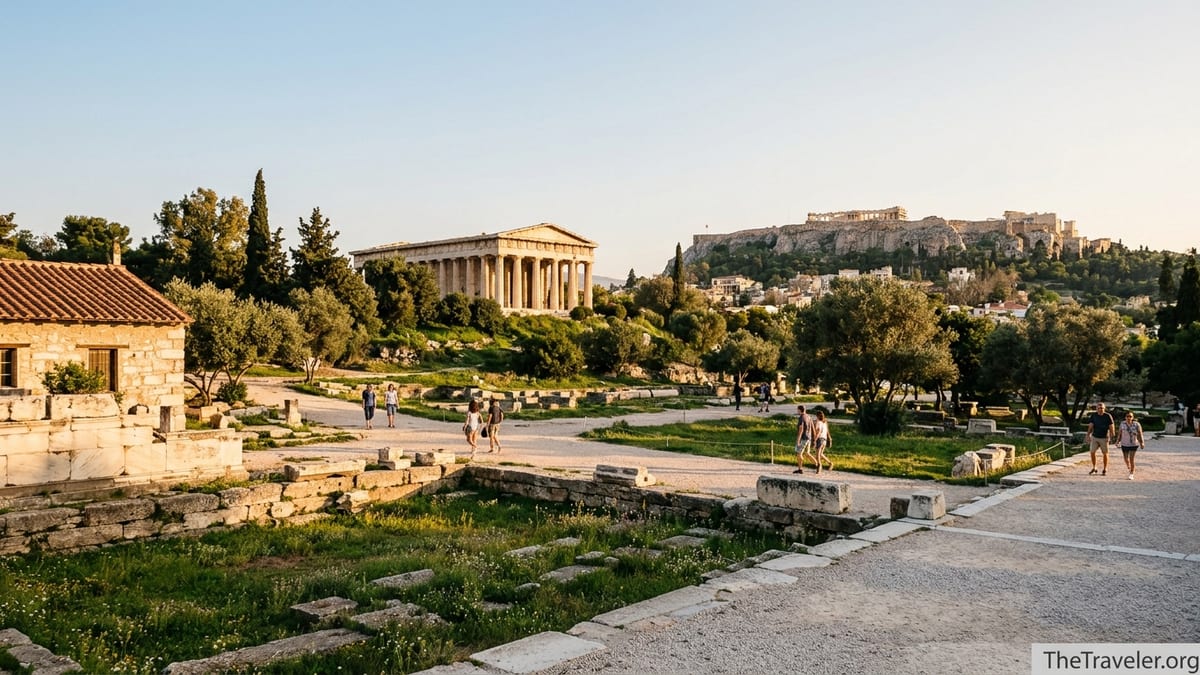
What the Ancient Agora Is and Why It Matters
The Ancient Agora was the civic and commercial heart of classical Athens. This was not just a marketplace. It was where citizens gathered to trade, debate laws, listen to speeches, worship at temples and even attend performances. When you walk through the site today you are moving through the same open space where Socrates is believed to have questioned his fellow Athenians and where the foundations of direct democracy took shape.
Unlike the Acropolis, which feels monumental and elevated, the Ancient Agora occupies a gentle valley at the foot of the hill. You enter a landscape of paths, low ruins and scattered columns framed by olive and pine trees, with the Acropolis rock rising to one side. It feels more like a park with ruins than a fenced-off monument, which makes it especially pleasant for a first-time visit, including for families who want space for children to explore without feeling rushed.
Several distinct structures help you imagine how the Agora functioned. On the hill overlooking the site stands the Temple of Hephaestus, one of the best-preserved ancient temples in Greece. Below, the long, colonnaded Stoa of Attalos has been reconstructed and now houses the Museum of the Ancient Agora. Other remains such as the Bouleuterion, where the city council met, and the foundations of various stoas and shrines are visible with interpretive signs as you walk.
Because it combines monumental architecture, a museum and open green space, the Ancient Agora makes a good first or second stop on a classic Athens itinerary. Many visitors pair it with a morning or afternoon at the Acropolis, as the two sites are within walking distance and visible from one another.
Tickets, Opening Hours and Practical Information in 2026
For 2026 the Ancient Agora and its museum operate with separate tickets from the Acropolis and other sites. The former combined ticket that covered multiple major sites in Athens is no longer offered, so you will need to purchase an individual ticket for the Ancient Agora. As of mid 2026, the standard adult ticket for the site and the Museum of the Ancient Agora is approximately 20 euros; the price is the same in winter and summer, but reductions apply for certain categories such as EU students and young visitors, in line with Greek Ministry of Culture policy.
Official information from the Ministry of Culture indicates that the museum ticket includes access to the archaeological site, and seasonal hours apply. In the summer period from roughly 1 April to 31 October, opening hours are typically 08:00 to 20:00, with Tuesday often opening slightly later, around 10:00. In the winter period from 1 November to 31 March, hours are shorter, generally 08:00 to 16:30 with the same later Tuesday opening. Last entry is usually around 20 minutes before closing. Because occasional changes occur for restoration work or heat-related closures, first-time visitors should reconfirm hours a day or two before visiting, either through their hotel or directly with the on-site phone number printed on recent ministry information.
You can buy tickets online through the official state ticketing platform or on the spot at the Ancient Agora ticket office on Adrianou Street in the Thissio / Monastiraki area. In high season, buying online for a specific entry time can help reduce queuing, particularly on weekend mornings when cruise ship excursions arrive. At quieter times, such as evenings after 17:00 or winter weekdays, most visitors report that walk-up purchase takes only a few minutes.
Remember that Greek archaeological sites have free admission days on select dates, such as 6 March, 18 April, 18 May, 28 October and the first Sunday of each month from November through March. If your visit coincides with one of these dates, you can enter the Ancient Agora without charge, but you should also expect higher local attendance, including school groups.
Exploring the Temple of Hephaestus
The Temple of Hephaestus dominates the western side of the Agora from its low hill, immediately catching your eye as you enter the site. Built in the mid 5th century BC and later converted into a church, it is one of the most intact Doric temples in Greece, with its colonnade, roofline and much of its sculptural decoration still in place. For a first-time visitor, this offers a rare chance to experience an ancient Greek temple almost as a contemporary Athenian might have seen it, rather than as a ruin of scattered columns.
Reaching the temple involves a gentle uphill walk on a stone and gravel path, manageable in regular walking shoes or sturdy sandals. The climb from the main central path takes only a few minutes, but in summer heat it is worth carrying water and pausing in the shade of the surrounding pines. At the top, you can walk all the way around the exterior of the temple, observing details like the triglyphs and metopes along the frieze and the subtle curvature of the steps that correct visual distortions, a design feature shared with the Parthenon.
The temple’s elevated position also provides excellent viewpoints. Looking south and east you see the Acropolis and Parthenon framed by trees, while to the north you look down onto the tiled roofs and cafes of the Thissio and Monastiraki neighborhoods. Many photographers choose late afternoon, around 17:00 to 18:30 in summer, for softer light on the stone and better contrast between the temple’s columns and the sky. Because tripods are generally not allowed without special permission on Greek archaeological sites, hand-held cameras and modern smartphones are the norm and work well in this light.
There is usually a rope barrier preventing entry to the cella, the inner chamber, so you view the interior from the perimeter. From some angles you can still glimpse traces of the temple’s later use as a church, such as masonry repairs. Visitors often spend 20 to 30 minutes circling the structure, taking photographs and enjoying the breeze, before descending again toward the center of the Agora.
The Stoa of Attalos and the Museum of the Ancient Agora
On the eastern side of the site stretches the long, two-story Stoa of Attalos, a reconstructed colonnaded building originally erected in the 2nd century BC by Attalos II of Pergamon as a commercial and social space. In the 1950s the American School of Classical Studies at Athens rebuilt the stoa to serve as the Museum of the Ancient Agora. Today its clean lines, long marble colonnade and cool interior hall make it a highlight of any visit, especially during hot midday hours.
The ground-floor colonnade is open to the archaeological site and shaded for most of the day, offering a pleasant promenade. Inside, the museum displays finds from excavations in the Agora area, from prehistoric pottery to Roman-period sculptures. First-time visitors usually focus on the exhibits that relate directly to Athenian democracy and daily life. These include ostraka, the pottery shards used for voting in ostracism, inscribed with the names of prominent politicians, as well as official decrees carved in stone and objects from law courts and public buildings.
The displays are compact enough that you can comfortably see the highlights in 45 to 60 minutes. Labels are primarily in Greek and English, and the arrangement progresses chronologically and thematically, which helps you connect what you saw outside with the objects inside. For example, after standing on the remains of the Bouleuterion earlier, you can view items associated with the city council, or after noting the foundations of shops around the Agora square you can examine coins and weights that regulated commercial life.
The Stoa of Attalos is also one of the more accessible parts of the complex for visitors with reduced mobility. Recent official information notes the presence of ramps, elevators and accessible restrooms in the building, and there are dedicated accessible itineraries that link the stoa with other nearby monuments. If accessibility is a concern, it is worth planning to spend more time inside the stoa and nearby flat areas, while treating steeper paths such as the ascent to the Temple of Hephaestus as optional.
Suggested Walking Route Through the Ancient Agora
A practical walking route for first-time visitors starts at the main entrance on Adrianou Street near the Thissio and Monastiraki neighborhoods. After purchasing or validating your ticket, enter the site and follow the main path that slopes gently downward into the open central area. Initially, take a few minutes simply to orient yourself: the Temple of Hephaestus rises on a low hill to your right, the Stoa of Attalos runs along the left-hand side, and the Acropolis appears beyond the trees ahead.
From the entrance, begin by walking toward the central open space, pausing at information panels that explain the layout of the ancient square. Spend 15 to 20 minutes here tracing the low stone outlines of important buildings such as the Royal Stoa and the Bouleuterion. Stand where the altar of the Twelve Gods once marked the city’s central point, from which distances in ancient Athens were measured. This perspective helps you appreciate how the Agora functioned as both marketplace and political center.
Next, follow the path up to the Temple of Hephaestus. Walk slowly around the temple, taking in both close-up architectural details and wider views of modern Athens. After circling the temple, descend by a different branch of the path to vary your views. Back on the lower level, continue across the site toward the Stoa of Attalos. On the way, you will pass foundations of shops and stoas; look for explanatory signs that point out, for example, where philosophers might have taught or where public officials sat in judgment.
Allow 45 minutes to an hour inside the Stoa of Attalos museum, starting with the democracy-related rooms and then moving through domestic objects, sculptures and inscriptions. When you exit, walk along the outer colonnade that faces the Agora. This is a good place to pause on a bench, review what you have seen and take photos framed by the columns. Finally, stroll back along the main path toward the entrance. Many visitors exit and then immediately continue on foot to nearby Monastiraki Square for a snack, or up pedestrianized Apostolou Pavlou Street toward the Acropolis and Areopagus Hill, using the Agora visit as a central chapter in a larger walking circuit of historic Athens.
First-Time Athens Tips: Timing, Comfort and Neighborhood Context
For a comfortable first visit, timing matters. In summer months, plan the Ancient Agora for early morning, roughly 08:00 to 10:30, or late afternoon after 17:00 to avoid the most intense heat and UV. Heat waves in Athens can push midday temperatures well above 35 degrees Celsius, and the open areas of the Agora offer limited shade. In cooler seasons, mid-morning or early afternoon visits work well, though short winter daylight hours and earlier closing times mean you should not start too late.
Wear flat, closed or well-strapped footwear suitable for uneven stone and gravel paths. Simple trainers or sturdy walking sandals are adequate; thin-soled fashion shoes are not ideal. Bring a refillable water bottle and sun protection, including a hat and sunscreen. There are some shaded benches, particularly near the Stoa of Attalos and beneath pine trees along the paths, but part of the pleasure of the site lies in wandering between them, so you will spend time in the sun. Small on-site kiosks vary, so do not rely on finding food and drink inside the archaeological zone itself.
The surrounding neighborhoods of Thissio and Monastiraki make it easy to integrate the Agora into a wider day of exploring. Before or after your visit, you can have coffee or a light meal at one of the cafes on Adrianou Street that face the railway tracks and look toward the site and the Acropolis. For example, many visitors choose a simple Greek coffee or fresh orange juice here while reviewing photos and guidebook notes. Later you can walk five to ten minutes to Monastiraki Square for street food such as souvlaki or gyros in pita from well-known local grill houses.
For orientation, note that Thissio metro station on Line 1 lies just a few minutes’ walk from the main entrance, while Monastiraki station, which serves both Line 1 and Line 3 to and from the airport, is also close by. This makes the Ancient Agora straightforward to reach even if you are staying in newer districts such as Syntagma or Kolonaki. If you choose to walk instead, pedestrianized routes like Apostolou Pavlou Street and the cobbled promenade around the Acropolis connect many of the main ancient sites in a continuous loop.
Understanding the Ancient Agora in the Context of Other Athenian Sites
First-time visitors often wonder how the Ancient Agora fits into a broader Athens sightseeing plan that might also include the Acropolis, the Acropolis Museum, the Roman Agora and the National Archaeological Museum. Thinking in terms of function and atmosphere can help. The Acropolis was the religious and symbolic high point of the city, home to major temples dedicated to Athena and other gods. The Ancient Agora, by contrast, was the level ground where political, commercial and everyday social life played out.
If you are in Athens for only one full day, many travelers prioritize an early-morning visit to the Acropolis, followed by the Acropolis Museum, and then choose either the Ancient Agora or the National Archaeological Museum in the afternoon, depending on whether they prefer an open-air walk or more time indoors. If you have two or three days, including the Ancient Agora becomes easier and gives your understanding of the city much more depth. Seeing the Parthenon first and then walking through the Agora later lets you picture Athenians moving from temple rituals down to political debate and trade.
It is also useful to distinguish the Ancient Agora from the Roman Agora, a smaller forum built later under Roman rule, located a short walk to the east near the iconic Tower of the Winds. Some first-time visitors accidentally go to the Roman Agora thinking they have seen the main Agora and only realize their mistake later. Checking that your ticket and entrance sign specify the Ancient Agora of Athens avoids confusion. If time allows, however, visiting both can illustrate how Athens evolved from a classical Greek city-state into an important urban center of the Roman world.
Price-wise, individual tickets to the various sites add up, especially for a family. A typical pair of adult travelers in 2026 might spend around 40 euros for the Ancient Agora, around 50 to 60 euros combined for the Acropolis and Acropolis Museum, and additional amounts for the National Archaeological Museum and smaller sites. Planning which sites matter most to you and spacing them over your stay can help your budget feel more manageable while still giving you a sense of Athens’ long history.
FAQ
Q1. How long should I plan for a first-time visit to the Ancient Agora?
Most first-time visitors are comfortable with 2 to 3 hours on site, which allows time to walk the main paths, visit the Temple of Hephaestus and explore the Museum of the Ancient Agora inside the Stoa of Attalos without rushing.
Q2. Is the Ancient Agora suitable for children and families?
Yes, the Ancient Agora works well for families because it feels like a spacious park with ruins. Children can walk relatively freely, and the combination of open space, birds, trees and visible temples often holds their interest better than a purely indoor museum.
Q3. Can I visit the Ancient Agora and the Acropolis on the same day?
Many travelers do both in one day. A common pattern is to visit the Acropolis early in the morning, take a break for lunch in the Plaka or Monastiraki area, then spend the later afternoon exploring the Ancient Agora when the light is softer and temperatures start to drop.
Q4. Do I need to book Ancient Agora tickets in advance?
Advance booking is not strictly required, but in peak months such as June, July and August it can save time. Buying online for a specific entry period reduces queuing at the ticket office, especially on weekend mornings or when multiple tour groups arrive at once.
Q5. Is the Ancient Agora accessible for visitors with reduced mobility?
Certain areas, including the Stoa of Attalos and its museum, have ramps, elevators and accessible restrooms, and some paths are relatively level. However, the overall terrain is uneven, and the path up to the Temple of Hephaestus is sloped and partly rough, so visitors with mobility challenges may prefer to focus on the more accessible sections.
Q6. Are there guided tours available at the Ancient Agora?
Yes, independent licensed guides often offer on-the-spot services outside the entrance, and many walking tours of historic Athens include the Ancient Agora as one of their stops. You can also book private or small-group tours in advance through reputable tour operators based in Athens.
Q7. What should I wear when visiting the Ancient Agora?
Comfortable walking shoes, sun protection and light, breathable clothing in warm months are recommended. There is no strict dress code beyond standard respect for a historic site, but you will be on your feet on uneven surfaces and exposed to the elements for much of your visit.
Q8. Is photography allowed at the Ancient Agora and in the museum?
Personal photography without flash is generally allowed both outdoors and in the Museum of the Ancient Agora. Tripods and professional equipment usually require prior permission from the authorities, so most visitors rely on handheld cameras or smartphones.
Q9. Are food and drinks available inside the site?
Options inside the archaeological area itself are limited and vary over time, so it is best to bring your own water and perhaps a light snack. For more substantial meals or coffee, you can choose from numerous cafes and tavernas on Adrianou Street and in nearby Thissio and Monastiraki immediately before or after your visit.
Q10. When is the best time of year to visit the Ancient Agora?
Spring and autumn are particularly pleasant, with milder temperatures and longer daylight than winter but fewer crowds and less intense heat than peak summer. If you must visit in July or August, aim for early morning or late afternoon and plan for frequent breaks in the shade.