


Few city walks capture the layers of Athens as completely as the route from Monastiraki through the Ancient Agora to Thissio, with the Temple of Hephaestus, the Stoa of Attalos and constant Acropolis views leading you on. This is the historic heart of the city, but it is also a very real, lived-in neighborhood where commuters step off metro trains, locals meet for coffee and visitors weave between ruins, cafes and rooftop terraces. This guide lays out a practical walking route and entrance strategy that links Monastiraki, the Agora, Thissio, Plaka and the slopes of the Acropolis into one coherent circuit, with photo stops and cool-down breaks that help you avoid both the worst heat and the frustration of backtracking.
Get the latest updates straight to your inbox!
Planning Your Route and Entrance Strategy
The Ancient Agora sits between Monastiraki and Thissio stations, just northwest of the Acropolis. For most visitors, the simplest plan is to start at Monastiraki, enter the Agora from its northeast gate on Adrianou Street, walk gradually uphill toward the Temple of Hephaestus and exit near Thissio, finishing with Acropolis views from Apostolou Pavlou pedestrian street. This creates a natural one-way flow that matches the site’s gentle slope and avoids repeating ground.
If you hold the combined 5-day ticket for Athens’ major ancient sites, which in 2026 costs about 30 euros in high season, you can use it to enter the Agora on any one of the five days it is valid. The ticket covers the Acropolis, Ancient Agora, Roman Agora, Hadrian’s Library, the Temple of Olympian Zeus, Kerameikos and Aristotle’s Lyceum, so many travelers choose to visit the Acropolis in the early morning and the Agora in late afternoon of the same day to spread out the walking and heat. Single-site tickets for the Ancient Agora are typically a bit more than half that price, so the combined option is worthwhile if you plan at least three sites.
Opening hours for the Agora and the Museum of the Ancient Agora in the Stoa of Attalos generally run from 8:00 to 19:30 in the main season, but times can vary slightly by month and public holiday, so it is worth a quick same-week check on the Hellenic Ministry of Culture’s official channels before you set out. Arriving within the first hour of opening or after 16:30 provides softer light and smaller crowds, and in July and August, the difference in temperature between 11:30 and 17:00 inside this largely unshaded site can be dramatic.
To minimize queuing, many visitors buy tickets in advance through authorized vendors or pick up the combined ticket at a less-busy site such as Hadrian’s Library or Kerameikos the day before. If you are staying near Monastiraki or Psiri, you can walk past the Agora ticket office on Adrianou Street in the evening to get a sense of peak times and plan around them.
Starting at Monastiraki: Markets, Metro and First Views
Monastiraki is one of the most convenient starting points in Athens, served by metro lines 1 and 3 and sitting at the junction of the historic center’s main walking spines. When you emerge into Monastiraki Square, the Acropolis rises directly ahead, with the Ancient Agora stretching out low and green to your left. The square itself is busy and visually noisy, with street vendors, buskers and a mix of souvenir stands and international chains. If you need an ATM, a quick snack or a restroom before entering the archaeological site, you will find all of them within a hundred meters of the station exit.
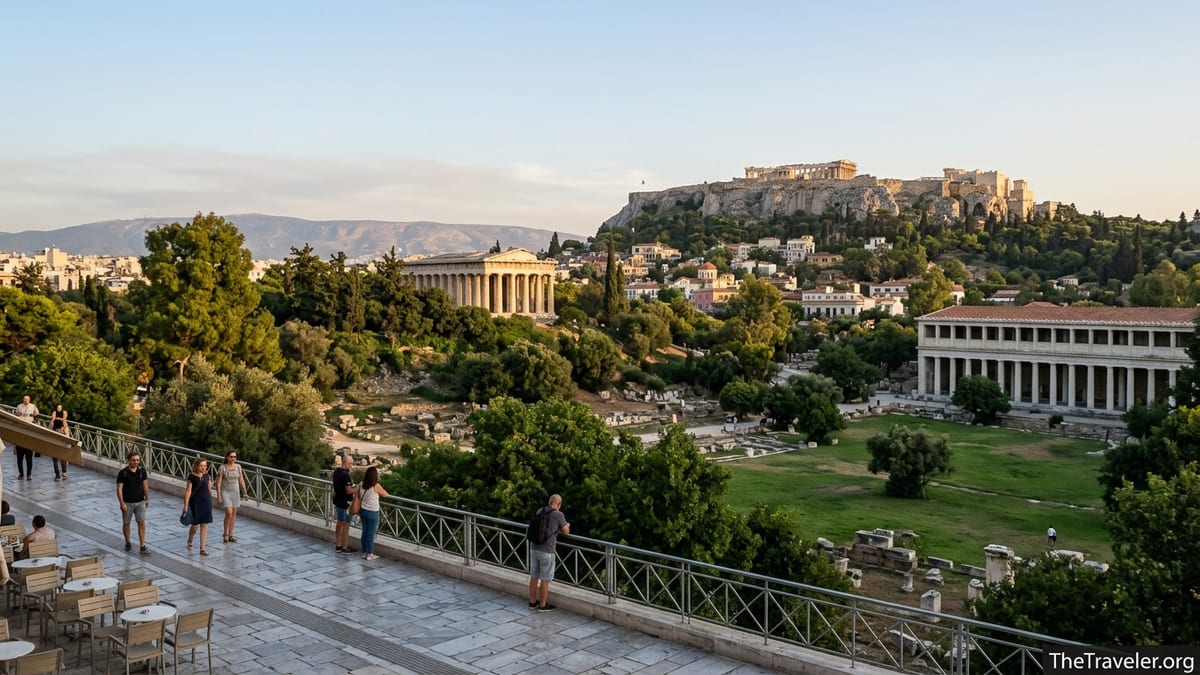
For a calm start and a first elevated photo, many travelers duck into a cafe with a rooftop terrace around Monastiraki. Even a simple Greek coffee on a terrace overlooking the square gives you a helpful mental map: the Acropolis high above, the cluster of ruins in the mid-ground marking the Agora, and the green hill of the Temple of Hephaestus toward Thissio. Spending 20 minutes here in the early morning can also let large groups clear the ticket office below before you join the line.
From the square, walk along Adrianou Street heading west, keeping the low fence of the Agora site on your left. This stretch runs parallel to the ancient Panathenaic Way and lets you preview the ruins from street level while still outside the ticketed area. You will pass small shops selling leather sandals, linen clothing and copies of Greek ceramics, alongside cafes that open early enough to serve breakfast. The northeast gate to the Ancient Agora appears on your left after about 5 to 7 minutes on foot, marked by a ticket booth and turnstiles set slightly back from the road.
If you prefer a quieter approach, you can also start by weaving through the flea market streets just off Monastiraki Square, then drop down to Adrianou near the small Church of the Pantanassa. This route is a little more indirect but gives you a sense of contemporary Athens commerce before you step into the archaeological landscape.
Inside the Ancient Agora: Following the Panathenaic Way
Once inside the Agora from the Adrianou entrance, you are effectively stepping onto the line of the Panathenaic Way, the ancient processional road that once ran from the Dipylon Gate in the Kerameikos cemetery up to the Acropolis. Today, the path is a wide gravel and dirt track that curves gently uphill toward the Temple of Hephaestus. For a logical, low-backtracking route, follow this main spine first, then loop back along the eastern side to reach the Stoa of Attalos and museum.
Walk slowly at first and let your eyes adjust from the commercial streets outside to the open, park-like space of the Agora. To your right, you will glimpse the line of the Stoa of Attalos in the near distance, its colonnade providing one of the most welcome shaded breaks later in the walk. To your left and ahead, the Temple of Hephaestus crowns the low hill. Scattered between these landmarks are foundations of stoas, law courts and administrative buildings that once formed the civic heart of classical Athens.
Although the temptation is to rush straight uphill to the temple, photographers may want to pause within the first 100 meters for a classic frame that combines low ruins, the line of the Panathenaic Way and the Acropolis above. In the softer light of early morning or late afternoon, long shadows from the remaining columns and trees create depth, and this middle distance gives context that close-up shots at the top sometimes miss.
Continue along the main path until it forks near the base of the hill. Take the upper branch that climbs toward the Temple of Hephaestus rather than wandering right toward the Stoa at this stage. This keeps your route efficient: you are using the natural slope of the site, doing the main uphill section first before dropping back down in the shade of the Stoa and eastern paths.
The Temple of Hephaestus: Hilltop Circuit and Acropolis Vistas
The Temple of Hephaestus, often called the Hephaisteion, is one of the best preserved Doric temples in Greece. Standing at the northwest edge of the Agora on a low hill, it offers both detailed architectural views and excellent sightlines back toward the Acropolis. When you reach the top, resist the urge to take only frontal photos; instead, walk the full circuit around the fenced perimeter path that encircles the temple to appreciate how its appearance changes with angle and light.
On the western and southern sides, you can capture images that include the fluted columns, triglyphs and metopes with a backdrop of trees and the city beyond. On the eastern side, looking down the slight slope, there are striking compositions where the temple sits above the scatter of Agora ruins with the Acropolis rising behind. Many visitors find that a standard phone camera or a 35 mm lens on a full-frame camera works well here, providing enough width to include context without shrinking the temple.
This hilltop is also one of the first truly panoramic Acropolis viewpoints along the route. Looking southeast, you see the Parthenon and the Propylaea clearly, while to the south you can glimpse the Areopagus and, in the distance, Philopappos Hill. Because the Temple of Hephaestus area is slightly exposed, this is a good moment to use sunscreen, put on a hat or sip water before continuing. There are a few benches along the hill’s perimeter path where you can sit briefly in partial shade and watch metro trains slide between Thissio and Monastiraki far below.
When you have completed the circuit, follow the path leading downhill on the eastern side of the hill back toward the center of the Agora. This keeps your movement in one direction instead of retracing steps down the same slope. As you descend, look for intermediate photo angles where the temple is framed by pine branches or where the columns align with distant modern buildings, underlining the contrast between ancient and contemporary Athens.
The Stoa of Attalos and Museum: Shade, Artifacts and Heat Break
From the foot of the Hephaestus hill, angle diagonally toward the long reconstructed colonnade of the Stoa of Attalos on the Agora’s eastern edge. This building, rebuilt in the 1950s on original foundations, now serves as both a museum and a crucial patch of deep shade on hot days. Its colonnaded ground floor is accessible with the same ticket that covers the Agora itself.
Inside, the museum displays a carefully curated selection of artifacts that bring the ruins outside to life: inscribed boundary stones, juror identification tokens, bronze weights, marble statues and everyday objects from wells and houses. For visitors who have just walked the open site, labels explaining the functions of the Bouleuterion, law courts and stoas connect the scattered foundations with the political and social history of ancient Athens. The museum is compact, and most travelers spend 30 to 45 minutes here, which also coincidentally allows your body temperature to drop after the exposed sections.
The upper level of the Stoa, where accessible, provides long, shaded vistas along the length of the colonnade and oblique views out toward the Agora and Acropolis through the gaps between columns. This is an excellent spot for more controlled architectural photography: the repeating rhythm of columns, the interplay of light and shadow on marble floors, and the contrast between the reconstructed structure and the fragmented ruins outside. Even in high summer, the thick stone walls and limited direct sun keep temperatures here distinctly cooler than in the open site.
Restrooms and a small staffed counter are located within or near the Stoa, and this is one of the few points inside the Agora where you can reliably find facilities. Although there is no full-service cafe on site, many travelers use the benches in the Stoa to snack on bottled water and fruit purchased earlier in Monastiraki, being careful to follow posted rules on food and drink inside the museum spaces.
Thissio and Apostolou Pavlou: Classic Acropolis Views Without the Climb
After exiting the Stoa of Attalos, continue south along the eastern side of the Agora, then curve west toward the main exit that leads toward Thissio. This route passes more low ruins and open grass before delivering you to the gate near the base of the Hephaestus hill. Once outside, you are only a few minutes’ walk from one of Athens’ most beloved promenades for Acropolis views: Apostolou Pavlou pedestrian street.
Turn right out of the gate and follow the gentle slope upward toward Thissio metro station. Cafes and small restaurants line the way, with outdoor seating facing directly toward the Acropolis and the Agora below. Establishments such as rooftop terraces along Apostolou Pavlou and nearby Iraklidon Street are popular for late afternoon drinks precisely because they combine sunset light on the Parthenon with a cooling breeze flowing down from the hill. Even a simple glass of iced tea or a shared plate of meze here can double as a cooling stop and a memorable viewpoint.
The pedestrian street itself offers one of the easiest spots in Athens to take a full Acropolis panorama without climbing. From several points between the station and the National Observatory, you can frame the hill, the Parthenon, the Propylaea and, below, the green canopy of the Agora. Street artists and musicians often set up along this stretch, and in the golden hour before sunset, the combination of live music, people strolling and the lit monuments above creates a strong sense of place.
If you prefer a quieter vantage point, continue uphill past the busier cafe strip toward the low rocky outcrops that lead to the Areopagus and the paths around Philopappos Hill. Even without going all the way up, short detours to these rocks reward you with slightly higher perspectives back over the Agora and the Temple of Hephaestus, adding variety to the viewpoints you collected earlier inside the site.
Looping to Plaka and the Acropolis: Avoiding Backtracking
One of the strengths of this route is that you can turn it into a loop rather than a linear walk. After enjoying Thissio, instead of returning the same way through the Agora, continue along Apostolou Pavlou as it arcs southeast and merges into Dionysiou Areopagitou, the broad pedestrian street that skirts the southern slopes of the Acropolis. This connects you naturally toward the Acropolis Museum area and, by extension, to Plaka and Anafiotika without repeating earlier segments.
From Thissio to the lower edge of Plaka via this pedestrian belt is a comfortable 20 to 25 minute walk at an easy pace, not counting photo stops. As you go, the views of the Acropolis shift subtly: first side-on with the Parthenon elongated, then gradually more frontal as you approach the theater of Dionysus and the modern museum. Along the way, there are several kiosks selling cold water, soft drinks and simple snacks that can serve as informal heat breaks if you did not pause longer in Thissio.
Once you reach the junction near the Acropolis Museum, you can climb into Plaka via one of the narrow staircases leading north. Within a few minutes, you will find yourself in a maze of pedestrian lanes with neoclassical houses, small churches and tavernas with shaded courtyards. This is a good place for a sit-down meal after the archaeological walks. Many travelers choose traditional spots around Lysikratous Square or the quieter streets above Adrianou, where you can try dishes such as moussaka, grilled octopus or gemista in outdoor settings beneath bougainvillea.
To close the loop back to Monastiraki without backtracking, simply follow Plaka’s downhill streets northwest. The route through Anafiotika, the tiny island-like quarter clinging to the northern slope of the Acropolis, then down into the lower Plaka lanes, eventually feeds back toward Monastiraki Square. The descent is almost entirely gentle and shaded, and in about 20 minutes you will re-emerge at your original starting point having drawn a complete circuit around and through the historic core.
Heat Management, Accessibility and Practical Tips
Athens summers are hot, and the Ancient Agora, like the Acropolis, offers relatively little deep shade away from trees and the Stoa of Attalos. Midday temperatures from June to early September commonly exceed 33 degrees Celsius. To manage this, structure your day so that the most exposed sections occur in early morning or late afternoon, using indoor or shaded sites as heat breaks. For example, you might enter the Agora at 8:00, climb to the Temple of Hephaestus by 8:30, explore the open ruins until around 9:30, then retreat into the Stoa museum until 10:15 before exiting toward shaded cafes in Thissio.
Carry water from the start; while there are some fountains and kiosks around the perimeter of the site and at nearby metro stations, you should not rely on finding them exactly when you need them. A broad-brimmed hat and light, breathable clothing make a noticeable difference on the open gravel paths. Footwear with closed toes and some grip is advisable, as stone surfaces and dusty slopes, particularly around the temple hill and Areopagus rocks, can be slippery, especially after a brief shower.
For travelers with limited mobility, the Agora has been undergoing improvements to make paths and viewing areas more accessible. The area around the Stoa of Attalos and the museum itself is among the more manageable sections, with ramped access and smoother surfaces. The slope up to the Temple of Hephaestus is more challenging, though parts of the view can still be appreciated from lower vantage points. In planning, it may be useful to focus your energy budget on the most meaningful sections: perhaps prioritize the Stoa museum, some of the central ruins and then the relatively level promenade of Apostolou Pavlou over steep detours.
From a safety perspective, the route described is in a busy, central area of Athens and is generally safe during daylight and early evening. As in any crowded urban space, keep valuables secure against pickpocketing, particularly around Monastiraki Square and in packed metro trains. In summer, be aware of lightheadedness or signs of heat stress, and do not hesitate to pause in the shade with a cold drink in Thissio or Plaka if you feel overexposed.
Itinerary Examples: Half-Day and Full-Day Circuits
Travelers with different time and energy levels can adapt this walking route to suit their schedule. For a focused half-day itinerary, particularly on a first full day in Athens, you might start at Monastiraki around 8:00, enter the Ancient Agora by 8:15, walk the Panathenaic Way to the Temple of Hephaestus and circuit the hill by 9:00, explore the central ruins until 9:45, then retreat into the Stoa museum until about 10:30. Exiting toward Thissio, you could then spend an hour on Apostolou Pavlou, lingering over a late breakfast or early lunch at a cafe terrace with Acropolis views, and finish by 12:00 before the heat peaks.
If you have a full day and the combined archaeological ticket, you can integrate the Acropolis and Plaka into a single, coherent circuit. One common pattern in 2026 travel advice is to visit the Acropolis itself at opening time, around 8:00, and finish there by 10:30, descending via the southern slopes. From the Acropolis Museum area, walk along Dionysiou Areopagitou toward Thissio, enjoy a light early lunch or coffee, then enter the Agora in the early afternoon when crowds are slightly smaller than at midday. After exploring the Agora and the Stoa, exit toward Monastiraki and drop into Plaka for a shaded late-afternoon wander and dinner.
For travelers staying near Syntagma or Kolonaki, a variation is to approach the route in reverse: stroll down through Plaka and Anafiotika in the morning, reach the Agora from the southeast side, exit toward Thissio by early afternoon, then ride metro line 1 back to Monastiraki or Omonia. This version uses the downhill nature of Plaka’s streets to your advantage and still grants multiple Acropolis viewing angles without requiring you to climb again late in the day.
Families with children often break the walk into two shorter segments over separate days: one morning devoted to Monastiraki, the Agora and Thissio, with plenty of ice cream stops built in, and another afternoon focusing on Plaka and the Acropolis Museum’s child-friendly exhibits. Spreading the experience out like this keeps each walk manageable and allows kids to connect what they see in the museum with the ruins they explored earlier.
The Takeaway
Walking the Ancient Agora from Monastiraki to Thissio, with its sequence of the Panathenaic Way, the hilltop Temple of Hephaestus, the cool interior of the Stoa of Attalos and the open vistas of Apostolou Pavlou, is one of the most efficient ways to understand how ancient and modern Athens interlock. With thoughtful planning, you can stitch this route into a wider circuit that takes in Plaka, the Acropolis slopes and the city’s everyday neighborhoods, all while minimizing backtracking and exposure to the fiercest heat.
By starting early or late, using shaded museum spaces as natural breaks, and choosing a direction of travel that works with the terrain, you transform a list of sights into a coherent, memory-rich walk. The result is not just a succession of monuments but a lived experience of Athens across millennia, from the democratic debates of the Agora to the coffee-fueled conversations of today’s cafe terraces, all under the watchful outline of the Acropolis above.
FAQ
Q1. How long does it take to walk from Monastiraki through the Ancient Agora to Thissio?
Most visitors spend about 2 to 3 hours walking this route at a moderate pace, including time to climb around the Temple of Hephaestus, visit the Stoa of Attalos museum and pause for photos.
Q2. Is it better to see the Ancient Agora before or after the Acropolis?
If you are visiting in summer, it is usually better to see the Acropolis first thing in the morning to avoid the strongest sun, then explore the Agora in late afternoon. In cooler months, the order matters less and you can choose based on your accommodation location.
Q3. Can I visit the Ancient Agora and Acropolis with the same ticket?
Yes, the combined 5-day archaeological ticket covers both the Ancient Agora and the Acropolis, along with several other major sites. It is good value if you plan to visit at least three included locations during your stay.
Q4. Are there good photo spots of the Acropolis inside the Ancient Agora?
Several. Key spots include the path circling the Temple of Hephaestus hill, the central stretch of the Panathenaic Way looking southeast and the upper level of the Stoa of Attalos where you can frame the Acropolis between the columns.
Q5. Is the walking route suitable for people with limited mobility?
Parts of it are. The area around the Stoa of Attalos and some central paths are relatively level and have improved surfaces, but the climb to the Temple of Hephaestus and the rocky viewpoints near the Areopagus are more demanding. Planning shorter sections with rest breaks is advisable.
Q6. Are there places to buy water and snacks along this route?
Yes. Monastiraki Square has many kiosks and minimarkets, and Apostolou Pavlou in Thissio is lined with cafes and restaurants. Inside the Agora itself, options are limited, so it is wise to bring water with you.
Q7. What time of day has the best light for photos in the Ancient Agora?
Early morning and late afternoon generally offer the softest, most flattering light, especially around the Temple of Hephaestus and the long perspectives from the Stoa of Attalos. Midday light can be harsh and flat in summer.
Q8. Do I need a guided tour for this walk, or is it easy to follow on my own?
The route is straightforward to follow independently using on-site signs and a basic map. A guided tour can add historical depth, but for many travelers a good guidebook or audio guide combined with this walking route is sufficient.
Q9. Is it safe to walk this route in the evening?
The Monastiraki, Agora perimeter, Thissio and Plaka areas are generally busy and feel safe into the evening, especially around restaurant streets and promenades. Normal city awareness is still recommended, particularly with valuables and cameras.
Q10. Can I complete the loop back to Monastiraki without repeating my steps?
Yes. After reaching Thissio, you can continue along Apostolou Pavlou toward the Acropolis slopes, then climb into Plaka and descend back to Monastiraki by different streets, creating a full, non-repetitive circuit through the historic center.