


In the historic heart of Athens, two neighboring archaeological sites often confuse first time visitors: the Ancient Agora and the Roman Agora. They sit within a few minutes’ walk of each other, both filled with columns, marble blocks, and pieces of Athenian history. Yet they were built in different eras, served different purposes, and offer very different experiences today. Understanding how they compare will help you plan smarter, avoid ticket surprises, and decide exactly how to fit both into a tight Athens itinerary.
Get the latest updates straight to your inbox!
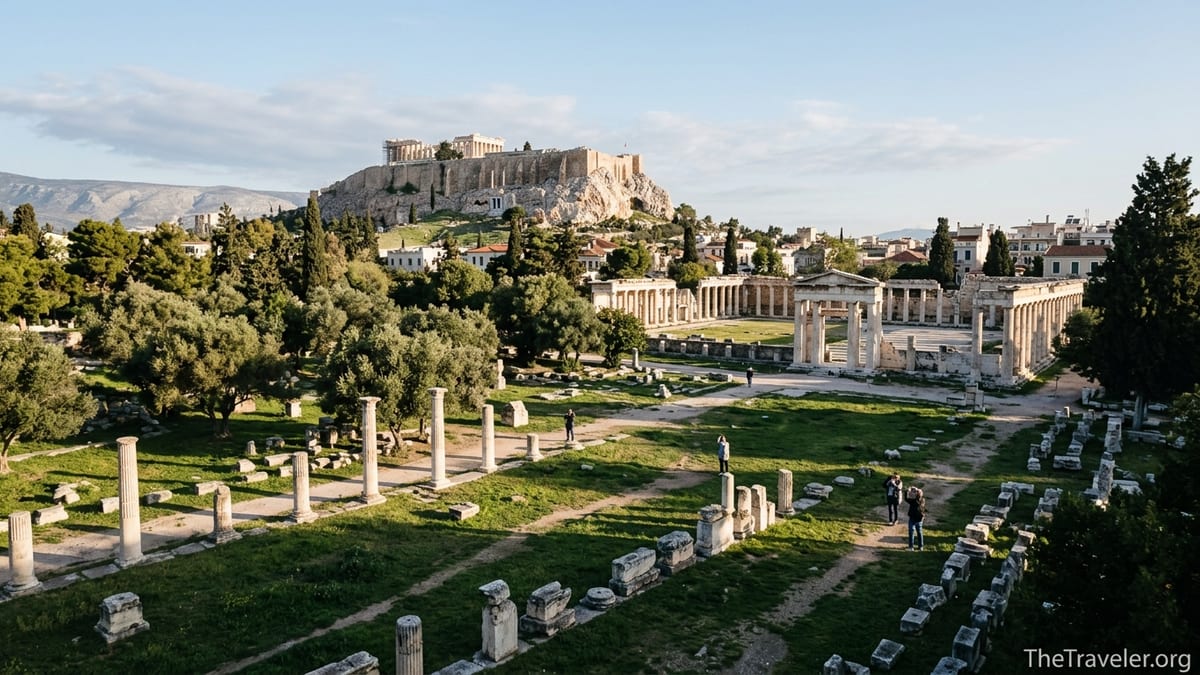
Ancient Agora vs Roman Agora at a Glance
The Ancient Agora was the main public square and political heart of classical Athens, active from the 6th century BC through the Hellenistic period. It was where citizens gathered to vote, attend trials, trade, and socialize beneath long colonnaded stoas. Walking through it today, you are essentially crossing the ground where Athenian democracy took shape and major philosophers like Socrates and later the young Plato moved among merchants and officials.
The Roman Agora, by contrast, is a later marketplace built to the east of the Ancient Agora during the 1st century BC and early 1st century AD, when Athens was under Roman rule. It was conceived primarily as a commercial hub, funded with Roman imperial money and designed according to Roman tastes, with a more compact, enclosed courtyard surrounded by shops and dominated by a monumental gateway.
For a visitor, the practical difference is scale and atmosphere. The Ancient Agora is a broad, park like archaeological landscape with scattered ruins and extensive greenery, crowned by the remarkably preserved Temple of Hephaestus and the reconstructed Stoa of Attalos with its museum. The Roman Agora is smaller, more tightly framed by modern streets and buildings near Monastiraki, and best known for distinctive features such as the Tower of the Winds and its elegant marble gateway at the entrance.
In most itineraries, travelers spend at least 1.5 to 2 hours at the Ancient Agora, often combining it with the Acropolis on the same day, while the Roman Agora typically fits into a 30 to 60 minute visit as you wander the historic Plaka and Monastiraki districts.
Location and How Each Agora Fits Into Modern Athens
Both agoras sit within the central historic core of Athens, but they feel slightly different within the modern city grid. The Ancient Agora sprawls just northwest of the Acropolis, below the neighborhood of Thissio. Many visitors first encounter it from the Thissio metro station entrance or as they follow the pedestrianized Apostolou Pavlou promenade. Once inside the site, urban noise quickly fades and you stroll among olive trees and grassy slopes with near constant views of the Acropolis above.
The Roman Agora lies a few hundred meters to the east, between the Plaka quarter and Monastiraki. Its main gate opens almost directly off narrow lanes lined with tavernas, souvenir shops, and small hotels. You can easily step from a busy café terrace into the archaeological enclosure, which makes the Roman Agora feel more tightly woven into contemporary street life.
In practical terms, this means you rarely have to choose one or the other based on location. A common walking route takes you from the Acropolis hill down through Plaka to the Roman Agora, then on to the Ancient Agora and Thissio, or the reverse. Many guided walking tours follow a similar loop, stopping for photographs at the marble Gate of Athena Archegetis in the Roman Agora before continuing to the wider Ancient Agora with its museum.
If you are staying near Syntagma or in central Plaka, the Roman Agora will likely be the first one you stumble upon during an evening stroll. If you are near Thissio or Kerameikos, the Ancient Agora usually becomes your natural starting point.
History and Function: Democracy vs Imperial Marketplace
The Ancient Agora functioned as the civic and social center of Athens during the classical period. This was where the city’s political institutions took tangible form. Public buildings such as the Bouleuterion housed the council of 500 citizens, while law courts and administrative offices lined the open square. Citizens gathered here to hear speeches, bring lawsuits, discuss policy, and participate in religious festivals that processed through the space.
Economically, the Ancient Agora was also a busy marketplace, but the emphasis was on multi purpose public life. Craftsmen sold pottery, metalwork, and foodstuffs; philosophers held informal discussions; priests oversaw sacrifices at small shrines. The wide, somewhat irregular layout reflected the organic growth of an early Greek public square rather than a single grand design.
The Roman Agora emerged centuries later, as Athens experienced renewed investment under Roman rule. Funded by Julius Caesar and completed under Augustus, the complex was designed as a more rational, rectangular marketplace. Shops and storerooms lined the colonnades, and measuring tables, fountains, and administrative offices helped regulate trade. The shift symbolized how the city’s day to day commercial life gradually moved from the old civic center to a purpose built Roman era market.
Walking these spaces today, you can feel the difference: the Ancient Agora evokes the messy, layered life of a free Greek city with politics, religion, and trade overlapping, while the Roman Agora has the tidier character of an imperial project focused on commercial order and practical administration.
Architecture and Atmosphere on the Ground
The Ancient Agora showcases primarily classical and Hellenistic Greek architecture, with later Roman and Byzantine layers. Its most iconic building, the Temple of Hephaestus, sits on a small hill on the western side of the site. This Doric temple, built in the 5th century BC, is one of the best preserved in Greece, so you can clearly see its fluted columns, entablature, and overall proportions without needing much imagination.
Another major feature is the reconstructed Stoa of Attalos, a long, two story colonnaded building rebuilt in the 1950s on its ancient foundations. Stepping inside gives a strong sense of how public porticoes once sheltered shops and gatherings. Around the site you also notice low stone outlines of ancient houses, council buildings, shrines, and wells, all set amid grass, wildflowers in spring, and scattered olive trees. The atmosphere is spacious and contemplative, especially in the early morning when tour groups are fewer.
The Roman Agora, though smaller, has its own distinctive set pieces. At the main entrance stands the Gate of Athena Archegetis, a marble gateway with four Doric columns and an inscription honoring its Roman benefactors. Within the courtyard, you see the outlines of shops that would have been rented to merchants, as well as paving slabs and drainage systems that hint at the site’s commercial function.
Just to the northeast, often visited together, rises the Tower of the Winds, an octagonal marble structure decorated with relief figures of personified winds. Inside, you can still see traces of mechanisms for a water clock and sundials, a reminder that this area once served as a practical hub for timekeeping and market regulation. The Roman Agora’s atmosphere tends to be more compact and urban, with views of surrounding houses, church domes, and café terraces framing the ruins.
Tickets, Opening Hours, and Practical Planning
Ticketing and opening hours can change, especially in 2026, so it is wise to check the latest information locally before your visit. As of mid 2026, Greece has adjusted its pricing and phased out the older combined ticket that once covered multiple central Athens sites. Travelers now typically buy separate tickets for the Acropolis and each major archaeological area, including the Ancient Agora and the Roman Agora, or use limited duration passes when available through official channels.
Indicatively, entry to the Ancient Agora, which includes access to the Stoa of Attalos museum, is priced noticeably higher than the Roman Agora, reflecting its larger size and more extensive monuments. In practice, visitors report paying roughly the equivalent of a modest restaurant meal in Athens for the Ancient Agora, while the Roman Agora commonly costs closer to a quick café lunch. Children, EU students, and other eligible groups often receive reduced or free admission, especially outside peak summer months, but rules can be specific, so carry student or ID cards if you hope to qualify.
Recent announcements for the Ancient Agora indicate extended summer opening hours from 8:00 to early evening on most days, allowing plenty of time to combine it with the Acropolis either earlier or later in the day. The Roman Agora typically follows similar seasonal schedules, though it may close slightly earlier on certain days or during off season periods. Heat is a real factor between June and September, since both sites have limited shade in their central areas. Many travelers choose to visit one site in the cooler morning and the second after an air conditioned lunch break.
At both agoras you will find basic facilities at or near the entrances, such as ticket booths, security checks, and modest restrooms. The Ancient Agora’s size means more walking on uneven paths, so comfortable shoes are important. The Roman Agora is easier to traverse quickly, which makes it convenient for travelers with limited mobility or those who prefer shorter site visits.
What Each Site Offers: Museums, Views, and Visitor Experience
The Ancient Agora offers a much richer on site museum experience. The museum in the Stoa of Attalos displays artifacts unearthed in the surrounding excavations, including pottery, coins, inscriptions, and everyday objects that bring to life the commercial and political activities that once took place there. Exhibits related to Athenian democracy, such as voting tokens and jury ballots, help you link the physical space outside with the institutions that shaped Western political thought.
From a scenic standpoint, the Ancient Agora rewards slow exploration. Climbing up to the Temple of Hephaestus yields wide views across the site toward the Acropolis. Photographers often linger here in late afternoon when the low sun warms the marble and casts long shadows through the columns. Families appreciate the relative open space, since children can walk short paths without the constant need to dodge traffic or step back onto narrow sidewalks.
The Roman Agora, on the other hand, is about concentrated highlights. There is no large on site museum, but you can closely inspect well preserved details such as inscriptions on the gate, column capitals, and the remains of fountains used by merchants and customers. The nearby Tower of the Winds, whether visited with a combined ticket or on a separate entry, adds a memorable architectural piece that differs significantly from the classical lines of the Ancient Agora.
For many travelers, the Roman Agora becomes a pleasant, shorter stop while exploring Monastiraki’s flea market and Plaka’s restaurants. You might, for example, spend your morning at the Acropolis and Ancient Agora, take a late lunch in Thissio or Monastiraki, then stroll through the Roman Agora in the softer evening light before dinner. The two sites complement each other: one provides depth and narrative, the other sharpens your sense of how Athens adapted under Rome.
Which Agora Should You Visit First?
If you have time for both, visiting the Ancient Agora first usually makes more sense. Starting there gives you the Greek baseline: you see how Athenians originally organized their civic and commercial life around a large, open meeting place. After absorbing the scale of the site and the story of democracy, you can then move to the Roman Agora and notice how the later marketplace reflects different priorities, such as more compact planning, stronger emphasis on regulated trade, and visible Roman sponsorship.
From a storytelling perspective, this order mirrors the historical timeline. You begin in the classical and Hellenistic periods, then progress into the Roman imperial era. Guides often build their narratives this way, explaining how Athens’ political importance declined even as its cultural prestige and monumental architecture remained attractive to Roman emperors and wealthy patrons.
However, there are reasons to reverse the sequence. Travelers arriving in Athens late in the day might find the Roman Agora more convenient to visit first simply because it is right on their way as they wander through Plaka and Monastiraki. Spending 30 to 45 minutes there gives you a first taste of antiquity without committing to a long site visit. You can then plan a dedicated morning for the Ancient Agora when you are rested and have more time.
If your main interest is photography, you may want to schedule the Ancient Agora during the first or last two hours of daylight when the light is softer, and fit the Roman Agora into whatever daylight remains. The Ancient Agora’s open views and elevated temple benefit particularly from good light, while the Roman Agora, hemmed in by city buildings, remains visually interesting even under harsher midday sun.
Sample Itineraries and Real World Trip Scenarios
Many first time visitors to Athens arrive with only one or two full days in the city and must make hard choices. A common one day route for high intent travelers might look like this in practice: an early morning ascent of the Acropolis as soon as the gates open, followed by a late morning walk down the hill and into the Ancient Agora for a two hour visit, including a break in the shade of the Stoa of Attalos museum. After lunch on a terrace in Thissio or Monastiraki, you continue on foot to the Roman Agora for a 30 minute visit before exploring Plaka’s lanes and perhaps visiting a nearby small museum or church.
Travelers with children often adapt this by shortening some site time and inserting gelato stops around Monastiraki Square. In such cases, parents sometimes choose to visit only the Ancient Agora interior, then view the Roman Agora from outside its fence while explaining the difference between the two. Even a quick look at the Gate of Athena Archegetis and the Tower of the Winds from the street can help older kids visualize how Roman Athens differed from classical Athens without requiring another full ticketed visit.
Repeat visitors or serious archaeology enthusiasts might do the opposite, spending extended time at the Roman Agora with a guide who can explain the inscriptions, building phases, and administrative functions in detail. They might then walk to the Ancient Agora on a separate day, tracing specific features like the Panathenaic Way that linked the agora to the Acropolis, or focusing on the remains of law courts and the council buildings.
Season matters too. In high summer, when afternoon temperatures can climb well above comfortable levels, splitting the two sites across different mornings will make your experience more pleasant. In quieter months such as March or late October, you can comfortably see both on the same day without feeling rushed, using the lively streets around the Roman Agora as a built in break between heavier historical stops.
The Takeaway
Both the Ancient Agora and the Roman Agora are worth a place on a well planned Athens itinerary, but they serve slightly different travel goals. The Ancient Agora is the more substantial, immersive site, where you can connect the dots between ruins, museum artifacts, and the story of Athenian democracy in a green, open setting. The Roman Agora is more compact yet distinctive, offering a focused glimpse of how Roman power reshaped the city’s commercial heart and left behind landmarks like the Gate of Athena Archegetis and the Tower of the Winds.
For most visitors with limited time, the smartest approach is to prioritize the Ancient Agora, allowing at least a couple of unhurried hours, and then add the Roman Agora as a flexible extra nearby. Think of the Ancient Agora as the main chapter and the Roman Agora as an important epilogue that completes the narrative of Athens’ transformation from independent city state to cherished provincial capital of a vast empire.
Whichever order you choose, seeing both sites on the ground, within walking distance of each other and under the shadow of the Acropolis, will give you a richer, layered understanding of Athens than any single monument can offer.
FAQ
Q1. Are the Ancient Agora and Roman Agora the same archaeological site?
The Ancient Agora and Roman Agora are two separate but neighboring sites in central Athens, built in different periods and serving different primary functions.
Q2. If I only have time for one, should I visit the Ancient Agora or the Roman Agora?
If you must choose, the Ancient Agora usually offers more variety and depth, with a larger area, a major temple, and a substantial on site museum.
Q3. Can I walk between the Ancient Agora and the Roman Agora?
Yes. The two sites are a short walk apart through the historic center, and most visitors comfortably include both on the same day on foot.
Q4. Do I need separate tickets for the Ancient Agora and Roman Agora?
At present, you should plan to buy separate tickets, as the older multi site combined ticket has been phased out and pricing structures updated.
Q5. How much time should I allow for each site?
Most travelers spend around 1.5 to 2 hours at the Ancient Agora and 30 to 60 minutes at the Roman Agora, depending on interest and energy.
Q6. Is one site better for families with children?
The Ancient Agora’s larger, greener space is often more comfortable for families, but the Roman Agora’s shorter visit can be easier for younger children.
Q7. Are there museums at both agoras?
The Ancient Agora has a dedicated museum in the Stoa of Attalos, while the Roman Agora focuses on open air ruins and nearby monuments rather than a large indoor museum.
Q8. Which site offers better views of the Acropolis?
The Ancient Agora generally provides broader, more photogenic views of the Acropolis, especially from the area around the Temple of Hephaestus.
Q9. Can I see the Roman Agora without paying for a ticket?
You can glimpse much of the Roman Agora, its main gate, and nearby Tower of the Winds from surrounding streets, though full access requires a ticket.
Q10. Do I need a guide to appreciate the differences between the two agoras?
A guide or good audio guide can add depth, but clear signage and basic background reading are usually enough to understand the key contrasts on your own.