


First time in Athens and trying to decide whether to start with the Acropolis or the Ancient Agora? Both are headline sites within a ten-minute walk of each other, yet they feel completely different on the ground. One is a dramatic rock crowned by the Parthenon and thick with tour groups; the other is a broad archaeological park where democracy once took shape, shaded by olive trees and often surprisingly quiet. This guide compares the two, using real-world timings, ticket options, and walking conditions to help you choose which site to visit first or how to combine them in a single, satisfying day.
Get the latest updates straight to your inbox!
Big Picture: Two Classics, Two Very Different Experiences
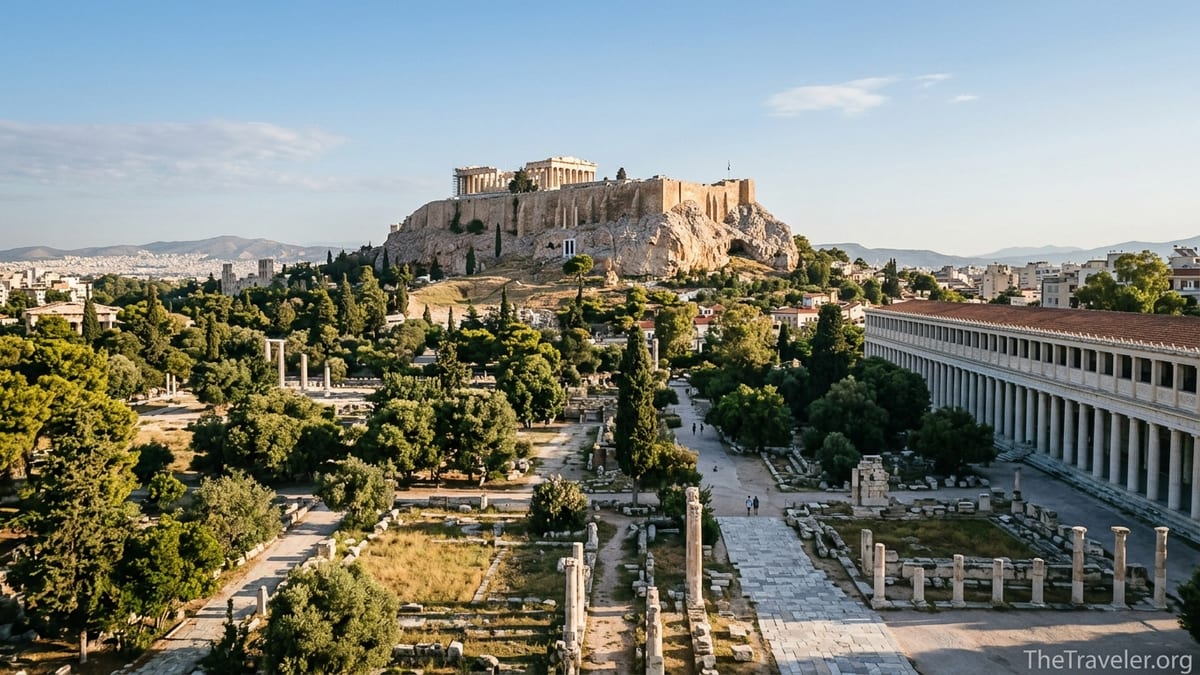
Standing in modern central Athens, the Acropolis and the Ancient Agora are barely 800 meters apart, yet most visitors describe them as completely different outings. The Acropolis is Athens’ cliff-top icon, with steep paths leading up to the Parthenon, the Erechtheion, and sweeping views across the city. The Ancient Agora sprawls below, a low-lying valley of ruins where Athenians once traded, voted, and listened to philosophers, anchored by the near-intact Temple of Hephaistos and the long, colonnaded Stoa of Attalos.
For many short-stay visitors with only one full day in Athens, the practical question is: where should you go first? In reality, both are worth seeing, but your decision should factor in heat and crowds, how much uphill walking you are comfortable with, how interested you are in political history versus iconic skyline views, and how you plan to buy your tickets. With some planning, you can easily visit both in one day; without it, you might find yourself queueing in the sun or rushing the more atmospheric site at the end.
Think of the Acropolis as the dramatic stage-set of classical Athens and the Agora as the backstage world where daily life actually unfolded. If you picture starting the day on a windy marble plateau with hundreds of other travelers, that is the Acropolis. If you imagine wandering through grassy paths under trees, with birdsong and scattered columns, that is the Agora. Knowing which tone suits you better for your first impression of ancient Athens is the key to planning.
In practical terms, entry tickets for both sites are now sold separately, usually around 20 euros for the Acropolis and a lower price bracket, often in the low teens or single digits, for the Ancient Agora depending on season and concessions. There used to be a multi-site combo ticket that bundled these and other ruins, but it has been phased out, so you will be choosing and timing each site individually.
History & Atmosphere: Iconic Temples vs Birthplace of Democracy
If your primary goal is to see the most famous monument in Greece, the Acropolis should logically come first. The plateau is dominated by the Parthenon, built in the 5th century BCE, along with the Erechtheion with its caryatid statues and the Propylaea gateway. As you climb, you pass the Theatre of Dionysos and the Odeon of Herodes Atticus on the slopes. It is an intense hit of classical architecture in one compact, elevated space, which is why first-time visitors who grew up seeing the Parthenon in textbooks often feel they “arrived in Athens” only when they step onto the rock.
The Ancient Agora, by contrast, tells a subtler story. This was the civic and commercial heart of classical Athens, a place for markets, law courts, and political assemblies. The Temple of Hephaistos, arguably the best-preserved classical Greek temple anywhere, stands on a low hill overlooking the site. The reconstructed Stoa of Attalos, now housing the site museum, gives you a rare sense of what a two-storey ancient shopping and meeting arcade felt like, with long shaded colonnades you can actually walk through.
Atmospherically, the Agora feels more like a park than a monument. Families spread picnic blankets below the temple, school groups cluster under trees while teachers point out the Bouleuterion foundations, and solo travelers wander the paths with audio guides. The connection to Athenian democracy is especially strong here; many guided tours pause in front of the remains of the law courts to explain how citizens were selected by lot and how public trials worked. If you are fascinated by the workings of ancient society rather than just the skyline, starting at the Agora can make your later visit to the Acropolis feel richer.
One practical way to choose: if you have limited museum interest, the Acropolis itself offers relatively little in-situ interpretation. Much of the sculpture is now in the Acropolis Museum or the British Museum. The Ancient Agora’s museum inside the Stoa of Attalos, on the other hand, has original ostraka (sherds used to vote someone into exile), household objects, and inscriptions that bring the site’s political role to life. For visitors who like objects as much as ruins, the Agora delivers more variety in one ticket.
Views, Photos & Crowd Levels Throughout the Day
For postcard views over Athens, the Acropolis is unmatched. From the south wall, you look down on the Odeon of Herodes Atticus and the modern Acropolis Museum; from the north side you can see Monastiraki, the domes of churches, and the green hill of Lycabettus. Photographers often time their visits for early morning or late afternoon when the light is softer and the marble glows. In peak months like June through September, entry slots from about 9:30 to early afternoon tend to be the most crowded, with slow-moving lines at the main gate and dense clusters around the Parthenon.
The Agora has its own, arguably more charming, viewpoint. From the terrace around the Temple of Hephaistos you get a classic side-on view of the Acropolis rock rising behind the roofs and trees of central Athens. This is where many travelers take their favorite photo of Athens: the Parthenon in the distance, framed by cypresses, not just a close-up of columns. Because the site is more spread out and has more vegetation, it rarely feels as packed as the Acropolis even when tour buses arrive.
In practical terms, if your priority is photography with as few people in your shots as possible, the best strategy is usually an 8:00 entry slot at the Acropolis, then a late-morning stroll to the Ancient Agora. That way, you reach the Parthenon before most group tours and cruise ship passengers, yet you still hit the Agora before midday heat is at its worst. Conversely, travelers staying nearby sometimes reverse the order: a quieter first hour at the Agora as it opens, then a timed afternoon Acropolis visit when most day-trippers have left and the sun is beginning to drop.
Be aware that crowd dynamics also affect your comfort. On hot days, standing in the exposed marble areas around the Parthenon under full sun can feel far more taxing than walking the same amount of time among trees in the Agora. Visitors with children or anyone sensitive to heat often report that their family’s patience runs out more quickly on the rock, so if you want to see it at your best, aim for your group’s freshest hours of the day.
Walking Difficulty, Terrain & Accessibility
The Acropolis requires more effort. From either main entrance, paths slope steadily upward on uneven stone and packed gravel. There are short stretches where the ancient rock is polished and can be slippery, especially if there has been rain. The final approach through the Propylaea involves climbing stone steps, often in a crowd, which can be stressful for visitors with mobility issues or a fear of heights. Reasonably fit visitors usually reach the top in 10 to 20 minutes at a moderate pace, but it can feel longer in summer heat.
The Ancient Agora is comparatively gentle. The site is largely flat or gently undulating, with wide dirt and gravel paths. The hill up to the Temple of Hephaistos is short and not particularly steep. Many visitors who found the Acropolis climb challenging later describe the Agora as “a relief” for their knees and ankles. There are benches in shaded spots, and the long ground floor of the Stoa of Attalos offers both seating and shelter from sun or sudden showers.
If walking difficulty is a major factor for you or someone in your group, it may be wise to “test” your energy at the Agora first. For example, an older traveler recovering from knee surgery might spend a few hours strolling the Agora paths and climbing the small hill to the temple. If that feels fine, they can then decide whether the more demanding Acropolis climb is feasible the next morning. Conversely, highly active travelers may want to tackle the Acropolis first, while legs are fresh, and reward themselves with an easier lap around the Agora afterwards.
Footwear also matters more on the Acropolis. Closed, sturdy shoes with good tread make a real difference on the smooth rock surfaces and uneven steps, whereas at the Agora many people are comfortable in regular sneakers. Whichever site you visit first, planning water breaks is important; there are water fountains at or near the entrances, but once you are on the Acropolis plateau, shade is limited, so you will be grateful for a filled bottle.
Tickets, Queues & How to Plan Your Time
By mid-2020s, ticketing for Athens’ ancient sites had shifted away from broad combo passes. Today, the Acropolis and the Ancient Agora generally sell separate tickets, each with its own price and policies. As of 2026, travelers routinely report paying around 20 euros for a standard Acropolis ticket in high season, with lower prices in winter months, while the Ancient Agora ticket typically costs somewhat less. Exact amounts can vary by season and visitor category, but the important point is that you should budget for two separate entries if you want to see both.
Timed entry has become the norm for the Acropolis to control crowding. Many visitors now reserve a specific hour slot online, especially for mornings between 8:00 and 11:00, and consider this as “the anchor” around which they plan the rest of their day. Third-party platforms and local tour operators also sell tickets or guided tours that include pre-booked entry. This is particularly valuable in peak travel months when day-of walk-up tickets can sell out for popular slots, or when queues at on-site ticket booths in mid-morning can stretch 30 minutes or more.
The Ancient Agora is still usually more flexible. While it can be busy in spring and early summer, on-the-day tickets at the entrance are common, and some recent visitors have mentioned simply scanning a QR code at the gate to purchase a digital ticket on their phone and bypass the physical line. For most people, this makes the Agora the better second site on a day when you already have a fixed Acropolis time: you can adapt your Agora visit earlier or later depending on how long you spend on the rock.
In terms of time allocation, a realistic plan for an average visitor is about 2 to 2.5 hours on the Acropolis (including the slopes) and 1.5 to 2 hours in the Ancient Agora, plus another 30 to 60 minutes if you like to linger in the Stoa of Attalos museum. If you are a photography or history enthusiast, add an extra hour to each. Many travelers with one intense sightseeing day in Athens choose an early Acropolis slot, a leisurely late-morning Agora visit, a lunch break in nearby Monastiraki or Thissio, and then the Acropolis Museum in the afternoon.
Best Orders & Sample Itineraries Based on Traveler Type
For most first-time visitors staying near the historic center, the most efficient and comfortable order in warm months is usually Acropolis first, Ancient Agora second. A typical day might look like this: 8:00 timed entry to the Acropolis, leaving the site around 10:30; coffee and pastry in the Plaka streets; then a 15-minute walk to the Agora entrance for a late-morning visit when the sun is higher but you have more shade. This pattern works especially well for families and anyone sensitive to heat, because it gets the exposed uphill walk done in cooler air.
However, some travelers are more inspired by stories of democracy and everyday life than by monumental architecture. If that sounds like you, starting with the Agora can be powerful. You might wander past the foundations of the Bouleuterion, imagine jurors scribbling names on ostraka in the law courts, and stand in front of the Stoa of Attalos reading about how merchants hawked their goods here. Then, when you climb the Acropolis later, perhaps at a late afternoon slot, the Parthenon and its temples feel like the visible crown of a society whose workings you just explored below.
Short on time, such as cruise passengers with only one long shore day, may have to choose only one of the two. In that case, the usual advice is: if you will probably never return to Athens, prioritize the Acropolis for its global iconic status. If you expect to come back or you strongly prefer open, quieter spaces and political history, the Ancient Agora can be the more enjoyable, less stressful single site. Travelers who have already visited the Acropolis on a previous trip often report that the Agora, visited fresh and without rushing, becomes a highlight of their second visit.
There is also a psychological angle: starting your Athens stay with the Acropolis can feel like “ticking off” the big must-see early, leaving you freer to enjoy the rest of your time without anxiety about queues or weather. Starting with the Agora, by contrast, allows your first encounter with ancient Athens to be slower and more reflective, building up to the big reveal on the rock the next morning. Either approach is valid; the best one depends on whether you prefer to get the headline sight done early or save it as a crescendo.
Seasonal & Weather Factors: Heat, Light and Free Days
Summer heat in Athens, especially from June to early September, is a major factor in deciding your order. On a typical July day, temperatures can climb above 32 to 35 degrees Celsius by early afternoon. On the Acropolis plateau there is little shade other than a few scattered trees near the edges and the shadows of the buildings themselves, which shift throughout the day. In these months, visiting the Acropolis in the first or last slots of the day is not only more pleasant but a basic safety measure, especially for children and older adults.
The Ancient Agora, with its trees and lower elevation, also heats up, but the combination of shaded paths and the option to retreat into the stone-walled Stoa museum makes it more forgiving in the midday sun. In high summer, you might decide to visit the Acropolis at opening time, then spend your late morning at the Agora, and retreat indoors to the Acropolis Museum or a café during the harshest afternoon hours, returning to the streets only in early evening.
In cooler months like November to March, the Acropolis can be windy and occasionally slippery after rain on the exposed marble. Under those conditions, some visitors prefer to start with the Agora, where muddy paths are easier to navigate than slick rock. Winter also brings reduced ticket prices and, on certain dates, free admission days at many archaeological sites. On these free days the Acropolis can see a dramatic spike in visitation, with long queues snaking down the hillside, while the Agora remains busy but manageable. Checking the calendar of free-admission days shortly before your trip and planning which site to do first on those dates can save you frustration.
Light is another seasonal consideration for photographers. In spring and autumn, the sun angle in early morning and late afternoon is particularly flattering for side-lighting the Parthenon and casting long shadows across the Agora’s ruins. If you are visiting in March or October and staying near the center, you might choose a late-afternoon Acropolis slot so that, after exploring the plateau, you can walk down to the Areopagus hill or the Pnyx for golden-hour city views, using the Agora earlier in the day when light is still softer but crowds are minimal.
The Takeaway
If you have the time and budget, seeing both the Acropolis and the Ancient Agora is the ideal way to understand ancient Athens. The Acropolis delivers the instant awe of the Parthenon and sweeping city panoramas; the Agora shows you where Athenians actually debated, worshipped, and shopped, with the bonus of one of the best-preserved temples in Greece and an engaging site museum. Rather than asking which site is objectively “better,” a more useful question is which you should schedule first based on how you travel.
For most visitors in warm weather, the strongest plan is practical rather than poetic: Acropolis first, with an early timed entry to beat the heat and crowds, followed by the more shaded and flexible Ancient Agora late in the morning or early afternoon. Travelers more interested in the workings of democracy and civic life might reverse that order, using a morning in the Agora to frame a late-afternoon or next-day Acropolis visit. Those with mobility concerns or uncertain stamina can use the gentler Agora as a test run, deciding afterward if the steeper Acropolis climb is realistic.
Whatever sequence you choose, give each site enough time to breathe. Budget at least two hours for the Acropolis including its slopes, and another two for the Agora and its museum, rather than trying to rush both between other commitments. Wear supportive shoes, carry water, and check ticketing details shortly before you travel so you can pre-book busy time slots and avoid unnecessary lines. In the end, the goal is not simply to collect sights, but to walk away with a sense of how the glittering temples on the rock and the busy civic square below once worked together to shape a city whose name still resonates around the world.
FAQ
Q1. If I only have time for one site, should I choose the Acropolis or the Ancient Agora?
If this is likely your only visit to Athens, most travelers prioritize the Acropolis because of the Parthenon and its global iconic status. If you expect to return, strongly prefer quieter, park-like spaces, or are especially interested in political history and everyday life, the Ancient Agora can be a more relaxed and equally rewarding single choice.
Q2. How much time do I realistically need at each site?
Plan around 2 to 2.5 hours for the Acropolis, including the climb up, time on the plateau, and a look at the slopes with the theaters. For the Ancient Agora, allow 1.5 to 2 hours for the grounds and an additional 30 to 45 minutes if you enjoy museums and want to explore the exhibits in the Stoa of Attalos.
Q3. Which site is easier for people with limited mobility or young children?
The Ancient Agora is generally easier. Its paths are flatter and there are more shaded resting spots. The Acropolis involves a steady uphill walk on sometimes slippery stone and steps through the main gateway. Families with strollers and visitors with knee or balance issues typically find the Agora more comfortable and may choose to visit it first to gauge their energy.
Q4. Is it better to visit the Acropolis or the Ancient Agora first in summer?
In the hot months, starting with the Acropolis as early as possible in the morning is usually best, because the plateau is exposed and can become extremely hot by late morning. You can then move on to the more shaded Ancient Agora when the sun is higher, taking advantage of trees and the indoor museum to escape the heat.
Q5. Can I still buy a single combo ticket that covers both sites?
Recent changes mean that the old multi-site combo ticket covering the Acropolis, the Ancient Agora, and several other ruins has been phased out. Today, most visitors purchase separate tickets for each site, either through the official Hellenic Heritage ticketing system or via reputable tour and ticket platforms that bundle entry with guiding services.
Q6. Do I really need to buy Acropolis tickets in advance?
In busy months, pre-booking a timed-entry Acropolis ticket is strongly recommended. Same-day walk-up tickets can sell out of popular time slots, and queues at the ticket office in late morning can be long. For the Ancient Agora, buying on arrival or using a QR code at the gate is often still practical, though advance purchase can also save time.
Q7. Which site offers better views and photo opportunities?
The Acropolis offers the most dramatic wide views over Athens, including the Lycabettus hill, city rooftops, and nearby monuments. The Ancient Agora, however, is where many visitors capture their favorite photo of the Acropolis itself, with the Parthenon rising above trees and the city when viewed from the area around the Temple of Hephaistos.
Q8. How close are the Acropolis and the Ancient Agora to each other?
The two sites are within comfortable walking distance in central Athens, typically about 10 to 15 minutes on foot depending on your route. Many visitors exit the Acropolis near the southeastern gate, wander through Plaka or Monastiraki for a snack, and then continue to the main Ancient Agora entrance near Thissio or Monastiraki metro stations.
Q9. Are guided tours worth it for these sites?
Guided tours can add a lot of context, especially at the Ancient Agora where the ruins are less visually obvious than the Parthenon. Many travelers choose a small-group or private Acropolis plus Agora tour for their first morning, then return on their own later to revisit favorite spots. If you are comfortable reading on-site panels or using an audio guide, exploring independently is also completely feasible.
Q10. How should I combine the Acropolis, Ancient Agora, and Acropolis Museum in one day?
A popular full-day plan is to book an 8:00 or 9:00 Acropolis entry, spend around two hours on the rock and slopes, walk down for a short break, then visit the Ancient Agora late morning. After lunch in nearby Monastiraki or Thissio, spend your afternoon at the Acropolis Museum, which is air-conditioned and helps interpret what you saw at both outdoor sites.