


The Ancient Agora of Athens is one of the most rewarding archaeological sites in the city, but its opening hours can shift with the seasons, holidays, heatwaves and official decisions from the Greek authorities. If you want to stroll past the Temple of Hephaestus or explore the exhibits inside the Stoa of Attalos without stress, it pays to understand how the timetable works and why you should always confirm it shortly before your visit.
Get the latest updates straight to your inbox!
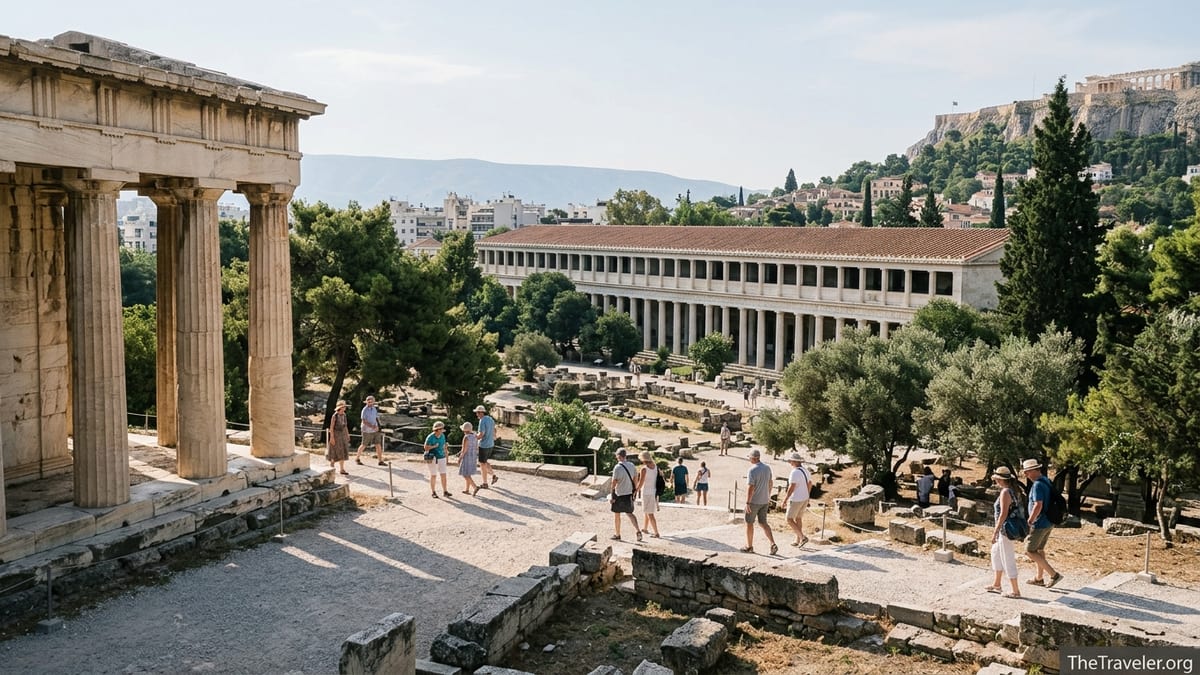
Current Opening Hours at the Ancient Agora
As of mid‑2026, the Ancient Agora of Athens generally follows the nationwide schedule for Greek state archaeological sites. In practical terms, that means longer hours in the warmer months and shorter, museum‑style hours in winter. For most travelers, the key rule is that the gates open in the early morning, around 8:00, and close in the early evening in winter and early nightfall in summer. This pattern has been consistent for years, even when the exact closing time shifts by half an hour.
Recent guidance from the authorities and partner institutions indicates that during the main summer period, roughly from 1 April to 31 October, the Ancient Agora operates from about 8:00 to 19:30, with the archaeological site and the Museum of the Ancient Agora in the Stoa of Attalos sharing the same broad timetable. In the winter season, from November through March, hours typically shorten to about 8:00 to 17:00, in line with other major outdoor sites in Athens. Think of this as a realistic framework rather than a fixed guarantee.
Travelers booking tickets through official channels or reliable partners will often see small variations in the listed closing time, for example 19:00 or 20:00 for summer and 17:00 for winter. These differences usually reflect transitional periods at the start or end of the season, or provisional decisions that are later fine‑tuned by the Ministry of Culture. If you check a tour operator in June and see 8:00 to 20:00, then look at a government document that says 8:00 to 19:30, you are seeing two views of the same basic schedule.
For a concrete example, visitors arriving in Athens in early May might find the official sign at the site entrance reading “Opening hours 08:00–19:30” while a large ticketing platform they booked through still shows 08:00–20:00. In practice, staff will begin clearing the site well before the posted closing time, and the last visitors will be guided toward the exit as the sun dips behind the Acropolis. This is why, even with a general understanding of the timetable, it is unwise to push your arrival too close to the evening cut‑off.
Seasonal Changes and What They Mean in Practice
The biggest difference in visiting the Ancient Agora across the year is the shift between the “summer” and “winter” schedules. In summer, the longer hours give you more flexibility. You may enter right after 8:00 to avoid the heat, drop in late in the afternoon after the Acropolis, or squeeze in a visit around a city walking tour. In winter, with the 17:00 closing time, you have a much narrower window and must plan your day around daylight.
These seasonal changes also affect how much time you realistically have on site. In July and August, sunset in Athens is late, and wandering around the Temple of Hephaestus at 18:30 still feels bright and relaxed. In January, by contrast, the light can fade soon after 17:00, which means an afternoon arrival at 15:30 might be the last comfortable slot if you want to see the grounds and then step inside the Stoa of Attalos museum.
Airline schedules and cruise timetables often interact awkwardly with winter hours. For example, a traveler landing from London at 13:30 on a January afternoon might reasonably hope to “quickly see the Agora” on the way to their hotel. In reality, by the time they clear immigration, reach central Athens and drop their bags, only an hour or so of visiting time may remain. In summer, that same flight arrival could still allow a relaxed late‑afternoon stroll through the site.
Shoulder seasons such as late March and early November can be the most confusing. Official announcements sometimes shift the start or end of the summer schedule by a few days, or introduce an intermediate timetable during daylight saving transitions. If you are traveling in these in‑between weeks, avoid relying on a generic “April to October” or “November to March” summary you saw months earlier and instead verify the schedule within a few days of your planned visit.
Last Entry Rules and How Much Time You Really Need
Last entry at the Ancient Agora is normally set a short time before the official closing hour, often around 30 minutes. This is a general rule applied across many Greek archaeological sites to give guards time to clear the grounds. If the sign at the gate says closing at 19:30, staff may stop admitting visitors around 19:00, and they will encourage those already inside to begin heading toward the exit not long afterward.
In practice, arriving only half an hour before last entry is not enough to appreciate the site. The Ancient Agora is larger and more varied than it appears from the street. Walking from the main entrance near Adrianou Street up to the Temple of Hephaestus, wandering the paths around the Church of the Holy Apostles, and exploring the exhibits in the Stoa of Attalos makes for a comfortable 1.5 to 2 hour visit. Many travelers combine the visit with a coffee in nearby Thiseio or Monastiraki, turning it into a half‑day experience.
Real‑world experiences show that pushing too close to closing time can be frustrating. Some visitors who bought a same‑day ticket in the late afternoon have reported being hurried through the site, with guards gently reminding them of the approaching closing time as they tried to linger at the temple. Others who arrived at the gate 20 minutes before posted closing were simply told they could not enter, because the last admission cut‑off had already passed. To avoid disappointment, treat the posted closing time as the moment the site is fully empty, not the moment you can still step inside.
For most travelers, a safe planning rule is to aim to be at the entrance at least 90 minutes, and ideally two hours, before the official closing time. If your schedule is tight, prioritize the open‑air monuments first. Walk directly up toward the Temple of Hephaestus for sweeping views over the Agora and the Acropolis, then loop back via the Stoa of Attalos to see the museum exhibits. Only when you are sure you have time left should you drift into side paths and quieter corners of the site.
Holiday Closures, Free Days and Special Disruptions
Because the Ancient Agora is managed by the Greek state, it follows the national calendar for public holidays and free admission days. The site is typically closed on 1 January, 25 March, 1 May, Easter Sunday according to the Orthodox calendar, 25 December and 26 December. On these dates the gates remain shut even if you see crowds in the surrounding cafés and markets. Planning a tight itinerary around Christmas or Orthodox Easter without checking opening hours is a common mistake.
On the other hand, several dates each year offer free entry, when the Ancient Agora and other state‑run sites in Athens waive the ticket fee. These often include certain cultural heritage days in spring and autumn and selected Sundays in winter months. While the exact list of free days can change, they usually attract a mixture of locals and budget‑minded travelers. If you happen to be in Athens on one of these days, expect the Agora to feel busier, especially in the late morning.
Beyond the regular holiday pattern, short‑notice disruptions are increasingly common. During heatwaves, the Ministry of Culture has repeatedly announced reduced visiting hours for open‑air sites, particularly in the hottest weeks of July and August. In such cases, the Ancient Agora may close in the early afternoon, for instance at 13:00, to protect both staff and visitors from extreme temperatures. If you arrive at 15:00 on such a day, you may find the gate locked even though general summer hours suggest it should be open.
Occasionally, partial closures within the site can also affect your experience. Restoration work inside the Stoa of Attalos, maintenance of paths, or safety inspections near the Temple of Hephaestus may temporarily limit access to specific areas. These are usually signposted at the entrance, but they rarely make their way into third‑party guidebooks or blog posts. When you plan a visit around a particular highlight, whether it is photographing the temple columns or seeing specific artifacts in the museum, it is worth asking staff at the ticket booth on arrival whether any sections are closed that day.
Summer Heat, Crowd Patterns and Best Time of Day
Athens summers have grown noticeably hotter in recent years, and the Ancient Agora is a largely open‑air site with limited shade away from the trees. The main paths are exposed to direct sunlight for much of the day. In July and August, temperatures at midday often climb well above 34 degrees Celsius, making a visit between 11:00 and 16:00 uncomfortable for many travelers. The stone surfaces and gravel paths radiate stored heat, and very young children, older visitors and anyone sensitive to high temperatures can tire quickly.
Real‑world schedule adjustments reflect this reality. During strong heatwaves, authorities have temporarily closed the Agora and similar sites in the afternoon, reopening only in the cooler hours or remaining closed for the rest of the day. In 2025, for example, several Athens sites reduced hours for multiple days due to extreme heat, catching some visitors off guard when they arrived after lunch expecting normal opening times. With climate patterns making such heat events more frequent, travelers in high summer should treat early mornings and early evenings as the default visiting windows.
The most comfortable and atmospheric time to visit in summer is usually between opening and around 10:00. The temperature is still relatively mild, low light picks out the details of the Temple of Hephaestus, and tour groups are only just beginning to arrive from cruise ships and hotels. Another good option is the final two hours before closing, when the heat eases and the site gradually empties out. In winter, mid‑morning to early afternoon, roughly 10:00 to 14:30, is ideal, balancing softer sunlight, fewer crowds and the shorter day.
Crowd patterns also depend on how people bundle the Agora with other sites. Many visitors do the Acropolis first thing in the morning, then move downhill through the Roman Agora and end at the Ancient Agora in early afternoon. Others start in Monastiraki, buy their ticket at the Ancient Agora right at 8:00, then climb up to the Acropolis later. If you want quieter paths and easier photos, consider reversing the most common flows. For instance, you might visit the Ancient Agora at opening time, then walk to the Acropolis Museum for an air‑conditioned midday break, and tackle the Acropolis itself in the late afternoon when the light softens.
Morning vs Afternoon Visits: Choosing What Suits You
Whether you should plan a morning or afternoon visit to the Ancient Agora depends on your tolerance for heat, your energy levels and how it fits with the rest of your itinerary. A morning visit works best for most travelers, particularly in summer. Arriving around 8:00 or 8:30 means cooler air, fewer groups, and more space to wander the ruins at your own pace. You can climb the gentle slope to the Temple of Hephaestus without the sun directly overhead, then step into the shaded Stoa of Attalos when the day begins to warm.
Afternoons, however, have their advantages. In the shoulder seasons of April, May, September and October, temperatures are usually comfortable enough to allow an unhurried afternoon stroll, and the site can feel pleasantly calm after 16:00 as day tours wrap up. Photographers often appreciate the warm side‑light on the columns in late afternoon, especially when clouds create texture in the sky above the Acropolis. If you are staying near Monastiraki, an afternoon visit can flow naturally into dinner in nearby Psyrri or Thiseio without backtracking across the city.
Families with small children or travelers recovering from jet lag may need to balance ideal timing with practical realities. A midday nap in an air‑conditioned hotel room can be more valuable than chasing the perfect golden hour. For example, a family arriving on a long‑haul flight might take a slow first morning, then aim for the Agora between 16:30 and 18:30, catching the cooler part of the day while still leaving time for an early dinner. In winter, with earlier closing, choosing a mid‑morning slot after a relaxed breakfast can avoid rushing against the 17:00 deadline.
Whatever time you choose, build in flexibility for the rest of your day. If you plan the Agora right before another fixed timed entry, such as a specific Acropolis slot or a pre‑booked evening food tour, any delay at the entrance or unexpected partial closure inside the site can add stress. A simple alternative is to pair the Agora with non‑ticketed activities nearby, like wandering through the flea market streets of Monastiraki, exploring the small shops along Adrianou Street, or sitting at a café with a view of the Acropolis. This way, if you need to adjust your visiting time by an hour, you will not be scrambling to rearrange reservations.
Why You Should Always Verify Hours Before You Go
Even though general patterns are predictable, the precise opening hours of the Ancient Agora are not completely fixed. They can change with new staffing decisions, public sector regulations, conservation work or extreme weather events. In the past few years, travelers have seen changes announced by the Ministry of Culture on short notice, including temporary closures due to strikes, restricted hours during heatwaves, and adjustments around special events or state visits.
Third‑party sources, including popular travel blogs, digital guidebooks and ticket resellers, often lag behind these changes. An article written in 2023 may still confidently state one timetable, while an updated government list in 2026 quietly shows another. A major ticketing platform might continue to advertise summer closing at 20:00 when the official policy has shifted to 19:30. Because of this, treating any single article or platform as definitive can lead to awkward surprises at the gate.
The most reliable information comes from the Greek authorities themselves and the staff who operate the site day to day. In practice, this means checking the Hellenic Ministry of Culture’s published opening hours for archaeological sites, looking at recent announcements related to the Ephorate of Antiquities of Athens, or calling the guardhouse or ticket office of the Ancient Agora shortly before your visit. Many hotels in central Athens are also used to helping guests confirm hours for major sites and can make a quick phone call on your behalf.
Consider two real‑world scenarios. A traveler reads in an older guidebook that the Agora closes at 20:00 in summer and aims to arrive at 19:15 after a late lunch in Plaka. On arrival, they find the gate closed because the last entry was at 19:00 and closing moved to 19:30 that season. Another traveler, visiting during a heatwave, sees only the standard 8:00 to 19:30 schedule in their printed guide, but a sign at their hotel desk warns that outdoor sites will shut at 13:00 for several days. The first traveler loses a visit; the second adjusts their plans and goes at 8:00 instead. The difference lies entirely in verifying the latest information.
The Takeaway
Understanding the opening hours of the Ancient Agora is less about memorizing exact times and more about recognizing patterns and planning around them. Expect an 8:00 opening year‑round, an early evening closing in winter and a later one in summer, with last entry roughly half an hour before the posted closing time. Build in at least 90 minutes to two hours for your visit, and resist the temptation to arrive at the very end of the day.
Seasonal changes, holiday closures and weather‑related adjustments mean that timetables printed long in advance are only guidelines. If you are traveling in the hot months of July and August, assume that mornings and late afternoons are the most realistic visiting windows, and be alert for heatwave‑related changes. Around major holidays or during shoulder seasons, double‑check that the site will be open on the specific day and time you plan to go.
Finally, remember that the most current information comes directly from Greek cultural authorities and on‑the‑ground staff, not from static brochures or outdated blog posts. A quick verification the week, or even the day, before your visit can save you from a closed gate or a rushed walk through one of Athens’ most atmospheric sites. With a bit of planning, the Ancient Agora can become a relaxed highlight of your time in the city, rather than a logistical headache.
FAQ
Q1. What are the typical opening hours of the Ancient Agora in summer?
In the main summer months, the Ancient Agora usually opens around 8:00 and closes around 19:30, with last entry roughly 30 minutes before closing.
Q2. How do the winter opening hours differ from summer?
From roughly November to March, the site generally operates on shorter hours, around 8:00 to 17:00, so you have a narrower daylight window for your visit.
Q3. When is the last entry time for the Ancient Agora?
Last entry is typically set about 30 minutes before the official closing time, although guards may begin discouraging new arrivals slightly earlier on busy days.
Q4. Is the Ancient Agora open every day of the year?
No. The site usually closes on major public holidays such as 1 January, 25 March, 1 May, Easter Sunday, 25 December and 26 December, and may close on other special days.
Q5. How much time should I plan for a visit?
Most travelers should allow at least 1.5 to 2 hours to explore the ruins, walk up to the Temple of Hephaestus and visit the museum inside the Stoa of Attalos.
Q6. What is the best time of day to visit in summer?
In summer, the most comfortable times are early morning, from opening until around 10:00, or late afternoon in the final two to three hours before closing.
Q7. Can opening hours change because of heatwaves or other events?
Yes. During extreme heat, strikes or special events, authorities may reduce hours or temporarily close the site, sometimes on short notice.
Q8. Where can I find the most up‑to‑date information on opening hours?
The most current details are usually provided by the Greek Ministry of Culture, the local Ephorate of Antiquities, or directly by staff at the Ancient Agora ticket office.
Q9. Are there free admission days at the Ancient Agora?
Yes. Several dates each year offer free entry to state‑run sites, including the Ancient Agora, though the exact calendar can change and should be checked in advance.
Q10. Do I need to book a timed ticket to match the opening hours?
Ticketing policies can change, but in many recent seasons standard tickets for the Ancient Agora have allowed entry at any time during open hours, subject to last entry rules.