


At the foot of the Acropolis, the Ancient Agora of Athens looks at first like a quiet archaeological park: scattered columns, low foundations, a lonely temple on a hill. With a little historical context, though, this open field turns into a crowded city square filled with citizens arguing politics, philosophers teaching under shaded colonnades, vendors shouting prices and jurors hurrying to court. This guide walks you through the Agora’s history and layout so you can read the ruins as Athenians once read their city, with a focus on democracy, philosophy and everyday life.
Get the latest updates straight to your inbox!
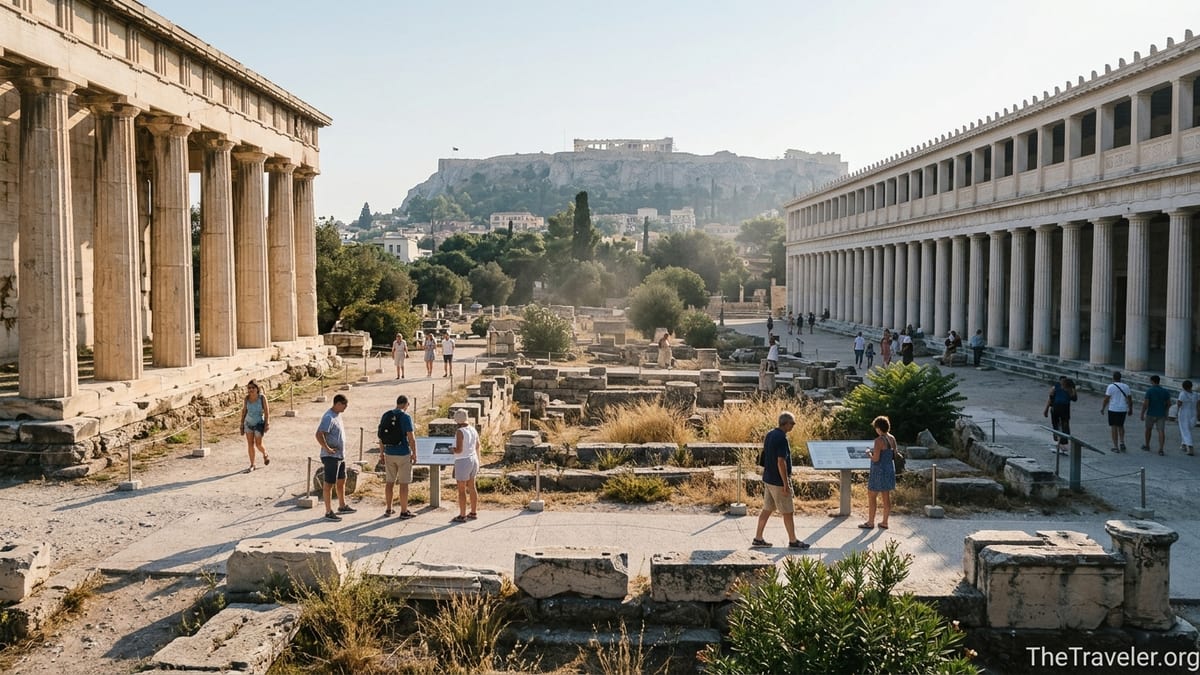
The Agora at the Heart of Athenian Democracy
The Ancient Agora was the civic center of classical Athens, a broad open square framed by public buildings, stoas and temples. In the 5th century BC, when the city’s radical democracy matured, this space was where institutions met, cases were heard and policies were prepared. Excavations by the American School of Classical Studies have revealed more than 30 acres of public buildings, inscriptions and small finds that show just how dense and busy this space once was.
Democracy in Athens rested on three main institutions: the Assembly of citizens, the Council of Five Hundred and the people’s courts. The Assembly usually met on the nearby Pnyx Hill, but the other two lived in and around the Agora. Councilors gathered in the Bouleuterion in the south sector, drafting decrees and supervising officials, while the courts, or dikasteria, used buildings and open spaces on the north and west sides. When you walk through the site today, it helps to imagine that almost any cluster of Athenians you see in your mind’s eye might be a political meeting.
For a modern visitor, the most obvious symbol of democracy here is the Stoa of Attalos, rebuilt in the 1950s and now housing the Agora Museum. In antiquity, this long two-story colonnade from the 2nd century BC was lined with shops; today, inside the museum, you can see bronze ballots used by jurors, official marble decrees and fragments of the water clocks that timed political speeches. It is one of the best places in Athens to connect physical objects with the abstract idea of democracy.
Think of the Agora as a place where politics were unavoidable, the way a central metro hub or busy city square works today. An Athenian might come to buy grain or olive oil, only to be pulled into a heated argument about a new naval policy or a public building project. Instead of reading opinions on a screen, men debated face to face, and the buildings around them channeled those arguments into formal institutions.
Stoas, Temples and the Architecture of Public Life
The Agora’s architecture was designed for people who spent much of their day in public. Long stoas, or covered colonnades, ringed the square and provided shade from the Attic sun, shelter from winter rains and a backdrop for commerce and conversation. These buildings were practical first and symbolic second, yet their placement and dedications also told Athenians what values mattered.
On the west side stood several key stoas. The Stoa Basileios, or Royal Stoa, housed the archon basileus, an official responsible for religious law. Nearby, the Stoa of Zeus Eleutherios honored Zeus as a god of freedom, linked to victory over Persia. When you stand on the western edge of the site and look toward the Acropolis, you are roughly where office-holders, litigants and philosophers once moved between shaded colonnades and open square.
Above the northwest corner of the Agora rises the Temple of Hephaestus, often called the best-preserved Doric temple in Greece. Built around the mid 5th century BC on the low hill of Kolonos Agoraios, it overlooked the workshops and foundries of metalworkers and potters. Today, visitors often walk up the path in late afternoon, when the marble takes on a warm color and the view across the Agora to the Acropolis gives a sense of how compact the ancient city center was.
Other shrines and small temples lined the square. Remains of the Temple of Apollo Patroos, dedicated to Apollo as ancestral father of the Ionian Greeks, stand close to the west side. Smaller shrines to Zeus Phratrios and Athena Phratria reminded citizens of their membership in kinship groups and religious associations. For a traveler used to separating religion and administration into different districts, it is striking to see how closely temples sit to law courts, council buildings and shops, as if city, gods and market were inseparable.
Markets, Money and Everyday Business in the Agora
To ancient Athenians the word agora meant both a physical square and the concept of a marketplace and a place of public speaking. The same verb could mean “to shop” or “to speak in public.” This double meaning captures how commercial and civic life overlapped. In the mornings, farmers from the countryside brought produce to sell: baskets of figs and grapes, amphorae of olive oil, live chickens and clay jars of wine. Artisans offered pottery, metal tools, sandals and textiles. Prices fluctuated with the season, just as they do now at a farmers’ market in modern Athens.
Coinage played a central role. The famous Athenian silver tetradrachm, stamped with the owl of Athena, circulated widely across the eastern Mediterranean and would have passed through countless hands in the Agora. In the 5th and 4th centuries BC, a skilled craftsman might earn a daily wage of one drachma, enough to feed a family modestly. Jurors in the people’s courts received a small fee as well, paid in the same coinage, so that even poor citizens could afford to serve. When you see the small bronze weights and balance pans in the Agora Museum, you are looking at the tools that underpinned trust in daily transactions.
Many visitors today experience the commercial side of the area just outside the archaeological fence. Cafes in nearby neighborhoods like Monastiraki serve modern versions of foods whose basic ingredients were already common in classical times: grilled fish with olive oil, bread, olives, cheese and local wine. Although no one is bartering bundles of firewood in the square anymore, the logic is familiar: people seeking supplies, gossip and the sense of being in the city’s center.
Regulation of the market also took place in the Agora. Inspectors checked measures, quality and prices, and decrees carved on stone laid out rules for selling grain or controlling imports. Some of these inscriptions survive in fragments, displayed in the museum or along the paths. They show that while the Agora looked like an open, free-flowing space, it depended on constant oversight to keep trade fair, much as modern city markets rely on health inspections and consumer law.
Courts, Politics and the Rough Edges of Democracy
Democracy in Athens was participatory and energetic, but it was not always gentle. The people’s courts, scattered around the Agora, could make or break a citizen’s career, seize property or even exile an individual from the city. Juries were large, often made up of hundreds of men selected by lot from those over 30 years old who volunteered. To prevent bribery or prearranged seating, jurors received bronze tickets and were assigned to specific courts on the day of the trial.
Archaeologists have identified law-court complexes through finds such as bronze ballots, juror identification tags and a stone base for a water clock, or klepsydra, used to time speeches. When you stand near the northern end of the Stoa of Attalos and look toward the open foundations nearby, you are in a zone where litigants once marshaled arguments about inheritance, trade disputes or accusations of political wrongdoing. Speeches that survive from Athenian orators describe scenes where crowds murmured approval or disapproval around the edges.
Political decisions also took shape here before reaching the wider Assembly. The Council of Five Hundred met in the Bouleuterion, a rectangular building in the south sector of the Agora. Councilors, drawn by lot from each of the ten tribes of the city, served for one year and prepared the agenda for the Assembly. In front of the council building was the Tholos, a round structure where a rotating group of fifty councilors stayed on duty, eating together at public expense and ready to respond quickly to emergencies. The foundations of both structures are visible today, and informational panels help you match ruins to their functions.
For the modern traveler, it is useful to remember that this system excluded many people. Women, enslaved persons, resident foreigners and younger men had no direct voice. Yet within its limits, the Athenian democracy took public participation unusually seriously, requiring ordinary citizens to take turns in offices and juries. As you cross the square, you can imagine that any man you picture leaning in discussion or standing alone in thought might be a juror on his way to court, a councilor heading to a session or a petitioner seeking redress.
Philosophy, Education and the Life of the Mind
The Agora was not only about institutions and trade. It was also a classroom and debating hall in the open air. Philosophers, sophists and teachers used the stoas and shaded corners as places to gather students, lecture and argue. Later traditions associate Socrates in particular with the Agora, wandering barefoot, questioning craftsmen, politicians and young aristocrats about justice and virtue.
In practical terms, this meant that a young Athenian could walk through the square and overhear arguments about the nature of courage, the best form of government or the structure of the cosmos, all while dodging vendors and friends. Fee-paying teachers offered more formal instruction, but informal conversation was central. The long colonnades created natural meeting points, just as modern university campuses use arcades and courtyards to foster chance encounters.
Philosophical schools with formal names, such as Plato’s Academy and Aristotle’s Lyceum, lay outside the Agora, but their members still used the central square as a place to meet people, observe politics in action and recruit students. When decrees were passed that affected education, religious festivals or public morality, the news spread quickly through the conversations here.
As a visitor, you might replicate a small part of this experience by sitting on a low wall or under a tree and simply listening. Tours often pass by with guides explaining the basics of democracy, but if you stay a little longer between groups, the quiet can help you imagine the layered soundscape of antiquity: distant hammering from workshops, footsteps on stone, arguments in the colonnades and the drone of a lecturer trying to hold his students’ attention.
Walking the Agora Today: What to Look For
Modern access to the Ancient Agora is via a ticketed entrance near the Monastiraki and Thissio neighborhoods. Many visitors combine it with the Acropolis on the same day, but the site rewards slow exploration. In summer months it opens early, allowing you to walk while the light is still soft and the temperature lower, much as Athenians preferred to do strenuous business in the morning before the midday heat.
A practical route begins along the central path that leads toward the Stoa of Attalos. Stepping inside the reconstructed stoa and visiting the Agora Museum gives useful context before you tackle the open ruins. Glass cases display coins, pottery, inscriptions and everyday objects such as terracotta toys, loom weights and cosmetic containers, reminders that this was a place where families lived and worked as well as voted and traded.
From the museum, you can climb up to the Temple of Hephaestus along a gently rising path. The temple’s colonnades are intact enough that you can appreciate proportions and column spacing, and there are views over modern Athens that help you situate the ancient square within the current city grid. Many travelers pause here to take photographs of the temple with the Acropolis in the background, a classic pairing of Athens’ two best-preserved classical landmarks.
Back down in the square, look for low stone outlines and interpretive signs marking the Tholos, the Bouleuterion and the various stoas along the west side. It often helps to carry a simple plan of the site, available in guidebooks and at many hotels and shops in the city center. With a map in hand, the scattered foundations resolve into a comprehensible cityscape: council chamber here, law court there, shrines standing between them like anchors of collective identity.
How Athenians Used the Agora Across the Centuries
The Agora evolved over nearly a millennium, reflecting Athens’ shifting fortunes. Early public buildings appeared in the 6th century BC as tyrants and reformers began to shape the space for civic use. After the Persian destruction in 480 BC, the Athenians rebuilt, adding stoas, fountains and new temples. The high classical period saw construction of the Temple of Hephaestus and expansion of administrative buildings, while in the Hellenistic era the Stoa of Attalos was added on the east side as a grand commercial building with shops.
Under Roman rule, the Agora remained important but shared its role with a newer Roman Forum nearby. Emperors contributed structures such as the Odeion, a small concert hall, and sponsored renovations. Over time, as Athens declined in political power, the square lost some of its administrative centrality but continued as a place of residence and worship. By late antiquity and the Byzantine period, houses and churches filled much of the area, burying classical levels under later neighborhoods.
In the 19th and early 20th centuries, as modern Athens expanded, homes and workshops again covered the area. Systematic excavation required the clearance of this dense residential quarter, a long process overseen by archaeologists. Walking the site today, it is worth keeping in mind that you are moving through layers of history: classical foundations, Roman additions, Byzantine and Ottoman remains and traces of the modern city that had to be removed so the Agora could be studied and opened to visitors.
This long continuity helps explain why the Agora feels less like a single monument and more like a landscape of memory. For Athenians across time, it has been a meeting place, a market, an administrative center and a neighborhood. For a traveler, that layered story offers a chance to think not only about ancient democracy but also about how cities continually reuse and reinterpret their central spaces.
The Takeaway
Seen with historical context, the Ancient Agora of Athens is not just a field of ruins beneath the Acropolis but a vivid record of how one city organized its public life. Here, Athenians met to draft laws, hear court cases, trade goods, honor the gods and debate ideas. The same square accommodated institutions of democracy, commercial stalls, philosophical conversations and religious rituals, weaving them into a single urban experience.
Walking the paths between the Stoa of Attalos, the Temple of Hephaestus and the scattered foundations, you move through the spaces that made the Athenian experiment in self-government possible. The details may be weathered and partial, but bronze ballots, water clocks, shrines and stoas still speak clearly about a society that expected its citizens to be present, attentive and engaged. For modern visitors, the Agora offers both a tangible link to that past and a prompt to reflect on how our own cities shape the way we live, argue and decide together.
FAQ
Q1. What is the Ancient Agora of Athens?
The Ancient Agora of Athens is the central civic and commercial square of the classical city, where political institutions, markets, courts and temples once clustered together.
Q2. How is the Agora connected to Athenian democracy?
The Council of Five Hundred, people’s courts and key magistrates worked in and around the Agora, so preparing laws, holding trials and administering the city all took place within this space.
Q3. What are the main buildings to see in the Agora today?
Key monuments include the restored Stoa of Attalos and its museum, the well-preserved Temple of Hephaestus on the hill, and the foundations of the Bouleuterion, Tholos and various stoas.
Q4. Where did philosophy happen in the Agora?
Philosophers and teachers used shaded stoas and open corners as informal classrooms, with figures like Socrates traditionally associated with questioning citizens in and around the square.
Q5. What role did markets play in the Agora?
The Agora functioned as the main marketplace, with farmers and artisans selling food, pottery, tools and other goods, while officials regulated measures and enforced commercial rules.
Q6. Can visitors still see evidence of the ancient law courts?
Yes. Archaeologists have identified law-court areas through finds like bronze ballots and a water clock base, and some of these remains and related objects are displayed in the Agora Museum.
Q7. How long did the Agora serve as Athens’ civic center?
The Agora developed from the 6th century BC and remained a key civic and commercial hub through the classical, Hellenistic and Roman periods, gradually changing function into late antiquity.
Q8. Is the Agora suitable to visit with limited time in Athens?
Yes. With about two hours you can walk the main paths, visit the museum in the Stoa of Attalos and climb to the Temple of Hephaestus for views of both the Agora and the Acropolis.
Q9. How does the Agora compare to the Acropolis for understanding Athens?
The Acropolis focuses on monumental temples and religious symbolism, while the Agora reveals everyday political, commercial and social life, making them complementary for understanding the city.
Q10. What is the best time of day to visit the Agora?
Mornings or late afternoons are generally more comfortable, offering softer light, fewer crowds and temperatures closer to what ancient Athenians preferred for their daily business.