


The Ancient Agora of Athens looks compact on the map, but on the ground it is a surprisingly spacious archaeological park, with ruins scattered between pine trees, low hills and sweeping city views. How long you spend here can easily make the difference between a rushed box-tick and one of the most memorable stops of your Athens trip. This guide breaks down realistic time frames for visiting the Ancient Agora, including quick and relaxed visit plans, how long to allow for the museum and the Temple of Hephaestus, where to pause for photos or shade, and sample itineraries that fit around the rest of a day in Athens.
Get the latest updates straight to your inbox!
Key Facts That Shape How Long You Need
The Ancient Agora sits directly below the Acropolis between Monastiraki and Thiseio, and functions today as an open archaeological park with relatively little shade in some areas. As of spring 2026, the official opening hours are generally 08:00 to 19:30 in the main season, giving you plenty of flexibility to visit in the cooler early morning or late afternoon. Tickets are sold on site and through the official Hellenic Heritage system and, since the old multi-site combo pass was discontinued, the Agora has its own separate ticket. Most recent reports put full price admission in the region of 10 to 20 euros per adult, with reduced and free-entry days available, so it is wise to check current pricing just before you travel.
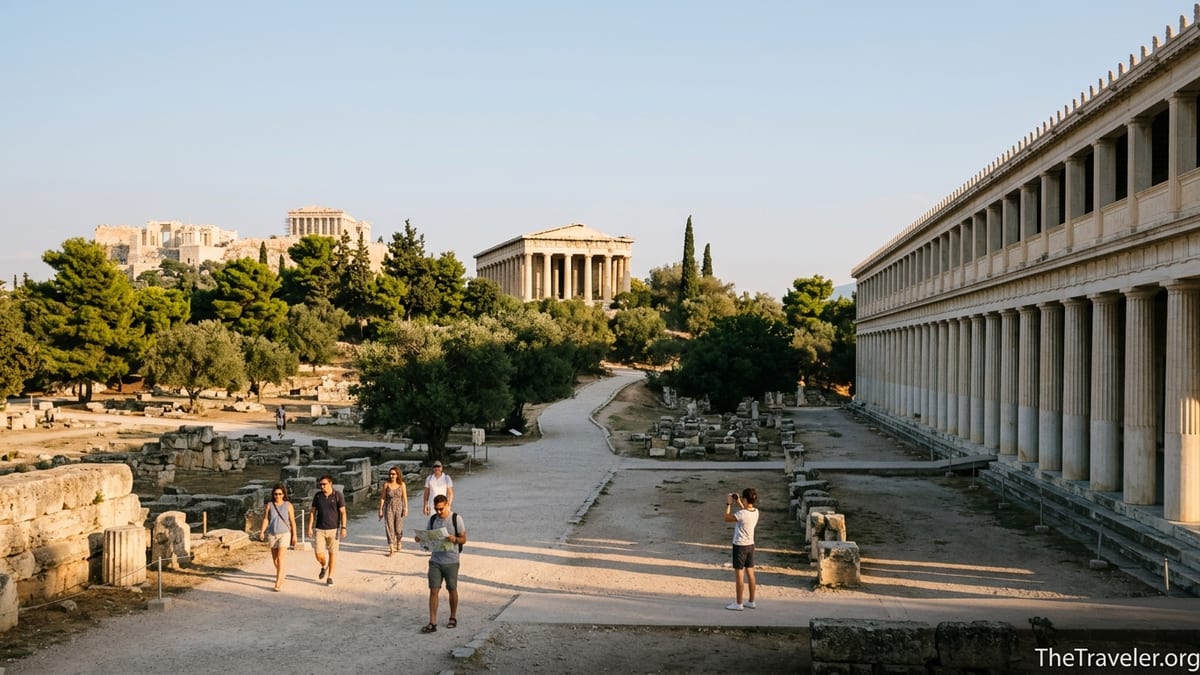
The site itself is larger than many visitors expect. It includes the Temple of Hephaestus on a low hill, the long reconstructed Stoa of Attalos that houses the Museum of the Ancient Agora, multiple stoas and civic buildings in ruin form, and walking paths that loop through olive and pine trees. Even walking briskly from one end to the other can take 15 to 20 minutes, and you will often be stopping to read panels, take photos or rest in the shade. As a result, most travelers find that anything under one hour feels rushed, one and a half to two hours feels comfortable, and two and a half to three hours allows for a genuinely relaxed visit.
Another factor is how much context you want. The Agora is where Athenian democracy was lived day to day, but the stones themselves can blur into one another if you arrive cold. Many people watch a short background video at their hotel the night before or listen to a basic audio guide on their phone, then use the on-site signs to anchor what they are seeing. If you book a guided tour that covers both the Acropolis and the Agora, the time allocation is largely fixed, often around one hour for the Agora portion; if you visit independently you can linger longer at the corners that interest you most.
Finally, consider the season and time of day. In July and August, midday heat in central Athens can be intense, with temperatures frequently above 33 degrees Celsius. That makes shade, water breaks and slower walking essential, which in turn stretches the time you realistically need. In March or November, you may comfortably cover the same ground in less time simply because you are not seeking out every patch of shade. Planning around those practicalities usually matters more than trying to hit some perfect “average” visit duration.
How Long for a Quick Visit
A quick visit to the Ancient Agora typically lasts 45 to 75 minutes and focuses on the essential highlights: the exterior of the Temple of Hephaestus, a walk through the central paths, and a short stop inside the Stoa of Attalos. This kind of visit works well if you are in Athens for only a day or two, or if you have already spent a full morning at the Acropolis and want a lighter follow up before lunch in Monastiraki.
If you are aiming for roughly 45 minutes, enter through the main gate near Adrianou Street, walk straight up the path to the Temple of Hephaestus, circle the temple once for different angles and city views, then loop back down past a few of the clearly signposted ruins like the Tholos and the Bouleuterion. You might only step briefly into the ground floor of the Stoa of Attalos to see the scale of the reconstruction and a couple of key statues, then head out. This pace assumes you stop for photos but do not spend long reading labels or examining smaller finds.
To stretch a quick visit to about one hour, add slightly more time in the museum and a second loop on a different path back toward the exit. For instance, you might spend 20 minutes at the Temple of Hephaestus, 20 minutes inside the Stoa of Attalos museum focusing on a few standout objects like the ostraka that were used in ostracism votes, and 20 minutes strolling through the central area. Many independent travelers who come straight from the Monastiraki metro station, walk the site at an easy pace, and skip a formal guide naturally end up in this one hour rhythm.
It is useful to remember that even a short visit requires a few non-negotiable time sinks. You will spend five to ten minutes buying or presenting your ticket if there is a small line, especially in high season mid morning. Security screening is usually quick but can add another couple of minutes. If you are walking from Syntagma or Plaka, the approach itself might take 10 to 20 minutes. As a result, when you plan a “45 minute” stop, you should think of that as time inside the site, not door to door from your hotel.
Designing a Relaxed Half Day at the Ancient Agora
For many travelers, the Ancient Agora is at its best when visited in a relaxed way over two to three hours. This gives you time to sit under the trees, read interpretive panels slowly, browse the museum without rushing, and simply enjoy the calm greenery in the middle of Athens. A common pattern is to start around 08:30 or 09:00, before the sun is high, and leave in time for a late morning coffee or lunch in nearby Thiseio or Monastiraki.
A good relaxed plan might allocate 30 to 40 minutes for the Temple of Hephaestus and its hill, including time to walk around the colonnades, take wide city views with the Acropolis in the background, and rest on a bench in the shade. You could then spend 40 to 50 minutes in the Stoa of Attalos museum, moving upstairs to see models and sculptures after exploring the ground floor everyday objects. The remaining hour can be used for slow exploration of the rest of the ruins, from the outlines of the Bouleuterion and the Tholos to the remains of various stoas where citizens once gathered.
Think of this as a park experience as much as a monument. On a spring morning in April or May, you might pause under pine trees to listen to birds and cicadas, or watch local school groups walk past their teacher holding laminated timelines. In September, you may sit on a bench looking across to the Acropolis, sipping bottled water from a kiosk just outside the gate and letting your legs recover from the marble slopes above. Building in these small pauses is what separates a relaxed visit from simply staying longer on your feet.
If you have children or older relatives with you, this longer time frame is also far kinder on energy levels. Families often break the visit into two clear segments, for example one hour around the temple and ruins, then a break in the shade or in the small café area outside, followed by another hour in the museum where there is air conditioning and restroom access. That pacing allows everyone to engage with the history without getting overstimulated or exhausted, particularly in summer.
Allocating Time for the Museum and Temple of Hephaestus
The Temple of Hephaestus is the single most visually striking structure in the Ancient Agora, a remarkably well preserved classical temple that still stands almost intact. Reaching it from the main entrance takes about 10 to 15 minutes at an easy pace, including a short uphill stretch. Most visitors spend at least 15 minutes walking around the exterior, noticing details in the frieze and enjoying the elevated views. Photography enthusiasts might comfortably linger for 30 minutes or more, waiting for tour groups to move and adjusting angles.
The Stoa of Attalos, which houses the Museum of the Ancient Agora, deserves more time than many quick itineraries allow. The long reconstructed colonnade itself is an exhibit, and inside the museum you will find inscribed stones, domestic pottery, coins and small objects that make daily life in classical Athens feel tangible. A very quick walk through at high season, focusing only on a handful of famous items, might take 20 minutes. A more thorough visit where you read some of the exhibition texts and look carefully at the ostraka, sculptures and models will more realistically take 40 to 60 minutes.
If your schedule is tight, decide in advance whether you are more interested in architecture in situ or smaller artifacts indoors. For instance, a traveler who has already spent hours in the Acropolis Museum might choose to dedicate just 20 minutes to the Stoa of Attalos exhibits and invest the rest of their time in the open air ruins, while someone fascinated by political history may want to see the physical remains of ostracism votes more closely and be willing to shorten time on the paths outside. Thinking in these trade offs makes it easier to adjust on the day without stress.
Remember that both the museum and the temple area can feel crowded when a tour group arrives. If you walk up to the Temple of Hephaestus and see three coach groups clustered on one side, consider doing a slow circuit in the opposite direction so that by the time you reach the busy corner the cluster has moved on. In the Stoa of Attalos, you can do something similar by starting upstairs or at the far end of the gallery, then looping back once the main group has passed through. These small tactical choices can preserve the sense of calm you want from a longer visit without actually needing more clock time.
Photo Stops, Shade, and Heat Break Strategies
Because the Ancient Agora is open and exposed in many sections, planning explicit photo and heat breaks is essential, especially from late May to early September. Popular Instagram style shots include the Temple of Hephaestus framed by pine branches from the lower path, long perspective lines inside the Stoa of Attalos, and panoramic views that capture both the Agora ruins and the Acropolis rock above. Taking these pictures need not consume huge amounts of time, but you will move more slowly as you frame shots, wait for people to clear, and check your results in bright light.
A sensible approach is to cluster your main photo stops in naturally shady or breezy locations. For example, walk directly up to the Temple of Hephaestus in the cooler part of your visit, when the sun is lower, then take your time with photos while you are still fresh. Later, when the temperatures rise, shift your focus to the museum interior, which is air conditioned and offers consistent lighting for photographing smaller artifacts where allowed. Between these two anchors, use brief pauses under trees along the central paths to catch your breath rather than standing in full sun at exposed viewpoints.
Hydration and rest are not optional in high summer. Many visitors carry a reusable water bottle and top it up at their hotel or at a café before entering, then plan to refill or purchase another cold drink as soon as they exit. The streets just outside the site, especially around Monastiraki and Thiseio, are lined with kiosks selling chilled bottled water, soft drinks and juice at typical central Athens prices. If you know you are sensitive to heat, consider visiting the Agora in the first slot of the day, for instance 08:00 to 10:00, and saving indoor attractions like the Acropolis Museum or the National Archaeological Museum for midday hours.
Footwear also plays a big role in how long you can comfortably stay. Surfaces in the Agora range from packed earth to gravel and occasional patches of worn stone, which can be slippery with thin soles or fashion sandals. Good walking shoes or sports sandals with decent grip will let you move steadily between photo spots without having to inch along. A brimmed hat and light, breathable clothing will reduce the need for emergency shade stops and make a two or three hour visit feel closer to a gentle stroll than a test of endurance.
Sample Itineraries: From One Hour to Half a Day
It can be helpful to think in concrete hour blocks when planning your Agora time around the rest of Athens. One realistic one hour itinerary starts at the main entrance at 09:00, walks directly up to the Temple of Hephaestus for 20 minutes of exploration and photos, then loops back through the central path with brief stops at a couple of signposted ruins before finishing with a 15 minute walk through the ground floor of the Stoa of Attalos and exiting around 10:00. From there you might head straight to Monastiraki Square for coffee and a pastry under the awnings.
A more generous two hour plan might begin at 16:00 after a midday break. You could spend 30 to 40 minutes walking from the entrance up to the temple and around its hill, another 30 minutes following side paths past the remains of the Tholos and the Heliaia, pausing on benches in the shade, then finish with 40 to 50 minutes in the museum. You would likely leave around 18:00, when the late afternoon light softens and the Acropolis glows, making the walk along the pedestrianized Apostolou Pavlou street toward Thiseio or back to Plaka particularly atmospheric.
To make the Ancient Agora the core of a half day, you might combine it with the Acropolis in a morning or afternoon arc. For example, take a pre booked timed entry to the Acropolis at 08:00, spend two to two and a half hours there including the slopes, then walk down via the Roman Agora area to reach the Ancient Agora gate around 11:00. After a brief rest and snack, use a curated 90 minute route through the Agora, focusing on the Temple of Hephaestus and the museum while skipping some of the more fragmentary ruins. You would exit around 12:30, ready for a long lunch in the shade.
Alternatively, if you are in Athens for several days and prefer slower travel, you could devote a single morning exclusively to the Agora. Arrive close to opening, spend 30 minutes exploring the lower ruins before most groups arrive, then climb to the temple when it is still cool. After a leisurely circuit and photos, retreat into the museum for as long as your curiosity leads you, perhaps an hour or more, then stroll the paths once more on your way out, seeing the same spaces in a different light. This kind of unhurried visit rarely takes more than three hours but leaves strong, coherent memories of the site rather than a blur of ancient stones.
Practical Planning Tips for Different Travel Styles
Your ideal time at the Ancient Agora also depends on how you like to travel. Solo travelers and history enthusiasts often choose to visit independently with a good guidebook or a downloaded audio guide, which lets them pause wherever something catches their eye. In practice, many of these visitors spend closer to two and a half hours on site, because every inscription or plan drawing invites a few extra minutes of reflection. If you recognize yourself in this style, allow more time than generic guidebook estimates and do not feel guilty about it.
Couples on a short city break might instead prioritize variety over depth, folding the Agora into a broader city stroll. A common pattern is to leave a central hotel near Syntagma mid morning, walk through Plaka and Monastiraki, visit the Ancient Agora for about 90 minutes, then continue to Psyrri for lunch or coffee. For this style, the key is to decide your upper time limit for the Agora in advance. Tell yourself, for example, that if you are still inside after two hours you will move on, even if you have not read every label in the museum, so that you do not unconsciously erode time from other experiences you care about.
Group tours offer convenience but limited control over time on site. Many combination tours marketed through agencies or platforms include the Acropolis, the Ancient Agora and sometimes the Acropolis Museum in a single morning or afternoon. In those cases, the Agora segment might last only 45 to 60 minutes, focused on the most important stories. That can be entirely satisfying if your priority is guided interpretation, but if you know you enjoy wandering on your own, consider returning later in your trip with a separate ticket for an unguided hour in the late afternoon light.
Whatever your style, booking tickets in advance through the official system when possible can remove one layer of uncertainty, especially in high summer when queues under the sun feel longer than they are. At the same time, do not be afraid of some spontaneity. Many recent visitors report that late afternoon entries at the Agora are often noticeably calmer than midday, with shorter lines and more space in the museum. If you find yourself nearby with energy and an open evening, walking over for an unplanned 90 minute visit can be one of the most rewarding decisions of your time in Athens.
The Takeaway
The Ancient Agora rewards whatever time you give it. A disciplined 45 minute route will let you glimpse the key landmarks, but most travelers are happiest when they allow between one and a half and three hours, depending on their interest and the season. Within that window you can explore the Temple of Hephaestus from multiple angles, absorb the stories behind everyday objects in the Stoa of Attalos museum, pause for photos with the Acropolis rising in the background, and still find moments of quiet shade among the pines.
Think of your visit less as a fixed duration to be checked off and more as a balance between energy, heat, and curiosity. Confirm current opening hours and ticket prices close to your travel dates, choose a time of day that suits your tolerance for sun, and sketch a simple route that matches how deeply you want to dive into the history. With that modest planning, the Ancient Agora will not just be another ruin on your Athens list, but a living landscape where the rhythms of the modern city and the echoes of classical democracy meet.
FAQ
Q1. How much time do I really need at the Ancient Agora?
Most visitors are comfortable with 1.5 to 2 hours, which allows time for the Temple of Hephaestus, a walk through the ruins, and a short museum visit without rushing.
Q2. Is it worth visiting if I only have 45 minutes?
Yes, if your expectations are realistic. In 45 minutes you can walk up to the Temple of Hephaestus, enjoy the views, and take a brief look inside the Stoa of Attalos.
Q3. How long should I allow for the Museum of the Ancient Agora?
A very quick look can take about 20 minutes, but most people who enjoy museums prefer 40 to 60 minutes to see the key objects without hurrying.
Q4. Can I combine the Ancient Agora and Acropolis in one morning?
Yes, but expect a busy schedule. Many travelers spend about 2 to 2.5 hours on the Acropolis and 1.5 to 2 hours at the Agora, with a short break in between.
Q5. What is the best time of day to visit in summer?
Early morning and late afternoon are best in summer, roughly 08:00 to 10:00 or after 16:00, when temperatures and crowds are usually lower.
Q6. Are there places to rest in the shade inside the site?
Yes, there are benches under trees along the main paths and shaded areas around the temple hill, and the Stoa of Attalos museum offers indoor respite from the sun.
Q7. Do I need a guided tour to appreciate the Ancient Agora?
No, you can visit independently using the on-site signs or an audio guide. Guided tours help with context but are not essential for an enjoyable visit.
Q8. How much walking is involved during a typical visit?
Expect at least 2 to 3 kilometers of walking on uneven ground for a standard 2 hour visit, including the gentle climb to the Temple of Hephaestus.
Q9. Can I visit the Ancient Agora with children or older relatives?
Yes, provided you plan extra time, bring water and sun protection, and use regular breaks in the shade or inside the museum to manage heat and fatigue.
Q10. Is it possible to visit the Agora spontaneously without pre booking?
Often yes, especially outside peak hours, but in high season pre purchasing tickets when available can reduce waiting time at the entrance.