


Anse Chastanet and Jade Mountain share the same lush 600-acre estate on St. Lucia’s southwest coast, but they deliver very different versions of a Caribbean escape. One is a relaxed, barefoot-chic beach resort. The other is an ultra-luxury, architectural icon where suites open directly to the Pitons and Caribbean Sea. Choosing between them is less about which is objectively better and more about which matches your budget, mobility, and travel style. This comparison breaks down the key differences in room design, private pools, beach access, views, privacy, stairs, dining, atmosphere, honeymoon appeal, and price to help you decide.
Get the latest updates straight to your inbox!
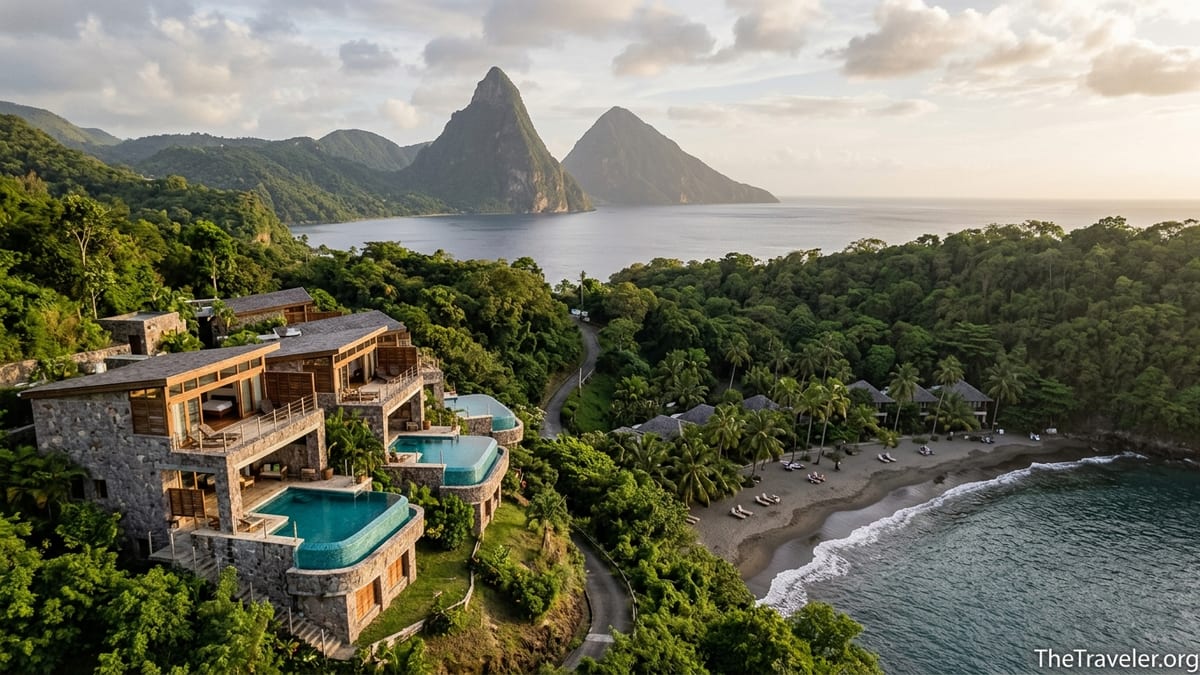
Setting the Scene: Sister Resorts on the Same Estate
Both Anse Chastanet and Jade Mountain sit just north of Soufrière on St. Lucia’s wild and mountainous western coast. They share a 600-acre private estate with two coves, Anse Chastanet Beach and Anse Mamin, backed by dense tropical forest. Guests at Jade Mountain use the same beaches and many of the same activity providers, including the on-site dive center and water sports, as guests at Anse Chastanet.
Despite this shared footprint, the way you experience the estate can feel dramatically different. At Anse Chastanet you might stroll from a shaded beachfront room across the sand to breakfast, with snorkel gear already in hand. At Jade Mountain, your day often starts in an open-walled sanctuary high above the sea, where an infinity pool blends into the view of the Pitons and room service breakfast arrives via your personal butler.
Logistics are also worth understanding before you commit. Reaching the estate from Hewanorra International Airport usually takes about 60 to 75 minutes by car along winding mountain roads. The final approach, the steep Anse Chastanet road, is notoriously bumpy and narrow. Many guests opt for a private transfer or even a helicopter plus car combination to lower the stress level on arrival, particularly when they are paying Jade Mountain prices and want to start their trip on a calmer note.
The shared setting creates a useful option: some travelers split their stay between the two resorts. For example, a couple might begin with four nights at Anse Chastanet for a more social, beach-focused experience, then end with three nights at Jade Mountain for a once-in-a-lifetime splurge in an infinity pool sanctuary.
Room Design: Rustic Charm vs Open-Walled Sanctuaries
The most striking difference between the two resorts lies in the room design. Anse Chastanet has 49 individually designed rooms, some at beach level and others terraced into the hillside. Many are open-air or semi-open, with wood louvered walls and high ceilings rather than sealed, air-conditioned boxes. The style is rustic and romantic: polished concrete or tile floors, locally crafted wooden furniture, colorful textiles, and hand-carved screens, often with views framed by lush greenery or the Pitons.
Because each Anse Chastanet room is different, your experience can vary. A Beachside Deluxe might put you steps from the sand with more shade, while a hillside Premium room could have a dramatic Piton panorama but more stairs to reach it. Some hillside units have three walls and an open fourth side, similar in concept to Jade Mountain but on a smaller scale and at a lower price point. Travelers who prefer uniform, modern hotel rooms may find the eclectic, somewhat weather-exposed design charming or frustrating depending on expectations.
Jade Mountain’s 29 “sanctuaries” and suites are a different universe. Designed as vast, open-walled living spaces, they typically have three solid walls and no fourth wall, so the entire front of the room is open to the view. Most sanctuaries include large private infinity pools that start essentially at the edge of the bed and project toward the Pitons and sea. Surfaces are finished with custom mosaics, exotic hardwoods, and locally quarried stone, creating a dramatic, almost sculptural feel rather than traditional hotel decor.
Room categories at Jade Mountain range from the entry-level Sky suites, which have large Jacuzzis but no private pool, up through Star, Moon, and Sun sanctuaries, where pool sizes and elevation increase. A Moon sanctuary, for instance, may have an infinity pool of 600 to 900 square feet, a dedicated dining area, and a bathroom where the tub is positioned to face the Pitons. Travelers sensitive to heat or needing full air conditioning should note that only one sanctuary has a fully enclosed, air-conditioned bedroom. The design prioritizes natural ventilation and immersion in the climate over climate control.
Private Pools, Views, and Privacy
If a private pool with a cinematic view is your top priority, Jade Mountain is the clear winner. At this resort, the infinity pool is the centerpiece of most sanctuaries, not an add-on. In a typical Star or Moon sanctuary, the pool is large enough for real swimming, with fiber-optic lighting at night and edges that visually merge with the sea and sky. You may find that most of your trip revolves around this space: coffee at sunrise on the pool ledge, floating while watching boats pass below at midday, and stargazing from the water after dinner.
Anse Chastanet does offer a handful of rooms with private plunge pools, but they are the exception rather than the rule. In practice many Anse guests use the two main beaches, the public resort pool, or head into the bay for snorkeling instead of spending hours in a private pool. Rooms without pools often compensate with generous balconies or terraces, open walls that bring in the sea breeze, and views of either dense jungle or the Pitons.
Views of the Pitons are one of the reasons both resorts command strong rates. At Jade Mountain, nearly every sanctuary is oriented directly toward Gros Piton and Petit Piton, with an elevated vantage that makes the mountains feel close yet untouchable. Privacy is also carefully engineered: sanctuaries are staggered so that pools and living spaces are mostly shielded from one another. You will occasionally hear muffled voices or faint music from elsewhere, but you generally do not see your neighbors.
At Anse Chastanet, Piton views are more variable. Some hillside rooms and the main Treehouse restaurant have spectacular angles on the twin peaks, while beachside rooms with closer shoreline access sacrifice the icon-of-St-Lucia view for immediate contact with the sand and sea. Privacy depends heavily on room selection. You might have a nearly secluded terrace enveloped by foliage, or you might be closer to footpaths and other rooms, particularly at beach level where guests are naturally more concentrated.
Beach Access, Stairs, and Mobility Concerns
When it comes to beach access, Anse Chastanet has the advantage. Anse Chastanet Beach is right in front of the resort and is one of the island’s best spots for off-the-beach snorkeling, with a marine reserve just offshore. A second, quieter beach, Anse Mamin, is a short boat ride or about a 10 to 15 minute walk along the coastal path. Guests often break up the day by taking breakfast near reception, snorkeling at Anse Chastanet mid-morning, then walking or boating to Anse Mamin for grilled lunches under the palm trees.
Jade Mountain guests use the same two beaches but need to travel down from the mountaintop. In practice, most people take the resort shuttle elevators and vehicles rather than walking. Expect a transfer of roughly 5 to 10 minutes from sanctuary to sand. The journey is scenic, but it does mean you are less likely to wander back and forth multiple times a day, especially in the hottest hours. Many Jade Mountain guests structure their time so mornings and late afternoons are for the beach, with the middle of the day reserved for enjoying the sanctuary pool.
Stairs are a critical consideration at both properties, but especially at Anse Chastanet. There are about 100 steps from beach level to the mid-hillside areas and restaurants, with additional stairs and sloped paths connecting different room tiers. The resort runs shuttles within the property, but some climbing and walking on uneven surfaces is hard to avoid. Travelers with knee issues, heart conditions, or significant mobility limitations should discuss specific room locations and access routes with the hotel before booking.
Jade Mountain has fewer long public stair runs for guests because indoor elevators and shuttles do some of the vertical heavy lifting. However, individual sanctuaries still involve steps and split-level layouts, and the open design with low walls and pool edges may be less comfortable for those with balance or vision challenges. As a real-world example, older couples sometimes opt for Anse Chastanet Beachside Deluxe rooms so they can avoid the longest climbs yet still access the estate’s amenities by shuttle when needed.
Dining, Atmosphere, and Daily Rhythm
Dining at Anse Chastanet has a convivial, resort-style rhythm. The Treehouse restaurant, perched on the hillside, offers breakfast and dinner with open-air seating and views toward the Pitons or the bay. On the beach level you will find casual venues for grilled fish, salads, and Caribbean specialties. Evening menus might feature lionfish ceviche, Creole curries using produce from the resort’s organic farm, and chocolate desserts made with cocoa grown on the estate. A recent addition is a periodic “Tropical Gastronomy” pop-up, highlighting local ingredients with more creative plating and tasting-menu-style courses.
The atmosphere here tends to be relaxed and social. You are likely to chat with other guests at the bar after a day of diving or hiking the nearby Tet Paul Nature Trail. Anse Chastanet regularly hosts guided snorkeling, boat trips to the Pitons, yoga sessions, and cooking demonstrations, all of which encourage guests to mingle. For some, this sense of a small, friendly community is part of the charm; for others seeking maximum seclusion, it may feel busy compared with Jade Mountain.
Jade Mountain’s primary dining space, the Jade Mountain Club, is reserved for Jade guests and sits at the pinnacle of the property with sweeping 270-degree views. Breakfast, lunch, and dinner can be taken here, but many guests choose in-sanctuary dining for at least some meals. With personal butler service, it is entirely realistic to enjoy multi-course dinners delivered to your private terrace while you stay wrapped in a bathrobe by the pool. Menus emphasize modern Caribbean flavors, fresh seafood, and ingredients sourced from the resort’s Emerald Estate farm, similar in philosophy to Anse Chastanet but presented in a more refined, intimate setting.
The mood at Jade Mountain is hushed and exclusive. There is no background soundtrack of pool games or loud bar music, and very few common spaces besides the restaurant and small public pool. Guests here often come to disconnect. A typical day might involve yoga in the morning, a private boat excursion or scuba outing, and then retreating to the sanctuary for private time. If you enjoy a polished, high-touch yet low-key environment, this atmosphere is a major draw.
Honeymoon & Romance: Which Feels More Special?
For a classic, blowout Caribbean honeymoon where budget is secondary, Jade Mountain is commonly ranked among the top choices in the region. The sanctuaries are deliberately designed for couples, with enormous beds, double showers, and bathtubs oriented toward the sunset. The fact that there are no children’s facilities or noisy pool scenes keeps the energy focused on adult relaxation and romance. Many couples choose to have private in-room spa treatments, candlelit dinners on their sanctuary terrace, or even small wedding ceremonies on the terrace or at one of the estate’s viewpoints.
However, Anse Chastanet can be equally romantic in a different way, especially for active couples or those who value being closer to the water. A hillside room with an open wall facing the Pitons can feel wonderfully atmospheric at night, with tree frogs chirping and the sound of waves below. Honeymooners who want to spend long days snorkeling, biking forest trails, or exploring Soufrière often appreciate being able to walk right out to the beach or hop on a boat without building everything around the sanctuary itself.
An important nuance is privacy style. At Jade Mountain, privacy is visual and spatial: you rarely see other guests, and your sanctuary is your cocoon. At Anse Chastanet, privacy is more about finding a quiet corner within a modestly busier environment. For example, a couple might claim a pair of loungers at the far end of Anse Mamin, which often feels semi-deserted outside peak times, then return to a hillside room that is semi-open to jungle sounds. The experience is slightly more “castaway” and less curated but no less romantic for the right pair.
Some couples split their honeymoon between the two. A realistic itinerary could be five nights at Anse Chastanet in a Piton-view hillside room followed by two or three nights in a Jade Mountain Star sanctuary. This allows time to dive, hike, and explore without feeling guilty about “wasting” expensive sanctuary hours, then finish with an ultra-luxury stay where the main plan is simply to stay put and enjoy the view.
Price, Value, and Level of Luxury
While exact numbers fluctuate by season and special offers, the gap between these two properties is significant. Entry-level rooms at Anse Chastanet commonly start around the mid- to high-hundreds of US dollars per night in slower seasons, climbing into the low four figures in peak holiday periods, especially for premium hillside or beachside categories. Package options that include some meals or diving credits can add value for travelers who plan to stay on property and be active.
Jade Mountain, by contrast, sits firmly in the ultra-luxury bracket. Even in shoulder seasons, it is common to see nightly rates that are several times those at Anse Chastanet, especially for sanctuaries with private infinity pools directly facing the Pitons. During peak winter or festive dates, real-world traveler reports describe rates reaching around 2,000 to 4,000 US dollars per night or more for top categories, before taxes and service charges. These numbers place Jade Mountain in the same price conversation as highly regarded luxury resorts elsewhere in the Caribbean.
What you buy with the price difference is not just square footage or a nicer bed. You are paying for the distinctive architecture, near-guaranteed Piton views, extremely high staff-to-guest ratio, and the sense of being in a near-private hideaway rather than a conventional hotel. For guests who value those factors, Jade’s pricing can feel justified. However, travelers who spend most of their time at the beach or off property may feel that much of the premium is wasted.
From a value standpoint, Anse Chastanet offers strong appeal for divers, snorkelers, and active travelers who want access to the same marine environment and broader estate at a lower nightly cost. You still benefit from the shared organic farm, the same coastline, and easy access to excursions like Sulphur Springs or the Piton climbs, just without the architectural drama and intense personalization of Jade Mountain. For many, this trade-off represents a sweet spot: high-end but not stratospherically priced, with enough character to feel special.
The Takeaway
Deciding between Anse Chastanet and Jade Mountain is not about identifying a universal “winner” so much as understanding which experience better matches your priorities. If you dream of a wide, open-walled sanctuary with a private infinity pool overlooking the Pitons, you prefer in-room dining and personal butler service, and your budget stretches comfortably into the ultra-luxury range, Jade Mountain is likely to deliver one of the most memorable stays you will ever have.
If, instead, you imagine waking up close to the beach, chatting with fellow travelers after a dive, exploring forest trails and nearby attractions, and you are comfortable with rustic-chic rooms that may be partially open to the elements, Anse Chastanet represents an excellent balance of character, location, and price. You still get the same dramatic coastline and access to Jade Mountain’s views from shared areas, without committing your entire budget to the room itself.
Mobility and comfort are also key. Anyone with serious concerns about stairs or heat should speak directly with the resort when booking, as both properties involve open-air spaces, elevation changes, and a layout shaped by the natural terrain. Choosing the right room category and location can make the difference between a magical stay and a challenging one, particularly at Anse Chastanet with its extensive stairways and at Jade Mountain with its open-air concept.
For travelers with the time and resources, a split stay may be the ideal solution. Start at Anse Chastanet to enjoy the estate’s beaches and activities in a more casual setting, then move up the hill to Jade Mountain for a final few nights of seclusion in an iconic sanctuary above the sea. Either way, the core ingredients remain the same: St. Lucia’s dramatic Pitons, warm Caribbean water, and an estate designed to keep you close to both.
FAQ
Q1. Are Anse Chastanet and Jade Mountain the same resort?
Anse Chastanet and Jade Mountain share the same 600-acre private estate and ownership, but they operate as distinct resorts with separate room inventories, dining spaces, and price levels. Guests at Jade Mountain generally have access to Anse Chastanet’s facilities and beaches, while Anse Chastanet guests do not normally use Jade Mountain’s sanctuary areas.
Q2. Which resort is better for honeymooners?
For a once-in-a-lifetime splurge focused on privacy and dramatic views, Jade Mountain is usually the stronger honeymoon choice thanks to its open-walled sanctuaries and private infinity pools. Anse Chastanet is also romantic, especially for active couples, but has a more social, beach-resort atmosphere and fewer rooms with private pools.
Q3. Do both resorts have air conditioning in the rooms?
Many rooms at Anse Chastanet rely on natural ventilation, ceiling fans, and open or louvered walls rather than full air conditioning, although some categories may offer partial cooling. At Jade Mountain, most sanctuaries are intentionally open-air, with only one sanctuary offering a fully enclosed, air-conditioned bedroom. Travelers who are very heat-sensitive should confirm specific room details before booking.
Q4. How difficult are the stairs and walking at the property?
Stairs are a significant factor, especially at Anse Chastanet, where around 100 steps connect beach and hillside levels and many rooms sit on steep terrain. The resort offers internal shuttles, but some climbing and uneven paths are hard to avoid. Jade Mountain uses elevators and shuttles for much of the elevation change, yet individual sanctuaries and paths may still involve steps, so guests with mobility issues should discuss needs in advance.
Q5. Can I use the beaches if I stay only at Jade Mountain?
Yes. Jade Mountain guests use Anse Chastanet Beach directly below the estate and the quieter Anse Mamin beach nearby. Most people reach the sand via resort-operated transport that links Jade Mountain to the beachfront, typically in 5 to 10 minutes depending on wait times and exact location.
Q6. How do prices at Anse Chastanet and Jade Mountain compare?
In general, Anse Chastanet’s nightly rates start in the mid- to high-hundreds of US dollars and rise into the low four figures at peak times for top room types. Jade Mountain is substantially more expensive, often several times the price of Anse Chastanet, with real-world traveler reports citing rates from roughly 2,000 to over 4,000 US dollars per night for high-category sanctuaries in busy seasons.
Q7. Which resort has better beach access?
Anse Chastanet offers more convenient beach access because some rooms sit near sea level and the main common areas are close to Anse Chastanet Beach. From Jade Mountain, you must travel down the hill via resort transport to reach the same beaches, so spontaneous quick dips are less common and beach time tends to be planned in longer blocks.
Q8. Is food included at either resort?
Neither resort is a typical all-inclusive in the mass-market sense, but both offer meal plans or packages that can bundle breakfast or additional meals into the rate. Exact inclusions vary by season and promotion, so it is wise to compare offers like breakfast-only versus modified American plan when you book, especially if you expect to dine mostly on property.
Q9. Is one resort better for diving and snorkeling?
Both resorts share the same dive center and marine environment, with excellent snorkeling from Anse Chastanet Beach and boat dives to nearby sites. The practical difference is that Anse Chastanet guests are physically closer to the dive shop and boats, which makes early-morning departures and quick snorkel sessions slightly easier than for Jade Mountain guests coming down from the hillside.
Q10. Can I split my stay between Anse Chastanet and Jade Mountain?
Yes, many travelers choose a split stay, for example starting with several nights at Anse Chastanet for a more active, beach-oriented experience, then moving up to Jade Mountain for a shorter ultra-luxury finale. The resorts are on the same estate, so transfers between them are straightforward and can be arranged through the hotel.