


Antalya Airport is the main gateway to Turkey’s Mediterranean coast, handling tens of millions of passengers every year. Yet many visitors only discover on arrival that there are two large international terminals plus a separate domestic terminal, and that choosing the wrong one can mean a stressful dash with heavy bags in the heat. This guide explains, in practical terms, how Antalya’s Terminal 1 and Terminal 2 work, which airlines use which building, how international and domestic flights are separated, and what to do if you end up in the wrong place.
Get the latest updates straight to your inbox!
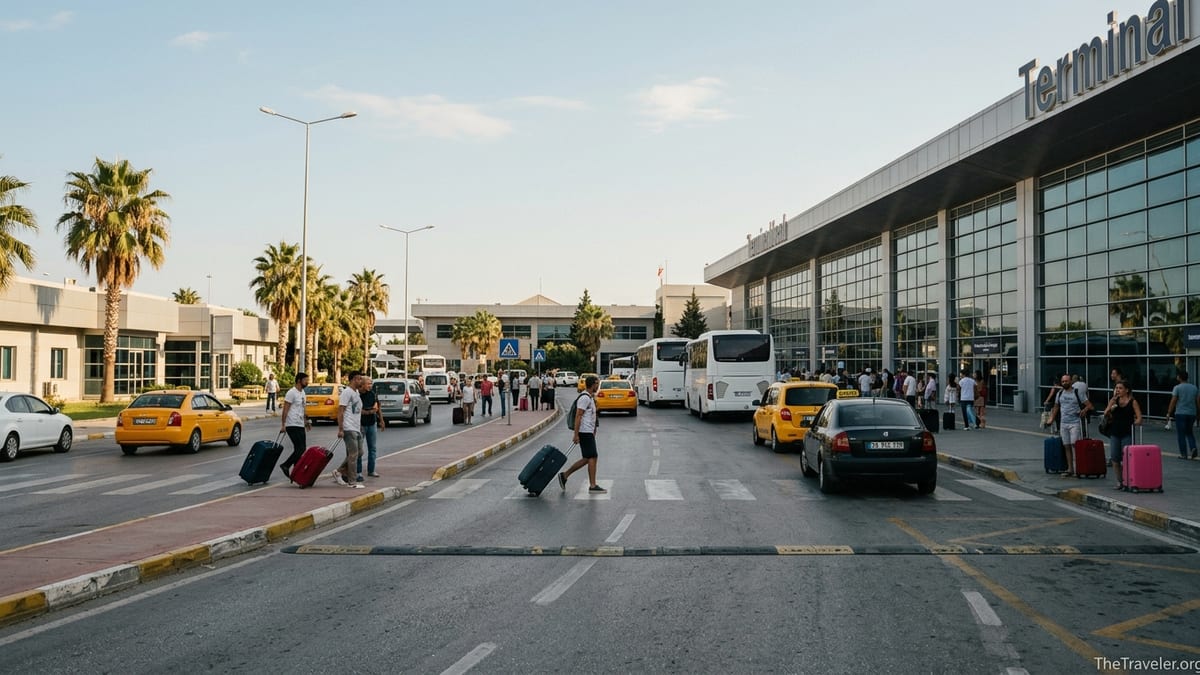
Understanding Antalya Airport’s Three-Terminal Layout
Antalya Airport is organized into three main passenger terminals: Terminal 1 and Terminal 2 for international flights, and a separate Domestic Terminal that handles flights within Turkey. The domestic building is sometimes labeled Terminal 3 on operational documents, but on signage for passengers you will usually just see "Domestic" or "İç Hatlar". All three terminals are located within the same airport complex east of central Antalya, but they are far enough apart that you cannot simply walk between them with luggage in a few minutes.
In practice, international leisure travelers from Europe, the United Kingdom and Russia are split between Terminal 1 and Terminal 2 based on airline and season. Domestic flights to Istanbul, Ankara, Izmir and other Turkish cities use the Domestic Terminal. When booking, your confirmation from the airline or travel company should indicate the terminal, for example “Antalya AYT, Terminal 1” or “Antalya AYT, Terminal 2.” If it does not, you can usually check the airline’s allocation on Antalya Airport’s official terminal list or via your tour operator’s documents shortly before travel.
The terminals are not identical twins. Terminal 1 is the older of the two main international terminals and is physically closer to the Domestic Terminal and the tram and city bus stops. Terminal 2 is newer and caters heavily to large charter and package operations, especially in peak summer. Both have their own check-in halls, security lanes, passport control, departure gates, baggage reclaim belts and landside arrival areas, so once you are in the correct terminal you rarely need to cross over to another building.
For a concrete example, a family flying from Manchester to Antalya on a TUI holiday flight in August may use Terminal 1, while a couple flying from London Gatwick on British Airways’ Euroflyer operation could be assigned to Terminal 2. On the ground, each group will use completely separate entrances, check-in desks and baggage belts, even though they are landing at the same airport on the same day.
International vs Domestic: Which Terminal Handles Which Flights?
The simplest rule is that any flight that starts or ends outside Turkey will use either Terminal 1 or Terminal 2. Flights that start and end within Turkey use the Domestic Terminal. This means that a flight from Antalya to Istanbul Airport or Istanbul Sabiha Gökçen Airport is domestic even if you are connecting onward to London or New York. You will check in and depart from the Domestic Terminal in Antalya, then connect to an international terminal at your next stop.
In day-to-day operations, Turkish Airlines, Pegasus Airlines and SunExpress use the Domestic Terminal for their Antalya–Istanbul and Antalya–Ankara routes, while the same airlines may use Terminal 1 or Terminal 2 for international routes. For instance, a morning Pegasus flight from Antalya to Istanbul Sabiha Gökçen departs from the Domestic Terminal, but a Pegasus flight from Antalya to Berlin typically uses one of the international terminals. The same applies for SunExpress flights to German cities like Düsseldorf or Frankfurt, which are treated as international and therefore handled in Terminal 1 or Terminal 2 according to the airline allocation chart for that season.
Antalya’s domestic operation is substantial because the city is a major hub for Turks traveling to and from the coast. On a random Saturday in July, you might see multiple Turkish Airlines flights to both Istanbul airports, plus frequent services by Pegasus and SunExpress to Izmir, Ankara, Adana and Trabzon. All of those flights will use domestic check-in desks and domestic security controls, and arriving passengers from those flights will exit into the domestic arrivals hall, separate from international arrivals in Terminals 1 and 2.
One key point of confusion is that some travel itineraries mix domestic and international legs onto one ticket. For example, a traveler from New York might fly to Istanbul and then continue to Antalya on Turkish Airlines. The final leg from Istanbul to Antalya is domestic even though the overall trip is international, so the Antalya flight arrives at the Domestic Terminal. That means if a friend is picking you up in Antalya, they must wait at the Domestic arrivals, not at Terminal 1 or 2.
Airline Differences: Who Uses Terminal 1 and Who Uses Terminal 2?
Unlike some airports that dedicate one terminal to low-cost carriers and another to full-service airlines, Antalya divides airlines between Terminal 1 and Terminal 2 largely based on operational planning and seasonal capacity. Both terminals host a mixture of flag carriers, leisure airlines and low-cost operators. The airport publishes a seasonal airline allocation document that lists each carrier and its assigned terminal, and this is updated periodically as schedules change.
As of the most recent allocations, many European charter and leisure airlines are concentrated in Terminal 1, including operators such as TUI, SunExpress and several Smartwings and TUI brands serving Central and Eastern Europe. Airlines like Pegasus, Ryanair’s Polish operation and a broad range of seasonal charters from Germany, Poland, the Netherlands and the Nordic countries also use Terminal 1 for a large share of their Antalya flights. On a busy Saturday in August, Terminal 1 can feel like a hub for package holidays, with aircraft from across Europe parked on adjacent stands as coach groups arrive in waves.
Terminal 2, by contrast, is heavily used by airlines serving Russia, the Caucasus, Central Asia and parts of Western Europe, alongside some major European carriers. For example, carriers such as Aeroflot, Air Astana, easyJet, Austrian Airlines and a number of Russian and Kazakh leisure airlines are assigned to Terminal 2 in recent seasons. During peak summer, Terminal 2 handles an intense schedule of flights from Moscow, St Petersburg, various cities in Kazakhstan and Western European capitals, often with large tour groups heading directly to resorts in Lara, Belek and Side.
These allocations can vary by year and season, and some airlines may operate from both terminals depending on the flight or code-share agreements. This is why checking your booking a few days before departure is essential. For instance, a British traveler might find their easyJet flight from London Gatwick uses Terminal 2 in May but is reassigned to Terminal 1 the following summer based on available capacity. When in doubt, confirm with your airline or tour operator in the week before you fly rather than relying on older trip reports.
Check-in, Departures and Security: What to Expect in Each Terminal
From a passenger’s point of view, the check-in and departure process at Terminal 1 and Terminal 2 is broadly similar. Both offer large check-in halls with numbered desks, overhead screens indicating flights and airline logos, and separate sections for economy, premium and business class when applicable. In high season, charter flight check-in tends to open about three hours before departure, while scheduled airlines may open their desks a bit earlier. If you are flying a popular Saturday morning charter to Germany or the UK in July or August, arriving at least three hours before departure is sensible, as queues can stretch across the hall.
Security screening and passport control are also comparable in both terminals. You first pass through hand baggage screening, then proceed to exit passport control for international flights. Families with children, elderly passengers and those with reduced mobility can typically use dedicated priority lanes where available, but availability and staffing may vary with demand. Once airside, both terminals provide duty-free shops, cafes, fast-food options and seating areas. Prices for food and drink airside are noticeably higher than in central Antalya; for example, a simple coffee and sandwich might cost the equivalent of 8 to 12 euros in a branded cafe inside either terminal, compared to significantly less in the city.
The Domestic Terminal offers a slightly simpler version of the same process, with check-in desks, security screening and domestic-only departure gates. Since domestic flights do not involve exit passport control, the flow of passengers is usually a bit faster. However, in peak holiday periods the domestic hall can still be crowded, especially around popular departure banks to Istanbul and Ankara. On a Friday evening in August, you might find locals heading home, resort staff traveling on days off, and tourists connecting through Istanbul, all sharing the same security queue, so building in an extra buffer of 30 to 45 minutes is wise.
A real-world example illustrates how operations differ. Imagine you are flying from Antalya to Vienna on Austrian Airlines. You will check in at Terminal 2, pass through international security and passport control, and depart from a gate in that building. A friend flying from Antalya to Izmir on SunExpress the same afternoon will go to the Domestic Terminal, pass through domestic security only, and board at a domestic gate. Even though their flights may depart within minutes of each other, their airport experiences happen in entirely separate buildings with no overlap.
Arrivals, Baggage Claim and Meeting Points
On arrival in Antalya, your experience depends on which terminal you land at. After disembarking, international passengers in Terminal 1 and Terminal 2 proceed through arrival passport control, then down to baggage reclaim. Each terminal has its own set of baggage belts, clearly marked with flight numbers that are also shown on overhead screens. Once you collect your luggage, you pass customs and enter a public arrivals hall, which contains currency exchange booths, car rental desks, transfer counters and exit doors to the forecourt where coaches, taxis and private transfers wait.
Because each terminal is separate, meeting your driver or friends at the correct arrivals area is crucial. Tour operators usually assign a numbered stand or meeting point inside or just outside the terminal. For instance, a large European package operator might instruct passengers arriving at Terminal 2 to look for “Stand 34” in the arrivals hall, where uniformed staff direct them to parked coaches for hotels in Belek and Side. Smaller transfer companies often wait with name boards in the public area just beyond the sliding doors from customs. If you are unsure which door to use, telling your driver “Terminal 1, international arrivals” or “Terminal 2, international arrivals” is more useful than simply saying “Antalya Airport.”
Domestic arrivals are handled in a separate hall at the Domestic Terminal. After disembarking from your domestic flight, you walk straight to baggage claim without passing through passport control, collect your bags and exit into a more compact arrivals area. This hall has its own taxi rank and pickup area, and many locals simply arrange to meet relatives directly outside a specific door. If you are connecting from an international flight to a domestic flight on separate tickets, you might find yourself arriving at Terminal 1 or 2 and then needing to reach the Domestic Terminal for your onward journey, which will involve a short transfer rather than a simple walk.
In practice, this separation occasionally causes confusion when groups split onto different flights. For example, one couple might land from Berlin with easyJet in Terminal 2, while their friends arrive from Hamburg with SunExpress in Terminal 1 an hour later. If they casually agree to “meet in the arrivals hall” without specifying the terminal, they may wait in different buildings. To avoid this, always confirm the exact terminal shown on each person’s boarding pass and agree in advance whether you will meet at a specific cafe, taxi area or hotel transfer desk.
Transfers Between Terminals: Shuttles, Tram and Taxis
If you accidentally go to the wrong terminal, or need to move between an international terminal and the Domestic Terminal, there are several practical options. The airport grounds are large, and while some sections of road have sidewalks, walking between terminals with luggage is not recommended, especially in hot summer weather. Instead, passengers typically use the airport’s shuttle options, city tram or short taxi rides.
Antalya’s modern tram line connects the airport area with the city center and the main intercity bus station. The tram stops are located near the Domestic Terminal and close to Terminal 1, which makes these two buildings slightly better connected to public transport. From the tram stop, airport roads and signage direct you toward the relevant terminal. If you arrive at Terminal 2 but later realize your domestic connection leaves from the Domestic Terminal, the most straightforward solution for most travelers is to take a taxi. The distance between Terminal 2 and the Domestic Terminal is short, and under normal traffic conditions the ride is usually less than ten minutes.
Local taxis queue outside the arrivals areas of all three terminals. For a quick transfer between terminals, you are effectively taking a very short airport ride, so fares are generally modest in local currency, though there is a minimum charge. As a rough example, a taxi within the airport grounds may cost the equivalent of 5 to 10 euros depending on time of day and any waiting time. Always make sure the meter is running before you set off. Some passengers traveling in groups opt to pre-arrange a private minivan transfer that can meet them at the correct terminal, especially if they are carrying large sports equipment or traveling with small children.
In addition to taxis and the tram, city buses and dedicated coach services stop at terminal forecourts and provide connections to central Antalya and resort areas. These services are particularly important for package tourists, as many tour operators coordinate coaches to match peak arrival and departure times at specific terminals. If you realize you are at the wrong terminal but your tour operator’s coach leaves from another one, tell the representative as soon as possible. In many cases, they can direct you to a shuttle or arrange for the coach to pick you up outside the terminal where you are waiting, avoiding unnecessary back-and-forth across the airport grounds.
Common Confusion Scenarios and How to Avoid Them
Despite clear signage, Antalya’s multi-terminal layout frequently catches visitors off guard, especially those arriving late at night or on tight connections. One common issue is passengers turning up at the wrong terminal for departure. For example, a traveler with a SunExpress ticket to Düsseldorf might assume that because they arrived at Terminal 2, their return flight leaves from the same building. If the airline’s allocation changed in the meantime or different flights use different terminals, they may discover too late that check-in is actually in Terminal 1. To avoid this, always check the terminal on your booking or on the airport’s daily departure screens on the morning of travel.
Another frequent confusion involves mixed domestic and international journeys. A visitor who flew in directly from London to Terminal 1 might not realize that a later flight from Antalya to Istanbul departs from the Domestic Terminal. If they head back to Terminal 1 by habit, they could lose half an hour walking around and asking agents before discovering they are in the wrong building. The simple rule is to check whether your final destination airport is in Turkey. If it is, you almost certainly need the Domestic Terminal for departure, even if your ticket is part of an international itinerary.
Transfers between friends or family arriving on separate flights also cause mix-ups. It is not uncommon for one group to arrive on an early-morning charter into Terminal 1, settle into a cafe there, and tell the second group to “find us at arrivals” without specifying. The second group may then emerge from Terminal 2, assume they are in the right place, and wait in a different building. In practical terms, the best way to avoid this is to exchange not just the airline and flight number but the terminal name ahead of time, and to use messaging apps with location sharing so you can verify which building someone is standing in.
Finally, many travelers are surprised by how quickly queues can build during peak holiday periods. Check-in and security in both Terminal 1 and 2 can be smooth in low season, but on Saturdays in July and August, hundreds of coaches can arrive within a short time frame. A realistic real-world scenario is a family arriving only two hours before a noon departure to Manchester, then spending nearly an hour in check-in queues followed by another 30 minutes in security and passport control. This leaves little time for food or shopping and creates unnecessary stress. Building in an extra hour in peak months and double-checking your terminal before you set out from your hotel are simple steps that dramatically reduce the risk of a missed flight.
The Takeaway
Antalya Airport’s Terminal 1 and Terminal 2 exist side by side to handle the enormous volume of international traffic heading to Turkey’s southern coast, while a separate Domestic Terminal looks after the busy network of internal flights. For visitors, the key to a smooth experience is not memorizing every airline allocation, but understanding the basic structure and double-checking which building you need before you travel.
In practical terms, this means confirming the terminal on your booking a day or two before departure, paying attention to whether your flight is domestic or international, and agreeing specific meeting points with friends, family or transfer companies based on terminal names rather than just “Antalya Airport.” If you do end up in the wrong place, taxis and shuttles can usually move you between terminals quickly, but allowing generous time during high season is essential.
By approaching Antalya Airport with this awareness, you transform what could be a confusing multi-terminal maze into a straightforward gateway to the beaches of Lara, Belek, Side and beyond. Whether you are landing in the pre-dawn hours on a charter from Berlin or catching an evening domestic hop to Istanbul, knowing the difference between Terminal 1, Terminal 2 and the Domestic Terminal will help you start and end your trip in Antalya as calmly as possible.
FAQ
Q1. How do I know if I need Terminal 1 or Terminal 2 in Antalya?
Your booking confirmation or airline app should show the terminal a few days before departure. If it does not, check the airport’s live departure boards by flight number on the day of travel, or contact your airline or tour operator for the latest allocation.
Q2. Are both Terminal 1 and Terminal 2 international terminals?
Yes. Terminal 1 and Terminal 2 both handle international flights. Domestic flights within Turkey use the separate Domestic Terminal, which is signed as "Domestic" or "İç Hatlar" rather than a numbered terminal for passengers.
Q3. My ticket just says "Antalya (AYT)" with no terminal. What should I do?
This usually means the terminal had not yet been assigned when the ticket was issued. In the week before your trip, re-check your airline’s app, your tour operator’s documents or the airport’s live flight information using your flight number to see which terminal is specified.
Q4. Can I walk between Terminal 1, Terminal 2 and the Domestic Terminal?
Although the terminals are on the same airport site, they are separated by internal roads and distances that make walking with luggage uncomfortable, especially in summer heat. Most travelers use short taxi rides, shuttle services or, for Terminal 1 and the Domestic Terminal, the nearby tram stop.
Q5. I am flying into Antalya from abroad and then connecting to Istanbul on a separate ticket. Which terminals will I use?
You will arrive at either Terminal 1 or Terminal 2, depending on your international airline. After collecting your bags and exiting arrivals, you will need to transfer to the Domestic Terminal for your onward flight to Istanbul, because that leg is domestic within Turkey.
Q6. Do the same airlines always use the same terminal in Antalya?
Not always. Antalya Airport publishes seasonal airline allocations, and airlines can move between Terminal 1 and Terminal 2 depending on schedules and capacity. For instance, an airline might operate from Terminal 1 one summer and from Terminal 2 the next, or even use different terminals for different routes.
Q7. Where should my driver or hotel transfer meet me?
They should meet you at the arrivals area of the terminal where your flight lands. Make sure they know your flight number and terminal name, for example “Terminal 1 international arrivals” or “Domestic arrivals,” and confirm a clear meeting point such as a particular exit door or transfer desk.
Q8. Is one terminal better than the other in terms of shops and restaurants?
Both Terminal 1 and Terminal 2 offer similar duty-free shops, cafes and fast-food options, with prices generally higher than in central Antalya. The differences are more about layout and crowd levels than about specific brands, so for most travelers the assigned terminal matters more than any minor variation in facilities.
Q9. How early should I arrive at Antalya Airport before my flight?
For international flights in peak summer, arriving at least three hours before departure is sensible due to potentially long lines at check-in, security and passport control. For domestic flights, two hours is usually adequate, but adding extra time during school holidays or weekends provides a useful buffer.
Q10. What happens if I show up at the wrong terminal?
Do not panic. Ask an information desk or airport staff member to confirm where your airline is checking in, then take a taxi or shuttle to the correct terminal. As long as you still have ample time before check-in closes, you can usually recover from the mistake with only a short delay.