


More news on this day
Asia’s tightly interlinked aviation network faced a sharp jolt as 1,578 flight delays and 106 cancellations rippled across 22 major hubs in a single operational cycle, disrupting travel plans for tens of thousands of passengers and underscoring how fragile regional connectivity remains amid volatile weather, crowded skies and ongoing infrastructure strains.
Get the latest news straight to your inbox!
Wide Disruptions Across a High-Growth Aviation Region
Publicly available disruption-monitoring data and regional media coverage indicate that the latest wave of irregular operations swept through a mix of mega-hubs and fast-growing secondary airports, from Southeast Asia’s tourism gateways to major business centers in East and South Asia. The 1,578 delayed departures and arrivals, coupled with 106 flight cancellations, concentrated around peak morning and evening banks when network carriers rely on tight connections to maintain schedule integrity.
The impact is particularly notable because Asia remains one of the fastest-expanding air travel markets, with recent airport connectivity rankings highlighting strong growth at leading hubs serving large metropolitan areas. Forecasts cited by airport industry groups project that Asia-Pacific and Middle East passenger volumes could reach into the tens of billions over the coming decades, magnifying the consequences whenever multiple hubs encounter simultaneous operational shocks.
In this latest episode, the 22 affected hubs formed a cross-border chain of disruption, where knock-on effects at one airport quickly propagated to others through shared fleets and crew rosters. Network-oriented airlines with dense intra-Asian schedules experienced the brunt of the turmoil, although point-to-point low-cost carriers also reported scattered cancellations where aircraft and crews fell out of position.
Operational data suggest that while the majority of flights still departed, the cumulative delays eroded connection buffers across several banks, forcing airlines to reprotect misconnecting passengers on later services and driving congestion at customer service counters and transfer desks.
Weather, Volcanic Ash and Airspace Constraints Combine
Reports from aviation news outlets and national transport agencies attribute a significant share of the disruption to a convergence of meteorological and environmental factors. Seasonal storms over parts of South and Southeast Asia prompted temporary ground stops at several hubs, while low cloud ceilings and heavy rainfall reduced arrival rates and forced holding patterns around major metropolitan airports.
In certain locations, volcanic activity and widespread haze played an outsize role. Recent coverage of ash clouds affecting air corridors in Indonesia and surrounding countries has described substantial cuts to capacity as airports briefly suspended operations or tightened operating minima. These conditions, combined with monsoon-related thunderstorms, reduced visibility and created turbulence along heavily used approach and departure routes, driving conservative spacing between aircraft and slower overall flow.
Overlaying the weather challenges, airspace restrictions linked to regional geopolitical tensions have narrowed routing options for long-haul flights transiting between Asia, the Middle East and Europe. Published analyses show that rerouted traffic often has to skirt closed or constrained air corridors, lengthening flight times, increasing fuel burn and compressing turnaround times at destination hubs. Even relatively modest en route delays can cascade across an airline’s daily rotations when schedule padding is already thin.
Experts cited in industry analyses note that while any one of these factors might be manageable on its own, the combination of storms, ash, haze and constrained airspace creates a complex operational environment in which even minor glitches in ground handling or air traffic management can tip airports into significant delay territory.
Strain on Airlines, Airports and Ground Infrastructure
The ripple effects from the 1,578 delays and 106 cancellations exposed continuing vulnerabilities in both airline operations and airport ground infrastructure. Carriers operating tightly utilized fleets faced difficult trade-offs between preserving long-haul segments and protecting regional connectivity, with some reportedly choosing to cancel shorter intra-Asian legs to keep widebody aircraft on schedule for intercontinental services.
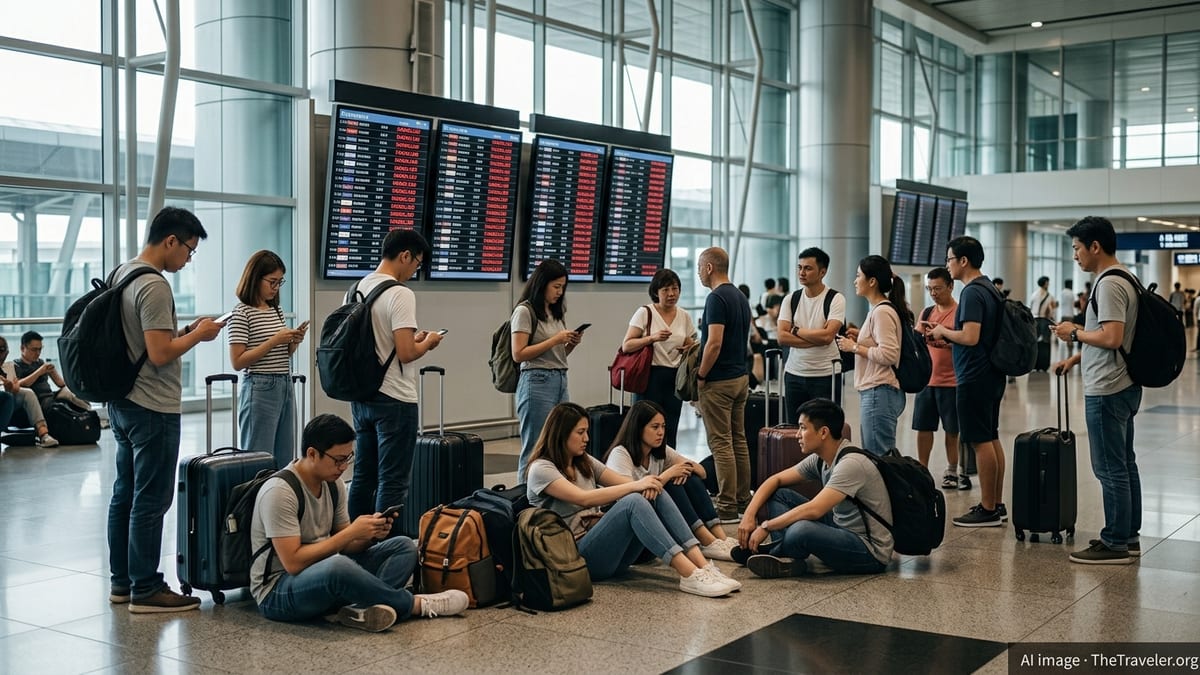
Ground handling and terminal operations also came under pressure. When multiple delayed arrivals converged within a compressed time window, airports reported crowded immigration halls and baggage claim areas, along with longer waits for aircraft stands and ground support equipment. At several hubs, images shared by travelers on social media showed long queues at check-in, security and transfer desks as passengers sought rebooking options or compensation under local regulations.
Publicly available guidance from civil aviation regulators across the region has, in recent years, encouraged airlines and airports to improve contingency planning for wide-scale disruptions, including better communication channels and minimum standards for care such as refreshments and accommodation. However, the scale of the latest event indicates that implementation remains uneven, particularly at secondary hubs where staffing and physical infrastructure have not always kept pace with traffic growth.
Industry observers point out that ground systems are still adapting to a more volatile operating environment characterized by frequent weather extremes, episodic airspace closures and lingering supply chain issues that can delay aircraft maintenance and parts deliveries. This combination can leave airlines with little spare capacity to recover quickly when irregular operations strike.
Passenger Experience: Longer Journeys and Frayed Connections
For passengers caught in the disruption, the most immediate effect was uncertainty. Travelers reported extended tarmac waits, rolling departure time changes and last-minute gate swaps as airline operations centers sought to rebalance aircraft and crew. Missed connections at major hubs forced many to accept overnight stays or multi-stop routings that turned what should have been straightforward journeys into day-long odysseys.
Social media posts and customer forums reflected frustration over inconsistent communication across carriers. Some travelers described timely mobile notifications and proactive rebooking, while others highlighted difficulties reaching call centers or obtaining clear information at crowded service desks. These accounts align with broader consumer feedback across the industry, which has increasingly focused on transparency and real-time updates during major disruption events.
The uneven experience also underscores a widening gap between well-resourced global carriers and smaller operators. Larger airlines with robust digital platforms and established disruption protocols appear better positioned to push out alerts, offer self-service rebooking and coordinate with airport partners. In contrast, leaner carriers with fewer staff and more basic IT systems can struggle to manage a surge of requests when several flights are delayed or canceled simultaneously.
Travel advisers observing the situation suggest that passengers flying through Asia’s busiest hubs build in longer connection times during storm and haze seasons, particularly when itineraries involve separate tickets or low-cost carriers that may not coordinate misconnection protection with full-service airlines.
Calls for Resilience in Asia’s Expanding Air Network
The latest disruption episode is prompting renewed discussion around resilience in Asia’s air transport system. Industry publications and think-tank reports increasingly argue that the region’s rapid traffic growth needs to be matched by commensurate investment in air traffic management modernization, weather forecasting integration and cross-border contingency planning.
Several policy analyses have urged closer coordination between aviation authorities, meteorological agencies and airport operators to improve early warning mechanisms for severe weather, volcanic ash and cross-border haze. Enhanced data sharing and common playbooks for capacity reductions could help airports and airlines manage throughput more predictably, reducing the risk of sudden gridlock when conditions deteriorate.
On the airline side, network planners are reassessing the balance between aircraft utilization and operational robustness. Some carriers are considering modestly lower daily utilization targets, additional standby crews or strategic spare aircraft to provide greater buffer during peak disruption seasons. While such measures entail higher costs, advocates argue that they may be outweighed by reduced compensation payouts, lower reputational risk and a more reliable product for passengers.
With Asia’s hubs jockeying for position in global connectivity rankings, the ability to recover quickly from shocks such as the one that produced 1,578 delays and 106 cancellations across 22 major hubs is likely to become an increasingly important competitive differentiator for both airports and airlines across the region.