


More news on this day
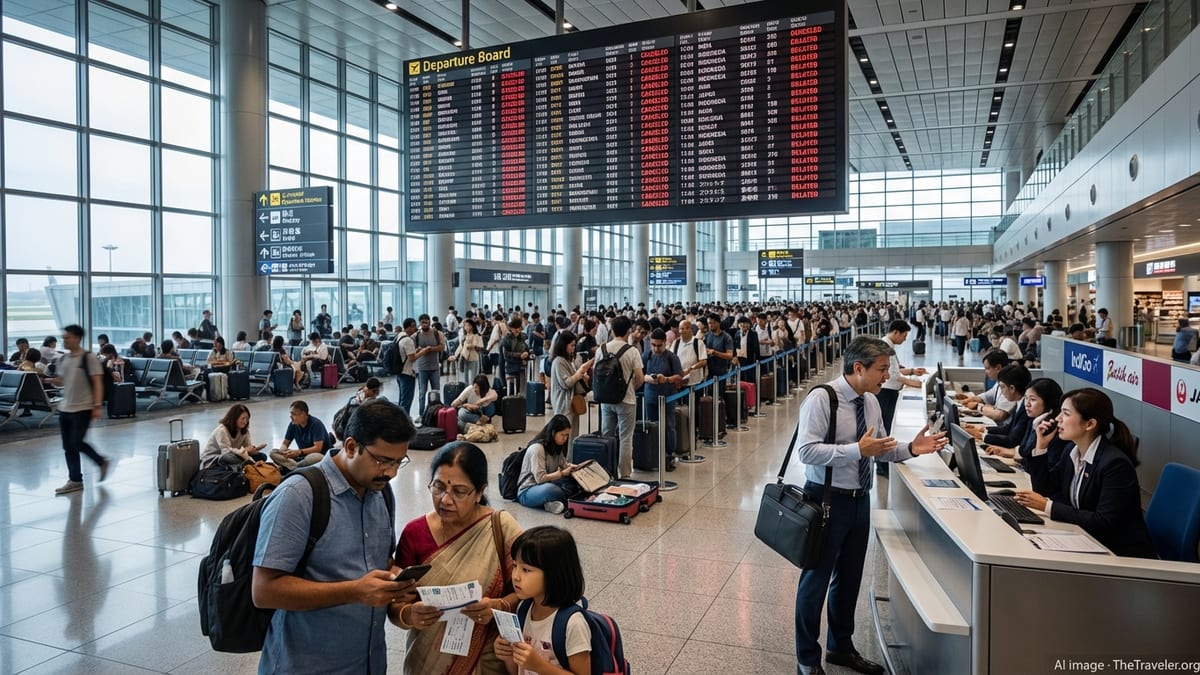
Hundreds of passengers across Asia and the Gulf were left stranded on April 12, 2026, as 445 flights were cancelled and 3,839 delayed across routes linking China, Japan, Singapore, Thailand, Saudi Arabia and other countries, disrupting operations at key hubs from Jakarta and Beijing to Tokyo, Jeddah and Dubai.
Get the latest news straight to your inbox!
Regional Hubs Buckle Under Mounting Operational Strain
Publicly available data and industry trackers show that the worst of the turmoil on April 12 was concentrated at major regional gateways, including Jakarta Soekarno Hatta, Beijing Capital, Tokyo’s Haneda and Narita airports, as well as Jeddah and Dubai. The scale of disruption sharply exceeded typical daily variances, pointing to network-wide stress rather than isolated incidents.
Reports indicate that carriers such as China Eastern, Batik Air, SpiceJet and ANA Wings were among the most heavily affected, with knock-on impacts for codeshare and interline partners. Flight status records show those airlines logged disproportionately high numbers of late departures and cancellations, rippling across domestic and international connections.
Aviation analysts cited in regional coverage describe a system already operating close to capacity after several years of traffic recovery, with limited slack in aircraft and crew availability. When multiple hubs experience congestion or weather disruptions on the same day, recovery windows narrow and delays cascade quickly across timetables.
Operational databases also point to bunching of departures at peak morning and evening waves, especially at tightly scheduled airports like Tokyo and Singapore. Once those peaks are disrupted, airlines struggle to reassign aircraft and crews without triggering further cancellations later in the day.
From Northeast Asia to the Gulf, Passengers Face Long Delays
According to aggregated flight-movement data referenced in recent regional reports, the 445 cancellations and 3,839 delays on April 12 were spread along a broad corridor from Northeast Asia down through Southeast Asia and onward to the Gulf. China, Japan and Singapore recorded some of the highest numbers, while Saudi Arabia and the United Arab Emirates added further pressure at the western edge of the affected network.
At Indonesia’s main hub in Jakarta, airlines including Batik Air reported significant disruption to both domestic and international services, complicating travel plans for passengers connecting onward to secondary cities. In China, China Eastern and other mainland carriers saw schedules heavily reshaped around Beijing and Shanghai, affecting itineraries linking to Europe, the Middle East and the rest of Asia.
Japan’s network also came under strain, with reports detailing extensive delays and cancellations affecting operations at Haneda and Narita. Regional feeders such as ANA Wings were impacted alongside larger flag carriers, leading to missed connections for travelers bound for Southeast Asia routes and onward long haul services.
In the Gulf, disruption at Jeddah and Dubai compounded the situation for passengers traveling between Asia and the Middle East. Airline schedule adjustments and aircraft rotations there created additional bottlenecks, particularly for travelers using these hubs as transit points between South and East Asia and destinations in Europe or Africa.
Weather, Congestion and Fuel Costs Drive a Perfect Storm
Recent coverage across Asian media suggests that no single trigger was responsible for the April 12 disruption. Instead, a combination of severe weather cells, air traffic congestion and longer-running pressures linked to jet fuel costs and routing constraints contributed to the scale of delays and cancellations.
Thunderstorms and poor visibility around several key airports, including in parts of East and Southeast Asia, led to temporary ground stops and capacity reductions. Once aircraft were forced into holding patterns or diverted to alternates, rotations tightened and later flights departed out of sequence, amplifying delays across multiple carriers.
At the same time, ongoing adjustments to flight paths around sensitive airspace in the Middle East have lengthened some Asia–Gulf routes, increasing fuel burn and narrowing operational buffers. Analysis pieces in regional business media have highlighted how higher fuel prices and longer routings are encouraging airlines to run tighter schedules, leaving less room to absorb unexpected shocks.
These dynamics build on broader demand recovery in Asia, where passenger volumes on many trunk routes have reached or surpassed pre-pandemic levels. Industry commentators note that airport infrastructure and staffing have not always kept pace, making the system more vulnerable when multiple stress factors converge on the same day.
China Eastern, Batik Air, SpiceJet and ANA Wings Under Scrutiny
Performance data compiled in recent days show that China Eastern, Batik Air, SpiceJet and ANA Wings were among the carriers most visibly hit by the April 12 turmoil, particularly at hubs such as Jakarta, Beijing, Tokyo and other high-traffic airports. While many airlines across the region logged delays, these operators featured prominently in disruption tallies.
For China Eastern, the latest wave of cancellations and missed connections adds to a period in which travelers have increasingly highlighted schedule changes and rebookings on social platforms and consumer forums. Publicly accessible flight histories suggest a pattern of tight aircraft utilization that offers limited leeway when a rotation is disrupted.
In Southeast Asia, Batik Air’s dense domestic and regional network made it especially vulnerable to the cascading impact of late departures. A single delayed inbound aircraft can affect multiple subsequent legs, and on April 12 those chain reactions appear to have been widespread.
Indian low-cost carrier SpiceJet also recorded notable disruption, in line with recent anecdotes from travelers reporting lengthy delays on certain routes. Regional feeders such as ANA Wings in Japan faced challenges of their own, with delays on short-haul sectors undermining connections onto mainline services operated by partner carriers.
Passengers Confront Uncertainty as Disruptions Continue Into Mid-April
The April 12 event followed and preceded other days of heavy disruption across Asia in mid-April, including further waves of delays and cancellations reported on April 13 and April 14. Newsrooms and aviation data providers have documented hundreds more flights affected at hubs in India, Thailand, Singapore, the United Arab Emirates and Indonesia, suggesting that pressure on the network has yet to fully abate.
Travel-focused outlets have highlighted recurring bottlenecks at airports such as Bangkok Suvarnabhumi, Singapore Changi, Tokyo’s Haneda and Narita, Dubai International and Jakarta Soekarno Hatta. For passengers, that has translated into longer queues, missed connections and, in some cases, overnight stays while airlines work through backlogs.
Consumer-facing coverage has increasingly emphasized practical steps for travelers, including monitoring flight status in real time, arriving early for departures through affected hubs and preparing contingency plans for tight connections. With further schedule adjustments anticipated as airlines respond to fuel costs, staffing patterns and airspace constraints, uncertainty is likely to remain a feature of regional travel in the short term.
The latest bout of disruption across Asia’s skies underscores how quickly a heavily utilized network can seize up when confronted with simultaneous operational and external shocks. For carriers such as China Eastern, Batik Air, SpiceJet, ANA Wings and others at the center of the April 12 chaos, restoring punctuality and rebuilding traveler confidence will be a key test as the busy summer travel season approaches.