


Travelers wandering through Greece today, from the Acropolis Museum in Athens to the archaeological site of Olympia, encounter two very different visions of war carved in marble and painted on pottery: the cool, armored figure of Athena and the fierce, charging Ares. They are siblings and fellow war deities, yet they stand for opposite ways of understanding conflict. One embodies strategy, justice and civic order, the other the rush of combat and the fury of battle. Understanding how the Greeks saw Athena and Ares is not only a journey into myth, but also a powerful lens for thinking about modern warfare, politics and even how we handle personal conflict on the road.
Get the latest updates straight to your inbox!
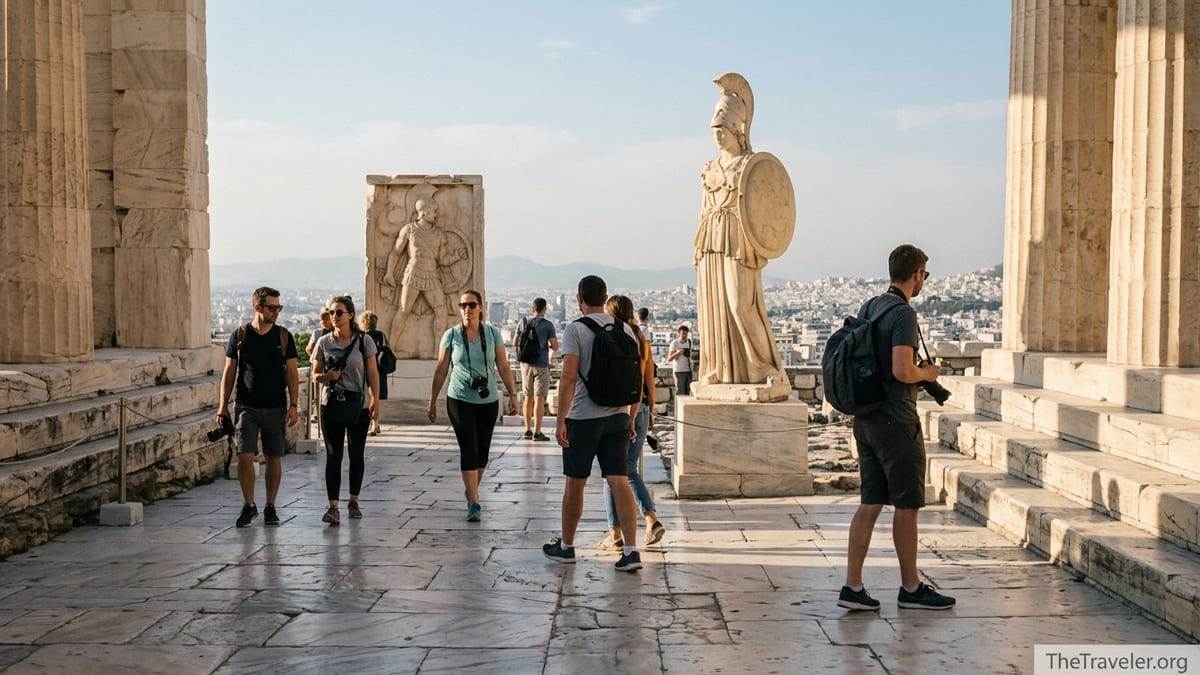
Two Faces of War: Who Are Athena and Ares?
In Greek mythology, both Athena and Ares belong to the core circle of Olympian gods, yet they represent incompatible attitudes toward war. Athena is the goddess of wisdom, strategic warfare and crafts. She protects cities, guides heroes and is closely tied to the life of Athens itself, from law courts to workshops. Ares, by contrast, is the god of brutal combat, bloodlust and the terrifying chaos that erupts once armies clash. Where Athena stands for planning and justification, Ares is the raw impact of violence once decisions have failed.
Travelers see this contrast immediately in Greek art. At the Acropolis Museum in Athens, marble reliefs and painted vases often show Athena calmly armed, spear upright, shield ready, helmet resting on her head but her posture controlled and composed. In contrast, when Ares appears on red-figure vases in the National Archaeological Museum, he is usually mid-stride or mid-charge, shield raised, sometimes surrounded by figures symbolizing panic and terror. The visual language makes the message clear: both are war deities, but their energy and purpose could not be more different.
Ancient writers underline this distinction. Athena is described as favoring “just war” and assisting only those whose cause is defensible, such as Odysseus in the Odyssey, while Ares is frequently portrayed as reckless and easily manipulated, even complaining to Zeus when he is wounded for throwing himself into battle without thinking. This is not a simple good versus evil split, but rather a tension between two necessary but dangerous aspects of conflict: the mind that plans and the violence that executes.
Wisdom vs Aggression: What Each Deity Really Represents
Athena’s wisdom is not abstract philosophy; it is practical intelligence that can design a city’s defenses, advise generals or help a sailor read shifting winds. In myth, she gives heroes tools and strategies rather than brute strength. She helps Perseus by providing a polished shield to see Medusa’s reflection, and she guides Odysseus with careful disguises and staged encounters instead of simple force. Her wisdom is the ability to foresee consequences and shape them.
Ares, by contrast, personifies the rush of adrenaline and the willingness to charge regardless of the cost. He is the god invoked in the heat of the clash, when shields slam and spears splinter. In literary sources he is often associated with rage, slaughter and the confusion of battle lines rather than clear planning or loyalty to a cause. He is not the disciplined phalanx holding a line but the breaking of that line, the moment when fear and fury decide more than orders do.
Modern travelers can see these two forces at work when visiting historic battlefields beyond Greece, such as the Verdun Memorial in France or the World War I museum in Thessaloniki. Exhibits show maps, coded messages and long-term plans that echo Athena’s strategic dimension, alongside shattered helmets, torn uniforms and personal letters that record the terrifying immediacy of Ares-like violence. The Greeks personified those realities as gods, but the underlying human experiences are still recognizable in every modern conflict zone and memorial site.
Athena in the Myths: More Than a “War Goddess”
Calling Athena simply a “war goddess” misses most of what made her central to Greek culture. She is equally the goddess of crafts, technology, law, olive cultivation and civic life. When travelers stand on the Acropolis and look up at the Parthenon, they are not just looking at a war temple but at a monument to a deity who was believed to protect courts, workshops and ships as much as hoplite formations. Inside museums across Greece, from Nafplio to Delphi, inscriptions and statuettes show Athena invoked for safe journeys, successful weaving and fair judgments.
Her association with the olive tree is especially important. On the rocky hill of the Acropolis, a single olive tree stands near the Erechtheion, traditionally linked to the myth in which Athena wins the patronage of Athens by gifting the city an olive tree: a symbol of food, oil, trade and peace. For today’s visitors, seeing that tree against the skyline is a reminder that Athena’s power lies in turning conflict toward stability and prosperity, not in glorifying battle itself.
Even on the battlefield, Athena’s role differs from that of a purely martial deity. In the Iliad she often restrains heroes from reckless charges and encourages coordinated action. Her shield, the aegis, is as much a symbol of protection and terror used to prevent attacks as it is an offensive weapon. In modern terms, she is closer to the idea of a defense minister focused on deterrence, diplomacy and long-term security planning than to a commander who simply wants to fight at any cost.
Ares in the Myths: The Dark Energy of Battle
Ares, however, embodies the part of war that even the Greeks distrusted. Cities like Sparta honored him more than others, but even there he was respected rather than loved. In many myths he is humiliated or outwitted, as when Hephaestus traps him in a net for his affair with Aphrodite or when Athena defeats him directly in combat. These stories suggest that the Greeks saw unrestrained aggression as ultimately self-defeating, even when it is frighteningly powerful in the short term.
At archaeological sites and in museums, Ares appears less frequently than Athena. When he does, his image often highlights armor and weapons more than facial expression or thoughtful pose. The emphasis is on the fact of fighting rather than its purpose. In the Iliad, Ares changes sides, fights for the Trojans, is wounded and retreats, reinforcing his instability. He is the embodiment of war as disaster, something that descends on cities and shatters families.
To understand Ares today, travelers can think of the way modern news footage shows sudden urban bombardments or chaotic front-line fighting. There is motion, dust, shouting and fear, but little sense of coherent aim. Museums in Berlin, Kiev or Sarajevo that document urban warfare often capture this feeling: not planned campaigns on a map, but streets where ordinary life has collapsed into random danger. Ares represents that collapse, the moment when society’s rules give way to raw survival.
Strategy vs Violence: How Athena and Ares Shaped Greek Ideas of War
For the Greeks, war was not a single, simple concept. It involved months of negotiation, careful logistics, seasonal timing and financial burden, as well as sudden clashes and long sieges. Athena and Ares together personified that complexity. Athena represented politics, planning and the hope that a conflict might secure justice or stability; Ares represented the price: blood, terror and the loss of control once weapons are drawn.
In practice, Greek city-states tried to shape their institutions along Athenian rather than Ares-like lines. The democratic assembly in classical Athens met on the Pnyx hill, just a short walk from the Acropolis. Travelers who climb that hill today stand where citizens once debated whether to launch military expeditions, weighing costs and outcomes. Those debates, known from historians such as Thucydides, often emphasize calculation, alliances and resource management: decisions made under Athena’s gaze. Yet once war began, the soldiers on the front line experienced something far closer to Ares, as shield walls broke and panicked retreats began.
Modern military academies often reflect this same duality without using mythic names. At places like the Hellenic Army Academy in Vari or the United States Military Academy at West Point, cadets study strategy, ethics and international law, subjects that resonate strongly with Athena’s domain. But field exercises, weapons training and simulations confront them with the reality of noise, fear and physical risk that Ares represents. Greek mythology simply dramatized this split in divine form.
Beyond the Battlefield: Athena, Ares and Everyday Conflict
The contrast between Athena and Ares is not only about ancient hoplites. It also offers a way of thinking about how people manage conflict in daily life, including while traveling. When a traveler faces a delayed flight, a lost bag or a tense conversation at a land border, an Ares-like reaction might be to shout at the nearest official or demand immediate resolution. An Athenian approach would involve calmly gathering information, understanding procedures, and seeking a solution that avoids escalation.
Consider a practical example from Athens International Airport. When a summer storm disrupts flights, passengers at crowded gates sometimes react with visible frustration. Those who push, yell at ground staff or try to cut queues embody something closer to Ares: instant anger, little thought for consequences. Others check the airline app, organize information in a small notebook, talk politely with staff and coordinate with fellow travelers to share taxis or accommodation near the airport. This is Athena in action: strategic thinking under stress, focused on the best possible outcome.
In a broader sense, modern diplomatic institutions from the United Nations headquarters in New York to the European Union buildings in Brussels can be seen as part of Athena’s legacy. They are spaces designed to settle disputes through negotiation, sanctions and agreements rather than open warfare. Yet the very need for peacekeeping forces and rapid reaction units acknowledges that Ares never completely disappears. The mythic contrast remains a useful metaphor for travelers trying to understand why some regions invest heavily in mediation and others slide quickly into street-level violence.
Visiting Athena and Ares: Where Travelers Meet Their Legends
Travelers interested in Athena and Ares can trace their mythic footprints across the Mediterranean. In Athens, the Parthenon and the small Temple of Athena Nike on the Acropolis both celebrate Athena as a bringer of victory through intelligence and civic strength. The Acropolis Museum displays bronze helmets, shields and statues that present her as a fully armed warrior, yet the surrounding galleries emphasize her patronage of sculpture, pottery and architecture.
A short walk from the Acropolis leads to the ancient Agora, where inscriptions and ruined stoas give a sense of the civic world Athena protected: markets, law courts and meeting places. The Stoa of Attalos, now a museum, shows how trade, politics and daily life intertwined under her watchful eye. Standing there, with the Acropolis visible above, visitors can imagine citizens asking Athena not only for success in battle but also for fair judgment in lawsuits and stability for their families.
Finding Ares is more subtle but still possible. In the National Archaeological Museum of Athens, and in collections in places like Olympia and Corinth, travelers can find depictions of the god in armor among other deities. Some sites, including parts of the Peloponnese historically associated with more martial cultures, preserve dedications and reliefs that emphasize the honor paid to violent courage. Beyond Greece, Roman sites such as the Forum in Rome or military museums in places like Trier in Germany sometimes highlight Mars, the Roman counterpart of Ares, showing how a more civic, disciplined view of war gradually softened his image compared to his Greek origin.
The Takeaway
Athena and Ares are not simply “good” and “bad” war gods. They are two lenses through which the Greeks understood a reality that remains with us: war requires planning and justification, but it is lived as noise, fear and blood. Athena stands for foresight, civic responsibility and the hope that force can sometimes serve justice. Ares reminds us that once violence begins, it rarely behaves according to plan.
For modern travelers exploring Greek sites or reflecting on global conflicts they read about in airport newsstands, the myths offer a cautionary lesson. Societies that honor only Ares risk glorifying destruction and losing sight of what wars are supposed to protect. Societies that honor only Athena may underestimate the destructive energy that bursts loose when diplomacy fails. Understanding both deities helps us read ancient temples and modern headlines with sharper eyes.
Perhaps the most practical message comes when we face conflict in our own journeys, from a heated argument over a rental car deposit on a Greek island to disagreements on a group tour. We always have a choice between an Ares-like reaction of anger and accusation, or an Athenian approach of strategy, empathy and long-term thinking. The myths of Athena and Ares remind us that the paths we choose in small conflicts shape the kind of world, and the kind of travels, we experience.
FAQ
Q1. Is Athena really a war goddess, or mainly a goddess of wisdom?
Athena is both. She is deeply involved in warfare, especially strategy and leadership, but she also governs wisdom, crafts, law and civic life, which makes her far more than a narrow battle deity.
Q2. How is Ares different from Athena in actual combat situations?
In myth, Athena plans campaigns, advises generals and helps heroes think their way through danger, while Ares throws himself into the thick of fighting, embodying fear, fury and the chaos of battle.
Q3. Why did the ancient Greeks generally favor Athena over Ares?
Most Greek city-states valued disciplined, citizen-based warfare and civic stability, so they admired Athena’s strategic and protective qualities more than Ares’s love of bloodshed and disorder.
Q4. Where can travelers best experience Athena’s presence in Greece today?
Key sites include the Acropolis and its museums in Athens, especially the Parthenon and the Temple of Athena Nike, as well as the ancient Agora that reflects the civic world she protected.
Q5. Are there specific places where Ares was especially honored?
Ares received worship in several regions, with stronger martial traditions such as parts of the Peloponnese, and his later Roman counterpart Mars became central in many Roman military centers.
Q6. How do Athena and Ares appear in the stories of the Trojan War?
Athena supports the Greeks with advice, planning and direct intervention in duels, while Ares often fights on the Trojan side, is impulsive, gets wounded and is scolded by Zeus for his recklessness.
Q7. What symbols help visitors recognize Athena and Ares in art and museums?
Athena is usually shown with helmet, spear, shield and sometimes an owl or olive tree, while Ares appears as a heavily armored warrior, often in motion, emphasizing weapons and aggression.
Q8. Do Athena and Ares have any roles outside of war?
Athena has many: she oversees weaving, crafts, shipbuilding, law and urban planning. Ares is more narrowly linked to combat, courage and the raw energy of violent confrontation.
Q9. How can Athena’s strategic approach be applied in everyday travel problems?
Travelers can imitate Athena by gathering information, anticipating obstacles, negotiating calmly and seeking solutions that protect relationships rather than reacting with instant anger.
Q10. What is the main lesson modern visitors can take from the contrast between Athena and Ares?
The contrast urges us to balance courage with foresight, recognizing that while conflict sometimes cannot be avoided, true strength lies in directing power wisely and limiting needless destruction.