


Auckland Airport is New Zealand’s main international gateway and busiest domestic hub, but its two separate terminals can easily confuse first-time visitors. The domestic and international terminals sit in different buildings about 10 to 15 minutes’ walk apart, and choosing the wrong one can cost you precious time or even a flight. This guide breaks down how the terminals work, which one you need for your airline and route, how to move between them, and what to do if you turn up at the wrong place.
Get the latest updates straight to your inbox!
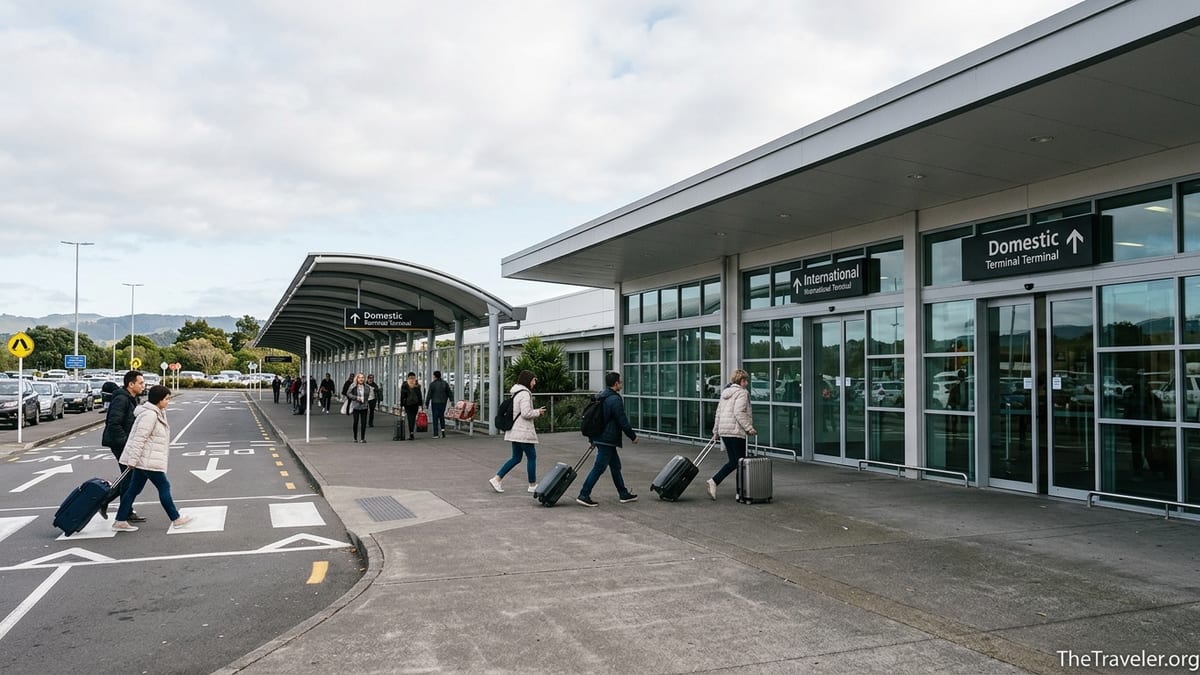
Domestic vs International: Understanding Auckland’s Two Terminals
Auckland Airport has two distinct terminals: the Domestic Terminal, used for most flights within New Zealand, and the International Terminal, used for almost all flights that cross New Zealand’s borders. They are separate buildings linked by a signposted walkway and a free transfer bus, so it is important to know which one you need before you get into a taxi or rideshare.
In practical terms, if you are flying between Auckland and another New Zealand city such as Wellington, Christchurch, Queenstown, Dunedin or Napier, you will usually use the Domestic Terminal. Major routes like Auckland to Wellington with Air New Zealand or Jetstar, and regional services with airlines such as Sounds Air or Barrier Air, all operate from the domestic side. If you are flying from Auckland to Sydney, Melbourne, Singapore, Los Angeles, Nadi or any other overseas destination, you will use the International Terminal, even if the flight is a short hop across the Tasman Sea.
There are a few edge cases that can confuse travellers. Codeshare tickets may show an overseas airline such as Singapore Airlines, Qantas or American Airlines on your booking, but if the actual flight between Auckland and another New Zealand city is operated by Air New Zealand, that segment will still depart from the Domestic Terminal. Always check the departure airport code (AKL) and the terminal information on your e-ticket or airline app, rather than relying only on the marketing airline’s name.
To keep it simple, think about whether your flight is crossing the border. If you are leaving New Zealand or arriving from another country, you will always pass through immigration and biosecurity in the International Terminal. If you are simply flying within New Zealand, you will use the Domestic Terminal and will not go through passport control at Auckland.
Layout, Walking Route and the Free Terminal Transfer Bus
The International Terminal sits closer to the main Airport Transport Hub and long-distance buses, while the Domestic Terminal lies roughly 900 to 1,000 metres away along a clearly signposted path. For most people, the walk between terminals takes about 10 to 15 minutes at a normal pace. The route is marked on the ground and on overhead signs, often referred to as a green line or terminal walkway, and passes car parks and airport service buildings rather than busy roads.
If you prefer not to walk, or you are travelling with heavy bags or young children, Auckland Airport operates a free terminal transfer bus. It runs roughly every 15 minutes from early morning to late evening, with typical operating hours around 5 am to just after 11 pm. You do not pay a fare or present a boarding pass; you simply wait at the clearly marked terminal transfer bus stop outside each terminal and board when the bus arrives. In normal traffic, the ride between terminals takes less than 10 minutes.
For example, a family landing internationally from Vancouver at around 7 am, with a connecting Air New Zealand flight to Queenstown at 10 am, may find the walkway a pleasant option after a long flight. Once they clear immigration, collect their bags and complete biosecurity, they can step outside, follow the terminal transfer signs and reach the Domestic Terminal on foot in about 12 minutes, giving the kids a chance to stretch their legs. An older couple with limited mobility making the same connection might instead follow the signs to the free transfer bus outside the international arrivals area, wait a few minutes and be dropped near domestic check in without a long walk.
Keep in mind that while the walk is not difficult, it is fully outdoors. On a wet or windy Auckland day, the free bus is often the more comfortable choice, especially if you are carrying skis, surfboards or multiple suitcases. Build a little buffer time into your plans in case you have just missed a bus and need to wait for the next one.
Which Terminal Does Your Airline Use?
Most travellers can determine their terminal based on the airline and route. Air New Zealand, New Zealand’s main carrier, uses the Domestic Terminal for all of its within-New-Zealand routes from Auckland, including frequent flights to Wellington, Christchurch, Queenstown, Dunedin, Nelson and Napier. The same airline uses the International Terminal for flights to destinations such as Sydney, Melbourne, Brisbane, Perth, Fiji, the Cook Islands, North America and Asia.
Jetstar, a major low-cost carrier on New Zealand domestic routes, also operates from the Domestic Terminal in Auckland for flights to cities like Christchurch, Wellington, Dunedin and Queenstown. Regional airlines such as Sounds Air and Barrier Air use domestic facilities as well. If your itinerary shows an Auckland to regional New Zealand airport such as Great Barrier Island, Whanganui or Westport, you can safely assume you will depart from the Domestic Terminal.
International carriers including Qantas, Singapore Airlines, Emirates, Fiji Airways, AirAsia and many others exclusively use the International Terminal for their Auckland services. For example, a Qantas flight from Auckland to Sydney, a Singapore Airlines flight from Auckland to Singapore, or an Emirates flight to Dubai will all check in and depart from the International Terminal. Even short trans-Tasman legs such as Auckland to Brisbane or Sydney always use the international side, because you are crossing a border and will pass through immigration and customs.
Complications arise when you have a mixed itinerary, such as New York to Auckland on Air New Zealand, followed by Auckland to Queenstown on Air New Zealand, all booked on one ticket. In that case, your long-haul sector arrives at the International Terminal, while your connecting domestic sector departs from the Domestic Terminal. Your booking confirmation may show both flights under the same airline code, but you will still need to pay attention to the terminal details for each segment and plan time for the transfer.
Arrivals, Baggage Claim and Transfers Between Terminals
On arrival into Auckland from overseas, you will always land at the International Terminal. After the aircraft parks, you pass through passport control, collect your checked luggage from the international baggage carousels, and then present your bags and arrival card at New Zealand biosecurity. Only once you have cleared all formalities can you exit into the international arrivals hall, where you will see signs pointing either to the city transport options or to the domestic transfer route.
If you are connecting to a domestic Air New Zealand flight and you have more than about an hour before your domestic departure, you can usually check in for that domestic leg at the Air New Zealand transfer desk inside the International Terminal. In some time windows, there are domestic bag drop counters on the ground floor for connecting passengers, which means you can hand over your luggage before walking or busing to the Domestic Terminal. If you are within roughly 60 minutes of your next domestic departure, airport and airline guidance typically recommends you head straight to the Domestic Terminal with your bags using the free transfer bus or walkway and check in there.
When you are arriving domestically into Auckland and departing on another domestic flight, your life is simple: you stay within the Domestic Terminal. You collect your bag from the domestic carousel, walk a short distance to the relevant check in or bag drop zone for your next domestic flight, or, if your bags are tagged through to your final domestic destination, simply follow the signs to your new gate. Many travellers on routes like Queenstown to Auckland to Kerikeri never see the International Terminal at all.
The critical point to remember is that bags cannot transfer themselves between terminals without you. If you are connecting from an international flight to a domestic one, you must always collect your checked luggage in international arrivals, clear customs and biosecurity, then either recheck the bag at a domestic transfer counter in the International Terminal or carry it with you to the Domestic Terminal for your next check in. Airline staff can assist if you are unsure which option applies to your specific connection.
How Much Time Do You Need to Transfer Between Terminals?
The time you should allow to move between Auckland’s terminals depends on whether you are connecting from domestic to international, international to domestic, or domestic to domestic. For a simple domestic to domestic connection within the same terminal, many travellers comfortably manage with 40 to 60 minutes, although booking a slightly longer gap provides more protection against delays and boarding cut off times.
For a domestic arrival connecting to an international departure, you remain landside and only need to move yourself and your hand luggage from one building to the other. Most travellers can walk between terminals in about 10 to 15 minutes, and security plus outbound border control at the International Terminal often takes another 20 to 40 minutes depending on the time of day and any peak periods. In practical terms, many airlines and experienced travellers prefer at least two hours between scheduled arrival of your domestic flight into Auckland and departure of your international flight out of Auckland.
International to domestic connections are more complex because you must clear immigration, collect bags, and pass through biosecurity before starting the transfer itself. On some mornings, this can be done in under an hour; on busy days or when several wide-body flights arrive together, queues can lengthen. For this reason, both airlines and the airport recommend treating three hours between your international arrival and domestic departure as a sensible minimum, especially if you are travelling with checked luggage, young children or anyone who may move more slowly.
Real-world examples illustrate the difference. A passenger flying from Wellington to Auckland to Singapore on one ticket might book a 2 hour and 30 minute connection, allowing time for a 15 minute walk from the Domestic to International Terminal, plus the usual international check in cut off. Another traveller arriving from Los Angeles at 6 am and connecting to a domestic flight to Rotorua at 8 am would be taking a risk: if immigration or biosecurity queues stretch longer than expected, even a speedy walk or quick bus ride to the Domestic Terminal may not be enough to make the bag drop cut off, particularly on a busy morning.
Wrong-Terminal Mistakes and How to Fix Them
Because the two terminals are in separate buildings, it is surprisingly easy to arrive at the wrong one, especially late at night or for travellers unfamiliar with Auckland. A common scenario involves someone flying from Auckland to Wellington who automatically asks a taxi driver to go to “the airport” and is dropped at the International Terminal out of habit. Only when they look for their flight on the screens, or fail to find their airline’s domestic check in area, do they realise they are in the wrong place.
If this happens, do not panic, but act quickly. Check your boarding pass or airline app again to confirm whether your flight is domestic or international. Once you realise you need the other terminal, follow the signs to the free terminal transfer bus outside, or, if you are comfortable with a brisk walk and have sufficient time, follow the marked walkway. In light traffic, you can usually get from one terminal to the other in 15 to 20 minutes using the bus, including waiting time, but that can be the difference between making and missing check in if you arrived with only a thin time margin.
Another frequent mistake occurs during connections, when a passenger arriving domestically assumes their next flight also departs from the Domestic Terminal, only to discover at the last minute that they are actually heading to an international destination like Nadi or Sydney. In that case, they may pass the time with a coffee in the domestic departures area, then realise too late that they should have transferred to the International Terminal and cleared outbound passport control. A hurried dash along the walkway with luggage and a stressed call to the airline is not an ideal way to start a trip.
The best way to avoid such mishaps is to double check your departure terminal a day before travel and again when you arrive at the airport precinct. Many rideshare apps in Auckland allow you to select “Auckland Airport Domestic” or “Auckland Airport International” as separate destinations. When you are travelling by taxi or shuttle, explicitly tell the driver you need the domestic terminal for a flight to another New Zealand city or the international terminal for an overseas flight. Inside the airport grounds, follow the colour-coded terminal signs rather than simply following the crowd.
Services, Check In Experience and What to Expect Inside Each Terminal
The International Terminal is built for longer journeys and higher passenger volumes, so it offers a broader range of check in zones, security and border control facilities, lounges and retail options. On departure, you enter a spacious check in hall with separate zones for different airlines, many of which provide self-service kiosks and bag drop machines alongside staffed counters. After check in, you proceed upstairs to security screening and then to outbound immigration and customs before entering the duty free and departure lounge area.
Inside international departures, travellers will find a typical mix of duty free shops, fashion retailers, travel accessories, cafes and bars. This makes it a comfortable place to pass time during a long layover or an early arrival for a long-haul flight. Airline lounges for carriers such as Air New Zealand, Qantas and others are located airside, accessible to eligible passengers. Families can expect baby change facilities and small play areas, and there are usually multiple options for a proper meal before boarding, from casual cafes to sit-down restaurants.
The Domestic Terminal feels more compact and utilitarian, designed for quick turnarounds and frequent short flights. Check in areas are often dominated by self-service kiosks and bag drop machines for Air New Zealand and Jetstar, with staffed counters nearby for assistance and special baggage like sports equipment. Security screening occurs closer to the gates, and for most domestic flights there is no passport control or customs clearance at Auckland, as you are staying within New Zealand.
Facilities in the domestic departures area usually include coffee stands, convenience-style food outlets, basic shops selling newspapers, snacks and last-minute travel items, and essential services like ATMs and toilets. Many business travellers appreciate the relative simplicity: arriving 60 to 90 minutes before a domestic flight is often sufficient, and the smaller footprint of the terminal reduces the time spent walking from security to gate. For regional flights that board via the tarmac, passengers may be bussed or walk across short outdoor sections, so it is smart to keep a jacket handy in cooler months.
Practical Tips to Choose the Right Terminal Every Time
To decide which terminal you need, start by asking three questions: Is my flight domestic or international? Which airline is operating the flight? Am I starting my journey in Auckland or connecting from another city? If you are flying between two New Zealand airports with a local carrier such as Air New Zealand, Jetstar, Sounds Air or Barrier Air, you will use the Domestic Terminal. If your flight is to or from any overseas city, you will use the International Terminal.
On e-tickets and booking confirmations, airlines usually display terminal information next to the Auckland airport code. Look for clear labels such as “Auckland (AKL) Terminal: Domestic” or “Auckland (AKL) Terminal: International.” In some apps, there may be a small terminal letter or word near the flight number. If this information is missing or unclear, check your airline’s “airports and terminals” page before you travel. As a general rule, assume that any flight involving passport control or duty free shopping uses the International Terminal.
When booking connections, build in enough time to comfortably move between terminals, especially when arriving from overseas. If a search engine presents you with a tight 65 minute international to domestic connection via Auckland, consider choosing a later onward flight instead, even if it means a longer layover. The extra buffer can save you from the stress and expense of missed connections if queues at immigration or biosecurity are longer than expected.
Finally, be prepared to adapt on the day. Monitor your airline’s app or departure screens for any last-minute gate or check in changes, and follow airport signage rather than old memories if you have not flown through Auckland recently. Current renovation projects and layout adjustments can shift check in zones and walking routes, but the underlying rule remains simple: domestic flights within New Zealand use the Domestic Terminal, international flights that cross the border use the International Terminal, and a clearly marked path plus a free bus connects the two.
FAQ
Q1. How long does it take to walk between Auckland’s domestic and international terminals?
For most travellers, the walk takes about 10 to 15 minutes at a normal pace, following a clearly signposted outdoor walkway between the two buildings.
Q2. Is there a free bus between the domestic and international terminals?
Yes. A free terminal transfer bus runs roughly every 15 minutes from early morning to late evening, linking the two terminals for all passengers.
Q3. Which terminal do I use for a flight from Auckland to Wellington or Christchurch?
Flights from Auckland to other New Zealand cities, including Wellington and Christchurch, depart from the Domestic Terminal, regardless of whether you fly Air New Zealand or Jetstar.
Q4. Which terminal do I use for flights from Auckland to Sydney, Melbourne or other overseas cities?
Any flight that leaves New Zealand, including short hops to Australia or the Pacific Islands, uses the International Terminal, where you clear passport control.
Q5. I am arriving from overseas and connecting to a domestic Air New Zealand flight. Do I collect my bags?
Yes. You must collect your checked bags in international arrivals, clear biosecurity, then either recheck them at a domestic transfer desk or at the Domestic Terminal.
Q6. What happens if I go to the wrong terminal in Auckland?
If you arrive at the wrong terminal, you will need to walk or take the free transfer bus to the correct one. This usually adds 15 to 20 minutes to your journey.
Q7. How much time should I allow for an international to domestic connection at Auckland Airport?
Allow around three hours between scheduled arrival of your international flight and departure of your domestic flight, especially if you have checked luggage.
Q8. Do I go through passport control for domestic flights within New Zealand at Auckland?
No. Domestic flights within New Zealand use the Domestic Terminal and do not involve passport control at Auckland, although standard security screening still applies.
Q9. Can I check in for my domestic Air New Zealand flight at the International Terminal?
In many cases you can, if you are arriving internationally and have more than about an hour before your domestic departure, using Air New Zealand’s transfer counters.
Q10. Are shops and food options better in the domestic or international terminal?
The International Terminal generally has a wider range of shops, duty free and dining, while the Domestic Terminal focuses on quicker, more functional services for short trips.