


Arriving in Bali should feel like the start of a holiday, not a paperwork scramble in the arrivals hall. Since Indonesia introduced its integrated All Indonesia digital declaration system, every international passenger landing at Denpasar’s I Gusti Ngurah Rai International Airport must complete a single online arrival card that covers immigration, customs and health. This guide walks you through exactly how it works in 2026, when to fill it in, and how to avoid the most common snags at Bali’s busy airport.
Get the latest updates straight to your inbox!
What Is the All Indonesia Digital Declaration?
All Indonesia is the national digital arrival system that Indonesia now uses at major airports and seaports, including Bali’s Denpasar (Ngurah Rai) International Airport. Instead of separate paper cards and QR codes, you complete one online form that serves as your immigration arrival card, your customs declaration and your health declaration. The system is available as a mobile app and via a website, and it generates a QR code that airport officers in Bali can scan.
The rollout began in 2025 at Jakarta, Surabaya and Denpasar, and by 2026 Bali-bound airlines from hubs such as Singapore, Kuala Lumpur and Sydney routinely remind passengers in their pre-departure emails to “complete the All Indonesia arrival form before boarding.” Many travelers now report that check-in staff or boarding gate agents at airports like Changi and Melbourne will ask to see your All Indonesia QR code on your phone before letting you board flights to Bali.
For visitors, the key advantage is that it replaces older systems like the separate Electronic Customs Declaration and SATUSEHAT health form. Instead of filling several different online forms on patchy airport Wi‑Fi after a long-haul flight, you can complete everything at home a day or two before departure. In practice, this means you spend less time queueing in the arrivals hall at Denpasar and more time getting to Canggu, Ubud or Uluwatu.
It is important to understand that All Indonesia is a mandatory government platform, not an optional travel convenience. Several foreign embassies and travel advisories now explicitly state that all international arrivals must use it. Travelers who arrive without having completed it are usually directed to stand aside in the arrivals area and fill it in on their phones before they can proceed to immigration and customs.
When and How to Complete the All Indonesia Form
The All Indonesia arrival form can be completed up to about three days before your scheduled arrival in Indonesia. In practical terms, if you are flying from Los Angeles to Bali via Taipei with a Monday evening arrival in Denpasar, you can safely complete the form from home on Friday or Saturday. Indonesian immigration officials have publicly encouraged passengers to do it no later than the day before arrival to avoid congestion at the airport.
Most travelers either download the All Indonesia app to their smartphone or access the official web portal from a laptop. In both cases, the process is broadly the same. You create or sign into an account, choose “Arrival Card” and then enter your personal data: name, passport number, nationality, date of birth and contact details. Next you add your travel information, such as your airline, flight number, date of arrival and port of entry. For Bali you should select Ngurah Rai or DPS as your arrival airport, which is how it appears on airline tickets and the form itself.
Once the basics are done, the form will ask for your intended address in Indonesia. If you are staying at a hotel like the Grand Hyatt Nusa Dua or a villa in Seminyak booked on a platform such as Airbnb, you should enter the full street address and local phone number if available. If you are touring multiple islands, list your first night’s confirmed accommodation. You also choose how long you plan to stay in Indonesia, which should match your visa or Visa on Arrival validity period.
After submitting, the system generates a QR code and a confirmation page. Many travelers take screenshots in case the email confirmation goes to spam or they lose signal on arrival. A typical example is a couple flying from Sydney who complete the form on Friday evening, screenshot the QR on their phones and also print a paper copy. When they land in Bali on Sunday morning, they simply present the QR at the inspection point if asked and pass through quickly while other passengers are still trying to load the website on the airport Wi‑Fi.
What the Digital Form Actually Covers: Immigration, Customs and Health
Although you only see one unified form, the All Indonesia system is really handling three different sets of information behind the scenes. Understanding what each part covers will help you answer honestly and avoid issues at Denpasar Airport.
First is the immigration arrival card. This section records your identity, passport details, purpose of visit and length of stay. For example, if you are coming for a two-week surf trip in Canggu on a Visa on Arrival, you will choose “tourism” as your purpose, list your return flight date and confirm that you are not working in Indonesia. Immigration officers at Bali can see this information when they scan your passport or the All Indonesia QR code at their counter.
Second is the customs declaration. Here you will be asked what you are bringing into Indonesia, particularly in terms of cash, electronics, alcohol, tobacco and high-value goods. For instance, if you are arriving with a new camera body worth the equivalent of several thousand US dollars plus four bottles of wine for a wedding in Ubud, you should declare these items. Indonesian customs rules change periodically, but as a rough guide you should expect to declare cash above the commonly cited thresholds, significant quantities of alcohol and large commercial quantities of goods. If you are just traveling with one or two surfboards, a laptop and personal clothing, you would normally select that you have “nothing to declare.”
The third element is the health and quarantine declaration. Since the pandemic, Indonesia has kept a basic health section asking you to confirm whether you have any symptoms such as fever or cough and whether you have recently visited areas with certain disease outbreaks or are bringing in animals, plants or food that might require quarantine inspection. A concrete example would be a traveler bringing in a dog or cat on the same flight: they must declare the animal, carry the necessary veterinary certificates and be prepared for the pet to be processed by quarantine officers at Ngurah Rai. Ordinary tourists with no animals and no symptoms simply confirm that they are healthy and not carrying restricted biological materials.
Step-by-Step Arrival Flow at Denpasar’s Ngurah Rai Airport
Knowing what to expect after your plane lands in Bali will make the transition much smoother. Denpasar’s Ngurah Rai Airport has a busy international arrivals zone, especially in the late afternoon and evening when flights from Australia, Southeast Asia and the Middle East often arrive within a short window.
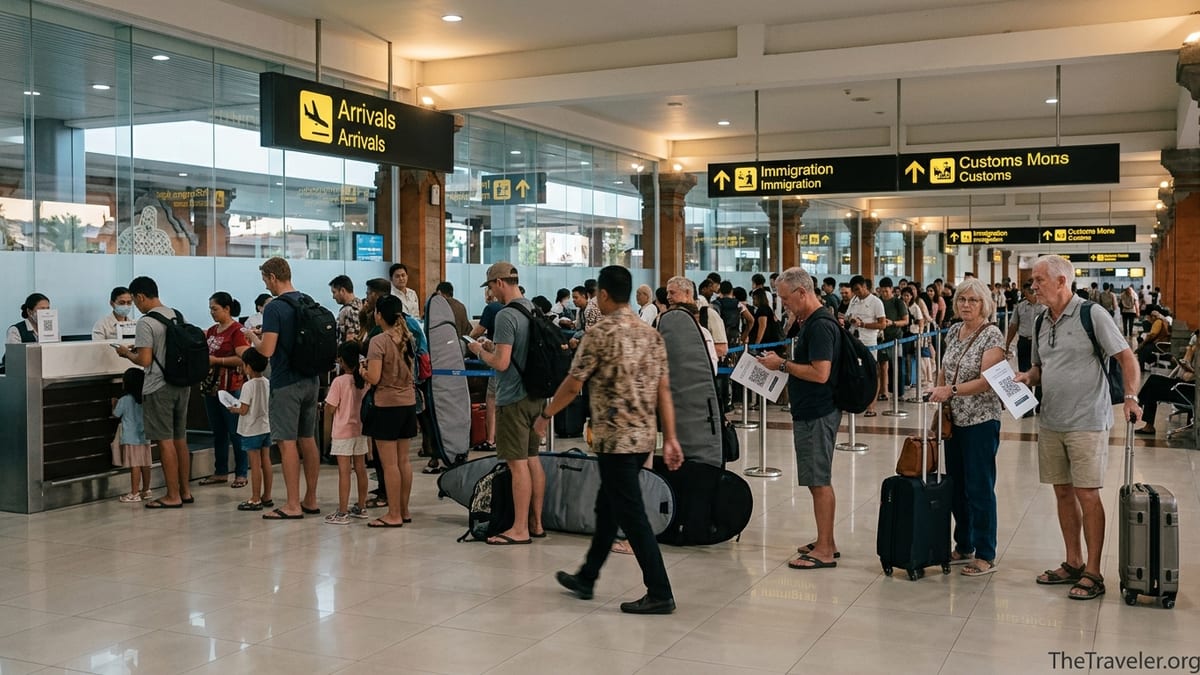
After disembarking, you follow signs for “Arrivals / Kedatangan” and proceed down a corridor toward the immigration hall. Before you reach the counters, there may be signs and digital screens reminding you about the mandatory All Indonesia declaration. In some cases, airport staff stand along the corridor holding tablets or printed boards that say “All Indonesia QR code check.” Travelers who already completed the form walk past, occasionally showing their QR if asked. Those who have not yet completed it may be directed to a side area with chairs where they can use their phones to fill the form, often competing for limited Wi‑Fi bandwidth.
Immigration comes next. If you need a Visa on Arrival and have not purchased it online, you stop first at the VOA payment counters, pay the fee in Indonesian rupiah or a major foreign currency, and receive a receipt. If you have an electronic Visa on Arrival or another type of visa, you go straight to the immigration counters. At the desk, the officer scans your passport, takes your photo and fingerprints and may ask to see your onward ticket or your All Indonesia confirmation. Many passengers report that officers now glance at the arrival data on their screen instead of scanning each QR code individually, so you may not always be asked to show it, but you should still have it ready.
Once your passport is stamped, you move to the baggage claim hall. Screens indicate which carousel is assigned to your flight. Bali’s carousels can be crowded when several wide-body aircraft land close together, so it is wise to keep your valuables and a change of clothes in your carry-on in case your checked bag is delayed. After collecting your luggage, you head toward customs inspection. Here, signage will again mention the digital customs declaration. In contrast to the past, there are fewer paper forms and more QR code posters. Officers may pull aside passengers at random for baggage scanning, particularly if their All Indonesia declaration suggests they are carrying large quantities of goods.
Common Mistakes Travelers Make With All Indonesia
Despite the system’s benefits, many visitors to Bali still make avoidable mistakes that slow them down or lead to uncomfortable conversations at the airport. One of the most frequent is leaving the declaration until the last minute and then being unable to complete it because the airport Wi‑Fi is overloaded or their mobile data does not yet work in Indonesia. A typical scenario involves a family landing from Doha at 7 pm, all trying to fill out the form at once while juggling tired children and cabin bags. They end up taking twice as long to clear immigration as passengers who completed the form the day before.
Another common error is using unofficial websites or paid “arrival card services” that mimic the look of the real platform. Travelers sometimes search online for “Bali customs declaration” and click on sponsored results that charge a fee for what is actually a free government form. Several Reddit and forum posts from 2026 mention people being charged 15 to 25 US dollars per person by third-party services that simply re-enter their details in the official system. While this usually does not prevent entry, it wastes money and introduces unnecessary risk, since you are sharing passport and travel data with a private company.
Incorrect or inconsistent information is also an issue. For example, passengers who enter a different arrival date than the one on their flight ticket, or who list their purpose of visit as “business” while they actually hold a tourist Visa on Arrival, may be questioned by immigration officers. Similarly, failing to declare items that clearly exceed duty-free allowances can lead to fines or the confiscation of goods. A recurring example is visitors bringing in several high-end smartphones or luxury handbags for friends and family; if these look like commercial imports rather than personal use, customs officers at Ngurah Rai have the authority to assess duties and taxes.
Finally, people sometimes forget that each adult must complete their own All Indonesia declaration. Children can typically be included in a parent’s form, but two adults traveling together usually need separate submissions. Couples who mistakenly complete only one form and attempt to present it for both may be asked to step aside while the second person fills out an additional declaration.
Health, Quarantine and Other Entry Checks in Bali
While health checks are now far lighter than they were in the immediate post-pandemic years, there are still occasional spot checks and quarantine procedures that can affect arrivals at Denpasar. The health section of the All Indonesia form asks about symptoms and recent exposure to specific infectious diseases. If you indicate that you feel unwell or have been in certain high-risk areas, you may be directed to a secondary screening area near the arrivals hall where health officers can take your temperature, ask further questions or, in rare cases, recommend you seek medical assessment before entering Bali’s general population.
Food, plants and animal products are another area where travelers sometimes run into trouble. Bali’s shops are full of coffee, spices and snacks, and many visitors want to bring their own in the other direction. However, on arrival, quarantine officers are more concerned with what you are bringing into Indonesia. For example, if you fly in with fresh fruit, seeds or untreated wooden handicrafts from another tropical country, they may require inspection. A backpacker arriving from Vietnam with bags of seeds bought at a local market would be wise to declare them in the All Indonesia form and be prepared for them to be taken for inspection or even refused entry.
Travelers bringing pets have a more complex process. Airlines that accept pets on flights to Bali, such as some regional carriers from Singapore or Australia, usually require advance veterinary documentation, including vaccination records and sometimes rabies certificates. On arrival at Ngurah Rai, the pet must be processed by quarantine officers. The All Indonesia form flags the presence of animals so that staff know to intercept the passenger before they exit the controlled area. Failing to declare a pet can cause serious delays and, at worst, the animal being placed in quarantine at the owner’s expense.
Finally, Bali has introduced a separate regional tourism levy that many visitors pay through a dedicated Bali tourism app or at payment counters. Experiences in 2026 suggest that this levy is often checked by local or provincial officers either at the airport terminal exit or at hotel check-in rather than by immigration or customs. Regardless of how strictly it is enforced at any given moment, it is completely separate from the All Indonesia declaration, and paying it does not remove your obligation to complete the national arrival card.
Practical Tips to Smooth Your Arrival at Denpasar
A little preparation can turn your arrival at Bali’s Ngurah Rai Airport from a confusing queue into a fairly quick experience. Filling in All Indonesia two or three days before your flight, saving the QR code on your phone and, if possible, printing it, is the single most helpful step. If you are traveling as a group, ensure each adult has their own QR code saved offline. A real-world example is a group of four friends flying from Perth who create a shared photo album on their phones containing screenshots of everyone’s QR, so if one battery dies they can still show the code from a friend’s device.
It also pays to double-check your details. Make sure your passport number is correct, your name matches your passport spelling, and your arrival date and flight number align with your ticket. If you are staying at a large resort such as the Apurva Kempinski in Nusa Dua or the Four Seasons in Sayan, use the full official hotel name and address listed in your booking confirmation. Officers occasionally ask where you are staying, and being able to answer clearly and consistently helps reassure them that you are a genuine tourist with firm travel plans.
On the customs side, think ahead about what you are carrying. If you have high-value electronics, expensive jewelry or multiple new items still in sealed boxes, consider whether you might be asked about them. Some travelers take photos of receipts or keep digital invoices handy in case customs asks for proof of value. This is particularly relevant for photographers arriving with several camera bodies and lenses or digital nomads carrying more than one laptop. While most personal-use items pass without issue, transparency tends to make inspections faster and less stressful.
Finally, plan how you will get online in case you need to update or show your All Indonesia declaration. Purchasing an eSIM from a reputable provider before departure, or arranging to collect a physical SIM card from a kiosk in the arrivals hall, can save time. Ngurah Rai’s public Wi‑Fi is sometimes slow when several flights land at once. Having your own data connection means you can pull up your QR code or email confirmation even if the airport network is overloaded.
The Takeaway
The shift to the All Indonesia digital declaration has modernised the arrival process at Bali’s Denpasar Airport, but it has also introduced a new layer of responsibility for travelers. Instead of scribbling a paper landing card on the tray table as the plane descends, you are now expected to complete a comprehensive online form before you even reach the gate. Those who adapt to this change by preparing early generally breeze through immigration and customs; those who do not can find themselves stuck in the arrivals hall, battling poor Wi‑Fi and long queues.
If you remember three things, make it these: first, complete the All Indonesia form no more than three days before arrival and save the QR code offline; second, answer the customs and health questions honestly, especially about cash, high-value goods and animals; and third, ignore unofficial “arrival card” services that charge fees for what is actually a free government requirement. With those basics covered, your first impressions of Bali are much more likely to be the island’s warm air and frangipani scent than the glare of fluorescent lighting in a crowded arrivals corridor.
FAQ
Q1. Do I really have to complete the All Indonesia form to enter Bali?
Yes. As of 2026, Indonesia treats the All Indonesia digital arrival card as mandatory at major international gateways, including Bali’s Ngurah Rai Airport. Passengers who arrive without it are usually asked to complete it on their phones in the arrivals area before proceeding.
Q2. When is the best time to fill in the All Indonesia declaration for a Bali trip?
You should complete it within the three days before your scheduled arrival in Indonesia. Many travelers do it 24 to 48 hours before their flight so that any last‑minute changes to travel plans can still be updated.
Q3. Can I submit one All Indonesia form for my whole family?
Each adult normally needs their own declaration, but children can usually be included on a parent or guardian’s form. In practice, two parents and two children might submit two adult forms, each listing one child, rather than four separate entries.
Q4. What happens if I make a mistake on the form after submitting it?
If you notice an error before you travel, the safest option is to log back in and submit a fresh declaration with the correct details. If you only realise the mistake on arrival in Bali, explain it honestly to the immigration or customs officer; they may update the information manually or ask you to complete a new form.
Q5. Do I still need to fill out a separate customs declaration at Denpasar Airport?
No separate paper customs form is normally required if you have completed All Indonesia correctly. The digital system includes your customs declaration, although customs officers can still question you and inspect your bags if they have concerns.
Q6. Is there any fee to use the All Indonesia app or website?
No, the official All Indonesia system is free to use. If a website or service asks you to pay a “processing” or “service” fee just to complete the arrival card, it is either unofficial or acting as a paid intermediary that you do not need.
Q7. Will immigration or customs in Bali always scan my All Indonesia QR code?
Not necessarily. In many cases, officers rely on data that already appears on their screens when they scan your passport. However, spot checks still happen, and some airlines ask to see the QR code before boarding, so you should keep it ready on your phone or printed out.
Q8. What should I do if the All Indonesia website or app is not working?
First, try again later or switch between Wi‑Fi and mobile data. If problems persist close to your departure, take screenshots of any error messages and be prepared to show them at the airport. In Bali, staff may direct you to a help desk or allow you to complete the form on arrival using airport connections.
Q9. Does the All Indonesia declaration replace my visa or Visa on Arrival?
No. All Indonesia is separate from your visa. You still need to meet Indonesia’s visa requirements, whether that means having a pre‑approved visa, using the electronic Visa on Arrival system or buying a Visa on Arrival at Denpasar Airport, depending on your nationality.
Q10. Do I need to complete All Indonesia again when I leave Bali?
For most ordinary tourists, the declaration is required only on entry to Indonesia, not on departure. When you fly out of Denpasar to another country, you follow normal exit procedures using your passport and boarding pass without submitting a new All Indonesia form.