


Landing at Bali’s I Gusti Ngurah Rai International Airport, better known as Denpasar or simply DPS, is exciting, chaotic and occasionally confusing, especially if it is your first time on the island. This guide walks you through the airport step by step, from landing to reaching your hotel, with realistic examples of what to expect for immigration, the Bali tourist levy, SIM cards, taxis, Grab, Gojek and essential first-time tips.
Get the latest updates straight to your inbox!
Understanding Bali’s Denpasar (DPS) Airport Layout
Bali’s main airport, I Gusti Ngurah Rai International Airport, sits between Kuta and Jimbaran on the island’s south-west coast. It has one combined complex with a clearly separated International Terminal and Domestic Terminal. Most first-time visitors arrive internationally, then exit via the ground-floor arrivals hall on the western side of the complex. The two terminals are within walking distance of each other but are served by different pickup points for taxis and ride hailing.
After your plane parks, you usually walk through an airbridge into the upper level of the International Terminal. You will follow signs for “Immigration” and “Visa on Arrival” before descending toward baggage claim and customs. Only after passing customs do you enter the public arrivals hall, where you will find ATMs, money changers, SIM card booths, tour desks, hotel counters and the official taxi desk. Outside this hall is the main curbside pickup area, which can be crowded in the evening bank of arrivals from places like Sydney, Singapore, Kuala Lumpur and Doha.
Knowing the basic layout in advance helps you avoid backtracking. immigration and visas first, then baggage, then customs, then the arrivals hall and services, and finally transport. If you have a domestic connection to islands like Lombok or Labuan Bajo, you will usually clear immigration in Bali, collect your bags, then re-check them in the Domestic Terminal, which requires a short walk or shuttle ride. Allow at least three hours between an international arrival and a separate domestic ticket to be safe.
For orientation, the popular beach areas of Kuta and Legian lie roughly 15 to 20 minutes north of the airport in light traffic, Seminyak about 30 to 40 minutes, Canggu 45 to 70 minutes, Sanur 25 to 40 minutes, Ubud 60 to 90 minutes, and Uluwatu 40 to 70 minutes. Travel time can easily double at peak hours, so factor this in when booking hotel pickups or estimating taxi prices.
Arrivals, Immigration, Customs and the Bali Tourist Levy
Once you disembark, you will be funneled to Immigration. Many nationalities, including travelers from much of Europe, North America and parts of Asia, are eligible for a Visa on Arrival, usually valid for 30 days and extendable once. You pay for this at a dedicated VOA payment counter before queuing for immigration inspection. Payment is typically accepted by card or cash in major currencies or Indonesian rupiah. Lines are often longest in the late afternoon and late evening when several wide-body flights land close together; in those periods, expect 45 to 90 minutes from landing to clearing immigration.
Separate from the immigration visa fee, Bali now charges a provincial tourist levy, officially called the International Tourism Levy, of 150,000 Indonesian rupiah per foreign visitor. This is a one-time payment per trip, not per day. Authorities encourage visitors to pay in advance using the “Love Bali” system, which generates a QR code you can show on arrival. If you have not prepaid, you can usually pay on arrival at designated levy counters or via payment endpoints at hotels and some attractions. While enforcement at the airport can be light at times, there have been reports of spot checks at popular tourist sites, so plan to pay the levy rather than ignore it.
After immigration, you proceed to baggage claim. Baggage carts are usually available and free to use. If your checked bag does not appear after the carousel stops, find the airline desk next to the belts and report it before passing customs. Airport staff are used to delayed bags on busy routes and will give you a reference report and contact details to follow up. Keep your luggage tags, boarding pass and a photo of your suitcase handy for this process.
Customs screening comes next. You will join either the “Goods to Declare” or “Nothing to Declare” line, then put your bags through an X-ray. There is a typical list of restricted items, including drones above certain specifications, professional filming equipment without permits, and large amounts of cash above Indonesian reporting limits. Officers often ask brief questions about the length of your stay or where you will be staying. Once cleared, you step into the public arrivals area, where the main decision becomes how you will reach your hotel.
Money, SIM Cards and Getting Connected at DPS
Immediately after customs, you will see currency exchange counters and ATMs. Airport exchange rates are generally less favorable than in town, sometimes around 5 to 10 percent worse. A practical strategy is to withdraw a modest amount of cash from a reputable bank ATM in the arrivals hall, such as BNI, BCA or Mandiri, just enough to pay for your first taxi or snacks, and then do a larger exchange or withdrawal in Kuta, Seminyak or Ubud where the spread is usually better. Inspect ATMs before use and avoid standalone machines with unfamiliar branding.
For mobile data, you will find official counters for major Indonesian providers such as Telkomsel, XL Axiata and Indosat in or just outside the arrivals area. These desks sell tourist-friendly prepaid packages with data bundles, sometimes including local call minutes. Prices change frequently, but as a general example, travelers in 2025 reported paying the equivalent of around 150,000 to 300,000 rupiah for 25 to 40 GB of data valid for 30 days on Telkomsel, which offers some of the best coverage across Bali including in Ubud and parts of North Bali.
Buying at the airport is more expensive than small phone shops in Kuta or Canggu, but still reasonably priced by international standards and far more convenient after a long flight. Staff at the official counters are experienced in setting up tourists’ phones and will usually register the SIM against your passport, insert it, and activate a data package on the spot. This can save you a lot of frustration compared with troubleshooting an eSIM alone while jet-lagged and standing in a taxi queue.
If you prefer to use an eSIM, several global providers offer Indonesia or regional Southeast Asia eSIMs that you can install before travel. However, network quality can still depend on the underlying local carrier, and some travelers report smoother speeds and better reliability with a local physical SIM. If you plan to use Grab or Gojek from the airport, consider getting a working local number and data before leaving the terminal, as the apps may require SMS verification and accurate GPS location to confirm your pickup.
Taxis, Hotel Transfers, Grab and Gojek
Once you exit into the arrivals hall, you will be approached by a mixture of official and unofficial drivers offering rides. The most straightforward option for many first-time visitors is to use the official taxi counter inside the terminal. Here you tell the staff your destination, such as “Legian,” “Canggu” or “Ubud,” and they quote a fixed fare from a printed zone list. You pay at the counter, receive a paper ticket, then meet your assigned driver just outside. Prices are higher than ride-hailing but transparent and reduce the need to negotiate while tired. As an approximate reference, travelers commonly pay in the region of 200,000 rupiah to Canggu, 150,000 to 200,000 rupiah to Seminyak or Jimbaran, and 400,000 to 600,000 rupiah to Ubud, depending on time of day and car type.
Many hotels and villas in areas like Nusa Dua, Uluwatu and Ubud offer private airport transfer services. For example, a mid-range Ubud hotel might quote 400,000 to 500,000 rupiah for a one-way pickup in a private car, while a luxury resort in Nusa Dua might include transfers in the room rate or charge more for a van. The advantages of a hotel pickup include a driver waiting with your name on a sign, no need to handle cash on arrival, and direct communication via WhatsApp if your flight is delayed. The downside is cost, which is typically higher than booking a Grab, Gojek or Bluebird taxi yourself.
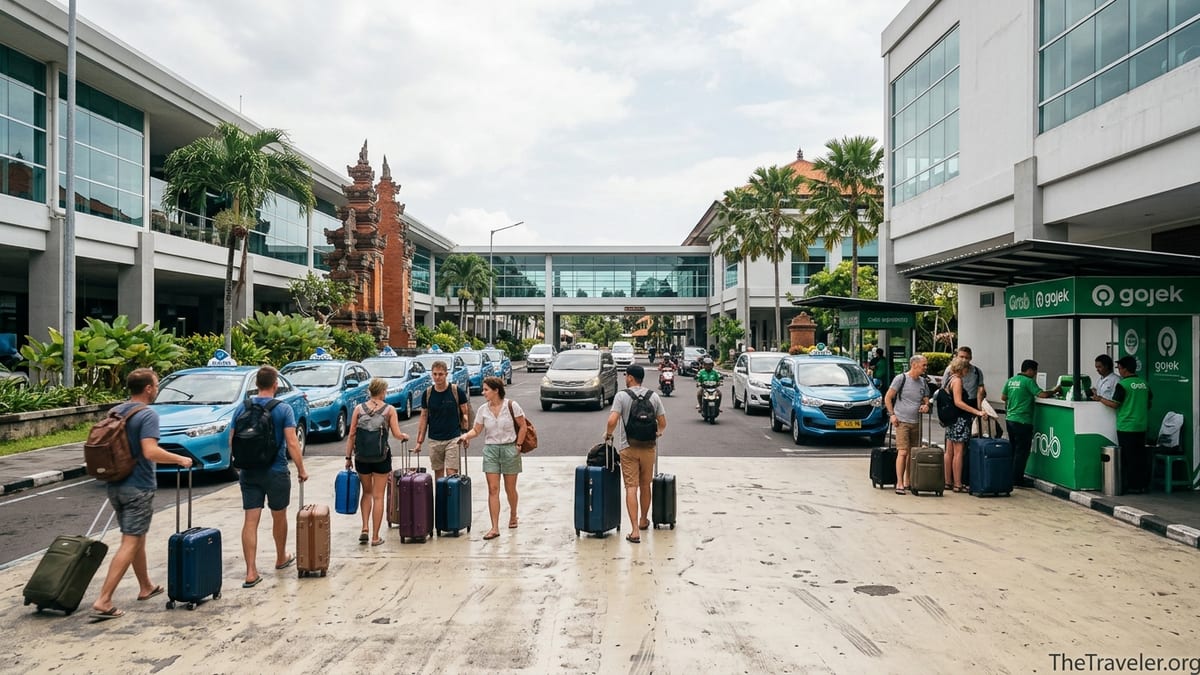
Grab and Gojek do operate at Bali airport under certain arrangements, though their exact procedures and pickup points can evolve due to local negotiations. At present, international arrivals often need to walk a short distance from the main exit to a designated ride-hailing pickup zone, sometimes indicated by signs for Grab or Gojek or via directions inside the app. Some travelers describe going left out of the arrivals doors, following the terminal frontage and signs until reaching a small air-conditioned lounge or kiosk where staff help match drivers with passengers. Expect short queues during peak times, but fares are usually lower and meter-based or app-based, giving you a clear estimate.
If you have trouble finding your driver, use the in-app chat and be prepared for written English that is simple but effective. It is common practice to share a pinned location from the app and to confirm the last four digits of the license plate. For late-night arrivals, consider that surge pricing can apply if several flights land together, and drivers may ask for an extra parking fee if they have waited a long time. Always confirm in the app that the trip has started before leaving the curb so the fare is logged correctly.
Realistic Costs and Common Transport Scenarios
For a first-time visitor, it helps to visualize typical routes and prices. Suppose you land at 8 pm from Singapore and stay in central Seminyak. Using the official taxi counter, you might pay around 200,000 rupiah for a standard car, reaching your hotel in 30 to 45 minutes if traffic flows. Ordering GrabCar from the ride-hailing zone might show an estimated fare of around 120,000 to 170,000 rupiah for the same route, but you may wait 10 to 20 minutes for a driver to arrive when there is a wave of flights.
Another common scenario is heading straight to Ubud after a long-haul flight from Europe or Australia. A pre-arranged hotel transfer or private driver often costs roughly 400,000 to 600,000 rupiah depending on vehicle size and your bargaining skills. In this case, the convenience and certainty are worth the extra cost for many travelers, as public transport options are minimal and ride-hailing fares can vary with traffic and demand. Journey time can be 60 to 90 minutes, longer if you arrive around sunset or during a festival.
Travelers on tight budgets sometimes walk or arrange to be picked up just outside the main airport perimeter, where local taxis and online ride-hailing rates can be lower. This can work if you are traveling light and know the area, but it is less comfortable with heavy luggage or family members in tow. For most first-time visitors, staying within the official pickup zones of the airport is safer and still affordable relative to resort prices and activity costs on the island.
For your return to the airport, Grab, Gojek and meter taxis like Bluebird are easier to use, as there are fewer restrictions on pickups at hotels and villas. From Canggu, for instance, a GrabCar to the airport might cost roughly 150,000 to 200,000 rupiah in normal traffic. From Ubud, expect around 300,000 to 400,000 rupiah. Always leave generous time for traffic jams, especially if traveling on a Friday afternoon, around major holidays, or during heavy rain when roads can flood and slow dramatically.
First-Time Bali Practical Tips After You Land
Stepping into the arrivals hall at DPS can feel overwhelming, with staff calling “Taxi, taxi,” drivers holding name boards, and vendors promoting tours or SIM cards. Take a moment to pause, breathe, and step to the side out of the main flow of passengers. Check your belongings, make sure your passport and phone are secure, and decide your next step calmly. Rushing into a ride with the first person who talks to you is one of the easiest ways to overpay or end up confused about the agreed fare.
Whenever possible, confirm all prices in Indonesian rupiah and not only in foreign currency. For example, instead of agreeing to “twenty dollars” to Seminyak, clarify the amount in rupiah on your phone’s calculator. Keep a rough conversion in mind; for many travelers, thinking of 100,000 rupiah as somewhere in the range of 6 to 8 US dollars is a helpful rule of thumb, depending on current exchange rates. This makes it easier to compare taxi quotes and SIM card offers without pulling out a currency app every time.
Jet lag, humidity and noise can lead to small but expensive mistakes, such as leaving a bag on a trolley, getting into the wrong car, or paying twice. Before driving off, double-check that your checked luggage, cabin bag and personal items like laptops or cameras are all in the vehicle. Note your driver’s name and license plate, which will appear in Grab and Gojek apps or on the taxi dashboard. Taking a quick photo of the car and plate can be useful if you accidentally leave something behind.
Finally, remember that the airport is just your first impression of Bali. Service standards and prices in the arrivals area do not always reflect the island overall. You may pay a little more and experience more touts here than you will in a quiet guesthouse in Sidemen or a well-run guesthouse in Canggu. Treat the first hour as a transition period: stay polite but firm, choose the most straightforward options, and focus on getting safely to your accommodation, where you can relax and plan the rest of your trip.
Staying Safe, Respectful and Avoiding Common Pitfalls
Bali is generally welcoming and safe, but minor scams and misunderstandings do occur, especially around the airport where there is a constant flow of newcomers. The most common issues involve inflated taxi prices, surprise add-on fees, or confusion about parking and toll charges. To minimize this, use fixed-fare counters, reputable ride-hailing apps, or pre-booked hotel transfers, and always clarify whether the quoted price is “all in” or if parking and tolls will be added. If a driver tries to change the price mid-journey, stay calm, refer back to the original agreement or app fare, and negotiate respectfully rather than confrontationally.
Respect for local culture starts from the moment you arrive. Dress comfortably, but remember that very revealing clothing in the airport and public spaces can feel out of place, particularly if you are heading directly to a temple area. For instance, if your first stop is Uluwatu Temple or Tirta Empul in central Bali, pack a light scarf or T-shirt in your carry-on so you can cover shoulders when needed. Removing shoes before entering certain indoor spaces, speaking softly, and avoiding stepping on offerings (small woven baskets with flowers and incense on the ground) are simple gestures that locals appreciate.
Another practical consideration is travel insurance and health precautions. The airport has a medical clinic and access to ambulances, but these are designed for emergencies, not routine care. Travel insurance that covers medical treatment and evacuation is wise, particularly if you plan to surf, ride a motorbike or hike volcanoes. At the airport, you may see signs reminding travelers not to bring certain foodstuffs or animal products due to biosecurity rules. Declare anything that might be questionable, as fines for undeclared prohibited items can be significant compared with the cost of simply discarding them before customs.
Lastly, be aware of your digital safety. Connect only to official airport Wi-Fi networks, and avoid logging into banking or highly sensitive accounts on public Wi-Fi without a VPN. If you are using airport charging stations, try to use your own USB power adapter plugged into a standard outlet rather than sharing unknown USB ports directly, which carries a small but real risk of data compromise. Once you have your local SIM and are in your hotel, you can reassess your connectivity needs from a more secure and comfortable environment.
FAQ
Q1. Do I need to pay the Bali tourist levy if I already have a visa?
The Bali tourist levy is separate from your visa or Visa on Arrival fee. Most foreign tourists must pay the 150,000 rupiah levy once per trip, even if they hold a visa, unless they fall under specific exemption categories such as certain diplomatic or transit situations.
Q2. Can I pay the Bali tourist levy on arrival at the airport?
Yes, if you have not paid online in advance, you can usually pay the levy on arrival at designated counters or via payment endpoints connected to the official system. However, paying before your trip often makes the arrival process smoother.
Q3. Is it better to get a SIM card at the airport or in town?
Buying a SIM at the airport is more expensive than at small shops in Kuta or Canggu, but it is far more convenient and still affordable. For most first-time visitors who want Grab or Gojek and maps working immediately, getting a Telkomsel, XL or Indosat SIM at the arrivals hall is a practical choice.
Q4. Are Grab and Gojek allowed to pick up passengers at Bali airport?
Grab and Gojek generally operate at the airport through designated pickup zones, which may be a short walk from the arrivals exit. Check the app after landing, follow the in-app directions or airport signs, and be prepared for a brief wait at busy times.
Q5. How much should I expect to pay for a taxi from the airport to Seminyak?
Fares vary with time of day and vehicle type, but many travelers pay around 150,000 to 200,000 rupiah using the official taxi counter, and sometimes a bit less when using Grab, Gojek or a meter taxi in normal traffic conditions.
Q6. How long does it usually take to get from DPS to Ubud?
In light to moderate traffic, the drive from the airport to central Ubud can take about 60 to 90 minutes. During peak hours, heavy rain or holidays, the journey can stretch longer, so allow extra time, especially if you are tired from a long flight.
Q7. Do I need cash immediately after landing, or can I rely on cards?
Cards are accepted at many airport counters and larger hotels, but taxis, smaller guesthouses and some SIM booths may prefer or require cash. It is sensible to withdraw or exchange a modest amount of rupiah at the airport for immediate expenses and then get better exchange rates later in town.
Q8. Is it safe to arrive in Bali late at night?
Late-night arrivals are common, and the airport remains active with taxis, ride-hailing drivers and hotel pickups. Use official transport options, keep your valuables secure, and communicate with your hotel about your arrival time so they know when to expect you.
Q9. What should I do if my luggage is lost or delayed?
If your bag does not appear on the carousel, go directly to your airline’s baggage desk inside the baggage claim area before passing customs. Provide your baggage tag and a detailed description of your suitcase, and keep the reference report they issue for follow-up by phone or email.
Q10. Are there public buses from the airport to tourist areas?
Public transport from the airport is limited. There are some local bus routes, but they may not be convenient for first-time visitors with luggage. Most travelers use taxis, ride-hailing services or hotel transfers to reach areas like Kuta, Seminyak, Canggu, Ubud or Uluwatu.