


Rome’s Leonardo da Vinci–Fiumicino Airport is one of Europe’s busiest gateways, and there is no single “best” way to reach it. The smartest choice depends on where you are staying, what time your flight leaves, how much luggage you have and how comfortable you are with Italy’s public transport. This guide walks through the main options – train, bus, taxi and Uber – with realistic prices, journey times and concrete examples so you can choose what works for your trip.
Get the latest updates straight to your inbox!
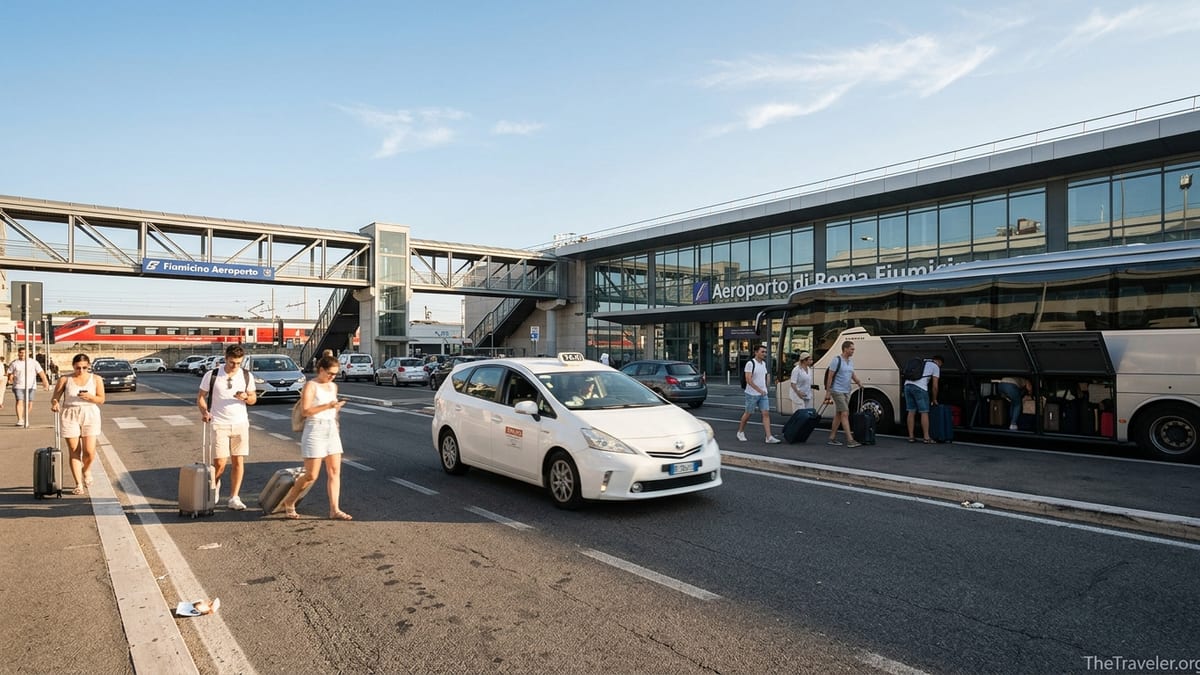
Understanding Your Options to and from Fiumicino
Fiumicino Airport sits around 30 kilometers southwest of central Rome. Travelers typically choose between the Leonardo Express airport train, a slower but cheaper regional train, several competing airport buses, official white taxis with fixed fares, or app-based rides such as Uber. Each option targets a different balance of speed, comfort and cost.
Imagine you are staying near Roma Termini station with a mid-morning flight to New York. A couple with roll-aboard bags might take the Leonardo Express train directly from Termini to Fiumicino in about 32 minutes, paying roughly the same as one person in a taxi from the airport. A family of four at a hotel by Piazza Navona, on the other hand, may prefer a taxi door to door, avoiding a metro or bus connection with young children and suitcases.
Where you are based in Rome matters. Guests in Trastevere or near Ostiense station often find the regional FL1 train, which stops at those stations on its way to Fiumicino, a good compromise. Travelers staying around the Vatican or Spanish Steps may lean toward a taxi or Uber to avoid hauling bags through metro stations and cobblestones. Nighttime departures, early red-eyes and tight connections further change the equation.
In practice, you may also mix options. Many visitors arrive in Rome and take the fast Leonardo Express into Termini, then use the metro or a local taxi to reach their hotel. On departure, once they know the city layout and traffic patterns better, they might opt for a taxi or Uber straight back to the airport for convenience.
Leonardo Express: Fastest for Termini and Connections
The Leonardo Express is the dedicated non-stop train between Roma Termini and Fiumicino Airport. It runs roughly every 15 minutes during most of the day, with a journey time of about 32 minutes. First departures are usually just after 6:00 in the morning, with the last trains close to midnight, making it usable for most daytime and evening flights.
At the time of writing, a one-way Leonardo Express ticket costs in the mid-teens in euros per person. There are occasional promotions, such as a “mini group” offer for four people traveling together for a discounted combined price, which can bring the per-person cost down a bit. Tickets can be purchased at Trenitalia machines and ticket counters at Termini or Fiumicino, or via apps. You must keep your ticket to scan through the turnstiles at both ends.
For travelers staying near Termini, the Leonardo Express is often the most reliable option. For example, someone sleeping at a hotel on Via Cavour can roll their suitcase 10 minutes to the station, catch a mid-morning Leonardo Express, and be at the airport just over half an hour later, with no worries about traffic jams on the ring road. It also works well for those connecting to high-speed trains: you can ride Leonardo Express into Termini, then board a Frecciarossa or Italo train onward to Florence, Naples or Venice.
The main drawbacks are cost for families and the need to reach Termini first. A solo traveler finds the price reasonable compared with a taxi, but a group of four will be paying something closer to the cost of a private transfer. Also, if you are staying far from Termini, such as in Prati or Trastevere, you must first take a bus, metro or taxi across the city to catch the train, which adds time and hassle, especially at rush hour.
Regional FL1 Trains: Good Value from Trastevere and Tiburtina
Alongside the Leonardo Express, regional FL1 trains connect Fiumicino Airport with several key stations across Rome, including Trastevere, Ostiense and Tiburtina. These trains are slower and stop more often, but tickets usually cost notably less than the dedicated airport service. They can be an excellent value, particularly if your accommodation is near one of the FL1 stops.
Consider a traveler staying in Trastevere, close to the tram lines and the neighborhood’s main station. Instead of going across town to Termini just to catch the Leonardo Express, they can walk 10 minutes to Roma Trastevere station and board an FL1 train directly to the airport. The ride usually takes around 25 to 30 minutes from Trastevere to Fiumicino. The ticket price is commonly several euros cheaper than the Leonardo Express, which becomes significant for couples or small groups.
Another example is a budget-conscious traveler staying near Tiburtina, a major rail and bus hub in eastern Rome. The FL1 serves Tiburtina as part of a cross-city route. From there, they can reach Fiumicino without navigating the busy corridors of Termini. This is especially attractive for guests using long-distance coaches from Tiburtina who then need to connect to the airport by train the next morning.
Regional trains require a little more attention to details. Schedules are sometimes less frequent than the Leonardo Express and can be affected by strikes or delays. You must also ensure your ticket is properly validated or scanned before boarding, depending on the type of ticket you buy. That said, for travelers who are comfortable reading departure boards and can handle one or two steps as they board older carriages, the FL1 line offers a useful mix of lower cost and decent speed.
Airport Buses: Cheapest but Traffic Dependent
Several private companies run direct buses between Fiumicino Airport and central Rome. Common routes include Fiumicino to Termini station, often stopping at points like Via Marsala behind the station. Prices tend to be in the single-digit euro range per person, making them one of the cheapest ways to travel between the city and the airport.
Imagine a solo backpacker arriving late morning with no tight schedule and staying in a hostel close to Termini. Taking a bus service that departs from Terminal 3 and drops off on Via Marsala might cost only a few euros and take around 45 to 60 minutes, depending on traffic. For that traveler, saving the difference compared to the Leonardo Express could pay for lunch or a museum ticket on arrival.
Buses are less attractive in peak traffic or for travelers staying far from the drop-off points. During weekday rush hours or when an accident clogs the ring road, the journey can easily stretch past an hour. Someone with an early-morning international flight and a hotel in Trastevere would likely not want to risk a crowded rush-hour bus from Termini and then a connection by tram or local bus with heavy luggage.
Most bus companies offer online booking with assigned time slots, although they generally allow you to board a later bus if your flight is delayed and there is space. However, seats are not always guaranteed on very busy days. The buses normally have luggage storage underneath, air conditioning of varying effectiveness and free Wi-Fi that may or may not work reliably. For budget travelers with time to spare, airport buses can be a sensible choice, but they require more slack in your schedule than the train.
Official Taxis: Door-to-Door Convenience for Groups
For many visitors, especially those traveling as a couple or family, the official white taxi remains the most comfortable way to travel between Rome and Fiumicino. Licensed taxis in Rome are white, carry a “TAXI” sign on the roof and display the “Comune di Roma” crest and license number on the doors. From the official taxi ranks at Fiumicino, there is a fixed fare to destinations in the historic center, defined by the Aurelian Walls.
Current official information indicates that trips between Fiumicino Airport and the city center within the Aurelian Walls are charged a flat fee in the mid-fifties in euros, including luggage and surcharges. In practice, recent travelers report paying around 55 euros from the airport to central neighborhoods such as the Pantheon, Spanish Steps or Trastevere. Always confirm the fixed price with the driver before you get in, and make sure you are using an official taxi from the designated rank outside Terminal 1 or Terminal 3.
Consider a family of four staying near Piazza Navona, each with a suitcase. Taking the Leonardo Express for four people plus a taxi or bus from Termini could easily approach or exceed the cost of a single taxi door to door from Fiumicino. In this scenario, the taxi offers significantly less hassle: no stairs in train stations, no crowding around luggage racks and no need to navigate Termini, which can be overwhelming on a busy day.
The main risk with taxis is encountering unlicensed drivers or misunderstanding the fare rules. Inside the terminal, you may be approached by people offering “taxi” services at prices that can be double or triple the official flat rate. Politely refuse and head instead to the signed taxi ranks outside. When traveling from your hotel back to the airport, your hotel reception can call a taxi for you; the same flat fare to Fiumicino applies from anywhere within the Aurelian Walls, and the meter should not be used for these trips.
Uber and Ride-Hailing: Premium Transport at a Premium Price
Uber operates in Rome, but not always in the budget-friendly format many travelers know from other cities. The most commonly available options at Fiumicino tend to be Uber Black and similar professional-driver services rather than ordinary private cars. As a result, prices are usually higher than the fixed-rate official taxis, especially at busy times, though you gain the convenience of app-based booking, driver tracking and electronic payment.
As a rough example, a mid-afternoon Uber Black ride from Fiumicino to a central hotel near Piazza di Spagna might show an estimated fare in the range of 70 to 90 euros, depending on demand. That is noticeably more than the standard taxi rate, but some travelers are willing to pay for the perceived comfort of newer vehicles, guaranteed air conditioning and a driver who meets them with a name sign at the arrivals area if they book higher service tiers.
Where Uber can be useful is in situations where you want a pre-booked ride at a specific time or prefer paying through the app without using cash. Someone catching a very early flight might schedule an Uber the night before, avoiding the small uncertainty of whether a taxi will be immediately available outside their apartment at 4:30 in the morning. Likewise, business travelers who need receipts emailed automatically to their company often like the digital trail provided by ride-hailing platforms.
However, availability can be uneven, and surge pricing during busy arrival waves or city events can push fares well above what you might expect. App-based services also share the same roads as taxis and buses, so they are equally vulnerable to traffic delays. For most leisure travelers, official taxis offer a more predictable price, while ride-hailing is best viewed as a premium backup or preferred option for those who value app convenience above cost.
How to Choose: Matching Transport to Your Trip
Choosing the best way to get to or from Fiumicino starts with three key questions: where you are staying, what your timing looks like and how you feel about managing luggage on public transport. Once you answer those, the choice between train, bus, taxi and Uber becomes clearer.
For example, if you are staying a short walk from Termini with a midday departure, the Leonardo Express is hard to beat. You enjoy a predictable 32-minute journey with minimal traffic risk. If an unexpected delay occurs, another train is usually along within about 15 minutes. This combination of speed and reliability makes it especially attractive for travelers catching long-haul flights to North America or Asia, where missing check-in cutoffs can be expensive.
On the other hand, if you are traveling with children or several suitcases and your hotel is deep inside the historic center on a narrow cobbled lane, the value of a door-to-door taxi or pre-booked car increases. A taxi might cost roughly the same as four individual Leonardo Express tickets, but it saves you from hauling luggage through crowded platforms and negotiating a final bus or metro ride. In Rome’s summer heat, that comfort can matter as much as the time savings.
Budget travelers with light bags and flexible schedules often lean toward buses or the FL1 regional trains, particularly if staying near Trastevere, Ostiense or Tiburtina. They accept a slightly longer journey and potential traffic in exchange for saving several euros per person. What matters most is building in enough buffer time: aim to arrive at the airport at least two to three hours before an international flight, more if you are traveling at peak holiday periods.
The Takeaway
No single transport option is perfect for every traveler heading to or from Rome Fiumicino Airport. The Leonardo Express shines for speed and reliability when you are near Termini. The FL1 regional line offers excellent value for those based around Trastevere, Ostiense or Tiburtina. Airport buses keep costs low for solo travelers and backpackers who are not in a rush. Official white taxis balance price and comfort, particularly for couples and families staying in the historic center. Uber and similar services add app-based convenience at a premium price.
The best strategy is to match the mode of transport to your specific circumstances. Check your flight time, your hotel location, how much you are carrying and your tolerance for crowds and transfers. If you are nervous about delays, lean toward the train. If you are exhausted after a long haul or traveling with kids, consider a taxi or pre-booked car. With a realistic understanding of prices, journey times and trade-offs, you can turn the trip between Rome and Fiumicino from a source of stress into a smooth start or finish to your Italian adventure.
FAQ
Q1. What is the fastest way to get between central Rome and Fiumicino Airport?
The fastest option for most travelers is the Leonardo Express train between Roma Termini and Fiumicino Airport, with a journey time of about 32 minutes and frequent departures throughout the day.
Q2. How much does a taxi from Fiumicino Airport to central Rome cost?
Official white taxis from Fiumicino to destinations within the Aurelian Walls have a fixed fare in the mid-fifties in euros, which typically includes luggage and surcharges. Confirm the flat rate with the driver before departure and make sure you use an official taxi from the signed rank.
Q3. Is the Leonardo Express worth the price compared to other options?
For solo travelers or couples staying near Termini, the Leonardo Express offers a fast, predictable trip that many find worth the higher fare. For families or groups of four, the combined cost can approach that of a taxi, so the value depends on your location, budget and comfort with using trains.
Q4. Are there cheaper train options than the Leonardo Express?
Yes. Regional FL1 trains connect Fiumicino with stations such as Trastevere, Ostiense and Tiburtina at a lower fare than the dedicated Leonardo Express. These trains are slightly slower and make more stops but can be very economical if your accommodation is near one of the stations they serve.
Q5. How reliable are airport buses from Fiumicino to Rome?
Airport buses are generally reliable but heavily affected by traffic. On clear roads, journeys to Termini may take around 45 minutes; during rush hour or after accidents on the ring road, they can take much longer. Buses are best if you are watching your budget and have generous time before your flight.
Q6. Does Uber work at Fiumicino Airport, and is it cheaper than a taxi?
Uber is available but often only in premium categories, which usually cost more than the official fixed-fare taxis. You gain app convenience, pre-booking and digital payment, but you typically pay a higher price, especially during busy periods when demand pushes fares up.
Q7. How early should I leave my hotel in Rome for an international flight from Fiumicino?
As a general guideline, plan to arrive at the airport at least two to three hours before an international departure. Factor in your chosen transport: trains offer more predictable timing, while buses, taxis and ride-hailing services need extra buffer for possible traffic delays, especially at peak times or on weekdays.
Q8. Is it safe to take taxis from Fiumicino Airport late at night?
Yes, using official white taxis from the designated airport ranks is generally considered safe at all hours. Avoid accepting rides from individuals inside the terminal who approach you with unsolicited offers. If arriving very late, an official taxi or pre-booked car is often more straightforward than navigating night buses or infrequent trains.
Q9. What is the best option if I am staying in Trastevere?
If you are near Roma Trastevere station, the regional FL1 train is usually the best balance of cost and convenience, taking around half an hour to reach Fiumicino. If you are deeper into the neighborhood, or carrying heavy luggage, many travelers choose a taxi directly to the airport or to Trastevere station to connect with the FL1.
Q10. Can I pay for airport transport with a credit card?
Yes, in most cases. Leonardo Express and regional train tickets can be bought by card at machines and ticket counters. Many bus operators accept online card payments when booking. Official taxis in Rome are increasingly equipped to take cards, but it is wise to confirm with the driver before starting your trip. Uber and similar services charge your card through the app.