


Gamla Stan is the Stockholm everyone comes for: cobblestones, steeples, cinnamon buns and centuries of history. Yet some of the most rewarding corners of the city sit just beyond its bridges, in places most visitors literally walk past on their way in and out of the Old Town. With a little planning, you can turn a standard Gamla Stan stop into a deeper exploration of Stockholm’s waterfronts, viewpoints and local neighborhoods.
Get the latest updates straight to your inbox!
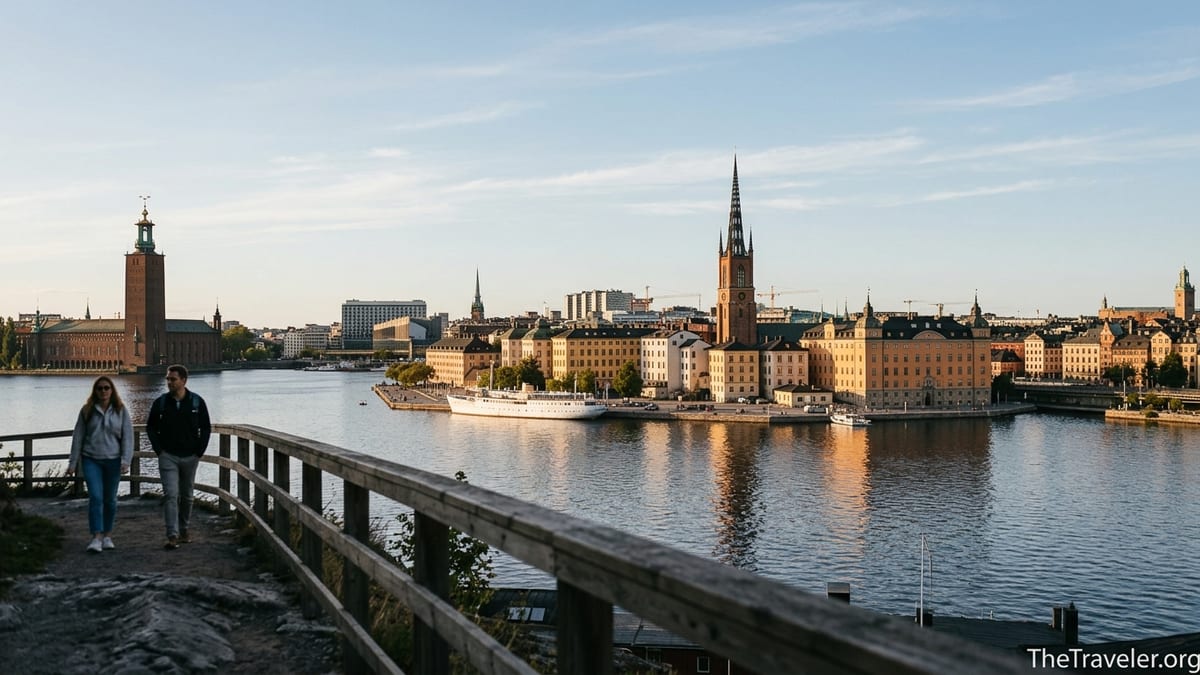
Riddarholmen: The Quiet Island in Gamla Stan’s Shadow
Many visitors cross the bridge from central Stockholm, see the Gamla Stan sign, and head straight for the Royal Palace. If you glance left instead and follow the water, you will find Riddarholmen, a small island that is officially part of Gamla Stan but feels worlds quieter. It is dominated by Riddarholmskyrkan, the red-brick church with a cast-iron spire that once served as Sweden’s royal burial church, surrounded by 17th century palaces that now house government offices. On a weekday evening you might share the square with only a handful of local office workers cutting through on their commute.
Riddarholmen rarely appears on first-time Stockholm itineraries, yet it offers some of the city’s most atmospheric waterfront promenades. The quays on the western side open to broad views across Lake Mälaren toward Stockholm City Hall’s tower and the bridges of Centralbron. In summer, Stockholmers sit along the stone edges with takeaway coffee or supermarket picnics, using the palace walls as windbreaks. Photographers love the long perspective of Gamla Stan’s facades seen from the southern tip of the island at sunset.
Practicalities are straightforward. There is no ticket gate to the island, and you can walk there from the western edge of Gamla Stan in about five minutes. Riddarholmskyrkan itself usually charges a modest entrance fee when open in summer, while the courtyards and quays remain free and accessible year round. If your schedule is tight, weave Riddarholmen into your arrival or departure: step off the metro at Gamla Stan station, cross to Riddarholmen for a 20 minute circuit, then continue into the Old Town’s busier alleys once you have taken in the wider setting.
Stockholm City Museum: The Story of the City at Slussen
Most people arrive at Gamla Stan via Slussen, the busy interchange one stop south on the metro. They follow the crowd across the bridge, rarely pausing at the low classical building on the Södermalm side that houses the Stockholm City Museum, or Stadsmuseet. That is a pity, because this free museum offers exactly the context that makes Gamla Stan’s alleys come alive, from medieval trade to 20th century housing experiments. Recent exhibitions trace Stockholm’s transformation from a small northern outpost to a Scandinavian capital, using models, films and everyday objects.
As of 2026 the City Museum typically opens Thursday to Sunday during the day, with occasional late evenings, and general admission to the permanent collection is free. Temporary exhibitions and special guided walks around the city may carry a separate charge, but even a short unguided visit can be valuable. You can study a large relief model of Stockholm that shows how Gamla Stan sits among the islands, then walk outside and recognize the same contours in real life as you cross the bridge.
The museum building faces a small square and tram stop, just a few minutes’ walk from Slussen’s metro exits. A practical itinerary is to arrive in late morning, spend an hour getting your bearings with the exhibitions and perhaps a coffee in the small café, then cross the bridge into Gamla Stan for lunch. On a rainy or cold day, the City Museum is an excellent backup when outdoor viewpoints are less appealing, and it is especially useful for travelers who like to understand the social history behind the colorful facades.
Monteliusvägen and Ivar Lo’s Park: Classic Views Back to Gamla Stan
Ask Stockholmers where to see Gamla Stan at its best, and many will send you not into the Old Town but up onto the cliffs of Södermalm. Monteliusvägen is a narrow pedestrian path that runs for roughly 400 to 500 meters along the edge of the Mariaberget hill. From its wooden walkways and rocky outcrops you look north across Lake Mälaren toward Gamla Stan’s rooftops, the pointed spire of Riddarholmskyrkan and the brick tower of Stockholm City Hall. It is one of the city’s most loved free viewpoints, popular for both sunrise and sunset.
Despite appearing in some guidebooks, Monteliusvägen still feels more local than touristy. Access points are residential side streets such as Kattgrand and Blecktornsgränd, which keeps large tour buses away. Even in high summer, you are more likely to see couples with food bags from a nearby supermarket than organized groups. Pack a takeaway fika from a bakery in Södermalm, find a bench or a flat rock along the path, and you have a postcard view of Gamla Stan without paying for an observation deck.
Just above part of the path sits Ivar Lo’s Park, a small terraced green space named after the Swedish writer Ivar Lo-Johansson. Families use the playground while older kids climb the steps up from the path to play football, and office workers bring lunch boxes on sunny days. Because it is slightly removed from the main tourist flows, the park makes a good pause if Gamla Stan’s streets feel crowded. To reach Monteliusvägen, take the metro to Mariatorget or Slussen and walk 10 to 15 minutes uphill; plan at least half an hour to linger, more if you come for sunset.
Slussen’s New Terraces and Katarinahissen: Linking Old Town and Södermalm
For years Slussen was known more as a construction site than a destination, as Stockholm rebuilt its central locks, roads and public spaces. By 2025 much of the new design had opened, including generous pedestrian terraces that step down toward the water between Gamla Stan and Södermalm. Visitors still tend to hurry through Slussen to reach Gamla Stan’s narrow lanes, but it is worth slowing down to see how the city connects old and new here. From the upper levels you get open views over the Old Town’s gables and across to the islands of Skeppsholmen and Djurgården.
One striking way to experience this link is via Katarinahissen, the glass elevator that carries pedestrians between the waterfront by Slussen and the hilltop square at Mosebacke on Södermalm. After years of closure, the lift was reopened, giving both locals and visitors a quick route up and a broad skyline panorama on the way. Step into the cabin at quayside level, ride up as Gamla Stan’s ochre facades slide into view, then walk along the elevated walkway toward Mosebacke’s cafés and performance venues, where Stockholmers gather in the evenings.
From a practical standpoint, Slussen is also one of the city’s best transit hubs. Metro lines intersect here, commuter ferries leave from the quays toward Djurgården and the inner archipelago, and buses fan out across Södermalm. If you are staying outside the center, you will likely change trains at Slussen at least once per day. Build in an extra 20 or 30 minutes the first time, head up to the new plazas and terraces, and orient yourself with the views back to Gamla Stan before dropping into the Old Town’s maze.
Skeppsholmen and Kastellholmen: Islands of Art and Quiet Water
Another area many tourists technically pass but do not explore is the pair of small islands east of Gamla Stan: Skeppsholmen and its even smaller neighbor Kastellholmen. Visitors headed to the popular museums on Djurgården cross the bridges right past them on the tram or bus. Yet Skeppsholmen offers a slower, more contemplative side of central Stockholm, with maritime views and cultural institutions in repurposed naval buildings. The Moderna Museet, for example, showcases modern and contemporary art behind simple brick walls, while the surrounding quays display old ships and views back toward Gamla Stan and the Royal Palace.
Because Skeppsholmen is compact and mostly car free, it is easy to add to a Gamla Stan day. Walk from the Old Town across Strömbron or Norrbro, skirt the waterfront past the Parliament buildings and Grand Hotel, then cross the low bridge onto Skeppsholmen. In 10 or 15 minutes you go from the bustle of Västerlånggatan to quays where the loudest sound is the slap of water against hulls. On a clear day in summer, locals sit on the rocks with takeaway lunches from central cafés, while visiting school classes run between cannons and anchors left from the island’s naval past.
From Skeppsholmen you can continue over the small bridge to Kastellholmen, crowned by its red brick citadel. The path around the outer edge gives a different angle on the central islands, with Gamla Stan’s silhouette to the west and Djurgården’s greenery to the east. There are no entrance fees for simply wandering these islands, although museum admissions vary. Even if you do not plan to visit any exhibitions, a one to two hour circuit makes a strong contrast with Gamla Stan’s tight streets and helps you feel Stockholm as a city built on water.
Metro Art and Side Streets: Hidden Layers Under and Around Gamla Stan
Travelers often focus so intently on reaching Gamla Stan that they ignore what lies under and around it. Stockholm’s metro is famous for its art installations, and several of the most interesting stations sit within a short ride of the Old Town. T-Centralen, the main hub one stop away, has deep-level platforms painted in blue and white patterns that resemble a cave. Kungsträdgården station, two stops away on the green line, incorporates fragments of old buildings and archeological finds from central Stockholm, arranged as if the city’s history has surfaced underground.
Using Gamla Stan as your base, you can ride one or two stops in different directions to sample this underground gallery without needing a specific tour. A 24-hour travel card costs roughly similar to a couple of single tickets and pays off quickly if you plan multiple rides. Time your trips so you pass through T-Centralen or Kungsträdgården during quieter periods, such as late morning or mid afternoon, when you can pause to photograph the art or simply stand back and watch commuters flow through the painted spaces.
Back above ground, the streets just beyond the busiest alleys of Gamla Stan hide more subtle details. While Västerlånggatan fills with souvenir shops and ice cream lines, parallel lanes like Prästgatan, Österlånggatan and the narrow alleys leading down to Skeppsbron show layers of different centuries in their varied facades and uneven floor levels. Look for small plaques marking medieval walls, or the sudden change in height where the old city walls once stood. Nearby squares such as Järntorget and Riddarhustorget are still in the Old Town, yet many visitors rush past them without understanding their former roles as trade and political centers.
Planning Your Gamla Stan Day to Include These Overlooked Spots
To take advantage of these often-missed places, it helps to think of Gamla Stan not as a single destination but as the center of a small walking constellation. Distances in central Stockholm are compact: Riddarholmen lies five minutes from the Old Town’s main arteries, the City Museum at Slussen is about 10 minutes away on foot, and Monteliusvägen is reachable with a 10 to 15 minute uphill walk. Skeppsholmen, on the opposite side, sits perhaps 20 minutes away via the bridges that pass Parliament and the Royal Palace. With a full day and decent weather you can comfortably connect several of these without feeling rushed.
One practical route starts at Slussen late morning. Visit the Stockholm City Museum for an hour, then walk across the bridge into Gamla Stan for lunch in a quieter side street off Västerlånggatan. After exploring the Old Town’s main sights, loop out to Riddarholmen for afternoon light along the quays. From there, catch the metro one stop to Slussen again and ride up Katarinahissen for an early evening view, or continue on to Mariatorget and walk to Monteliusvägen for sunset over the city. Another day, combine a Gamla Stan morning with an afternoon wander on Skeppsholmen and Kastellholmen, ending with coffee at a waterside café before returning through the Old Town as the crowds thin.
Weather and daylight make a difference. In high summer, Stockholm can have more than 18 hours of light, which means you can save viewpoints like Monteliusvägen or Katarinahissen for later in the evening when day-trippers have left Gamla Stan. In winter, when daylight may last only six hours, consider prioritizing indoor stops like the City Museum or the metro art, and time your outdoor walks for the brightest part of the day. Either way, building these lesser-visited spots into your plan will leave you with a more layered memory of Stockholm than a quick stroll along a single tourist street.
The Takeaway
Many travelers treat Gamla Stan as a checklist: see the Royal Palace, photograph Stortorget, buy a magnet and move on. Yet the Old Town works best as part of a wider landscape, framed by quiet islands, working locks and neighborhood viewpoints. Riddarholmen’s palaces, the Stockholm City Museum at Slussen, the clifftop path of Monteliusvägen, the ferry quays and the art-filled metro stations together tell a fuller story about how Stockholm has grown around its medieval core.
If you have already booked a hotel near Gamla Stan or a short stop on a cruise, you are perfectly placed to discover these spaces most visitors walk straight past. Set your alarm a little earlier or keep one evening unplanned, add a detour up a hill or along an extra bridge, and let the Old Town recede into the wider city. When you look back on Stockholm, you will remember not only narrow streets but also the feeling of standing above the water, seeing how those streets fit into the archipelago as a whole.
FAQ
Q1: How much time do I really need in Gamla Stan if I also want to see these nearby areas?
Most visitors can see Gamla Stan’s main streets and squares in three to four hours, but if you add Riddarholmen, Slussen’s City Museum and a viewpoint like Monteliusvägen, plan a full day. This allows time for café stops and unhurried walks between neighborhoods.
Q2: Is Monteliusvägen safe to visit in the evening for views of Gamla Stan?
Monteliusvägen is a residential walkway and is generally considered safe, especially in summer when there are usually other people around until late. As in any city, keep an eye on your belongings and stick to the main lit path rather than taking unmarked shortcuts down the slopes.
Q3: Do I need to pay anything to visit Riddarholmen and the waterfront viewpoints?
Walking around Riddarholmen, including the quays and squares, is free at all hours. You may pay an entrance fee if you choose to visit the church when it is open, but the views of Gamla Stan, City Hall and the surrounding water cost nothing.
Q4: Are these areas accessible in winter, or should I only plan them for summer trips?
Riddarholmen, Slussen’s terraces and the paths around Skeppsholmen are open year round, though they can be cold and sometimes icy in winter. Monteliusvägen also remains accessible, but you should wear shoes with good grip and check local conditions if it has recently snowed.
Q5: Is the Stockholm City Museum worth visiting if I only have one day in the city?
If you enjoy understanding how a city developed, the Stockholm City Museum is a valuable stop even on a short visit. An hour among its models and exhibits will make your walk through Gamla Stan more meaningful, and admission to the main collection is typically free, which helps on a tight budget.
Q6: How can I fit Skeppsholmen and Kastellholmen into a Gamla Stan-focused itinerary?
Start your day in Gamla Stan, then walk over the bridges past the Parliament buildings and along the waterfront to Skeppsholmen after lunch. Spend an hour or two circling Skeppsholmen and Kastellholmen, enjoy the views back to the Old Town, and return through central Stockholm in the late afternoon.
Q7: What kind of ticket should I buy for using the metro between Gamla Stan and nearby stations?
If you expect to ride the metro several times in one day, a 24-hour public transport card usually offers better value than buying individual tickets. It covers trips between Gamla Stan, Slussen, T-Centralen and other nearby stations, and also includes buses and some commuter ferries within the central zones.
Q8: Are there good food options near these lesser-known spots, or should I plan to eat in Gamla Stan itself?
Gamla Stan has plenty of restaurants, but you will often find better value and more local crowds on Södermalm near Slussen or along the streets leading to Monteliusvägen. Consider having a coffee or light meal in Södermalm before or after your viewpoint walk, or bringing picnic supplies from a supermarket to enjoy on the quays or in a park.
Q9: Can I visit all these places with children, or are some better suited to adults?
Most of the areas around Gamla Stan, including Riddarholmen, the City Museum, Skeppsholmen and Monteliusvägen, are family friendly. Children often enjoy the open spaces, boats and viewpoints, though parents should keep a close eye near water edges and on clifftop paths where railings may not be continuous.
Q10: What is the best way to avoid crowds while exploring Gamla Stan and its surroundings?
Aim to walk Gamla Stan’s main streets early in the morning or later in the evening, when cruise ship groups are less numerous. Use the busier midday period to visit quieter spots such as Riddarholmen’s quays, the Stockholm City Museum or Skeppsholmen’s waterfront, and save popular viewpoints like Monteliusvägen for sunset on days with good weather.