


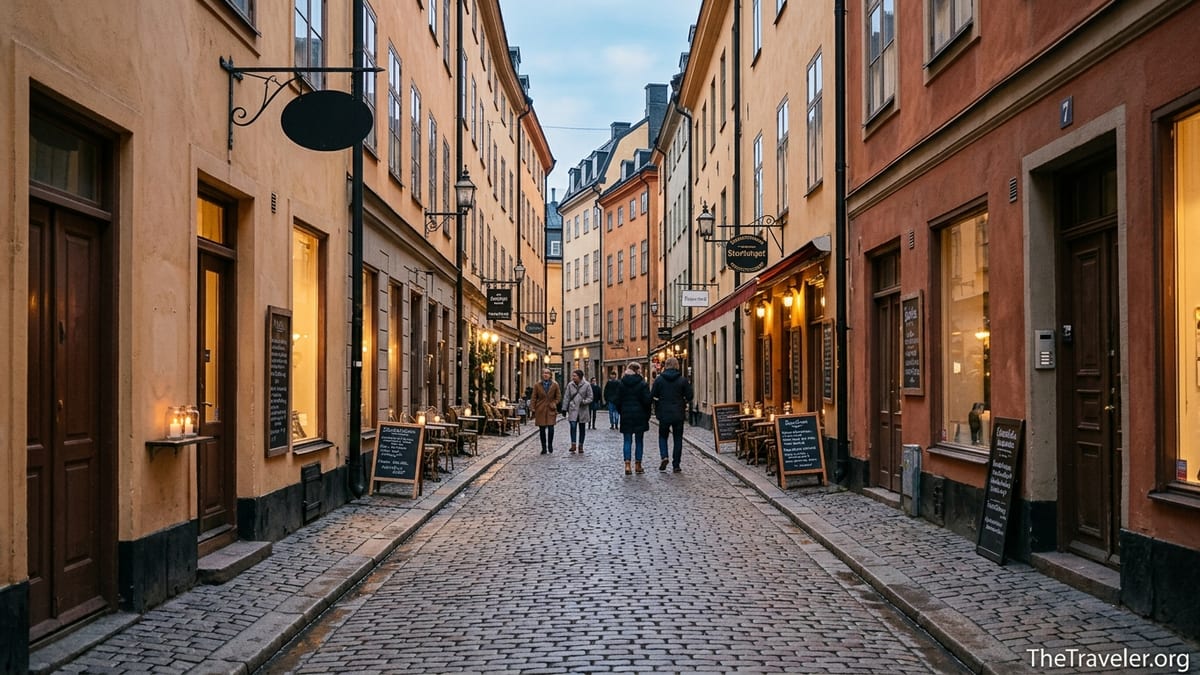
Stockholm has grown into a sleek, waterside capital of contemporary design, tech start-ups, and minimalist coffee bars, but its emotional center of gravity remains a compact medieval island: Gamla Stan. Walk just a few minutes from the central station and suddenly the glass offices fall away, replaced by crooked cobblestones, ochre facades, and the smell of cinnamon buns drifting from tiny cafés. For many locals and visitors, this is where Stockholm feels most itself, a place where 13th-century alleys and 21st-century life still intertwine every day.
Get the latest updates straight to your inbox!
A Small Island Where Stockholm Began
Gamla Stan is not just Stockholm’s old town in a poetic sense. The city itself was founded here in the mid-13th century on what was once called “the town between the bridges,” the compact cluster of islands that controlled trade routes between Lake Mälaren and the Baltic Sea. Today, modern Stockholm spreads far beyond, yet the original medieval street grid on this tiny island still shapes how people move, meet, and experience the city’s history.
Stand on Stortorget, the main square, and you can see how the past still anchors the present. The Stock Exchange Building on the north side houses the Swedish Academy and the Nobel Prize Museum, where rotating exhibits trace the lives and discoveries of laureates. A few steps away, the colorful townhouses leaning into the square are among the most photographed facades in Sweden, yet they remain working buildings with apartments above and cafés below. Commuters cut across the square on their way to offices in Norrmalm, while school groups file into the museum, using the same public space for completely contemporary routines.
Much of Gamla Stan’s power lies in how intact it feels. Urban planners often cite it as one of Europe’s best preserved medieval centers, and you sense this in the narrow canyons of streets like Prästgatan or Österlånggatan, where the building line barely wavered even as the city industrialized. Even the names tell the story of a place where merchants, sailors, clergy, and aristocrats once negotiated power and profit, long before Stockholm became a modern capital.
Yet Gamla Stan is not a museum sealed off behind ticket booths. It is home for roughly 3,000 residents and workplaces for many more, which keeps the island’s rhythms grounded in everyday life rather than nostalgia alone.
Royal Ceremonies and Everyday Rituals
One key reason Gamla Stan still feels like Stockholm’s heart is that the Swedish state quite literally operates from here. The Royal Palace, one of Europe’s largest inhabited palaces, dominates the northeastern side of the island. On any given weekday, you might see official black Volvos sweeping through the courtyard, diplomats hurrying toward receptions, or a changing of the guard procession passing directly in front of tourists holding take-away coffees.
Peek into Storkyrkan, Stockholm Cathedral, just behind the palace, and you are stepping into the stage set of Sweden’s national story. This is where royal weddings, coronations, and memorial services have been held for centuries. When Crown Princess Victoria married Daniel Westling in 2010, the televised images of the procession emphasized the same streets and skyline visitors walk through today, reinforcing Gamla Stan as the ceremonial backdrop for everything from medieval monarchs to modern constitutional events.
At the same time, the rituals that make the island feel alive are just as often small-scale and personal. Office workers from nearby ministries and banks crowd into cafés on Västerlånggatan in late morning for fika, the cherished Swedish coffee break that usually includes a cinnamon or cardamom bun. A typical fika here might cost the equivalent of 60 to 90 Swedish kronor for a coffee and pastry, not cheap by global standards, but part of a deeply rooted social routine that continues regardless of the season.
On summer evenings, you may see residents walking dogs along the quays by Skeppsbron, pausing to chat with neighbors while cruise passengers spill down gangways across the road. The juxtaposition of state pageantry, tourism, and perfectly ordinary errands keeps Gamla Stan from slipping into theme-park territory and reminds visitors that this is, fundamentally, still a neighborhood.
Streets That Still Dictate How the City Moves
Stockholm has extended its public transit network into a complex web of metro lines, buses, and commuter trains, yet Gamla Stan remains a vital hinge in that system. Gamla Stan metro station, on the red and green lines, funnels thousands of riders daily between the central business districts to the north and more residential Södermalm to the south. Even if residents rarely think of themselves as “going to the old town,” the transit map routes them right under it.
Above ground, the original medieval street pattern still shapes modern flows. Västerlånggatan follows the outside of the former western city wall, a gently curving spine now lined with shops and restaurants. Parallel to it on the inner side of the old fortifications, Prästgatan remains a quieter lane, where you can almost picture packhorses and merchants from centuries past. Cross-streets like Kåkbrinken or Tyska Brinken still channel people uphill and downhill in the same places where staircases once climbed over defensive ramparts.
Even car traffic tells you that this island still matters. Buses and taxis cross the bridges at Slussen and Riddarholmen, framing Gamla Stan as a central knot in the city’s road network. During weekday rush hours, you might spot civil servants hurrying from the Parliament building on Helgeandsholmen to meetings in ministries just south of the island, weaving around visitors taking photos in front of the Riksdag, all within a few minutes’ walk.
For travelers, this centrality is pragmatic as well as symbolic. Many visitors base themselves near Stockholm Central Station or in Södermalm and end up passing through Gamla Stan several times a day. It becomes the natural place to grab an early-morning coffee en route to a ferry, or a late-night gelato returning from a concert, reinforcing the idea that the old town is not a special excursion but something you constantly move through.
Cafés, Fika Culture, and the Scent of Everyday Life
Nothing brings the human scale of Gamla Stan to life quite like its cafés. The district may be small, but it offers a dense cluster of spots where you can linger over strong Swedish coffee and watch the city pass by. Places like Café Kladdkakan on Stora Nygatan or Under Kastanjen, set on a small square shaded by a chestnut tree, have become informal living rooms for both locals and visitors. At Under Kastanjen, it is common to see a mix of residents reading newspapers, students with laptops, and families sharing plates of cinnamon buns at any hour of the day.
Prices reflect the area’s popularity. Expect to pay roughly 45 to 60 kronor for a filter coffee and 40 to 65 kronor for a pastry in most Gamla Stan cafés. While this may be a little higher than in outlying districts, you are paying for more than caffeine. You are renting a front-row seat on a centuries-old streetscape where the aromas of freshly ground beans mingle with the faint salt of Baltic air drifting in from the harbor.
Some venues knit the old town into the city’s wider social fabric. Grillska Huset, operated by a social enterprise, serves coffee and baked goods in a historic building on Stortorget, with profits supporting charitable initiatives. Locals recommend it not only for its cardamom buns but also for the chance to enjoy fika in a place that consciously ties everyday indulgence to community impact. On sunny days, the outdoor tables fill with everyone from pensioners to visiting families, all squeezed between the same colorful facades featured on postcards.
Even late in the evening, Gamla Stan’s cafés and café-bar hybrids keep a warm glow in the windows. Spots like Kaffekoppen, tucked into vaulted medieval cellars, serve as both café by day and intimate bar by night, proving that the old town’s nightlife does not rely only on loud clubs but on cozy corners where conversations linger as long as the candlelight holds.
Shops, Crafts, and the Fine Line Between Souvenir and Heritage
Walk down Västerlånggatan at midday and the sheer variety of shops makes it clear that Gamla Stan is one of Stockholm’s busiest commercial arteries. There are certainly tourist-heavy storefronts selling Viking helmets, T-shirts, and fridge magnets. Yet between them, you still find family-run workshops, design boutiques, and bookstores that keep the island rooted in real cultural production rather than pure novelty.
For example, several small glass and ceramics studios showcase work by Swedish artisans who often staff the shop themselves. It is not unusual to see a glassblower explaining their techniques to a customer or a potter discussing glaze colors in the back room. Prices can run into the hundreds of kronor for a handcrafted mug or bowl, but buyers leave with something distinctly connected to place rather than a generic Scandinavian motif.
Bookshops and record stores further underline Gamla Stan’s role as a cultural hub. Secondhand shops tucked into basements off Köpmangatan or Stora Nygatan offer Swedish novels and international titles side by side, while a handful of specialty stores focus on Nordic crime fiction or art books. A visitor hunting for an English-language edition of a Stieg Larsson novel, for instance, can often find it here alongside local histories of Stockholm that explain how the alley outside the door looked 300 years ago.
Dining options mirror this blend of commercial reality and heritage. Historic restaurants such as Fem små hus, serving Swedish classics like herring, venison, and reindeer in a series of stone-vaulted cellar rooms, have been welcoming guests for decades. Reservations here or at similarly atmospheric establishments may start from around 400 to 600 kronor per main course, but for many travelers the chance to eat traditional food beneath centuries-old brick arches is worth the splurge. In contrast, simple lunch spots offering meatballs with lingonberries or salmon plates for around 140 to 200 kronor keep Swedish home-style cooking accessible to a broader crowd.
Festivals, Seasons, and Shared Memories
Gamla Stan feels like Stockholm’s heart partly because so many shared memories are staged here across the year. Visit in December and the transformation is remarkable. Stortorget hosts what is widely regarded as Stockholm’s most traditional Christmas market, with red wooden stalls arranged around the square selling spiced glögg, gingerbread, handmade ornaments, and knitwear from small Swedish producers. As dusk falls mid-afternoon, strings of lights and the glow from stall windows reflect off snow-dusted cobblestones, creating scenes that feel lifted from a Nordic storybook but with card readers and contactless payments quietly ticking away behind the counter.
Families from the suburbs come into the city specifically for this market, combining it with a visit to Skansen’s open-air museum or a concert in the city center. The result is a rare blend of tourists and Stockholmers sharing the same space in a festive mood. For many locals, annual rituals like buying the year’s first cones of roasted almonds at Stortorget or stopping for a saffron bun at a nearby café are as important as the stalls themselves.
In summer, the vibe shifts completely but the sense of centrality remains. Cruise ships anchor just a short walk away, and the square outside the Nobel Prize Museum fills with guided groups following umbrellas and multilingual explanations about Nobel laureates. Street musicians set up under narrow arches, playing everything from classical violin to Swedish folk songs, while children chase pigeons around the same fountain that has anchored the square for centuries.
Shoulder seasons further reveal Gamla Stan’s soul. In early spring and late autumn, when crowds thin and the air turns crisp, you might walk long stretches of Prästgatan or Baggensgatan almost alone, passing only local dog walkers or cyclists cutting through the island. It is in these quieter moments that the echoes of the medieval town feel closest and the reasons for the island’s enduring pull become easiest to sense.
How Travelers Can Experience Gamla Stan Like a Local
Because Gamla Stan is such a major attraction, it is tempting to treat it like a checklist: see the palace, snap a photo in Stortorget, buy a souvenir, and move on. Yet the district reveals its true character when you slow down and fold it into your daily routine, much the way Stockholmers do.
One practical approach is to base yourself within a short walk or a single metro stop of the island and plan to pass through Gamla Stan multiple times. Grab your first coffee of the day at a quiet café on a side street like Kindstugatan before the crowds build. Use the central metro station to connect to museums on Djurgården or business meetings in Kista, then return via Gamla Stan in the evening for dinner in a cellar restaurant or a sunset stroll along the eastern quay.
Timing also matters. Early mornings reward photographers and contemplative travelers with near-empty lanes, mist rising from the water, and delivery trucks restocking bakeries. Midday offers prime people-watching on Västerlånggatan or Stortorget, albeit with higher foot traffic and more promotional pitches from tour operators. Late evenings, especially outside peak summer, restore a more local feel as residents reclaim the streets and the city lights shimmer in reflections off the black water around the island.
Travelers who want to understand Stockholm as more than a postcard often combine Gamla Stan with neighboring districts. Crossing south to Södermalm via Slussen highlights the contrast between medieval fabric and late-19th-century grid, while walking north toward Norrmalm shows how modern shopping streets like Drottninggatan radiate outward from the historical core. In each case, Gamla Stan functions as a mental compass point: no matter how much the skyline changes, the old town’s church spires and ochre walls remain a constant reference.
The Takeaway
Gamla Stan continues to feel like the heart and soul of Stockholm because it is more than a preserved relic. It is the city’s point of origin, the setting for royal ceremonies and daily commutes, a transport hub and a café-scented living room, a backdrop for Christmas markets and quiet morning walks alike. Its medieval street pattern still dictates how people cross the water, while its palaces and churches provide the symbolic language for Sweden’s national story.
For travelers, engaging with Gamla Stan as a living neighborhood rather than only a historic attraction unlocks a deeper understanding of Stockholm itself. This is where you can sip coffee in a 17th-century cellar while scrolling through a digital transit app, buy handmade ceramics a few steps from a palace, or watch children play in a square that has hosted both medieval fairs and Nobel ceremonies. In a city that keeps evolving, this small island’s enduring pull proves that history and modern life can coexist not just in harmony, but with genuine warmth and vitality.
FAQ
Q1. Where exactly is Gamla Stan located within Stockholm?
Gamla Stan is a small island district in central Stockholm, situated between Norrmalm to the north and Södermalm to the south, easily reached on foot or by metro.
Q2. How much time should I plan to explore Gamla Stan?
Allow at least half a day to stroll the main streets, visit Stortorget, see the Royal Palace exterior, and enjoy fika. A full day lets you add museums and quieter side alleys.
Q3. Is Gamla Stan very touristy, or do locals still spend time there?
It is busy and touristy on main streets, especially in summer, but locals still come for cafés, restaurants, Christmas markets, and everyday errands, keeping it a lived-in neighborhood.
Q4. What are some must-see sights in Gamla Stan?
Key sights include Stortorget square, the Royal Palace, Stockholm Cathedral, the Nobel Prize Museum, and atmospheric lanes such as Västerlånggatan, Prästgatan, and Mårten Trotzigs Gränd.
Q5. Are cafés and restaurants in Gamla Stan more expensive than elsewhere in Stockholm?
Prices can be slightly higher than in outer districts, but you still find a range: simple cafés and lunch spots alongside more upscale cellar restaurants serving classic Swedish dishes.
Q6. When is the best time of year to experience Gamla Stan?
Summer offers lively street life and long evenings, while December brings the Christmas market and festive lights. Spring and autumn are quieter and ideal for slow exploration.
Q7. Is Gamla Stan suitable for travelers with limited mobility?
Cobblestone streets and some steep alleys can be challenging, but main routes and squares are relatively level, and many cafés and museums provide step-free or assisted access.
Q8. Can I stay overnight in Gamla Stan, or is it better to sleep elsewhere?
There are several hotels and guesthouses in Gamla Stan that offer a very atmospheric base, though rooms may be smaller and prices higher than in nearby neighborhoods.
Q9. Is Gamla Stan safe to visit in the evening?
Gamla Stan is generally considered safe, with well-lit streets and regular foot traffic. Normal city awareness is sufficient for most visitors after dark.
Q10. How can I experience Gamla Stan in a less touristy way?
Visit early in the morning or in the evening, focus on side streets rather than only Västerlånggatan, choose independent cafés, and combine your walk with nearby Södermalm or Norrmalm.