


More news on this day
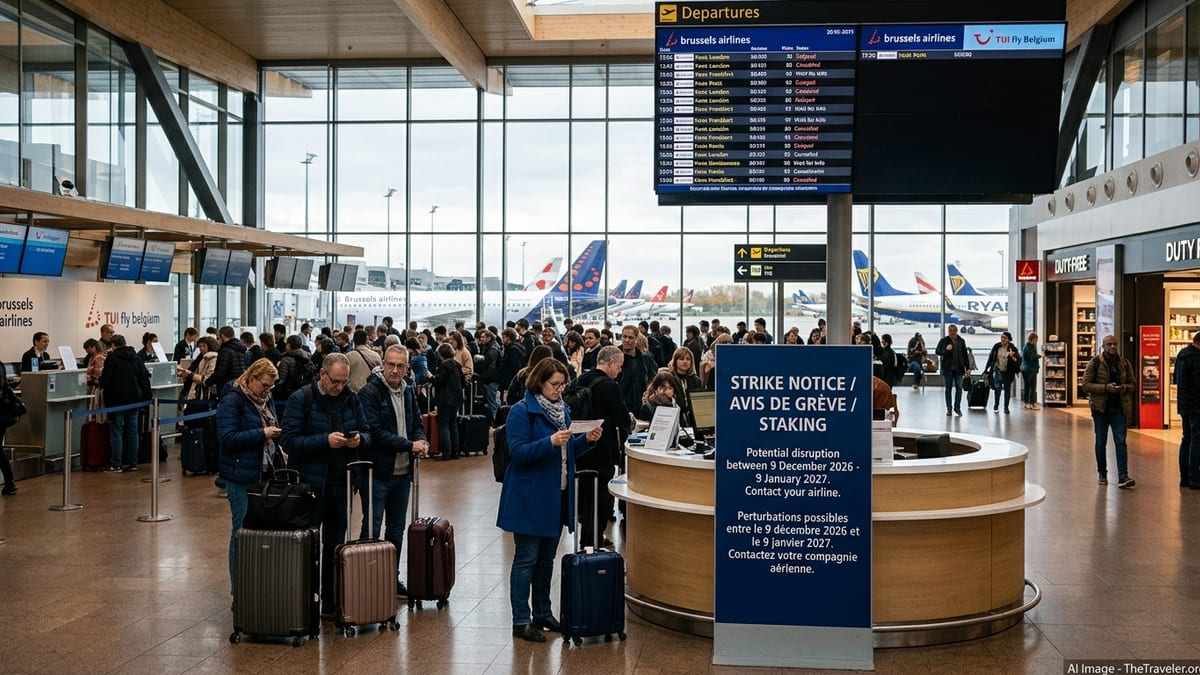
Belgian air traffic controllers have filed a month-long strike notice covering 9 December 2026 to 9 January 2027, creating fresh uncertainty for travellers using Brussels and other Belgian airports over the Christmas and New Year peak, even though no specific strike dates have yet been confirmed.
Get the latest news straight to your inbox!
Month-long strike window filed after November airspace shutdown
The new strike notice was lodged on the evening of 23 November by unions ACV Transcom and VSOA, which represent staff at Skeyes, Belgium’s state-owned air navigation service provider. The filing gives the unions the legal option to organise walkouts at any time between 9 December 2026 and 9 January 2027 across Skeyes operations, including en-route air traffic control and services at major airports such as Brussels Airport and Brussels South Charleroi.
The move comes less than 24 hours after a national day of industrial action on 23 November that led Skeyes to suspend regular air traffic control services between 07:00 and 21:00. During that period, most flights at Brussels Airport were cancelled and Charleroi effectively halted all operations, with several hundred services scrubbed or diverted as airlines were forced to redesign their schedules on short notice.
For now, the new notice does not mean a continuous strike. It defines a period during which industrial action is legally possible if talks between unions and management break down. No individual strike days have been announced, and the unions involved have stated in multiple local media reports that they aim to avoid action during the core Christmas holiday period if possible, although this intention has not been formalised into specific guarantees.
Skeyes rejects “disproportionate” notice and seeks defined strike periods
Skeyes management responded on 24 November by formally rejecting the scope of the notice, describing a potential month of rolling industrial action without preannounced dates as disproportionate and incompatible with the planning needs of airlines, airports and passengers. The provider has asked the unions to clarify exactly when any stoppages might occur and to notify it in advance of the likely operational impact so that timetables can be adjusted more predictably.
According to Belgian media summaries of the company’s position, Skeyes says it remains available for negotiation and supports further conciliation efforts. However, it argues that a broadly worded notice covering the entire period from 9 December to 9 January creates an unacceptable level of uncertainty for the aviation sector, particularly so soon after a complete or near-complete shutdown of Belgian airspace during the November national strike. The company has urged that any future industrial action be framed within narrower windows that still respect the right to strike but allow for contingency planning.
The dispute follows a period of tense social dialogue at Skeyes in 2026. Earlier talks over working conditions and career arrangements produced draft agreements that did not win the backing of all union organisations. Public documents from Belgium’s federal parliament show that the federal mobility minister had already been examining how a minimum level of air traffic control service might be guaranteed during strikes, a discussion that has now gained visibility after the November shutdown and the subsequent month-long notice.
Unions highlight rest, schedules and end-of-career rules as core grievances
Union statements and local news reports describe the conflict as primarily focused on working arrangements, rest periods and end-of-career conditions rather than headline wage demands. Representatives for ACV Transcom and VSOA have argued that chronic staffing pressures and what they view as insufficiently protective rest rules are increasing fatigue among controllers, which they link directly to operational safety risks in Belgian airspace.
The unions point in particular to dissatisfaction over shift patterns, conditions for older employees and the perceived quality of social dialogue with Skeyes management. They say that recent negotiating rounds did not adequately address how late-career controllers are treated or how work schedules are adapted to reflect staffing realities. In their public messaging, controllers have repeatedly framed the dispute as one about safety and sustainable workloads, warning that exhausted staff at radar screens and control towers could jeopardise the safe and orderly flow of traffic.
Management has not publicly accepted that current working arrangements are unsafe but has acknowledged in parliamentary exchanges and previous social discussions that staffing and rostering are sensitive topics in an environment where even small disruptions can quickly cascade into significant delays or cancellations. The present conflict is occurring against a backdrop of wider debates across European air traffic control about recruitment, automation and the long-term design of duty rosters.
Potential impact on Brussels, Charleroi and overflights through Belgian airspace
If unions decide to take industrial action within the 9 December to 9 January window, the effects could be felt at multiple levels of the Belgian aviation network. Skeyes is responsible for air traffic services at Brussels Airport and Brussels South Charleroi, as well as at several regional airports and in the lower-level airspace for which Belgium retains competence. During the 23 November national strike, the withdrawal of regular Skeyes services led Brussels Airport to cancel the vast majority of its schedule and prompted Charleroi to scrap all flights during the daytime shutdown, illustrating how exposed the system is to controller stoppages.
In any future strike, the specific impact would depend on what level of service Skeyes can maintain, how many controllers participate and whether action is limited to certain towers or approach sectors. Even partial reductions in capacity can trigger slot restrictions and knock-on delays across Europe, because flights that depart late from Brussels or Charleroi may miss connections elsewhere, and aircraft scheduled to transit Belgian airspace at lower altitudes might have to reroute or adjust timings. Airspace above a certain flight level is managed by Eurocontrol from Maastricht and can remain available for overflights even when lower sectors are disrupted, but this does not remove the need for functioning departure and arrival control at Belgian airports.
Travellers booked to fly to, from or through Belgium during the strike window should be aware that, as of late November 2026, there is no confirmed programme of cancellations or schedule reductions. Airlines have not yet published special timetables for December and early January in response to the notice. Any eventual disruption would likely be announced closer to the time if talks fail and unions decide to name specific strike days or hours. Passengers will remain reliant on updates from their airline or tour operator, alongside notices from Brussels Airport, Charleroi and other affected airports.
Government debates minimum-service rules as holiday period approaches
The renewed labour dispute is unfolding as Belgium’s federal authorities evaluate whether to legislate for minimum service guarantees during air traffic control strikes. In written responses to parliamentary questions earlier in 2026, the federal mobility minister confirmed that the government was studying how a baseline of passenger flights could be maintained during industrial action at airports and at Skeyes, while still respecting constitutional rights to strike and to collective bargaining. Those deliberations had already been prompted by previous stoppages and now gain added urgency in light of the November shutdown and the new December–January notice.
Any concrete minimum-service law would require political agreement and would not be in place by 9 December. For this holiday season, therefore, the only formal developments are the notice filed by ACV Transcom and VSOA and Skeyes’ rejection of its broad scope. Negotiations and conciliation efforts are expected to continue in the coming days and weeks. Local reports indicate that unions have called on Skeyes management to come to the table rapidly, and have signalled that no additional strikes will be launched while a formal conciliation process is in progress, although this assurance is dependent on how the talks evolve.
The timing is particularly sensitive for the wider travel sector. December and early January are among the busiest periods of the year for Brussels Airport, which handles large volumes of family visits, winter holidays and business travel compressed into a short window. Tour operators and airlines are already monitoring the situation, but without detailed strike dates they cannot yet implement clear contingency plans, such as shifting capacity to neighbouring countries or offering proactive rebooking options on a large scale.
What travellers should check next and how to plan around the uncertainty
For travellers, the key point is that the strike notice creates a risk window but does not automatically cancel flights between 9 December 2026 and 9 January 2027. As of 25 November 2026, no specific strike days, times or service levels have been announced for that period. Unions have signalled an intention to spare the central Christmas holidays if possible, and conciliation talks between Skeyes and union representatives are expected, but these factors cannot be treated as firm guarantees that all flights will operate normally.
Passengers who have already booked flights involving Brussels, Charleroi or other Belgian airports in December or early January should monitor communications from their airline and check their booking regularly in the days before travel. If a strike is formally called for a given date, carriers typically adjust timetables, prioritise certain long-haul and connection-critical services, and provide options such as free rebooking, refunds or rerouting where required by European passenger rights rules. Exact policies differ from airline to airline, so travellers should rely on the conditions published by their own carrier rather than on general assumptions.
Those who have flexibility may wish to consider booking itineraries that allow for alternative routing through nearby hubs, such as Amsterdam, Paris, Frankfurt or Luxembourg, especially for travel on dates where industrial action is more likely if talks falter. However, at this stage there is no official advice to avoid Belgian airports altogether during the strike window, and no neighbouring country has announced special capacity measures in direct response to the notice. As negotiations progress, the most practical step for travellers is to stay informed, keep contact details up to date with airlines and allow extra time at the airport during the holiday period in case operational adjustments are made at short notice.