


More news on this day
Virgin Australia passengers face renewed disruption this week as airport guest services staff represented by the Australian Services Union prepare fresh protected industrial action at Sydney, Melbourne, Brisbane and Adelaide, after talks over a new enterprise agreement again failed to resolve disputes about pay, shift length and key conditions.
Get the latest news straight to your inbox!
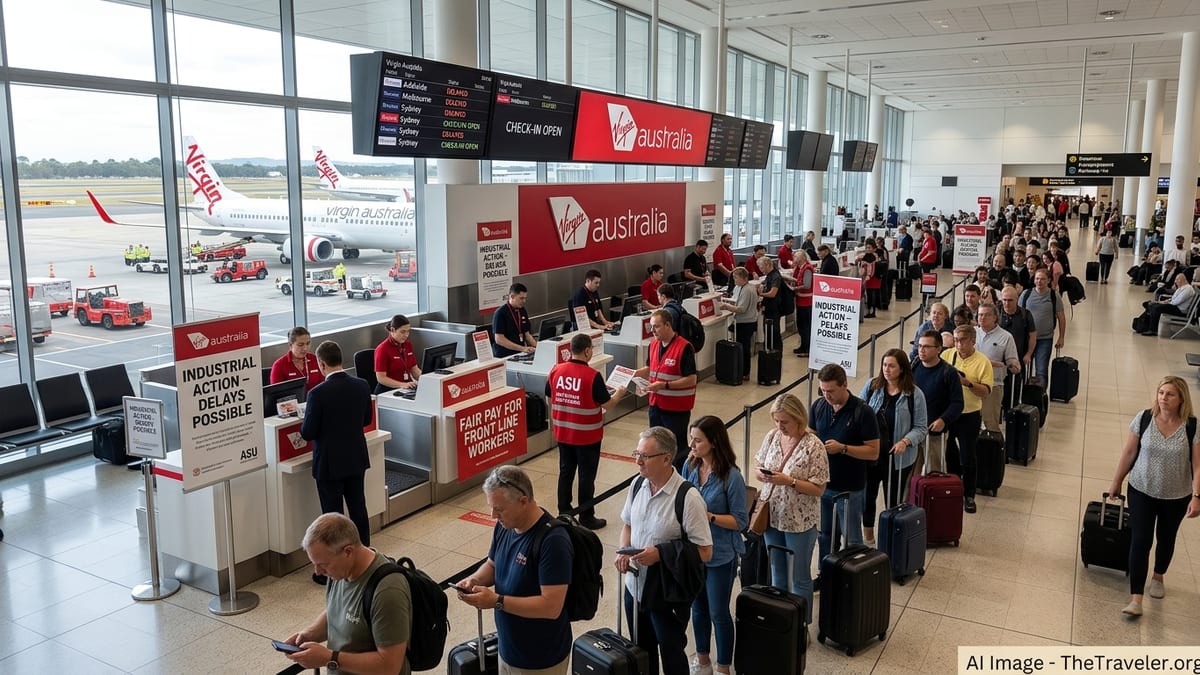
Who is striking and where disruptions are expected
The latest round of industrial action centres on Virgin Australia’s guest services and airport customer-facing workforce, including staff at check-in counters, bag drop, boarding gates and baggage service desks, as well as some contact centre employees covered by the Virgin Australia & ASU – Guest Services & Guest Contact Centre Agreement. That agreement, approved in late 2023, formally operates until 30 June 2026, but bargaining for a replacement deal has been under way throughout 2026 as unions seek to revise pay scales and rostering before the nominal expiry date.
According to notices issued by the Australian Services Union and industry advisories, members plan to stop work at four of Virgin Australia’s busiest domestic hubs: Sydney, Melbourne, Brisbane and Adelaide. On the strike day, workers in Sydney, Melbourne and Brisbane are scheduled to walk off the job for a total of four hours across peak periods, while Adelaide staff are expected to undertake a two-hour stoppage. The action builds on earlier phases of the campaign in October and November in which staff began with low-level measures such as wearing union material and distributing flyers before moving to more disruptive stoppages.
Virgin Australia’s own commercial policy documents and travel updates show that the airline is treating the stoppages as a potential operational risk at those four airports and has allowed affected customers limited flexibility to move bookings around a key November strike date. The carrier has advised that it will try to maintain its published schedule by adjusting rosters and redeploying staff where possible, though on-time performance will depend on how widely workers participate in the industrial action at each port.
What unions and the airline are disputing
At the core of the dispute are pay rises, the proposed introduction of longer nine-hour shifts at ordinary rates, protections around days in lieu and broader concerns about workload and staffing levels at busy domestic terminals. The Australian Services Union argues that Virgin Australia’s current offer does not adequately compensate staff for what they describe as increasingly complex customer service work, carried out in high-pressure environments and often at unsociable hours, especially after years of wage restraint during the pandemic and the airline’s restructuring.
Union statements and industry reporting indicate that guest services employees are seeking higher base-pay increases than those proposed by Virgin, firmer safeguards against compulsory nine-hour shifts being rostered at single-time rates, and stronger guarantees that existing conditions such as days in lieu for public holiday work will be locked into any new agreement. Officials have publicly linked their claims to Virgin Australia’s reported financial performance, pointing to an underlying profit in the 2025–26 financial year and arguing that front-line workers should receive what they characterise as a fairer share of the airline’s recovery.
Virgin Australia has not released the full draft text of its enterprise agreement proposal, but in public comments it has outlined headline figures and key elements of the offer. The airline says it has put forward base pay rises of 5 per cent in each of the first two years of a new deal and 4 per cent in the third year. When shift penalties and related changes are factored in, the company describes the package as worth roughly 17 to just under 29 per cent over three years for some classifications. It has also highlighted proposals for more permanent roles, a clearer classification structure with progression pathways, and rosters that would provide additional days off over the course of a year.
How the industrial action has escalated through 2026
The industrial campaign has unfolded in stages across 2026 as frustration grew over the pace of bargaining. In October, after negotiations failed to produce a breakthrough, the Fair Work Commission granted a protected action ballot order covering guest services and related staff. This allowed ASU-represented employees to vote on whether to authorise specific forms of industrial action, up to and including short strikes and work bans, provided subsequent actions complied with notice requirements under Australian workplace law.
Following a successful ballot, workers initially adopted less disruptive tactics in early November, such as varying uniform requirements, displaying union messaging and handing out information to passengers while continuing to process flights. Shortly after, the union escalated to targeted service bans at gates across selected airports. These measures included withdrawing priority boarding, boarding all customers at once instead of in groups by cabin or frequent flyer tier, refusing to accept last-minute cabin baggage at the gate and waiving certain fees on eligible transactions. While those actions did not prevent flights from operating, they altered the boarding process and cut into ancillary revenue that airlines often rely on.
Peak-hour stoppages at major hubs followed as talks again stalled. On earlier strike days, Virgin Australia maintained that it was able to operate its schedule with limited disruption by using contingency staffing and planning rosters around the notified industrial action. Travel-industry advisories and airport communications, however, urged passengers to expect longer queues, late boarding and a higher risk of knock-on delays as even short gaps in customer service coverage at busy times can quickly push back departures. The newly announced strike is the latest step in this pattern of escalation, and union officials have warned that further actions are possible if an agreement remains out of reach.
Impact on passengers at key Virgin Australia airports
For travellers, the most visible effects of the dispute are likely to occur at check-in, bag drop and boarding rather than in the air. Virgin Australia’s domestic operation relies heavily on tightly timed morning and late-afternoon banks of flights linking Sydney, Melbourne, Brisbane and Adelaide with regional and interstate destinations. Any staffing shortfall or work stoppage during these peaks can slow baggage processing, extend check-in queues and delay boarding, reducing the buffer that airlines typically build into turnaround times to keep aircraft departing on schedule.
So far, there is limited evidence of widespread same-day cancellations being attributed solely to this industrial action. Instead, disruption has largely taken the form of delays and congestion in terminal areas, compounded at times by unrelated factors such as weather or security bottlenecks. On previous strike days, Virgin Australia has said publicly that it expected minimal impact to its operations, and in some instances flights have operated largely as scheduled. Nonetheless, travel advisories in late November have consistently recommended that customers flying with Virgin on notified action days allow extra time at the airport and monitor real-time updates, reflecting the inherent uncertainty created when staffing levels are not fully predictable.
Passengers requiring additional assistance, families with young children and those travelling with complex itineraries such as separate connecting tickets are particularly exposed to these uncertainties. For them, longer queues at customer service desks and more crowded gate areas can make it harder to resolve problems quickly if a flight is delayed or if they need to adjust plans. Airports, for their part, have not reported any direct impact on safety or security functions, which are usually staffed separately from guest services roles. However, operators must still adjust terminal management to cope with shifting passenger flows, especially when boarding is compressed into a shorter window close to scheduled departure as part of certain work bans.
What Virgin Australia and unions are advising affected travellers
In line with Australian industrial relations law, the ASU is required to give Virgin Australia advance notice of each bout of protected action. This requirement, combined with the airline’s commercial and customer policies, gives passengers some scope to plan around likely disruption on specific days. Ahead of a mid-November strike affecting Adelaide, Brisbane, Melbourne and Sydney, for example, Virgin issued a commercial policy allowing eligible customers to move their booking to an alternative flight on the same route within a defined window on either side of the action date without paying change fees or fare differences in the same fare class.
For upcoming strike days, travellers booked on Virgin Australia services are being advised by both the airline and independent travel sources to keep a close eye on their reservations from at least 48 hours before departure. The most up-to-date information is typically available through Virgin’s mobile app and online manage-booking tools, where customers can see any schedule changes, new departure or arrival times and gate assignments. Where industrial action is scheduled at a particular airport, it is prudent to arrive earlier than usual, especially for morning and late-afternoon departures from major hubs, to allow for potential congestion at check-in and bag drop.
Those with time-sensitive onward connections, such as separate international tickets on other carriers, may wish to consider moving to an earlier Virgin Australia domestic flight where rebooking options are available, or to build in a longer layover than they might normally choose. Travel insurance policies vary in how they treat delays linked to industrial disputes, so passengers concerned about financial exposure should check the conditions of their cover rather than assuming that all disruption will be compensable. Virgin Australia has reiterated that, while it is activating contingency measures and expects to operate its schedule, conditions on the day will depend on the scale of participation in the strikes and the success of its operational workarounds.
What happens next in the Virgin Australia pay dispute
Beyond the immediate effect on flights, the key question for both staff and travellers is how long the current pattern of rolling industrial action will continue. As of late November 2026, there is no public indication that Virgin Australia and the Australian Services Union have reached an in-principle agreement on new pay and conditions for guest services staff, nor has the dispute progressed to formal intractable bargaining procedures that can, in some circumstances, lead to binding arbitration. Both sides publicly say they remain open to further talks, but their positions on core issues such as the scale of pay rises and protections around nine-hour shifts remain some distance apart.
The dispute is unfolding within a wider context of assertive bargaining across Australia’s aviation and transport sectors, where several workforces are seeking to recover what unions describe as ground lost to inflation and earlier wage freezes. Within Virgin Australia itself, cabin crew represented by the Transport Workers Union have voted overwhelmingly in favour of a separate protected action ballot over their own pay and rostering concerns. At this stage, however, no specific dates have been announced for industrial action by cabin crew, and the airline’s published timetables for both domestic and short-haul international services remain unchanged.
If Virgin Australia and the ASU can reach a compromise in the coming weeks, rolling stoppages could ease before the peak summer holiday period. If talks remain stalled, further limited strikes and work bans are possible, subject to legal notice requirements and the appetite of members to continue action that affects both their income and passenger travel plans. For now, travellers planning to fly with Virgin Australia over the next few weeks should assume that intermittent disruption remains a possibility, check their bookings regularly and be prepared to adjust their itineraries if new strike dates are announced or if existing action escalates.